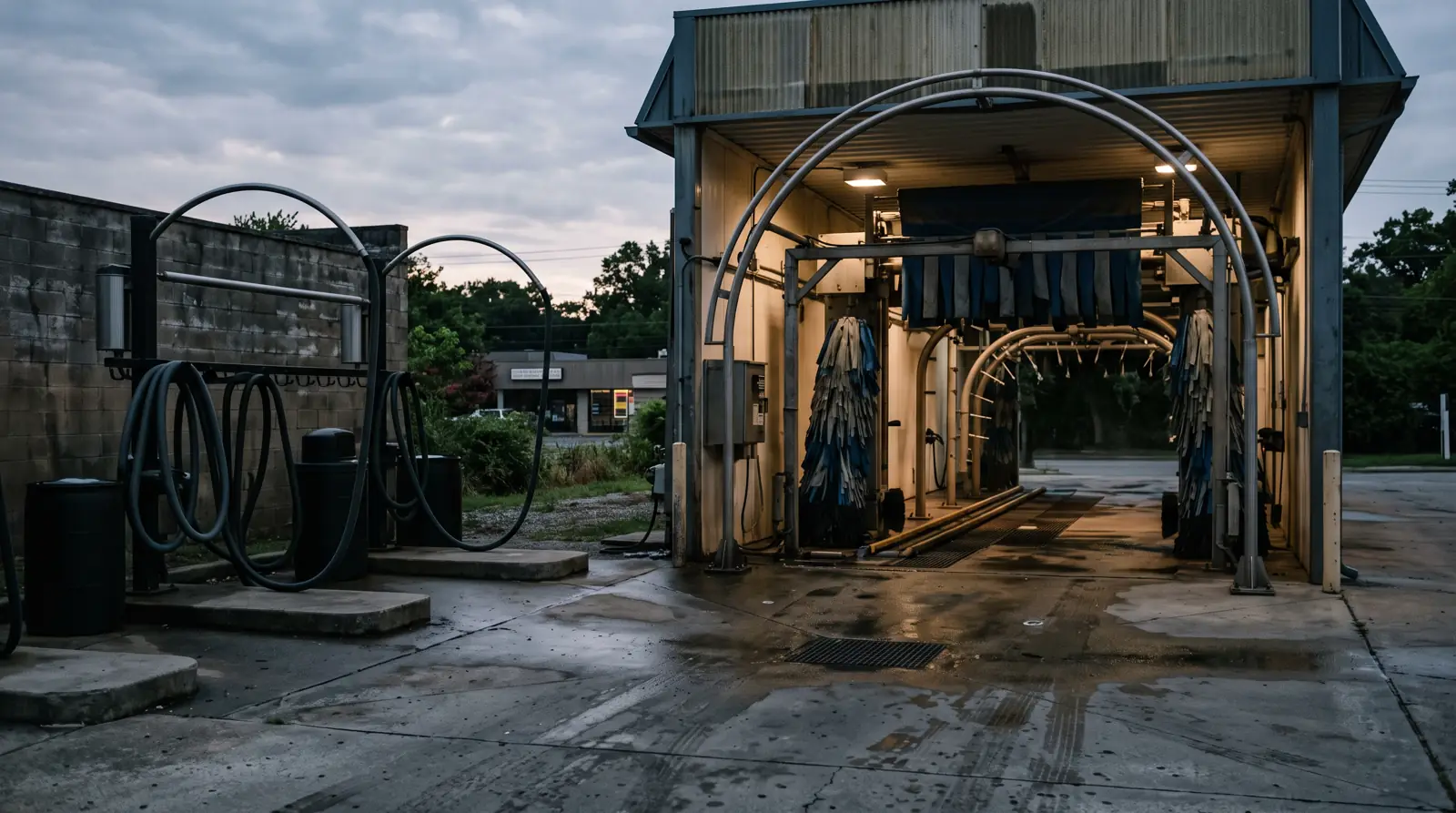
A car wash franchise costs $3,482,389 to $11,846,697 before land for a Tommy’s Express tunnel under its April 2026 FDD, and $188,350 to $459,000 for a Fleet Clean mobile wash truck.
Key takeaways
- Tommy’s Express is the only fixed-site car wash system with a Clean FDD on Minnesota’s CARDS registry as of November 2, 2026. Its Item 7 runs from $3,482,389 (62-foot World Model) to $11,846,697 (Flex Model), and every table excludes the cost of purchasing real estate.
- Franchising is rare in this industry: 504 of 16,381 car wash establishments (3.1%) were franchise establishments in the 2017 Economic Census (NAICS 811192).
- EPA’s WaterSense at Work Section 5.4 (November 2023) puts average fresh water use at 15.0 gallons per vehicle for self-service bays, 30 for conveyor tunnels and 44.8 for in-bay automatics, using a 2018 industry study.
- Any discharge to a municipal storm sewer that is not entirely stormwater is an illicit discharge under 40 CFR 122.26(b)(2) unless an NPDES permit covers it, so wash water has to be reclaimed or sent to a sanitary sewer with the sewer authority’s approval.
- Georgia certifies permanent car washes for $50 a year and requires conveyor washes built after January 1, 2000 to recycle at least 50% of their water, per the Georgia EPD inspection checklist.
- Percentage fees on sales differ by format: Tommy’s Express charges 4% royalty, 1% brand fund and at least 2% local marketing; Fleet Clean charges 8.5% royalty plus a 2.5% fund contribution (Fleet Clean FDD, Item 6).
Which car wash formats are sold as franchises, and what does each filing say it costs?
Most car wash formats that buyers search for have no franchise disclosure document on file in Minnesota’s public FDD registry. A CARDS search for “wash” on November 2, 2026 returned one fixed-site car wash system, Tommy’s Express. Ziebart covers detailing in a leased shop, Fleet Clean covers mobile fleet washing, and no in-bay automatic or self-serve franchisor appeared.
| Format | Franchise FDD on CARDS | Item 7 range | Land or lease assumption | Equipment line in Item 7 | Source |
|---|---|---|---|---|---|
| Express tunnel (conveyor) | Tommy’s Express, issued April 14, 2026 | $3,482,389 to $11,846,697 | Excludes purchase or long-term lease of real estate; buildable land about .35 to 2.0 acres | TCWS Scope of Work $1,905,972 to $5,465,974, bought from the franchisor’s affiliate | Tommy’s Express FDD, Items 5 and 7 |
| In-bay automatic (rollover) | None found under “wash” | No filing | No filing | No filing | Minnesota CARDS search, Nov 2, 2026 |
| Self-serve wand bays | None found under “wash” | No filing | No filing | No filing | Minnesota CARDS search, Nov 2, 2026 |
| Detailing and protection shop | Ziebart, issued April 17, 2026 | $450,100 to $924,000 | Leased shop; leasehold improvements $80,000 to $300,000; excludes a free-standing build | Equipment Package $100,000 to $180,000 (hoist, detailing and vacuum system, hot water extractor, pressure washers) | Ziebart FDD, Item 7 |
| Mobile fleet wash | Fleet Clean, issued April 30, 2026 | $188,350 to $459,000 | Lease $9,000 to $24,000 if a location is required | Chassis $45,000 to $70,000 plus Proprietary Wash Box and Installation $72,000 to $78,000 | Fleet Clean FDD, Item 7 |
In-bay and self-serve washes are usually equipment purchases rather than franchises. EPA describes in-bay automatics as common at gas stations “where vehicle washing is a secondary service option,” and a seller of wash equipment owes you a disclosure document only if the deal meets the FTC Franchise Rule definition. If anyone calls an equipment package a franchise, ask for the 23-item document described in our guide to the franchise disclosure document.
The Census count shows how thin the franchised segment is. Of the 504 franchise car wash establishments in 2017, 424 were franchisee-owned and 80 franchisor-owned, out of 16,381 car wash establishments with payroll. The share had fallen from 5.6% (861 of 15,384) in the 2007 Economic Census, as our automotive franchise statistics report shows by NAICS code.
How much does tunnel length add to a Tommy’s Express build?
Tunnel length and site type move the Tommy’s Express total more than any other choice. The April 14, 2026 FDD prices five configurations in Item 7: a 62-foot World Model at $3,482,389 to $4,163,279, tunnels of 90, 110 and 130 feet at $5,112,819 to $7,529,460, and a Flex Model at $9,135,438 to $11,846,697. None of the five includes land.
| Configuration | Item 7 total | Total construction costs | TCWS Scope of Work | Car Wash Equipment line | Buildable land | Basis stated in the notes |
|---|---|---|---|---|---|---|
| World Model 62 ft | $3,482,389 to $4,163,279 | $1,249,470 | $1,905,972 to $1,980,840 | $155,708 | About .35 to 0.75 acres | One prototype in Holland, Michigan (Note 6) |
| 90 ft tunnel | $5,244,264 to $6,638,930 | $2,522,235 to $2,731,145 | $2,395,082 to $2,924,816 | $233,094 | About .53 to 0.7 acres | A single project completed in 2024 (Note 7) |
| 110 ft tunnel | $5,112,819 to $6,971,565 | $2,258,087 to $2,864,871 | $2,527,785 to $3,123,725 | $211,964 to $248,629 | About .58 to 0.77 acres | Excludes three projects with unusually high contractor costs (Note 8) |
| 130 ft tunnel | $5,308,564 to $7,529,460 | $2,323,138 to $3,271,346 | $2,658,479 to $3,275,145 | $218,504 to $257,129 | About .63 to 0.85 acres | Excludes one project with unusually high contractor costs (Note 9) |
| Flex Model | $9,135,438 to $11,846,697 | $3,813,530 to $5,397,754 | $4,994,961 to $5,465,974 | $220,115 to $256,605 | Approximately 2.0 acres | One finished project and one contractor bid, Colorado Springs (Note 10) |
Item 7 totals run from $3,482,389 (62-foot World Model, low) to $11,846,697 (Flex Model, high), all before land. Source: Tommy’s Express FDD issued April 14, 2026, Item 7.
The 110-foot low estimate ($5,112,819) sits below the 90-foot low ($5,244,264) because the 90-foot figures rest on one 2024 project, per Note 7. Note 1 says the spread among the 90, 110 and 130-foot tunnels comes “primarily” from the type and quantity of equipment. For those three tunnels, low quotes assume 8 vacuums and a two-lane point of sale; high quotes assume 20 vacuums, three lanes and extra heating parts for cold climates.
Climate pushes the choice too. Item 1 says Tommy’s locations in northern states can expect larger peak-day swings in winter, “usually requiring longer tunnels.” Every config lists the same Soft Cost Total of $122,347 to $272,169 and Additional Funds of $100,000 to $500,000 for three months, so the gap between rows is construction and equipment. The affiliate, TCWS, is the sole approved supplier of the packages and may earn a profit on them.
Who pays for the land under the wash?
The FTC Franchise Rule names “real property, whether purchased or leased” as an Item 7 line at 16 CFR 436.5(g)(1)(i)(C), yet the three car care FDDs handle land three ways. Tommy’s Express leaves real estate out of every total, Ziebart prices a leased 6,000 square foot shop, and Fleet Clean budgets $9,000 to $24,000 for a lease it may or may not require.
| Brand | Premises cost inside Item 7 | Left out of Item 7 | Site size the FDD uses |
|---|---|---|---|
| Tommy’s Express | Soft costs $122,347 to $272,169 (civil engineering, water tap fees, site reports, licenses and permits) plus construction | Purchase or long-term lease of real estate, taxes and shipping | About .35 acres (62 ft, low) to about 2.0 acres (Flex) |
| Ziebart | Leasehold improvements $80,000 to $300,000; utilities, rent and deposits for three months $38,100 to $56,000 | Buying unimproved land and building a free-standing shop | 6,000 square feet at $15 to $20 per square foot |
| Fleet Clean | Lease $9,000 to $24,000; permits, licenses and fees $500 to $2,500 | Nothing for land; a location is needed only if the franchisor requires one (Note 4) | Not stated; one equipped vehicle to start |
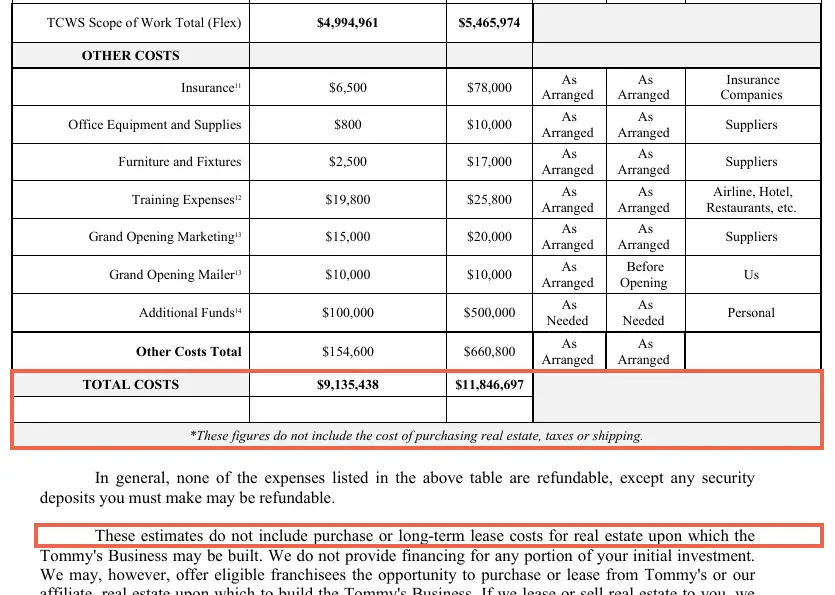
Tommy’s Express adds that it or an affiliate may sell or lease the land to you and “may earn a profit on the lease or sale” (Item 7, page 30); Item 12 says it anticipates a profit from that arrangement. Put the land cost or ground rent next to the Item 7 total before comparing it with any other franchise, and use our franchise initial investment research to see how other systems treat real estate.
How many gallons does each wash format use per car?
Water per car separates the formats more sharply than price. EPA’s WaterSense at Work Section 5.4 (November 2023) reports average fresh water use of 15.0 gallons per vehicle for self-service bays, 30 for conveyors and 44.8 for in-bay automatics in a 2018 study, and up to 85.3 gallons for a frictionless conveyor without reclaim.
| Format | Average fresh water per vehicle | Without reclaim | With reclaim | Source |
|---|---|---|---|---|
| Conveyor tunnel | 30 gpv (2018 study); 34 gpv (2002 study) | 65.8 gpv friction; 85.3 gpv frictionless | 1.9 to 4.9 gallons of reclaimed water per gallon of fresh (2018) | EPA WaterSense at Work 5.4, pp. 3 to 4 |
| In-bay automatic | 44.8 gpv (2018); 43.3 gpv (2002) | Up to 74.1 gpv | As little as 19.1 gpv | EPA WaterSense at Work 5.4, p. 4 |
| Self-service | 15.0 gpv | Not reported | Often not feasible: customers dump debris or change oil in the stalls | EPA WaterSense at Work 5.4, p. 5 |
Fresh water per car ranges from 15.0 gallons at self-service bays to 85.3 gallons for a frictionless conveyor without reclaim. Source: EPA WaterSense at Work 5.4, November 2023.
Gallons matter twice: once on the water bill and again on the sewer bill, which EPA says is “often calculated based upon a fraction of metered water consumption.” The Tommy’s Express Franchise Agreement (Section 3.4) puts water reclamation equipment inside the mandatory equipment package, and Item 7 Note 3 warns that water tap fees “vary greatly from municipality to municipality,” so check the tap fee before you buy the site.
Where is car wash water allowed to drain?
Wash water has four possible exits, and federal rules close one of them. Discharges to a municipal storm sewer that are not entirely stormwater count as illicit discharges under 40 CFR 122.26(b)(2), and a sanitary sewer connection must meet the pretreatment limits in 40 CFR 403.5. That leaves reclaim, the sanitary sewer with local approval, or a state ground discharge permit.
- Reclaim. EPA says a reclaim system should at minimum separate grit, oil and grease, which is enough to reuse water in the rocker panel and undercarriage stage; other stages need filtration, reverse osmosis or deionization. In-bay sites with reclaim should hold a five-second dwell before the car exits.
- Sanitary sewer. Under 40 CFR 403.5, no user may send pollutants that cause pass through or interference, discharges with pH lower than 5.0, or petroleum oil in amounts that interfere with treatment. Washington’s Ecology publication 95-056 requires prior approval from the local sewer authority.
- Storm drain. Small MS4 permits must “effectively prohibit” non-stormwater discharges under 40 CFR 122.34(b)(3). The short list of flows addressed only when significant names “individual residential car washing,” not commercial washing.
- Ground. Washington requires a State Waste Discharge Permit and does not recommend it; Ecology publication 95-056 calls closed-loop recycling the preferred option.
Sludge volume depends on format. The Washington manual cites an EPA study with median total suspended solids of 659 ppm at wand-type washes, 158 ppm at roll-over washes and 101 ppm at tunnels, and tells operators to inspect grit traps daily and clean them at least once a week. Mobile operators face a harder problem: the Fleet Clean FDD (Item 1) says compliance “may require that you have a Franchise Location” unless a third party takes the wash water.
Which state water rules can you check before signing a lease?
Two state agencies publish rules a buyer can read in an afternoon. Georgia’s Environmental Protection Division runs a car wash certification created under SB 466 of the 2008 session, with a $50 fee and a one-year certificate. Washington’s Department of Ecology sets discharge best practices in publication 95-056, revised November 2012. EPA also names Denver Water and San Antonio programs.
| Jurisdiction | Rule or program | What it requires | Source |
|---|---|---|---|
| Georgia | Car Wash Certification (SB 466, 2008) | Inspection by a Georgia Certified Backflow Tester; $50; valid one year; conveyor washes built after January 1, 2000 recycle at least 50%; self-serve nozzles at no more than 3 gallons per minute; certified sites are not treated as outdoor water users during watering restrictions | Georgia EPD, Car Wash Certifications |
| Washington | Vehicle and Equipment Washwater Discharges BMP Manual, 95-056 | Closed loop preferred; sewer discharge with local approval; ground or storm sewer discharge needs a State Waste Discharge or NPDES permit; containment sump held quiet for at least 2 hours before release | Washington Ecology, rev. November 2012 |
| Denver and San Antonio utilities | Denver Water Car Wash Certification; SAWS WaterSaver Car Wash | Named by EPA as programs that reward or require reclaim and allow more flexibility during drought | EPA WaterSense at Work 5.4, p. 5 |
| Federal (all states) | 40 CFR 403.5 and 40 CFR 122.26 | Sewer pretreatment limits; storm sewer illicit discharge definition | eCFR, current through October 29, 2026 |
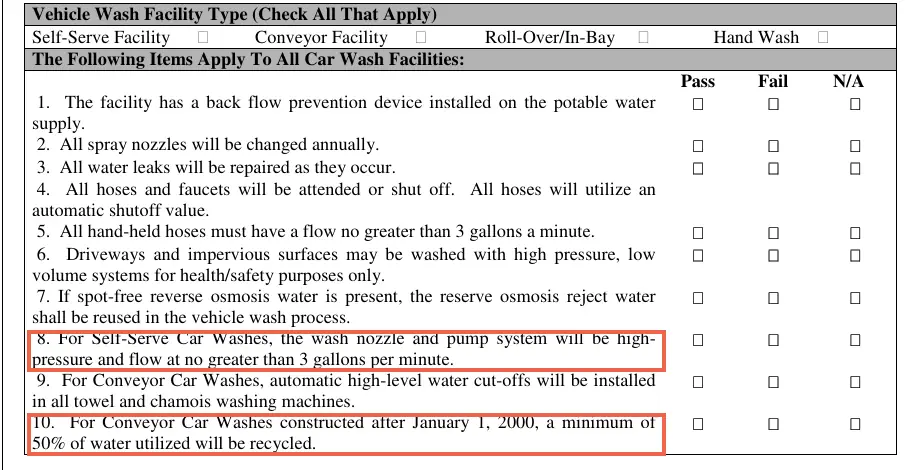
Georgia’s form makes the reclaim question binary: item 10 fails any conveyor wash built after January 1, 2000 that recycles less than half its water, and the certificate must be renewed each year with no reminder from EPD. A Tommy’s Express in Georgia would need its required reclamation equipment to clear that 50% line.
What zoning approvals stand between a signed franchise agreement and opening day?
Zoning decides whether a parcel can hold a car wash at all, and the franchisor’s clock keeps running while you wait. Tommy’s Express requires opening within 18 months of receiving approvals to build, or 180 days after the equipment package arrives, whichever comes first (Item 11). Two 2026 municipal records show the approvals a wash can need.
| Approval | Who grants it | Example in a primary document |
|---|---|---|
| Zone change | City council after planning commission | Los Angeles case APCNV-2024-493-ZC-CU2: MR-2 and P-1 to C2-1, where an express car wash is allowed as of right (Council File 26-0287) |
| Conditional use permit | Planning commission or zoning board | Same Los Angeles case: deviations from LAMC 12.22 A.28 for hours (7 AM to 9 PM), window transparency, landscape setbacks, loading and signage |
| Conditional use as a zone rule | Governing body by ordinance | Springfield Township, New Jersey Ordinance 2026-14, adopted July 14, 2026: car washes a conditional use in the Highway Commercial (H-C) zone (notice of final adoption) |
| Environmental review | Lead agency | Los Angeles ENV-2024-494-MND, a Mitigated Negative Declaration adopted for the 7,300 square foot wash with 32 vacuum stations |
| Water tap and sewer connection | Water utility and sewer authority | Tommy’s Express Item 7 Note 3: tap fees sit in soft costs and should be verified before buying the site |
| Sign permit | Building or zoning department | Tommy’s Express Item 7 Note 5: the TCWS signage package includes permitting and installation |
The Los Angeles planning case carries a 2024 number and the council file is numbered 26-0287, so that entitlement ran across at least two calendar years. Item 11 of the Tommy’s Express FDD lists local zoning among the factors that affect timing; our research on how long it takes to open a franchise compares opening windows across FDDs.
- Sign the Franchise Agreement and pay the $50,000 initial franchise fee, fully earned at signing (Item 5).
- Get the site approved, then pay $43,500 to $106,000 for architectural drawings (Item 5); start zoning, sewer and tap applications.
- Within three years of signing, sign the building and equipment purchase order and pay 20% at notice to proceed (Franchise Agreement 3.3; Item 5).
- Pay 50% before building steel ships, 26% before equipment ships and the balance before start-up teams arrive (Item 5).
- Send the onsite manager to about 20 days of training in Holland, Michigan, no later than six weeks before opening (Item 11).
- Open within 18 months of build approvals or 180 days after equipment delivery, whichever is earlier (Item 11).
What percentage of every wash goes to fees and required marketing?
Ongoing fees take between 7% and 11% of sales across the three filings, before fixed charges. Tommy’s Express charges a 4% royalty, a 1% Brand Development Fee and at least 2% local marketing. Ziebart charges 8% plus a 2% marketing fee capped at $30,000 a year. Fleet Clean charges 8.5% plus a fund contribution currently set at 2.5% (Item 6 of each FDD).
| Line (Item 6) | Tommy’s Express | Ziebart | Fleet Clean |
|---|---|---|---|
| Royalty | 4% of Gross Sales, weekly | 8% of Gross Sales (5% on listed products) | 8.5% of Gross Revenue |
| Brand or marketing fund | 1% Brand Development Fee | 2% National Media Advertising, capped at $30,000 a year | Up to 4.5%, currently 2.5% |
| Required local spend | At least 2% a month, spent with local vendors | Not used in this stack | Not used in this stack |
| Percentage stack | 4% + 1% + 2% = 7% | 8% + 2% = 10% until the cap | 8.5% + 2.5% = 11% |
| Fixed or other fees | Technology Fee $119 a week x 52 = $6,188 a year | Minimum royalty from year 4; minimum product purchases 10% of sales in listed categories | NAF Fee 5% to 10% on national account revenue |
| Transfer | $10,000 fee; transfer damages of at least $500,000 if the buyer stops operating as Tommy’s Express | See Item 6 | See Item 6 |
All three FDDs include an Item 19 with historical sales data from existing outlets; this page does not reproduce those figures. Read Item 19 in each filing yourself and compare it with the fee stack above, using our Item 19 research for how the disclosures are built and our royalty rate research for where 4% and 8.5% sit across 259 FDDs.
What changes if you buy an existing Tommy’s Express?
Resales are growing in this system. Item 20 of the Tommy’s Express FDD lists 13 transfers from franchisees to new owners in 2025, against 4 in 2023 and 2 in 2024, with 6 of the 2025 transfers in Florida. The system ended 2025 with 260 outlets (244 franchised, 16 company-owned), and 123 signed agreements had not yet opened.
A resale skips zoning and construction but inherits the seller’s site, lease or deed and equipment age. The Franchise Agreement lets Tommy’s require a remodel no more than every five years (Item 6), so ask when the last one happened. Ziebart went from 96 outlets at the end of 2023 to 92 at the end of 2025, while Fleet Clean went from 55 to 62.
Car wash format by budget, land and water: a decision table
Match the format to three facts you can check this week: the cash and credit you can commit, whether you control land, and where the site’s wash water can legally go. The thresholds below come from the Item 7 tables of the three FDDs and from EPA, Georgia and Washington rules; any row that fails points to a different format or a different site.
| If your situation is | Then | Threshold source |
|---|---|---|
| You can fund more than $3,482,389 plus land and control at least .35 buildable acres | An express tunnel franchise is within reach; get TCWS quotes for the 62-foot and 90-foot layouts | Tommy’s Express Item 7, Notes 6 and 7 |
| Your parcel is about 2.0 acres and the budget reaches $11,846,697 before land | Compare the Flex Model with a 130-foot tunnel at $5,308,564 to $7,529,460 | Tommy’s Express Item 7, Notes 9 and 10 |
| You have $450,100 to $924,000 and a leasable 6,000 square foot shop with overhead doors | A detailing and protection shop fits; no tunnel or reclaim plant needed | Ziebart Item 7, Notes 5 and 7 |
| You have $188,350 to $459,000 and no site | A mobile fleet wash fits only after you line up a legal wash water disposal point | Fleet Clean Item 1 and Item 7 Note 13 |
| The only drain on the site is a storm drain | Stop until a sanitary sewer connection or closed-loop reclaim is confirmed | 40 CFR 122.26(b)(2); Ecology 95-056 |
| The site is in Georgia and the wash is a conveyor | Design for at least 50% recycling and budget $50 a year for certification | Georgia EPD checklist, item 10 |
| You want an in-bay or self-serve wash | No franchise FDD exists on CARDS; you would buy equipment and run an independent wash | Minnesota CARDS search, Nov 2, 2026 |
Nothing on this page is legal, financial or investment advice; take the site plan, sewer letter and FDD to a civil engineer and a franchise attorney before you sign. Tommy’s Express states on Item 7 page 30 that it does not finance any part of the initial investment, so a tunnel at $3,482,389 or more needs outside capital such as the loans our SBA franchise loan research tracks, and a consultant can line up the questions, as our page on what a franchise consultant does explains. Repair and lube brands sit in our automotive franchise opportunities comparison.
How we compiled this
On November 2, 2026 we ran eleven name searches on Minnesota’s CARDS registry and opened the three current Clean FDDs that cover car washing (Tommy’s Express, Ziebart and Fleet Clean), reading Items 1, 5, 6, 7, 11, 12, 19 and 20 in layout text. We also read EPA WaterSense at Work Section 5.4, four eCFR sections, Georgia and Washington state guidance, two municipal zoning records and the 2017 Economic Census franchise file. We excluded Item 19 figures, brands without a filed FDD and five municipal documents that blocked automated access or no longer loaded.
Frequently asked questions
How much does it cost to open a car wash franchise?
It depends on the format. The Tommy’s Express FDD issued April 14, 2026 lists $3,482,389 to $11,846,697 in Item 7 for an express tunnel, before land. Ziebart’s detailing shop runs $450,100 to $924,000 and a Fleet Clean mobile fleet wash $188,350 to $459,000, according to Item 7 of each 2026 filing.
Is a car wash franchise profitable?
Tommy’s Express, Ziebart and Fleet Clean each include an Item 19 with historical sales data, and that is where to read actual outlet results. Profit then depends on the fee stack (7% of Gross Sales at Tommy’s Express, 11% at Fleet Clean under Item 6), land cost left out of Item 7, and water and sewer bills tied to gallons per car.
Do car washes have to recycle water?
Not everywhere. No federal rule sets a recycling percentage, but Georgia requires conveyor washes built after January 1, 2000 to recycle at least 50% of their water to earn state certification. EPA says reclaim systems should at minimum separate grit, oil and grease, and the Tommy’s Express equipment package already includes water reclamation equipment.
Can a car wash drain into a storm drain?
Plan on no. Under 40 CFR 122.26(b)(2) any discharge to a municipal storm sewer that is not entirely stormwater is an illicit discharge unless an NPDES permit covers it, and the small MS4 exemption list names only individual residential car washing. Washington’s Ecology manual sends commercial wash water to reclaim or, with approval, the sanitary sewer.
How much land does a car wash franchise need?
Tommy’s Express Item 7 notes list buildable land of about .35 to 0.75 acres for the 62-foot World Model, .53 to 0.85 acres for 90 to 130-foot tunnels and approximately 2.0 acres for the Flex Model. None of those land costs is inside the Item 7 totals, which exclude purchasing real estate, taxes and shipping.
Can you buy an existing car wash franchise instead of building one?
Yes, within a franchise system and with the franchisor’s consent. Item 20 of the Tommy’s Express FDD records 13 franchisee-to-new-owner transfers in 2025, up from 2 in 2024. Item 6 lists a $10,000 transfer fee, and transfer damages of at least $500,000 apply if the buyer stops operating the site as a Tommy’s Express.
Sources
- Tommy’s Express Franchise Disclosure Document, issued April 14, 2026, Tommy’s Express LLC, Minnesota CARDS (Items 1, 5, 6, 7, 11, 12, 19, 20 and Franchise Agreement 3.3 to 3.5). Accessed 2026-11-02.
- Ziebart Franchise Disclosure Document, issued April 17, 2026, Ziebart Corporation, Minnesota CARDS (Items 6, 7, 19, 20). Accessed 2026-11-02.
- Fleet Clean Franchise Disclosure Document, issued April 30, 2026, FW Fleet Clean, LLC, Minnesota CARDS (Items 1, 6, 7, 11, 19, 20). Accessed 2026-11-02.
- Franchise registrations search, Minnesota Department of Commerce CARDS. Accessed 2026-11-02.
- WaterSense at Work, Section 5.4 Vehicle Washes (EPA-832-F-23-003), November 2023, U.S. Environmental Protection Agency. Accessed 2026-11-02.
- 16 CFR 436.5, Disclosure items, eCFR. Accessed 2026-11-02.
- 40 CFR 122.26, Storm water discharges, eCFR. Accessed 2026-11-02.
- 40 CFR 122.34, Permit requirements for regulated small MS4 permits, eCFR. Accessed 2026-11-02.
- 40 CFR 403.5, National pretreatment standards: Prohibited discharges, eCFR. Accessed 2026-11-02.
- Car Wash Certifications, Georgia Environmental Protection Division. Accessed 2026-11-02.
- Inspection Checklist for Permanent Facility Car Washes, Georgia Environmental Protection Division. Accessed 2026-11-02.
- Vehicle and Equipment Washwater Discharges: Best Management Practices Manual, publication 95-056 (revised November 2012), Washington State Department of Ecology. Accessed 2026-11-02.
- 9119 De Soto Avenue Express Car Wash, Council File 26-0287 (APCNV-2024-493-ZC-CU2), City of Los Angeles. Accessed 2026-11-02.
- Ordinance No. 2026-14, notice of final adoption, July 14, 2026, Township of Springfield, New Jersey. Accessed 2026-11-02.
- 2017 Economic Census, Franchise Status (EC1700FRAN), U.S. Census Bureau. Accessed 2026-11-02.
- 2007 Economic Census, Franchise Status (EC0700CFRA1), U.S. Census Bureau. Accessed 2026-11-02.