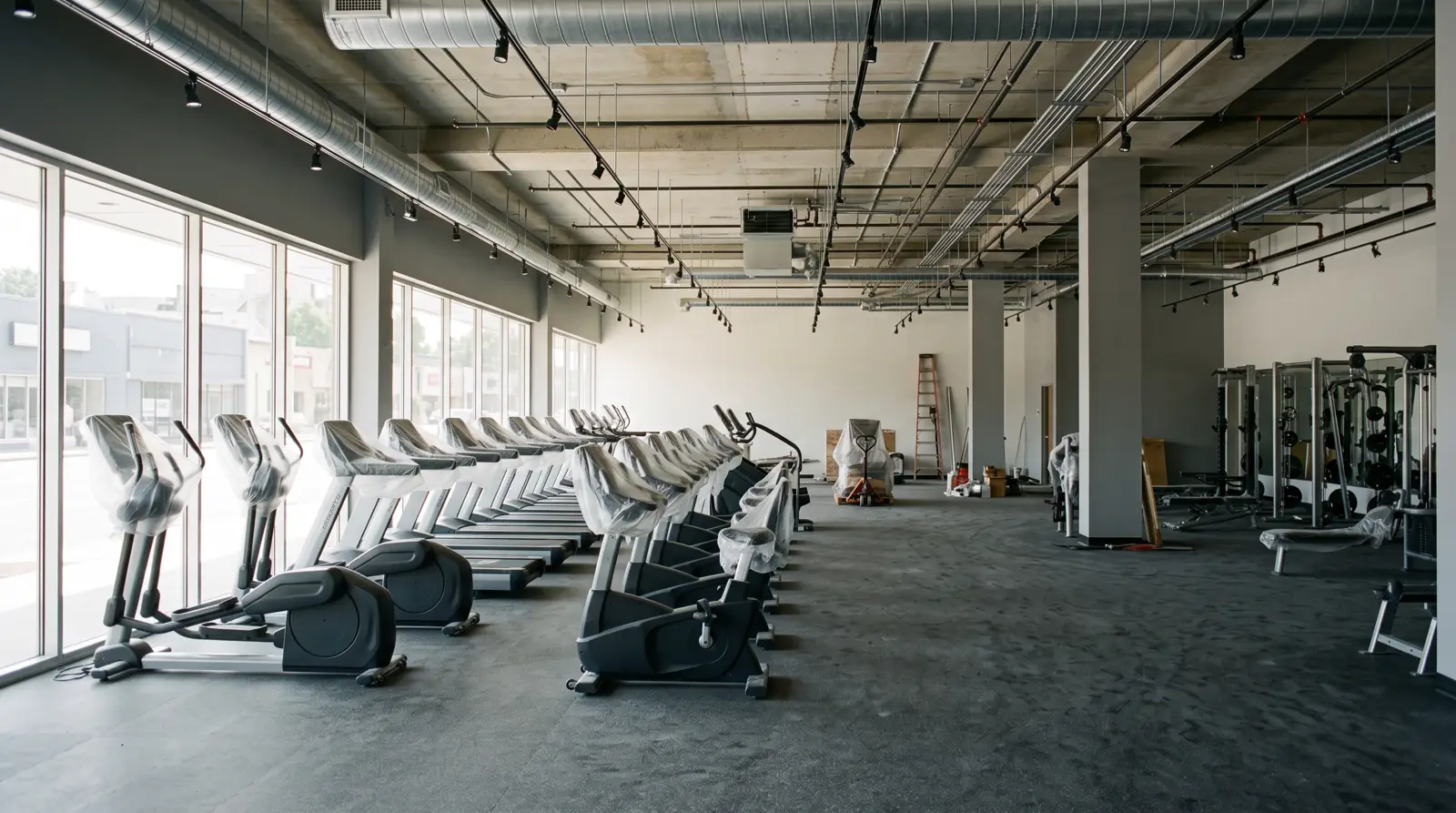
A Crunch Fitness franchise costs $2,147,500 to $5,367,000 per gym before rent, for a club of about 20,000 to 60,000 square feet, according to Item 7 of the April 29, 2026 disclosure document.
Key takeaways
- The Crunch Franchising FDD issued April 29, 2026 prints an Item 7 range of $2,147,500 to $5,367,000 for a Crunch Fitness club and $3,192,500 to $5,277,000 for a Crunch Select club, with real estate excluded.
- Two lines carry about 84% of the Crunch Fitness range at both ends: leasehold improvements of $950,000 to $3,000,000 and fitness equipment and fixtures of $850,000 to $1,500,000 (Item 7 of the FDD).
- Crunch is the only approved supplier of fitness equipment, tanning beds, hydromassage beds, lockers and flooring, and keeps a share for coordinating the order (Item 8 of the 2026 FDD).
- Before opening, the franchise agreement requires pre-opening and pre-sale marketing of at least $15,000 per month, and memberships cannot be presold until the owner and manager finish training (Items 11 and 16 of the Crunch FDD).
- Each club carries a $35,000 fee whether signed alone or under a development agreement, and each territory covers about 75,000 people (Items 5 and 12 of the disclosure document).
- Crunch may require a trade-dress renovation costing $250,000 to $1,500,000 not more than once every five years, and can require new cardio equipment no more often than every five years (Item 11 and Franchise Agreement s.5.6 in the FDD exhibits).
Where does $2.1 million to $5.4 million go inside a Crunch Fitness box?
Most of a Crunch Fitness budget is construction and equipment. Item 7 of the Crunch Franchising FDD issued April 29, 2026 lists 16 priced lines for a Crunch Fitness club, and the leasehold line ($950,000 to $3,000,000) plus the equipment line ($850,000 to $1,500,000) total $1,800,000 at the low end and $4,500,000 at the high end. Rent, land and security deposits are not in any line.
The table below copies each Crunch Fitness line as printed. The Crunch Select table on FDD pages 19 and 20 uses the same lines with five different amounts, compared further down.
| Item 7 line (Crunch Fitness) | Low | High | Paid to | Source |
|---|---|---|---|---|
| Initial franchise fee | $35,000 | $35,000 | Crunch | Item 7, pp.17 to 18 |
| Architect fees | $35,000 | $60,000 | Architects, engineers | Item 7, pp.17 to 18 |
| Permitting fees | $5,000 | $15,000 | Permitter, third parties | Item 7, pp.17 to 18 |
| Training expenses (3 to 5 days) | $4,000 | $8,000 | Hotels, airlines, restaurants | Item 7, pp.17 to 18 |
| Real property | See Note 4 | See Note 4 | Landlord or seller | Item 7, pp.17 to 18 |
| Leasehold improvements | $950,000 | $3,000,000 | Approved suppliers, third parties | Item 7, pp.17 to 18 |
| Fitness equipment, fixtures, other fixed assets | $850,000 | $1,500,000 | Approved suppliers | Item 7, pp.17 to 18 |
| Opening inventory | $8,000 | $16,000 | Approved suppliers | Item 7, pp.17 to 18 |
| Site selection travel | $500 | $3,000 | Selected broker | Item 7, pp.17 to 18 |
| Utilities, licenses, surety bonding, prepaid | $30,000 | $100,000 | Utilities, agencies, bonding companies | Item 7, pp.17 to 18 |
| Professional fees | $20,000 | $50,000 | Lawyers, accountants | Item 7, pp.17 to 18 |
| Signs | $25,000 | $50,000 | Approved supplier | Item 7, pp.17 to 18 |
| Office equipment, technology, furniture, graphics, supplies | $100,000 | $200,000 | Approved suppliers | Item 7, pp.17 to 18 |
| Initial advertising | $45,000 | $75,000 | Approved media companies | Item 7, pp.17 to 18 |
| Insurance | $15,000 | $35,000 | Insurers | Item 7, pp.17 to 18 |
| Construction extension fee | $0 | $20,000 | Crunch | Item 7, pp.17 to 18 |
| Additional funds, three months | $25,000 | $200,000 | Payroll, utilities, operations | Item 7, pp.17 to 18 |
| Total | $2,147,500 | $5,367,000 | Item 7, pp.17 to 18 |
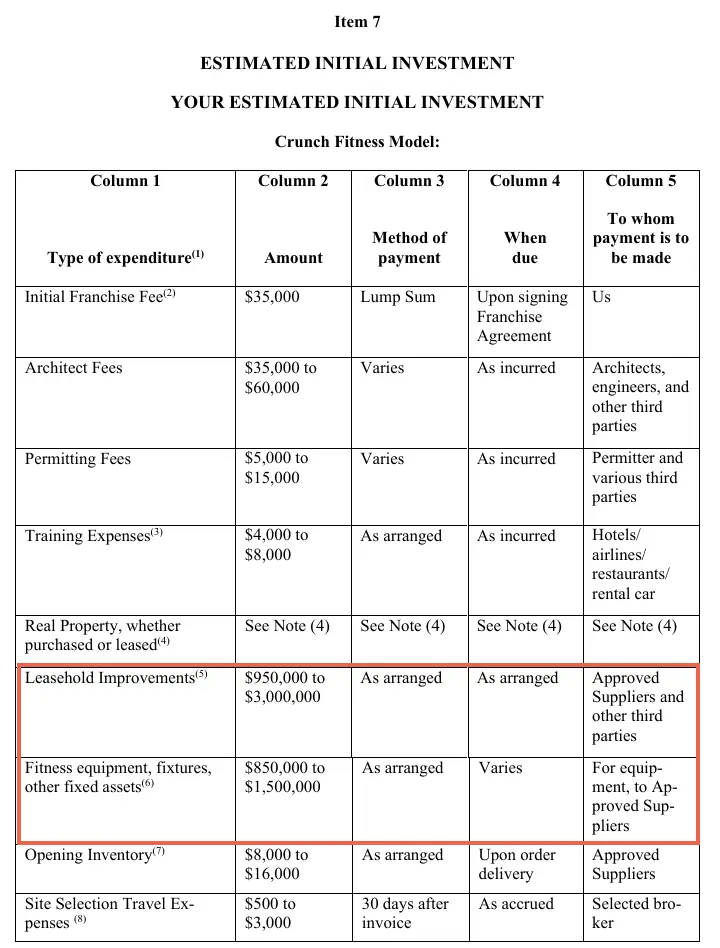
Leasehold improvements and equipment make up about 84% of both ends of the Crunch Fitness Item 7 range. Source: Crunch FDD issued April 29, 2026, Item 7.
What square footage is the estimate built around?
Item 7 Note 4 sizes a Crunch Fitness club at approximately 20,000 to 60,000 square feet and a Crunch Select club at approximately 15,000 to 30,000, usually leased in high-traffic shopping centers or strip malls. The FDD gives no rent figure: Crunch states it cannot estimate real estate costs, including security deposits, in a low-high range.
The Crunch franchise FAQ is narrower. It describes locations of 20,000 to 40,000 square feet, a preferred size of 25,000 to 30,000, and at least 125 parking spots. Under the FTC Franchise Rule, 16 CFR 436.5(g), a franchisor may add extra Item 7 tables for differences in premises size, and Crunch splits only by format, not by box size, so a 60,000 square foot site and a 20,000 square foot site share one range.
What does the leasehold line pay for: HVAC, plumbing, locker rooms?
Item 7 Note 5 lists what the $950,000 to $3,000,000 leasehold line covers: demolition, construction, insulation, partition walls, ceilings, flooring, cabinets, plumbing, HVAC, electrical, and fire and security systems. The line does not break out locker rooms or showers as their own cost, so their plumbing and finishes sit inside it, while lockers themselves are bought through Crunch under Item 8.
Two conditions in Note 5 move the number. The estimate assumes a market outside the most expensive metropolitan areas, naming New York as an example where costs may exceed the range. It is also net of the landlord’s tenant upfit allowance, so a lease with a smaller allowance pushes the build-out cost toward or past $3,000,000.
Do the printed lines add up to the printed totals?
They do. Adding the 16 priced Crunch Fitness lines gives $2,147,500 and $5,367,000, matching the printed totals, and the Crunch Select lines sum to $3,192,500 and $5,277,000. The arithmetic also shows how little the smaller lines matter: everything outside build-out and equipment is $347,500 to $867,000.
| Group of Item 7 lines (Crunch Fitness) | Low | High | Share of total (low / high) |
|---|---|---|---|
| Leasehold improvements | $950,000 | $3,000,000 | 44.2% / 55.9% |
| Fitness equipment, fixtures, fixed assets | $850,000 | $1,500,000 | 39.6% / 27.9% |
| All 14 other priced lines | $347,500 | $867,000 | 16.2% / 16.2% |
| Printed total | $2,147,500 | $5,367,000 | 100% |
Why do the equipment, lockers and flooring go through Crunch?
Item 8 of the Crunch Franchising FDD issued April 29, 2026 names Crunch as the only approved supplier for fitness equipment, tanning beds, hydromassage beds, lockers and flooring. The franchisee or its leasing company pays Crunch in full, and Crunch passes most of the money to third-party suppliers while retaining a portion for its coordination services. Item 8 also states that Crunch will make a profit on equipment and tanning beds it sells.
The scale is disclosed. For 2025, Crunch Franchising reported $22,066,990 in revenue from franchisee required purchases or leases, 19.64% of its total revenue of $112,377,668. Crunch estimates required purchases at about 30% to 45% of everything a franchisee buys to open and run the club, and says supplier payments to it usually run 3% to 10%. Our research on franchise supplier rebates compares how other franchisors disclose this.
Item 7 Note 6 describes the $850,000 to $1,500,000 equipment figure as initial down payments that assume purchase, including delivery, installation and shipping. Crunch Select’s equipment line tops out lower, at $1,350,000. Approving an outside supplier for other categories costs $1,500 plus expenses, and using an unapproved vendor carries a $2,500 fee for a first violation, $5,000 for a second and $10,000 after that (Item 6).
How long does a Crunch presale run, and what does it cost before opening day?
A Crunch presale is the period when memberships are sold before the gym opens, and Item 11 of the Crunch Franchising FDD issued April 29, 2026 requires pre-opening and pre-sale marketing of at least $15,000 per month during it. The club must also open within 10 months of the lease or franchise agreement in an existing building, 12 months for a building not yet built, and four months for a conversion.
Those deadlines run from whichever comes first, the lease or the franchise agreement. Item 11 says franchisees typically open four to 10 months after signing a lease. Up to four 30-day extensions cost $5,000 each, which is why Item 7 carries a $0 to $20,000 construction extension line.
| Presale step | Deadline or cost | Source |
|---|---|---|
| Sign franchise agreement | $35,000 fee, lump sum | Item 5 |
| Submit a site (no lease yet) | Within 60 days; if Crunch does not answer within 20 business days, the site counts as disapproved | Item 11 |
| Open after lease or agreement | 10 months (existing building), 12 months (not built), four months (conversion) | Item 11 |
| Train before presale | Pre-Sale Training 8 hours; Pre-Sale Launch 32 hours; ABC pre-sale training 40 hours | Items 11 and 16 |
| Presale software | ABC system fully operational when presale begins; $159 per month | Items 6 and 11 |
| Presale marketing | At least $15,000 per month pre-opening | Item 11 (FA s.7.1.3) |
| Extensions | Up to four of 30 days, $5,000 each | Item 5 |
| Opening | Written approval to open from Crunch; up to five days of in-club opening training at Crunch’s expense | Item 11 |
The Item 7 initial advertising line of $45,000 to $75,000 equals three to five months at the $15,000 monthly floor. A presale that runs longer than five months, or spends above the floor, costs more than that line, and the difference would come out of the $25,000 to $200,000 additional funds line or new money.

What does Florida law add to a gym presale?
Florida, where Item 20 shows 74 franchised Crunch Fitness clubs at the end of 2025, regulates presold memberships under its health studio law. Florida Statutes s. 501.016 requires a $25,000 bond per location before a business tax receipt issues, and a copy of any escrow account holding funds sold before full operation, with a date certain for opening.
| Florida rule | Requirement | Statute |
|---|---|---|
| Registration | $300 annual fee per business location | s. 501.015(2) |
| Security | $25,000 surety bond, letter of credit or certificate of deposit per location | s. 501.016(1) to (2) |
| Presale funds | Copy of escrow account for services sold before full operation, with a date certain for opening | s. 501.016(7) |
| Buyer cancellation | 3 days, excluding weekends and holidays; refund within 30 days | s. 501.017(1)(a) |
Item 1 of the Crunch FDD flags the same issue nationally: some states require bonding before a club opens, escrow of membership fees sold in advance, and a defibrillator with trained staff on duty. Item 16 adds Crunch’s own condition, that escrow agents must be acceptable to Crunch. Ask a local franchise lawyer which statute governs presales in your state before the presale budget is set.
What does a Crunch club owe Crunch and ABC each month?
Once open, a Crunch club pays a 5.0% royalty and a 2% Brand Marketing Fund contribution on monthly Gross Sales, plus $159 per month to ABC Financial Services for club software and $75 per month for technology support, per Item 6 of the Crunch Franchising FDD issued April 29, 2026. ABC drafts the royalty and fund by the 5th of the following month. Local advertising is a separate, larger obligation.
| Recurring fee | Amount | Paid to | Source |
|---|---|---|---|
| Royalty | 5.0% of monthly Gross Sales | Crunch (drafted by ABC) | Item 6 |
| Brand Marketing Fund | 2% of monthly Gross Sales, or a pro rata share of actual marketing costs | Crunch | Item 6 |
| Local advertising | Lesser of 7% of Gross Sales or an age-based minimum | Approved media suppliers | Item 6; Item 11 |
| Club management software | $159 per month plus processing fees | ABC Financial Services | Items 6 and 8 |
| Technology and IT support | $75 per month | Crunch | Item 6 |
| Online enrollment | $5 per enrollment | Crunch | Item 6 |
| Card interchange and processor fees | Set by card networks and processors | Processors | Item 6 |
The local advertising rule is the one most guides skip. Each month the club spends the lesser of 7% of Gross Sales, including personal training, or a minimum tied to club age. Brand Marketing Fund contributions do not count toward it. Our franchise advertising fund research shows how other systems stack fund and local spend.
| Club age | Age-based minimum (excludes personal training) | Cap that applies | Source |
|---|---|---|---|
| Before opening | At least $15,000 per month pre-opening and pre-sale | None stated | Item 11 |
| 1 to 24 months open | Greater of $10,000 or 8% of Gross Sales | 7% of Gross Sales including personal training | Item 6 |
| 25 to 72 months open | Greater of $8,000 or 7% of Gross Sales | 7% of Gross Sales including personal training | Item 6 |
| More than 72 months open | Greater of $10,000 or 5% of Gross Sales | 7% of Gross Sales including personal training | Item 6 |
If a club skips local marketing for two consecutive months, Item 6 lets Crunch draft the funds from the club’s designated account and place the advertising itself.
What do one club, a multi-unit deal and an area deal cost in fees?
The fee is $35,000 per club on every route in Item 5 of the Crunch Franchising FDD issued April 29, 2026: the initial franchise fee for a single club, the Multi-Unit Fee per club under a Multi-Unit Development Agreement, and the Development Fee per club under an Area Development Agreement. The multi-club fees are paid in one lump sum when the development agreement is signed, not club by club.
Item 1 sets the density for area deals at one club for every 75,000 people residing or working in the Development Area, and Item 12 gives each club a protected territory of about 75,000 people. Crunch says new franchisees paid between $0 and $35,000 in initial fees in 2025, with reductions possible for large developers and veterans. Our franchise territory rights research compares population-based territories across brands.
| Route | Example size | Clubs required | Fees due at signing | Source |
|---|---|---|---|---|
| Single franchise agreement | 1 territory of about 75,000 people | 1 | $35,000 | Items 5 and 12 |
| Area Development Agreement | Development Area of 300,000 people | 300,000 / 75,000 = 4 | 4 x $35,000 = $140,000 | Items 1 and 5 |
| Area Development Agreement | Development Area of 750,000 people | 750,000 / 75,000 = 10 | 10 x $35,000 = $350,000 | Items 1 and 5 |
| Multi-Unit Development Agreement | Negotiated number of Trade Areas of 75,000 people each | 1 per Trade Area | $35,000 per club | Items 1 and 5 |
Missing the schedule costs money too. A 90-day development extension is $10,000 per club, granted at Crunch’s discretion, and Item 5 says a missed schedule can void any fee discount and make the full standard fees due. Transferring an area or multi-unit agreement costs $10,000 plus $5,000 per franchised club (Item 6).
Crunch Fitness or Crunch Select: which format costs more to build?
Crunch Select costs more at the low end and slightly less at the high end. Its Item 7 range is $3,192,500 to $5,277,000 against $2,147,500 to $5,367,000 for Crunch Fitness, because Select’s leasehold line starts at $2,000,000 for a smaller, more finished club of 15,000 to 30,000 square feet. Item 20 of the Crunch Franchising FDD issued April 29, 2026 shows zero franchised Select clubs open at the end of 2025.
The comparison below adds two other gym franchises from their own 2026 filings. Our Planet Fitness franchise cost breakdown covers that brand’s equipment financing options, and the Anytime Fitness franchise cost review covers a much smaller 24-hour club.
| Measure | Crunch Fitness | Crunch Select | Planet Fitness | Anytime Fitness | Source |
|---|---|---|---|---|---|
| Item 7 total | $2,147,500 to $5,367,000 | $3,192,500 to $5,277,000 | $1,282,500 to $5,386,000 | $539,329 to $905,482 | Crunch FDD Item 7; Planet Fitness FDD May 22, 2026; Anytime Fitness FDD amended Sept. 14, 2026 |
| Club size in Item 7 | About 20,000 to 60,000 sq ft | About 15,000 to 30,000 sq ft | About 15,000 to 25,000 sq ft | 4,000 to 7,000 sq ft | Item 7 notes of each FDD |
| Leasehold line | $950,000 to $3,000,000 | $2,000,000 to $3,000,000 | $1,000,000 to $2,167,000 | Not compared | Item 7 of each FDD |
| Initial franchise fee | $35,000 | $35,000 | $40,000 | $42,500 | Item 5 of each FDD |
| Royalty | 5.0% of Gross Sales | 5.0% of Gross Sales | 7% of EFT Dues Draft | $842 per month Monthly Fee | Item 6 of each FDD |
| Franchised outlets, end of 2025 | 481 | 0 | Not compared | Not compared | Crunch Item 20 |
The Select table differs from the Fitness table in five lines only: leasehold ($2,000,000 to $3,000,000), equipment ($850,000 to $1,350,000), professional fees ($20,000 to $60,000), office and technology ($75,000 to $150,000) and additional funds ($45,000 to $300,000). Item 1 says Select carries upgraded equipment and amenities for higher cost-of-living markets.
What will Crunch bill again in years 5, 6 and 10?
Three later bills belong in a Crunch budget. Item 11 of the Crunch Franchising FDD issued April 29, 2026 lets Crunch require a trade-dress renovation, including equipment replacement, not more than once every five years, estimated at $250,000 to $1,500,000. Section 5.6 of the franchise agreement lets Crunch require new cardio equipment no more often than every five years and other equipment no more often than every six. Renewal after 10 years can require a full remodel.
| When | What Crunch can require | Cost stated | Source |
|---|---|---|---|
| Not more than every 5 years | Trade-dress renovation, including worn equipment | $250,000 to $1,500,000 | Item 11; Item 6 |
| Not more than every 5 years | Replace all cardio equipment | Inside the renovation estimate | Franchise Agreement s.5.6 |
| Not more than every 6 years | Replace all other exercise equipment | Inside the renovation estimate | Franchise Agreement s.5.6 |
| End of 10-year term | Renewal: new agreement, upgrade to current standards, possible complete remodel | $15,000 renewal fee plus upgrade | Item 17(b) to (c); Item 6 |
| Early exit | Liquidated damages if terminated for cause or by you without cause | Royalties for 24 months | Item 6 |
Up to three 10-year renewals are available under Item 17, each on the then-current agreement, which can carry different royalty and fund terms. A $250 per day trade-dress non-compliance fee applies if a required update is not made after notice and cure (Item 6).
Where do older Crunch cost numbers still circulate?
Most Crunch cost figures in circulation predate the 2026 FDD. The Crunch franchise FAQ still showed an initial investment of $668,000 to $3,488,000 when checked on November 3, 2026, while Item 7 of the April 29, 2026 filing prints $2,147,500 to $5,367,000. Several third-party guides also repeat a $25,000 fee that Item 5 now lists as $35,000.
| Claim in circulation | Where it appears | What the April 29, 2026 FDD says |
|---|---|---|
| Investment $668,000 to $3,488,000 | Crunch franchise FAQ, checked November 3, 2026 | $2,147,500 to $5,367,000 (Item 7, Crunch Fitness) |
| Locations of 20,000 to 40,000 sq ft | Crunch franchise FAQ | Approximately 20,000 to 60,000 sq ft for Crunch Fitness (Item 7 Note 4) |
| $25,000 franchise fee | Several guides, including a lender’s page updated October 2026 | $35,000 (Item 5) |
| 1% advertising fund | A lender’s cost page updated October 2026 | 2% Brand Marketing Fund (Item 6) |
| Investment $356,000 to $2,200,000 | Same lender’s cost page | $2,147,500 to $5,367,000 (Item 7) |
| $15,000 per month local ads in year one | A franchise news profile dated March 2023 | $15,000 per month is the pre-opening floor; after opening, the age-based rule applies (Items 6 and 11) |
Conversion, ground-up or multi-club: what should your Crunch plan budget for?
The fit turns on four numbers: the Crunch FAQ minimums of $2.5 million combined net worth and $500,000 liquid capital, an Item 7 high end of $5,367,000 against the $5 million SBA 7(a) loan maximum, the deadline for your site type, and your state’s presale rules. Item 10 says Crunch offers no direct or indirect financing.
| If | Then | Why (source) |
|---|---|---|
| Your site is an existing gym you can convert | Price the conversion yourself and plan to a four-month opening deadline | Item 7 Note 1 says Crunch cannot estimate conversion costs; Item 11 deadline (FDD) |
| The building is not built yet | Budget land and construction outside Item 7 and plan to 12 months | Item 7 Note 4 excludes buying land and building; Item 11 |
| The site is in a top-cost metro such as New York | Expect build-out above $3,000,000 | Item 7 Note 5 |
| You will presell in Florida | Add a $25,000 bond, $300 registration and an escrow plan before the first sale | Fla. Stat. s. 501.016; s. 501.015 |
| You want 2 or more clubs | Expect $35,000 per club at signing and first-club working capital near $200,000 | Item 5; Item 7 Note 16 |
| You meet the FAQ minimums only with partners | Each owner signs the Owner’s Guaranty unless Crunch waives it | Crunch FAQ says minimums are combined; Item 15 (FDD) |
| You need to borrow most of the budget | Line up lenders early; Crunch does not finance | Item 10; SBA 7(a) cap of $5 million |
| You prefer Crunch Select | Start from a $3,192,500 low estimate with no open franchised Select clubs to visit | Item 7; Item 20 Select Table 1 |
Owner pay is shaped by these same lines, not by a promised figure. Item 7 Note 16 says the additional funds estimate excludes any draw or salary for you. Item 19 of the FDD reports Gross Revenue for Crunch Fitness format gyms grouped in thirds; we do not republish those figures, and the place to read them is Item 19 of the current Crunch FDD. Our franchise affordability research shows how many US families meet minimums like Crunch’s.
How fast is the Crunch Fitness system adding clubs?
Item 20 of the Crunch Franchising FDD issued April 29, 2026 shows Crunch Fitness franchised clubs rising from 359 at the end of 2023 to 415 in 2024 and 481 in 2025, while company-owned clubs fell from 8 to 5. In 2025, 82 franchised clubs opened, 13 ceased operations for other reasons, two were not renewed and one was terminated. Our fitness franchise statistics report sets these counts against other gym brands.
| Year end | Franchised | Company-owned | Total | Transfers during year | Source |
|---|---|---|---|---|---|
| 2023 | 359 | 8 | 367 | 9 | Item 20 Tables 1 and 2 |
| 2024 | 415 | 8 | 423 | 25 | Item 20 Tables 1 and 2 |
| 2025 | 481 | 5 | 486 | 31 | Item 20 Tables 1 and 2 |
Crunch Fitness outlets grew from 367 to 486 between the ends of 2023 and 2025; franchised clubs rose from 359 to 481. Source: Crunch FDD issued April 29, 2026, Item 20 Table 1.
Item 20 Table 5 lists 5 franchise agreements signed but not opened and 95 projected new franchised Crunch Fitness clubs for the next fiscal year, 19 of them in Texas. Item 20 Table 2 counts 31 transfers to new owners in 2025, the main route to an already open club.
How we compiled this
We read the 357-page Crunch Franchising disclosure document issued April 29, 2026 from the Minnesota CARDS database, the Crunch franchise FAQ, 16 CFR 436.5, Florida Statutes ss. 501.015 to 501.017 and the SBA 7(a) program page, all accessed in November 2026. Anytime Fitness figures come from its FDD amended September 14, 2026; Planet Fitness figures come from our earlier review of its May 22, 2026 FDD. Item 19 revenue figures and franchisee names were excluded. This page is general information, not legal, financial or investment advice.
Frequently asked questions
Is Crunch Fitness a franchise?
Yes. Crunch Franchising, LLC has sold Crunch franchises since April 2010, and Item 20 of its April 29, 2026 FDD counts 481 franchised and 5 company-owned Crunch Fitness clubs at the end of 2025. An affiliate, Crunch, LLC, separately runs 26 Signature clubs. Funds managed by Leonard Green & Partners own the parent company, per Item 1.
How much does a Crunch Fitness franchise owner make?
The FDD does not state an owner salary. Item 19 of the current Crunch FDD reports Gross Revenue for Crunch Fitness format gyms by thirds, which we do not republish. Owner pay is what remains after the 5% royalty, 2% fund, local advertising, rent, payroll and debt on the build, and Item 7 Note 16 excludes any owner draw from working capital.
What are the Crunch Fitness franchise requirements?
The Crunch franchise FAQ asks for at least $2.5 million in combined net worth and $500,000 in liquid capital, plus a site with at least 125 parking spots. Under Item 15 of the FDD, you, an owner or a trained manager must supervise the club on site, any manager must live in the territory, and entity owners sign a guaranty.
Does Crunch finance its franchisees?
No. Item 10 of the 2026 Crunch FDD states that Crunch does not offer direct or indirect financing and does not guarantee notes or leases. Buyers usually combine equity, equipment leasing and bank or SBA loans. The SBA 7(a) program caps a loan at $5 million, below the $5,367,000 high estimate.
How long does it take to open a Crunch Fitness?
Item 11 of the Crunch FDD says franchisees typically open four to 10 months after signing a lease. The contract deadline is 10 months in an existing building, 12 months for a new building and four months for a conversion, with up to four 30-day extensions at $5,000 each.
How big is a Crunch Fitness territory?
Item 12 of the April 2026 FDD gives each club a protected territory of about 75,000 people, measured with third-party demographic software. Crunch will not place another Crunch club inside it while you comply, but other clubs may advertise there, and there is no exclusive marketing territory.
Sources
- Crunch Franchising, LLC, Franchise Disclosure Document, issued April 29, 2026 (Minnesota CARDS 36375-202604-12), Items 1, 5, 6, 7, 8, 10, 11, 12, 15, 16, 17, 19, 20 and Franchise Agreement s.5.6. Accessed November 3, 2026.
- Crunch, Franchise FAQ. Accessed November 3, 2026.
- Electronic Code of Federal Regulations, 16 CFR 436.5, Item 7. Accessed November 3, 2026.
- Florida Statutes 2025, s. 501.015, s. 501.016 and s. 501.017. Accessed November 3, 2026.
- U.S. Small Business Administration, 7(a) loans. Accessed November 3, 2026.
- Anytime Fitness Franchisor LLC, Franchise Disclosure Document, as amended September 14, 2026, Items 5, 6 and 7. Accessed November 3, 2026.
- Planet Fitness Franchising LLC, Franchise Disclosure Document, issued May 22, 2026, Items 5, 6 and 7. Accessed October 27, 2026.