A Burger King franchise cost runs $348,400 to $4,730,600 before real estate in the 2026 FDD, plus contract remodels; missing a remodel program deadline raises the royalty by 3.0 points.
Key takeaways
- Six Item 7 budgets, none with land: the Burger King Franchise Disclosure Document, issued March 26, 2026, as amended September 2, 2026, prints $2,039,200 to $4,730,600 for a traditional freestanding restaurant and $348,400 to $789,100 for an indoor MRS unit, excluding real estate (Item 7).
- Two remodels are written into every term: an exterior remodel to the Current Image by the Midterm Date, and a Successor Remodel finished 3 years to 3 months before the 20-year term ends (Franchise Agreement, Exhibit D1, Sec. 5.B(2) and 17.B(4)).
- Late remodels cost royalty points: missing a Reclaim the Flame 2, Sizzle Jr. or Midterm Remodel Forbearance deadline adds 3.0% of Gross Sales to the royalty until BKC verifies the work (2026 FDD, Item 6, Note 2).
- BKC pays toward some remodels: a Full Sizzle Jr. remodel finished by a 2026, 2027 or 2028 deadline earns a $100,000 cash contribution for operators graded A or B, against 10 purchased term years at $2,500 each (Items 5 and 11).
- Resales outnumber new builds: 242 franchised Burger King restaurants changed hands between owners in 2025, against 83 new franchised openings (Item 20, Tables 2 and 3).
When does the Burger King contract make you remodel, and how far ahead?
The Burger King Franchise Agreement sets two remodel dates inside each 20-year term and a third trigger on any sale. The exterior must match the Current Image by the Midterm Date printed on the Key Contract Data page, and a full Successor Remodel must be finished 3 years to 3 months before expiry if you want a successor agreement (Exhibit D1, Sec. 5.B(2) and 17.B(4)).
Current Image is not frozen at signing. BKC and the Franchisee Advisory Council meet every year to set its components, the result binds each franchisee, and a deadlock goes to a sole arbitrator in Miami, Florida (Sec. 5.B(2)(ii)). The Midterm Date cannot fall before the ninth anniversary of the restaurant’s last Successor Remodel, even one finished under an earlier agreement.
| Trigger | What must be done | Timing | Where it is written |
|---|---|---|---|
| Opening a new restaurant | Build to current plans; Double Drive Thru required except in food courts, in-lines, indoor MRS and Big Box units | Before opening | Item 7, note 10; Item 11 |
| Midterm Date | Remodel the exterior to the Current Image in effect at the end of the prior calendar year | On or before the Midterm Date; not before 9 years after the last Successor Remodel | Exhibit D1, Sec. 5.B(2)(i) |
| Successor agreement | Interior and exterior remodeling or rebuilding to the then Current Image | Finished not more than 3 years and not less than 3 months before expiry | Exhibit D1, Sec. 17.B(4); Item 17(c) |
| Transfer to a new owner | All repair and maintenance done; restaurant brought up to current image | Before BKC approves the transfer | Item 17(m) |
| Carrols Refranchise purchase | Remodels listed in the Remodel Agreement | By that agreement’s deadlines; BKC may withhold resale consent until done | Item 17(l) |
| Technology | Upgrade hardware, software and POS | When BKC requests, for PCI compliance or new programs | Item 11; Exhibit D1, Sec. 5.D and 5.F |
| Signs | Remove and destroy signs BKC declares obsolete | Within the time BKC specifies | Exhibit D1, Sec. 5.C |
For a buyer, the clock can matter more than the build cost. A restaurant bought with 4 years left on its agreement is 1 year from the opening of its Successor Remodel window, so the purchase price, the remodel and the successor fee land close together. Failure to make required remodels is a curable default with 30 days to cure under Item 17(g).
What does a missed remodel deadline add to the royalty?
A missed remodel deadline raises the royalty rather than triggering a one-time fine. Under the Reclaim the Flame 2, Sizzle Jr. and Midterm Remodel Forbearance agreements, the royalty becomes the rate in force before the deadline plus 3.0% of all Gross Sales, from the deadline until BKC verifies the remodel or the agreement expires (2026 FDD, Item 6, Note 2, pages 32 to 33).
| Agreement | Royalty consequence | Other cost or condition | Source |
|---|---|---|---|
| Reclaim the Flame 2 Master Program Agreement (Exhibit X1) | Prior rate plus 3.0% until verified completion or expiry | Certain program defaults are non-curable under the Franchise Agreement | Item 6, Note 2, p. 32; Item 17(h) |
| Sizzle Jr. Remodel Program Agreement (Exhibit X4) | Prior rate plus 3.0%, same period | Contribution only at FSS Remodel Grade A or B | Item 6, Note 2, p. 32 to 33; Item 11 |
| Midterm Remodel Forbearance Agreement (Exhibit W) | Prior rate plus 3.0%; also applies if a Termination Event occurs and BKC keeps the franchise in place | Covers every restaurant listed for remodel | Item 6, Note 2, p. 33 |
| Original Reclaim the Flame (Exhibits N1 and N2) | Prior rate plus 3.0% until verified | Program closed to new entrants | Item 6, Note 2, p. 33 |
| Earlier incentive programs | Royalty rises to 6.0% or 7.5% until the remodel is confirmed | Deferred Remodel Default Payments | Item 6, p. 29 |
| Any remodel reported done but found incomplete | None | $1,500 Follow Up Walk-Thru fee | Item 6, p. 28 |
The standard Burger King royalty is 4.5% of monthly Gross Sales, so an operator at that rate would pay 7.5% after a missed deadline under any of the first three agreements. An operator who elected 6.0% under Reclaim the Flame 2 would pay 9.0%. Royalty structures at other systems are compared in our franchise royalty rates report.
How much will Burger King contribute to a Sizzle Jr. or Reclaim the Flame 2 remodel?
For Sizzle Jr. work, Item 11 prints fixed cash contributions: $100,000 for a Full Sizzle Jr. remodel with a 2026, 2027 or 2028 deadline, $75,000 for 2029 and later, and $20,000 to $35,000 for exterior-only work. Reclaim the Flame 2 amounts are not printed; they turn on the FSS Remodel Grade, the remodel type and the royalty rate elected (Item 6, Note 2; Item 11).
| Sizzle Jr. remodel type | Scope (Exhibit X4, Sec. 3) | Remodel deadline | Cash contribution | Term years to buy at $2,500 each |
|---|---|---|---|---|
| Full Sizzle Jr. | Signage, exterior, parking lot, driveways, sidewalks, landscaping and interior | 2026, 2027 or 2028 | $100,000 | 10 ($25,000) |
| Full Sizzle Jr. | Same | 2029 and later | $75,000 | 10 ($25,000) |
| Exterior Only Sizzle Jr. | Signage and building exterior | 2026 or 2027 | $35,000 | Enough to reach 10 years after the deadline; none if the interior was 20/20 Light |
| Exterior Only Sizzle Jr. | Same | 2028 | $30,000 | Same rule |
| Exterior Only Sizzle Jr. | Same | 2029 and later | $20,000 | Same rule |
| Signage Only | Signage | 2026 or 2027 | $10,000 | None required or permitted |
| Signage Only | Signage | 2028 and later | $5,000 | None required or permitted |
- An Exterior Only contribution drops by $5,000 where BKC already paid toward replacing the restaurant’s signs.
- Swapping a circular pylon sign cabinet for the “bun” shape adds $10,000 (2026 or 2027 deadline), $7,500 (2028) or $5,000 (2029 and later) on Signage Only and Exterior Only jobs.
- A Full Sizzle Jr. remodel on a site where BKC owns the land and building adds $7,500 per purchased term year.
- Full Sizzle Jr. contributions shrink in proportion when the term left after the deadline is under 10 years.
- Eligible restaurants were built or remodeled to the 20/20, 20/20 Light or Garden Grill images, and Exhibit X4 makes the franchisee “solely responsible for all costs and expenses incurred in the Remodel(s)”.
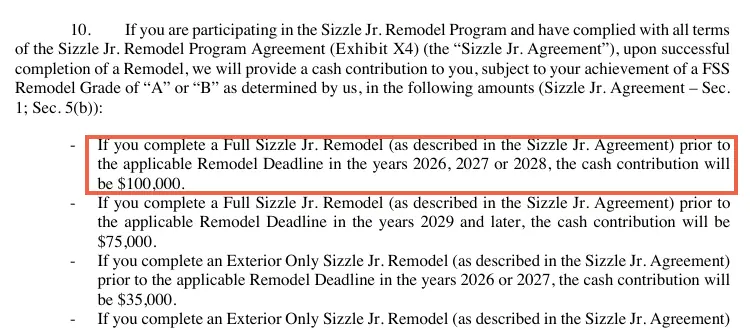
The term-year arithmetic below uses only printed FDD rates: $2,500 per purchased year (Item 5, p. 22) and the Item 11 contribution schedule. Construction cost for a remodel is not printed anywhere in the FDD; the only remodel figure in Item 7 is note 10, which says a Double Drive Thru “may increase your remodel costs between $80,000 and $120,000”.
| Scenario | Term years purchased | Successor franchise fee | Printed BKC contribution |
|---|---|---|---|
| Full Sizzle Jr., 2027 deadline, BKC owns land and building | 10 | 10 x $2,500 = $25,000 | $100,000 + 10 x $7,500 = $175,000 |
| Full Sizzle Jr., 2029 deadline, franchisee controls the site | 10 | $25,000 | $75,000 |
| Exterior Only, 2028 deadline, 4 years left, interior not 20/20 Light | 10 minus 4 = 6 | 6 x $2,500 = $15,000 | $30,000 |
| Reclaim the Flame 2 remodel, 6 years left on the agreement | 20 minus 6 = 14 | 14 x $2,500 = $35,000 | Not printed; set by FSS Remodel Grade and elected royalty |
The money behind these programs is disclosed at parent level. Restaurant Brands International’s FY2025 Form 10-K says Burger King plans to invest up to $700 million through year-end 2028 under Reclaim the Flame, and that $176 million of up to $550 million planned for Royal Reset remodels, technology and equipment had been funded by December 31, 2025. An RBI release dated April 30, 2024 called the second wave a $300M co-investment with franchisees covering about 1,100 remodels through 2028.
What does a new Burger King cost to build, by facility type?
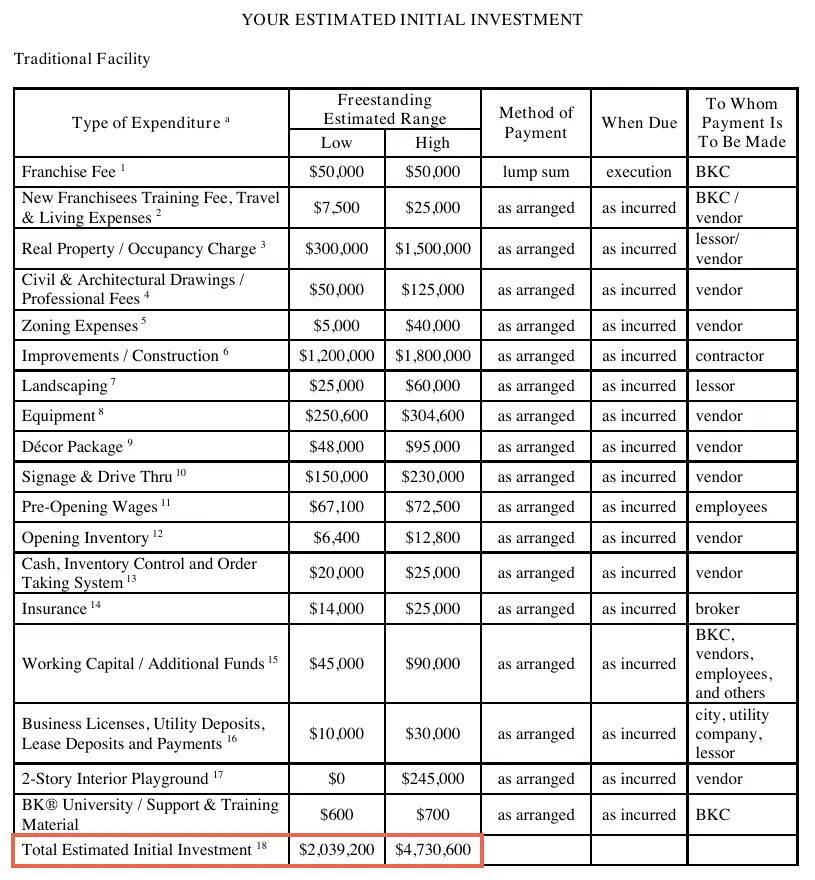
Item 7 of the 2026 Burger King FDD prints six budgets, all excluding the purchase of real estate: $2,039,200 to $4,730,600 for a traditional freestanding restaurant, $944,800 to $1,942,800 in-line or end cap, $896,200 to $1,682,800 co-brand, $655,720 to $1,131,700 in a mall food court, $564,600 to $979,100 Big-Box and $348,400 to $789,100 for an indoor MRS unit.
| Facility type | Low | High | Franchise fee in Item 7 | Improvements or construction | Source |
|---|---|---|---|---|---|
| Traditional freestanding | $2,039,200 | $4,730,600 | $50,000 | $1,200,000 to $1,800,000 | Item 7, p. 41 |
| In-Line / End Cap | $944,800 | $1,942,800 | $25,000 | $400,000 to $850,000 | Item 7, p. 42 to 43 |
| Co-Brand | $896,200 | $1,682,800 | $25,000 to $50,000 | $300,000 to $650,000 | Item 7, p. 42 to 43 |
| Mall Food Court | $655,720 | $1,131,700 | $15,000 to $50,000 | $200,000 to $380,000 | Item 7, p. 43 to 44 |
| Big-Box | $564,600 | $979,100 | $25,000 to $50,000 | $200,000 to $380,000 | Item 7, p. 44 to 45 |
| Indoor MRS | $348,400 | $789,100 | $15,000 to $50,000 | $30,000 to $150,000 | Item 7, p. 43 to 44 |
A traditional freestanding Burger King carries the widest Item 7 range, $2,039,200 to $4,730,600, before real estate. Source: Burger King Franchise Disclosure Document, issued March 26, 2026, as amended September 2, 2026, Item 7, pages 41 to 45, accessed November 2, 2026.
In the traditional budget, construction at $1,200,000 to $1,800,000 and the real property or occupancy charge at $300,000 to $1,500,000 carry most of the spread. Note 3 adds that unimproved land for a freestanding site may run $250,000 to $2,000,000, outside the total. Optional items sit inside the high end: a 2-Story Indoor Playground at $150,000 to $245,000 and outdoor seating at $5,000 to $18,000 (notes 9 and 17).
Two assumptions shape the smaller lines. Working capital of $45,000 to $90,000 covers a 3-month start-up phase (note 15), and the $67,100 to $72,500 in pre-opening wages assumes managers paid for 3 months and shift coordinators for 10 weeks (note 11). How each column of an Item 7 table is built is explained in our guide to the franchise disclosure document.
Does the traditional Item 7 total match its own lines?
Not at the low end. The 18 printed lines of the traditional table add up to $2,249,200, which is $210,000 more than the printed low total of $2,039,200; the high lines add up to $4,730,600 and match. The five non-traditional tables add up exactly. Ask BKC in writing which low figure it stands behind before it goes into a loan package.
| Item 7 table | Sum of printed lines, low | Printed low total | Sum of printed lines, high | Printed high total |
|---|---|---|---|---|
| Traditional freestanding | $2,249,200 | $2,039,200 | $4,730,600 | $4,730,600 |
| Co-Brand | $896,200 | $896,200 | $1,682,800 | $1,682,800 |
| In-Line / End Cap | $944,800 | $944,800 | $1,942,800 | $1,942,800 |
| Mall Food Court | $655,720 | $655,720 | $1,131,700 | $1,131,700 |
| Indoor MRS | $348,400 | $348,400 | $789,100 | $789,100 |
| Big-Box | $564,600 | $564,600 | $979,100 | $979,100 |
Which payments go to Burger King Company, from application to monthly fees?
Before opening, Burger King Company collects $57,750 to $62,500 according to the cover page, a range that matches the $50,000 franchise fee plus the $7,500 training fee plus a $250 individual or $5,000 entity application fee (our arithmetic). After opening, the royalty is 4.5% and the advertising contribution 4.5% of monthly Gross Sales, plus fixed technology and program charges (Items 5 and 6).
| Fee | Amount as printed | When due | Item and page |
|---|---|---|---|
| Application fee | $250 per individual; $5,000 per Entity | With the application | Item 5, p. 20 |
| Franchise fee, 20-year term | $50,000; prorated for shorter terms, minimum $15,000 | Before opening | Item 5, p. 20 |
| TRA or MTRA deposit | $5,000 per TRA; $10,000 per committed MTRA opening; credited to the fee | At signing | Item 5, p. 23 |
| Development Agreement fee | $50,000 prepaid per committed restaurant; $25,000 for later units at FSS grade A or B | At signing | Item 5, p. 23 to 24 |
| Training fee | $7,500 per trainee | Before training | Item 5, p. 24 |
| Royalty | 4.5% of monthly Gross Sales | 10th of the next month | Item 6, p. 25 |
| Advertising contribution | Up to 4.5%; 4.5% for Fuel the Flame participants through December 31, 2027 | Monthly | Item 6, p. 25 and 36 |
| Investment Spending | Up to 2.0% of Gross Sales, set by franchisees in the DMA | Monthly | Item 6, p. 27 |
| Digital Services Fee | $110 per month plus 1% of monthly digital sales, capped at $4,500 per year | Monthly | Item 6, p. 28 |
| Service Desk Fee | $750 to $1,200 per year | On demand | Item 6, p. 25 |
| BK University | $700 per year | On demand | Item 6, p. 27 |
| Burger King Foundation | $1,000 per restaurant per year, bought or fundraised | On demand | Item 6, p. 29 |
| Static Menu Board Kit | $200 to $300 per month without an outdoor digital menu board | Monthly | Item 6, p. 28 |
| Franchise Extension Fee | $2,500 per year of extension | At extension | Item 6, p. 26 |
| Network Standardization (vendor) | $220 to $450 per month | Monthly | Item 11, p. 63 |
Where BKC is the landlord of land and building, minimum annual rent is typically 10% of capitalized site acquisition and construction costs, rising 12% every 5 years, set against percentage rent of typically 8.5% of monthly Gross Sales up to $133,333.33 and 10% above it (Item 6, Note 4). Under Fuel the Flame, the 4.5% advertising rate combines a 4.0% legacy rate with a 0.5% increment; how such funds are governed across systems is covered in our franchise advertising fund research.
Popeyes, Burger King’s sister brand under Restaurant Brands International, uses the same TRA, MTRA and Development Agreement structure, set out line by line in our Popeyes franchise cost breakdown.
Is buying an existing Burger King cheaper than building one?
The FDD does not price existing restaurants. Carrols Refranchise Program prices are “determined at the time of the offer,” and resales between franchisees are private deals. What the FDD fixes are the add-ons: a $2,000 transfer fee, a $7,500 new franchisee training fee, a current-image upgrade before approval and, on Carrols deals, a $10,000 resale fee per restaurant (Items 5, 6 and 17).
| Cost element | New build | Buy from a franchisee | Carrols Refranchise Program |
|---|---|---|---|
| Price | Item 7: $348,400 to $4,730,600 by facility | Negotiated with the seller; not in the FDD | Set at the offer by location, condition, quantity and BKC capital spending |
| Deposit | $5,000 TRA or $10,000 per MTRA opening | Not set by the FDD | 5% of the purchase price, refundable within 30 days |
| Fees to BKC at closing | $50,000 franchise fee for 20 years | Seller pays $2,000 transfer fee plus $500 per extra restaurant, and $7,500 if the buyer is new to the system | $10,000 resale fee per restaurant, technology installation fee up to $5,000, plus Item 5 initial fees |
| Remodel status | Built to current plans | Brought up to current image before approval (Item 17(m)) | Remodels set by a Remodel Agreement; resale consent may be withheld until done |
| Advertising rate | 4.5% under Fuel the Flame | 4.0% kept until the later of the seller’s expiry or December 31, 2028, where the seller paid 4.0% | Fuel the Flame Co-Investment Agreement required (Item 1) |
| BKC right of first refusal | Not applicable | BKC may match the third-party offer (Item 17(n)) | BKC is the seller |
| Time to open or take over | Several months to 2 years or more from a TRA or MTRA (Item 11) | At closing | At closing |
Transfers between franchisees outnumbered new franchised openings in each year from 2023 to 2025: 242 against 83 in 2025. Source: Burger King Franchise Disclosure Document, issued March 26, 2026, as amended September 2, 2026, Item 20, Tables 2 to 4, accessed November 2, 2026.
Item 20 counts, as printed: franchised outlets opened numbered 61 in 2023, 63 in 2024 and 83 in 2025; transfers between franchisees numbered 245, 254 and 242; company restaurants sold to franchisees numbered 0, 11 and 48. The franchised count fell from 6,992 at the start of 2023 to 5,518 at the end of 2025, largely because RBI’s May 16, 2024 purchase of Carrols Restaurant Group moved 1,023 franchised restaurants into company ownership (Item 20, Tables 1 to 4).
BKC projects 39 new franchised outlets in the next fiscal year and lists no signed agreements awaiting opening (Table 5). Resale activity across brands is measured in our franchise resale index, and transfer charges at other franchisors are compared in our franchise transfer fees report.
What the Carrols Refranchise Program adds
RBI’s FY2025 Form 10-K says it intends to remodel and refranchise the vast majority of the restaurants acquired from Carrols and to fund those remodels primarily from the restaurants’ own cash flow. For a buyer, the Carrols addendum ties the purchase to remodels: BKC may withhold consent to any later resale until required remodels are done, and may buy the restaurants back at depreciated value if the franchise ends first (Item 17(l) and (o)).
Financing: Crown Your Career and SBA 7(a) records
Apart from leasing sites it controls, BKC finances one route: Crown Your Career, open to BKC and affiliate employees buying company restaurants, at the Wall Street Journal Prime Rate plus about 1% to 4%, for terms typically 10 years or less and capped at the private financing you raise (Item 10). If BKC pays for the remodel of such a restaurant, the royalty may rise by 1% to 5% for a period (Item 6, Note 2).
Crown Your Career loans also require a guaranty from you and your spouse or partner, a structure examined in our franchise personal guarantee report. Outside BKC, SBA records show 51 SBA 7(a) loans under franchise code S0275 from FY2020 to June 30, 2026, 8 of them for a change of ownership, plus 3 SBA 504 loans, per the SBA FOIA loan files compiled in our SBA franchise directory tracker.
Which Burger King cost figures in circulation are out of date?
Several cost guides updated in 2025 and 2026 still quote the 2025 FDD or older fee tables. The current FDD, amended September 2, 2026, moves the traditional range and the digital fee, and prints no net worth or liquidity minimum at all; that requirement comes from Burger King’s franchising website, which asks for a $1 million net worth and $500,000 in liquid assets.
| Claim in circulation | What the 2026 FDD prints | Source |
|---|---|---|
| “Traditional restaurant: $2,064,200 to $4,730,500” (guides updated December 2025 and August 2026) | $2,039,200 to $4,730,600 | Item 7, p. 41 |
| “$500 per month building improvement fee” | No such line in the Item 6 fee table | Item 6, p. 25 to 30 |
| “Digital app license of $0.30 per digital transaction” | $110 per month plus 1% of monthly digital sales, capped at $4,500 per year | Item 6, p. 28 |
| “$1 million net worth and $500,000 liquid” cited as FDD terms | Not in the FDD; Item 17(g) gives 180 days to cure a failure to meet the then-current financial policy | franchising.bk.com; Item 17 |
| “$50,000 franchise fee” for every format | $50,000 is the 20-year standard; Item 7 shows $25,000 in-line and $15,000 to $50,000 for food court and MRS | Items 5 and 7 |
Build, buy or remodel: which commitment matches your capital and timeline?
Match the route to the deadline you can carry. A new freestanding build ties up $2,039,200 or more before land and takes several months to 2 years or more from a TRA; a resale closes faster but inherits the seller’s remodel clock; an operator with an A or B FSS grade can apply Sizzle Jr. contributions against remodel spending (Items 7, 11 and 17).
| If your position is | Then the FDD points you to | Threshold to check |
|---|---|---|
| Land control and $2 million or more outside real estate | Traditional build under a TRA with a $5,000 deposit | Printed low total $2,039,200 versus a $2,249,200 line sum |
| Under $1 million to deploy | Indoor MRS or Big-Box ($348,400 to $979,100) | Shorter term possible; fee prorated, $15,000 minimum |
| Seller has 3 years or less left on the agreement | Price the Successor Remodel into the offer | Remodel finished 3 years to 3 months before expiry |
| Seller is in an RTF2, Sizzle Jr. or Forbearance agreement | Get the deadline and completion status in writing | Missed deadline: royalty plus 3.0% |
| Plan for 3 or more new restaurants | Development Agreement or MTRA | $50,000 prepaid per committed unit under a Development Agreement, or $10,000 per MTRA opening; a development shortfall can reset royalty to the Base Fee |
| BKC or affiliate employee | Crown Your Career | $7,500 deposit; Prime plus about 1% to 4%; no other business until the later of year 5 or loan repayment |
| Buying a former Carrols restaurant | Carrols Refranchise Program | 5% deposit, $10,000 resale fee, resale locked until remodels are done |
Ask BKC for the Key Contract Data page of any restaurant you consider, because it carries the Midterm Date. Item 19 of the same FDD has a Section A with gross sales distributions for 2025 and a Section B on sales after remodels; we do not reproduce either, and our Item 19 research explains how to read them. This page summarizes disclosure documents and is not legal, financial or investment advice; a franchise attorney can confirm how Sec. 5.B and 17.B apply to a specific agreement.
How we compiled this
We read the 1,043-page Burger King FDD issued March 26, 2026, as amended September 2, 2026, from Minnesota’s CARDS database, including Exhibits D1 and X4, and rebuilt all six Item 7 totals from their printed lines. We checked it against 5 other primary sources accessed in November 2026: RBI’s FY2025 Form 10-K, an RBI release of April 30, 2024, Burger King’s franchising requirements page, 16 CFR 436.5 and SBA FOIA loan files. We excluded every Item 19 figure and the performance threshold in the Fuel the Flame note under our no-earnings rule.
Frequently asked questions
Is Burger King a franchise?
Yes. Burger King Company LLC, a Florida company formed in 2022 and an indirect subsidiary of Restaurant Brands International, franchises the system. Of 6,649 U.S. Burger King restaurants at December 31, 2025, BKC or an affiliate owned 1,132 and franchisees operated the rest, according to Item 1 of the FDD issued March 26, 2026, as amended September 2, 2026.
How much is the Burger King franchise fee?
The standard fee is $50,000 for a 20-year term, prorated for shorter terms with a current minimum of $15,000 (Item 5). Item 7 notes that a 10-year term typically carries a $25,000 fee. Under a Development Agreement, restaurants opened after the prepaid fees run out cost $25,000 each if your FSS Development Grade is A or B.
How much do Burger King franchise owners make?
Item 19 of the 2026 FDD has two sections: Section A covers gross sales distributions for restaurants open all of 2025, and Section B covers sales changes after remodels. Under our editorial rule we do not reproduce those figures. Owner results turn on the 4.5% royalty, the 4.5% advertising rate, rent and the Item 7 capital deployed, so read Item 19 directly.
Can I buy a Burger King franchise for sale instead of building one?
Yes. Item 20 records 242 transfers between franchisees in 2025, and BKC sold 48 company restaurants to franchisees that year. The seller pays a $2,000 transfer fee and, for a buyer new to the system, a $7,500 training fee. BKC must approve the buyer, may match the offer under its right of first refusal, and requires the restaurant brought up to current image (Items 5, 6 and 17).
Is there a Burger King franchise owners list?
Exhibit O1 of the FDD lists U.S. franchised restaurants as of December 31, 2025, and Exhibit O3 lists 331 franchisees who left the system or had not communicated with BKC. We do not republish names. Item 20 also warns that some current and former franchisees signed provisions restricting what they can say about their experience.
What net worth does Burger King require?
The FDD prints no minimum. Burger King’s franchising website asks for a minimum net worth of $1 million and $500,000 in liquid assets, plus a personal guarantee of the franchise agreement. Inside the FDD, Item 17(g) gives 180 days to cure a failure to meet the then-current financial policy, so ask BKC for that policy in writing before applying.
Sources
- Burger King Company LLC, Franchise Disclosure Document, issued March 26, 2026, as amended September 2, 2026 (Minnesota CARDS document 37219-202609-03), accessed November 2, 2026.
- Restaurant Brands International Inc., Form 10-K for fiscal year 2025, SEC EDGAR, accessed November 2, 2026.
- Restaurant Brands International, “Burger King Announces Additional Investment to Achieve 85%-90% Modern Image in U.S. Restaurants by 2028,” April 30, 2024, accessed November 2, 2026.
- Burger King, “Who We’re Looking for in Potential Franchisees”, accessed November 2, 2026.
- 16 CFR 436.5, Disclosure items (FTC Franchise Rule), GovInfo, 2025 edition, accessed November 2, 2026.
- U.S. Small Business Administration, 7(a) and 504 FOIA loan data (as of June 30, 2026), accessed via our compiled dataset, November 2026.