
A franchise attorney is a lawyer you hire to check a franchise deal before you sign: the personal guarantee, territory, transfer, renewal, termination, non-compete and dispute clauses, plus the franchisor’s litigation and state enforcement record.
Key takeaways
- The personal guarantee is close to universal: 97.3% of 259 FDDs issued 2025 to 2026 require or provide for one and 96.1% set no dollar cap, per our franchise personal guarantee fact sheet built from Minnesota CARDS filings.
- 53.3% of the same 259 FDDs say franchisees signed confidentiality clauses in the last three fiscal years, a disclosure Item 20 must make under 16 CFR 436.5(t)(7).
- You get 14 calendar days with the FDD before you sign or pay, and 7 calendar days with any agreement the franchisor changed unilaterally and materially, under 16 CFR 436.2(a) and (b).
- 99.6% of 245 renewable agreements make you sign the franchisor’s then-current agreement at renewal, so a change your attorney wins may not outlast the first term (Minnesota CARDS FDDs, 2025 to 2026).
- The State Bar of California certifies Franchise and Distribution Law as a legal specialty, one of 12 areas on its list in October 2026.
- California requires a written fee contract once total expense will foreseeably exceed $1,000 (Bus. & Prof. Code 6148); New York requires an engagement letter unless the fee is expected to be under $3,000 (22 NYCRR 1215.2).
| Key number | Value | Source |
|---|---|---|
| FDD waiting period before signing or paying | 14 calendar days | 16 CFR 436.2(a) |
| Waiting period after a unilateral, material change | 7 calendar days | 16 CFR 436.2(b) |
| Item 3 look-back for prior litigation | 10 years | 16 CFR 436.5(c)(1)(iii) |
| FDDs with an owner personal guarantee | 97.3% of 259 | Minnesota CARDS, 2025 to 2026 |
| FDDs disclosing signed confidentiality clauses | 53.3% of 259 | Minnesota CARDS, Item 20 |
| FDDs with a post-term non-compete | 88.4% of 259 | Minnesota CARDS, Item 17 |
| Median fixed-dollar transfer fee | $10,000 (245 FDDs) | Minnesota CARDS, Item 6 |
| State franchise enforcement orders, 2015 to October 14, 2026 | 562 in 8 states | State order lists |
What does a franchise attorney do for a buyer?
A franchise attorney on the buyer side reads the FDD and every contract attached under Item 22, explains what you are promising, flags where the agreement differs from the FDD summaries, and asks for changes where the franchisor allows them. The FTC’s Consumer’s Guide to Buying a Franchise (September 2020) says a lawyer can help you understand your obligations under the franchise contract.
The contract is the binding text, not the FDD summary. Item 22 must attach “all proposed agreements regarding the franchise offering” (16 CFR 436.5(v)), and when the 23-row Item 17 table and the attached agreement disagreed in our study of 259 FDDs, our coders recorded the agreement. For what each of the 23 Items contains, use our guide to the franchise disclosure document.
| Adviser | Works for | What they cover | Source |
|---|---|---|---|
| Your franchise attorney | You, under a written fee agreement where state rules require one | Contracts in Item 22, guarantee, Item 17 terms, state addenda, Items 3 and 20 | FTC guide (2020); Cal. BPC 6148 |
| Accountant | You | Item 21 financial statements | FTC guide (2020) |
| The franchisor and its counsel | The franchisor | Prepare the FDD and agreement the Rule makes the franchisor furnish to you | 16 CFR 436.2(a) and 436.5 |
| Franchise consultant or broker | Ask who pays them | Shortlists brands; the FTC guide tells buyers to talk to franchisees rather than rely on the broker alone | FTC guide (2020) |
Which clauses should a franchise attorney review?
Twelve clauses decide what you personally owe, where you can operate, how you can leave and how disputes run, and each has a fixed home in the FDD. The three tables below give the Item, the rule paragraph, what our studies of 259 FDDs issued 2025 to 2026 measured, and the question to put to your franchise attorney. Check each against the brand’s own FDD.
Share of 259 FDDs issued January 2025 to August 2026 (Minnesota CARDS) containing each clause, from our guarantee, transfer fee, agreement terms, territory, litigation and gag clause studies, October 2026.
Money and personal liability: guarantee, transfer and renewal
These four clauses decide what you personally owe and what leaving costs. The guarantee is the widest: in 96.8% of FDDs with one, the guarantor answers for payment and performance of the whole agreement, and 86.6% of guarantee forms let the franchisor pursue the guarantor without first pursuing the franchisee company, per our personal guarantee study.
| Clause | Where in the FDD | What 259 FDDs show (2025 to 2026) | Ask your attorney |
|---|---|---|---|
| 1. Personal guarantee | Guarantee form attached under Item 22 (16 CFR 436.5(v)) | 97.3% require or provide for one; 96.1% uncapped; 3 of 247 forms (1.2%) cap liability | Who must sign, and does my liability end with the term or continue after a sale? |
| 2. Spouse signature | Guarantee form, spouse consent, cover-page risk statement | 35.5% make spouses sign a guarantee; 9.3% ask only for a consent or acknowledgment | Is my spouse a guarantor or only consenting? |
| 3. Transfer fee | Item 6 fee table (436.5(f)) | 97.7% list one; median fixed fee $10,000 (245 FDDs); 34.7% add a broker or referral charge on a sale | Is a move into my own company covered (66.8% waive, cut or limit the fee to costs for that)? |
| 4. Renewal | Item 17 rows b and c (436.5(q)) | 94.6% offer renewal; 99.6% of renewable agreements require the then-current agreement; 90.2% charge a renewal fee; 83.7% require a remodel | What could the then-current agreement change at renewal? |
Sources: our franchise transfer fee fact sheet for rows 3 and the waiver share, and the personal guarantee study for rows 1 and 2.
Territory, termination and the exit
These four clauses decide whether the franchisor can place a unit near you, end the agreement, block your sale, or keep you out of the trade afterward. Item 12 must print “You will not receive an exclusive territory” when the grant is not exclusive (16 CFR 436.5(l)(5)(i)), and 78.3% of the FDDs that print it still promise some protected area, per our territory rights study.
| Clause | Where in the FDD | What 259 FDDs show (2025 to 2026) | Ask your attorney |
|---|---|---|---|
| 5. Territory | Item 12 (436.5(l)) | 81.1% promise a protected area; 53.3% of protected areas can be cut by a performance rule or other right; 92.9% keep online sales inside it | What shrinks my area, and which channels are reserved? |
| 6. Termination and cure | Item 17 rows e to h | 4.2% allow termination without cause; median cure period 30 days | Which defaults are non-curable, and does my state’s relationship law add notice? |
| 7. Transfer approval | Item 17 rows k to n | 8 of 19 jurisdictions with a relationship law limit a franchisor’s refusal of a transfer | What conditions must my buyer meet, and is there a right of first refusal? |
| 8. Post-term non-compete | Item 17 row r | 88.4% include one; 86.0% of covenants last 2 years; median radius 20 miles | Does the covenant bind me personally through the guarantee (94.4% of guarantees do)? |
Virginia’s ban on post-term franchise non-competes took effect July 1, 2026 under Va. Code 13.1-563(A)(4), and 52.5% of sample FDDs issued from April 13, 2026 already cite it, per our franchise agreement terms study. Row 7 comes from our franchise relationship laws tracker, which found a general relationship statute in 18 states and Puerto Rico as of October 8, 2026.
Disputes, disclosures and the franchisor’s record
The last four clauses decide where and how fast you can bring a claim, and what the franchisor’s history says. 71.4% of the 259 FDDs require binding arbitration, and 96.5% of US franchisors naming a court venue pick their own home state, so a dispute may be heard far from your unit. Items 3 and 20 are where the record shows up.
| Clause | Where in the FDD | What 259 FDDs show (2025 to 2026) | Ask your attorney |
|---|---|---|---|
| 9. Forum, law and arbitration | Item 17 rows u to w | 71.4% binding arbitration; 96.5% home-state venue; 91.1% home-state governing law | Does my state void an out-of-state venue clause (7 jurisdictions do by statute)? |
| 10. Waivers and claim deadlines | Franchise agreement under Item 22 | 79.5% jury waiver; 87.3% class action waiver; 73.0% shorten the time to sue, most often to 12 months | Which waivers does my state addendum strike? |
| 11. Confidentiality (gag) clauses | Item 20 (436.5(t)(7)) | 53.3% disclose signed clauses; 39.8% deny any | Can former owners still talk to me, and to regulators? |
| 12. Litigation and enforcement | Item 3 (436.5(c)), plus state order lists | 57.1% list an Item 3 action; 25.5% list a franchisee suit against the franchisor | What do the listed franchisee claims allege, and are any still pending? |
The 73.0% figure compares with the 3 years allowed under Minn. Stat. 80C.17, and 98.5% of the 259 FDDs carry Minnesota pages that override notice, forum, release and limitation terms for Minnesota buyers. Rows 11 and 12 come from our franchisee association and gag clause study and our Item 3 litigation study.
State orders sit outside the FDD. Our franchise enforcement tracker counted 562 orders in 8 states from 2015 to October 14, 2026, and 74.0% involved an unregistered offer or sale; your attorney can read the Minnesota CARDS enforcement list, the Washington DFI list and the California DFPI list for the franchisor’s name.
The FTC’s policy statement of July 12, 2024 says clauses that prohibit a franchisee from reporting potential law violations to the government are unfair, and its footnote 20 says nothing in it alters the Item 20 duty under 16 CFR 436.5(t)(7). The same day, the FTC said franchisors cannot lawfully collect fees that were not previously disclosed.
When should you hire a franchise attorney?
Hire the franchise attorney as soon as you hold the FDD for a brand you are serious about, not when signature pages arrive. The FTC Franchise Rule bars signing or paying until 14 calendar days after you receive the FDD, and until 7 calendar days after you receive an agreement the franchisor changed unilaterally and materially (16 CFR 436.2(a) and (b)). Those windows are the review time.
| Event | Minimum wait | Rule |
|---|---|---|
| You receive the FDD | 14 calendar days before you sign a binding agreement or make any payment | 16 CFR 436.2(a) |
| FDD sent by first-class mail | Counts as furnished only if sent at least 3 calendar days before the required date | 16 CFR 436.2(c)(3) |
| Franchisor changes the agreement unilaterally and materially | 7 calendar days with the revised agreement before you sign it | 16 CFR 436.2(b) |
| Nonrenewal at the end of the term | 180 days notice in Minnesota and California | Minn. Stat. 80C.14 subd. 4; Cal. BPC 20025 |
Worked example: the earliest signing dates
Suppose the FDD reaches you by email on March 2, 2026, and the franchisor later rewrites the territory clause on its own and delivers the revised agreement on March 12. Both clocks run, and the later date controls. Counting calendar days under 16 CFR 436.2, the first day you can sign is March 19, 2026.
| Step | Date | Arithmetic |
|---|---|---|
| FDD received | March 2, 2026 | Day 0 |
| Earliest signing on the original agreement | March 16, 2026 | March 2 + 14 calendar days |
| Revised agreement received | March 12, 2026 | Unilateral, material change |
| Earliest signing on the revised agreement | March 19, 2026 | March 12 + 7 calendar days, later than March 16 |
How much does a franchise attorney cost?
No state bar fee survey we could open reports a price for franchise document review, so this page gives no dollar range. What public rules fix is the paperwork: in California a written fee contract is required once total expense will foreseeably exceed $1,000 (Bus. & Prof. Code 6148), and in New York an engagement letter is required unless the fee is expected to be under $3,000 (22 NYCRR 1215.2).
| Fee structure | How it is billed | What the written terms should name | Source |
|---|---|---|---|
| Flat fee | One fixed amount for a defined scope | Which documents are covered: FDD, franchise agreement, guarantee, each addendum and exhibit | Cal. BPC 6148(a)(1) lists flat fees as a basis of compensation |
| Hourly | Rate multiplied by time worked | The hourly rate and how bills state the basis of each charge | Cal. BPC 6148(a)(1) and (b) |
| Limited scope | Review only, with negotiation or entity work excluded | The scope of the legal services, in writing | 22 NYCRR 1215.1(b)(1) |
| Fee disputes | Arbitration where the state provides it | Your right to arbitrate fee disputes under Part 137, where applicable | 22 NYCRR 1215.1(b)(3) |
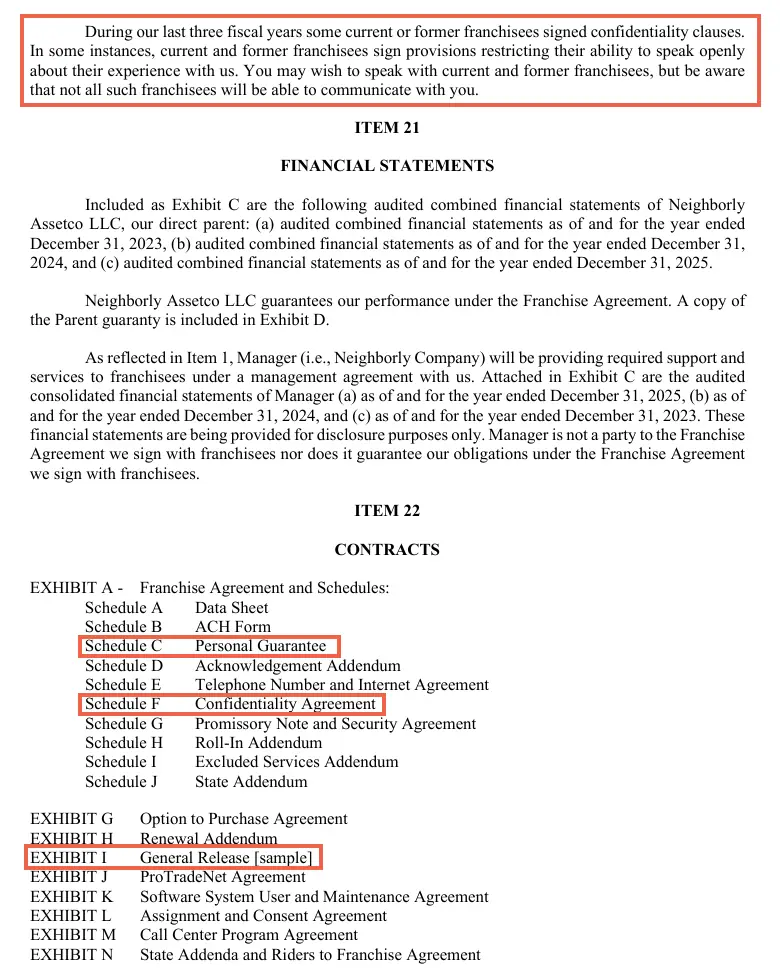
Scope drives the bill more than anything else, and the Item 22 list shows the scope. On a single page, the Dryer Vent Wizard FDD issued April 1, 2026 lists a franchise agreement with 10 schedules (A to J) and Exhibits G to N, including a personal guarantee, a confidentiality agreement and a sample general release. Under Cal. BPC 6148(b), a California client who asks for a bill generally gets it within 10 days.
How do you check a franchise attorney’s license?
Look the lawyer up in the licensing database of the state where you will operate, then read the status and any discipline entries yourself. In the 3 states below the lookup is run by the state bar or the state supreme court’s regulator, and it confirms a license, not franchise experience. Since 91.1% of US franchisors naming one governing-law state pick their home state, ask who covers that state’s law too.
- Get name and bar number from the engagement letter, plus every state where the lawyer says they are admitted.
- Search the state lookup listed in the table below for each of those states.
- Read license status: California publishes a Notice of License Status Changes dashboard, and the Illinois ARDC lists lawyers whose status changed in the last 30 days, 90 days or year.
- Read public discipline entries and orders linked from the record.
- Ask about franchise experience: how many franchise agreements they reviewed for buyers in the last 12 months, and whether they represent this franchisor.
| State | Official lookup | Run by | What it offers (checked October 2026) |
|---|---|---|---|
| California | Attorney Search | The State Bar of California | Search by name or bar number; advanced search for certified specialists; license status changes dashboard |
| California | Find a Certified Specialist | The State Bar of California | Franchise and Distribution Law is a certified specialty area |
| Illinois | Lawyer Search | Attorney Registration and Disciplinary Commission of the Supreme Court of Illinois | Registration and discipline information; search of lawyers not currently authorized to practice |
| Texas | Find a Lawyer | State Bar of Texas | Public menu lists Find a Lawyer, an Ineligible Attorney List and File a Grievance |
A state certification is the closest public test of franchise focus: the State Bar of California’s Board of Legal Specialization lists Franchise and Distribution Law among 12 specialty areas, with Privacy Law launching January 1, 2027. A lawyer without it can still be experienced, which is why step 5 asks for a count, not a claim.
Can a franchise attorney negotiate the franchise agreement?
Sometimes, inside limits the documents themselves show. A franchisor that rewrites the agreement on its own must hand you the revised text 7 calendar days before you sign (16 CFR 436.2(b)), and state pages already rewrite some terms: 98.5% of the 259 FDDs carry Minnesota addenda. Ask your franchise attorney which of these four limits applies to your deal.
- Renewal resets the deal. 99.6% of renewable agreements require the then-current agreement, so negotiated terms can lapse after the first term, commonly 10 years (65.6% of the 259 FDDs).
- Guarantee caps exist but are rare. 3 of 247 guarantee forms cap liability, at $250,000 in two forms and $1,000,000 per guarantor in one, so a cap request asks for an exception.
- Transfer relief is common for your own company. 66.8% of FDDs with a transfer fee waive, reduce or limit it to costs for a transfer to your own entity, which matters if you sign personally and form a company later.
- Territory protection can be conditional. 30.5% of protected territories depend on a minimum performance requirement, so the quota is a negotiating point as much as the map.
What do franchise attorney guides get wrong?
We compared the claims in top-ranking franchise attorney guides, read in October 2026, with the primary sources. Five points recur: fee ranges with no survey behind them, call-the-owners advice that skips gag clauses, “exclusive territory” language, FDD-first framing that skips the attached agreements, and any-business-lawyer advice. The table below states each claim neutrally beside the primary source.
| What several guides say | What the primary source shows | Source |
|---|---|---|
| A flat fee range is “typical” for an FDD review | Ranges come from firm marketing; no fee survey we opened publishes one. California and New York set written-fee rules at $1,000 and $3,000 | Cal. BPC 6148; 22 NYCRR 1215.2 |
| Call former franchisees to validate the system | 53.3% of 259 FDDs disclose signed confidentiality clauses, and Item 20 warns some owners cannot talk | 16 CFR 436.5(t)(7); Minnesota CARDS FDDs |
| Your attorney will secure an exclusive territory | 85.3% of FDDs print “You will not receive an exclusive territory”; 53.3% of protected areas can be cut | 16 CFR 436.5(l)(5)(i); Minnesota CARDS FDDs |
| The attorney reviews the FDD | The binding terms sit in the Item 22 agreements; Item 17 is a summary table with 23 rows | 16 CFR 436.5(q) and (v) |
| Any business lawyer will do | The FTC says to choose a lawyer experienced in franchise matters; California certifies Franchise and Distribution Law | FTC guide (2020); State Bar of California |
Do you need a franchise attorney for your deal?
Most buyers signing a unit agreement face at least one of the triggers below, since 97.3% of the 259 FDDs carry a personal guarantee. Use the table to decide what the review must cover; the flowchart shows the same four checks in signing order. This page is general information, not legal, financial or investment advice.
| If | Then | Why |
|---|---|---|
| FDD in hand for fewer than 14 calendar days | Wait: do not sign or pay | 16 CFR 436.2(a) |
| Agreement changed by the franchisor on its own | Wait 7 calendar days with the revised text | 16 CFR 436.2(b) |
| Personal guarantee or spouse signature required (97.3% and 35.5% of FDDs) | Attorney reads the guarantee form, including survival after a sale (45.2% are silent) | Personal guarantee study |
| Item 20 gag clause or Item 3 franchisee suits (53.3% and 25.5%) | Attorney reads Items 3 and 20 and the FTC’s July 12, 2024 statement | 16 CFR 436.5(c) and (t)(7) |
| You operate in one of 18 states or Puerto Rico with a relationship law | Ask how it changes cause, notice and cure for termination | Relationship laws tracker |
| You are buying an existing unit | Ask who pays the transfer fee (median $10,000) and any buyer training fee (29.3% charge one) | Transfer fee fact sheet |
| None of the above apply | Sign only after the review is done | FTC guide (2020) |
For where the attorney review sits among the 8 steps of a purchase, from budget to signing, see our guide to buying a franchise.
How we compiled this
On October 26, 2026 we read 16 CFR 436.2 and 436.5, the FTC’s buyer guide and 2024 policy statement, Cal. BPC 6148, 22 NYCRR Part 1215 and the California, Illinois and Texas lawyer lookups. Clause shares come from 8 of our studies of 259 Minnesota CARDS FDDs issued 2025 to 2026. We surveyed no lawyers and name none; Florida, New York and Pennsylvania lookups blocked our requests, so they are left out.
Frequently asked questions
Do I need a lawyer to buy a franchise?
No federal rule requires one, but the FTC’s Consumer’s Guide to Buying a Franchise (September 2020) tells buyers to consider talking to a lawyer and an accountant, and to choose a lawyer experienced in franchise matters. Since 97.3% of 259 FDDs issued 2025 to 2026 require or provide for a personal guarantee, most buyers take on personal liability, which is the first clause worth a lawyer’s read.
How much does a franchise attorney charge to review an FDD?
Each lawyer sets a flat fee, an hourly rate or a limited-scope arrangement, and no state bar survey we opened reports a price for franchise review. California requires a written fee contract once total expense will foreseeably exceed $1,000 (Bus. and Prof. Code 6148), and New York requires an engagement letter unless the fee is expected to be under $3,000. Ask which Item 22 documents the fee covers.
Is a franchise lawyer the same as a franchise attorney?
Yes. Both mean a licensed lawyer who works on franchise matters, and the title alone says nothing about focus. The State Bar of California certifies Franchise and Distribution Law as one of 12 listed specialty areas, and its Attorney Search checks a lawyer by name or bar number. Elsewhere, ask how many buyer-side franchise agreements the lawyer reviewed in the last 12 months.
How long do I have to get the FDD reviewed?
At least 14 calendar days. Under 16 CFR 436.2(a), the franchisor must give you its FDD at least 14 calendar days before you sign a binding agreement or pay anything, and under 436.2(b) it must give you an agreement it changed unilaterally and materially 7 calendar days before you sign it. Hire the attorney on day 0, not when signature pages arrive.
Does a franchise attorney check lawsuits against the franchisor?
They should. Item 3 of the FDD must list certain actions from the 10 years before its issuance date (16 CFR 436.5(c)), and 57.1% of 259 FDDs issued 2025 to 2026 list at least one. State orders are separate: our tracker counted 562 franchise enforcement orders in 8 states from 2015 to October 14, 2026, and 74.0% involved an unregistered offer or sale.
Can former franchisees refuse to talk to me?
Some can. 53.3% of 259 FDDs issued 2025 to 2026 disclose that franchisees signed confidentiality clauses in the last three fiscal years, and Item 20 must then warn that not all owners will be able to communicate with you. The FTC’s July 12, 2024 policy statement says clauses that stop franchisees reporting potential law violations to the government are unfair.
Sources
- 16 CFR 436.2, Obligation to furnish documents, U.S. Government Publishing Office, CFR 2026 edition. Accessed October 26, 2026.
- 16 CFR 436.5, Disclosure items, U.S. Government Publishing Office, CFR 2026 edition. Accessed October 26, 2026.
- A Consumer’s Guide to Buying a Franchise, Federal Trade Commission, September 2020. Accessed October 26, 2026.
- Policy Statement on Franchisors’ Use of Contract Provisions, Including Non-Disparagement, Goodwill, and Confidentiality Clauses, Federal Trade Commission, July 12, 2024. Accessed October 26, 2026.
- FTC Takes Action to Ensure Franchisees’ Complaints are Heard and to Protect Against Illegal Fees, Federal Trade Commission, July 12, 2024. Accessed October 26, 2026.
- Business and Professions Code 6148, California Legislative Information. Accessed October 26, 2026.
- 22 NYCRR 1215.1 and 1215.2, New York court rules as reproduced by Cornell Legal Information Institute. Accessed October 26, 2026.
- Attorney Search and Legal Specialty Areas, The State Bar of California. Accessed October 26, 2026.
- Lawyer Search, Attorney Registration and Disciplinary Commission of the Supreme Court of Illinois. Accessed October 26, 2026.
- State Bar of Texas public menu (Find a Lawyer, Ineligible Attorney List). Accessed October 26, 2026.
- Minnesota CARDS franchise registrations (259 FDDs, issued 2025 to 2026) and Dryer Vent Wizard FDD issued April 1, 2026, Minnesota Department of Commerce. Accessed October 26, 2026.
- Code of Virginia 13.1-563 and Minnesota Statutes 80C.17, as cited in our franchise agreement terms study (October 2026).
- State order lists of the Minnesota Department of Commerce, Washington DFI and California DFPI, as read for our enforcement tracker on October 14, 2026.