Franchise examples include Club Pilates and Jiffy Lube (business format), Ace Hardware and Cornwell tool trucks (product distribution), Coca-Cola bottlers (manufacturing), Rodeway Inn hotels (conversion) and Zenshi sushi counters inside grocery stores (host site).
Under the FTC Franchise Rule, 16 CFR 436.1(h), a franchise is any deal that combines a trademark licence, significant control or assistance, and a required payment. The 17 systems below are sorted by type, and each one carries the FDD item, unit count or federal statute that shows why it belongs in that type.
Key takeaways
- Club Pilates reported 1,179 franchised studios and no company-owned studios at the end of 2025, a plain business-format example (Club Pilates FDD, issued April 17, 2026, Item 20).
- Only 6 of 259 recent FDDs charge no royalty at all, among them Ace Hardware and Cornwell, two product distribution franchises paid through what owners buy (Minnesota CARDS filings, 2025 to 2026).
- Gas stations, car dealers and soft drink bottlers are franchises under their own federal statutes: 15 U.S.C. 2801, 15 U.S.C. 1221 and 15 U.S.C. 3501.
- Conversion franchising is concentrated in hotels: 16 of 18 lodging FDDs offer a conversion program, against 1 of 27 food and beverage FDDs (Minnesota CARDS filings, 2025 to 2026).
- A fractional franchise is a legal test, not a part-time franchise: more than 2 years in the same type of business and 20% or less of first-year sales (16 CFR 436.1(g)).
| Key number | What it measures | Source |
|---|---|---|
| 832,521 | US franchise establishments, 2025 estimate | IFA and FRANdata, 2026 Franchising Economic Outlook, p. 9 |
| 259 | FDDs in our dataset, issued January 2025 to August 2026 | Minnesota CARDS |
| 6 of 259 | FDDs that charge no royalty | Minnesota CARDS, Item 6 |
| 29.7% | FDDs with a conversion program (77 of 259) | Minnesota CARDS, Items 5 and 7 |
| 48.6% | FDDs offering an area development agreement (126 of 259) | Minnesota CARDS, Items 1, 5 and 12 |
| 3,572 | Zenshi counters franchised inside host stores, year to March 31, 2025 | Zenshi FDD, Item 20 |
The establishment count and its 2026 projection are tracked in our franchise statistics fact sheet. Every FDD figure on this page can be checked against the 259 filings in our free franchise disclosure document database.
What are the main types of franchises, with examples?
Franchise examples fall into five working types: business format, product distribution, manufacturing, conversion and host site, with multi-unit structures such as area development layered on top of any of them. The table lists 17 real systems, the franchised units each reported in Item 20 of its latest Minnesota-filed FDD, and how the franchisor is paid, which is the fastest way to tell the five types apart.
| Type | Example | What the franchisee runs | Franchised units (Item 20) | How the franchisor is paid | Source |
|---|---|---|---|---|---|
| Business format, storefront | Club Pilates | Reformer Pilates studio | 1,179 (end 2025) | 8% of gross sales (Item 6) | Club Pilates FDD, issued Apr 17, 2026 |
| Business format, auto service | Jiffy Lube | Oil change and light repair center | 1,765 (end 2025) | Percentage royalty, tiered (Item 6) | Jiffy Lube FDD, issued Mar 27, 2026 |
| Business format, mobile | Poop 911 | Residential pet waste removal route | 254 (end 2024) | 25% of gross revenues (Item 6) | Poop 911 FDD, issued May 21, 2025 |
| Business format, in-home | Visiting Angels | Non-medical in-home care agency | 541 (end 2025) | Tiered percentage of gross revenues (Item 6) | Visiting Angels FDD, issued Apr 20, 2026 |
| Professional service | Focus CFO Group | Client development for fractional CFOs, as an Area President | 65 (end 2025) | No royalty; franchisee receives a share of client revenue (Item 6) | Focus CFO FDD, issued Apr 14, 2026 |
| Product distribution, cooperative | Ace Hardware | Hardware store in a retailer-owned cooperative | 4,885 (end 2024) | No royalty line; purchases through the cooperative (Item 6) | Ace Hardware FDD, issued Mar 27, 2025 |
| Product distribution, mobile | Cornwell | Tool dealership run from a truck | 793 (end 2024) | No franchise fee or royalty; dealer buys inventory (Items 1 and 6) | Cornwell FDD, issued Apr 1, 2025 |
| Product distribution, food | The Human Bean | Drive-through espresso outlet | 176 (end 2025) | No royalty; franchisor sells coffee and supplies (Item 6) | The Human Bean FDD, issued Feb 25, 2026 |
The first 8 rows are business format and product distribution systems; the next 9 cover manufacturing, conversion, host-site and master franchise examples.
| Type | Example | What the franchisee runs | Franchised units (Item 20) | How the franchisor is paid | Source |
|---|---|---|---|---|---|
| Manufacturing (bottler) | Coca-Cola Consolidated | Bottling and distribution in 14 states and DC | Not an FDD system | Buys concentrate under an incidence-based pricing agreement | Form 10-K for FY2025 |
| Conversion, auto repair | Fix Auto | Collision shop, often an existing one | 212 (end 2024) | 3% of gross sales with a monthly minimum (Item 6) | Fix Auto FDD, issued Jun 13, 2025 |
| Conversion, hotel | Rodeway Inn (Choice Hotels) | Existing economy hotel, rebranded | 432 (end 2025) | 5.0% of gross room revenues (Item 6) | Rodeway Inn FDD, issued Apr 1, 2026 |
| Conversion, real estate | Sotheby’s International Realty | Existing brokerage, rebranded | 672 (end 2025) | 6% of gross revenue per transaction (Item 6) | Sotheby’s International Realty FDD, issued Mar 30, 2026 |
| Hotel, new build or conversion | Comfort Inn (Choice Hotels) | Midscale hotel under Comfort Inn, Comfort Inn and Suites or Comfort Suites | 1,643 (end 2025) | 6.0% of gross room revenues (Item 6) | Comfort Inn FDD, issued Apr 1, 2026 |
| Host site, grocery | Zenshi | Sushi counter inside a store someone else owns | 3,572 (FY to Mar 31, 2025) | Host store collects sales and pays out the shares (Item 6) | Zenshi FDD, issued Jul 22, 2025 |
| Host site, big-box | Da Vi Nails | Nail salon inside a Walmart store, on a sub-lease | 387 (end 2024) | Flat monthly franchise fee (Item 6) | Da Vi Nails FDD, issued Apr 14, 2025 |
| Host site, travel center | Hardee’s (travel center FDD) | Restaurant in a travel center or gas and convenience store | 1,369 Hardee’s restaurants, all formats (FY2025) | 4% to 5% of gross sales (Item 6) | Hardee’s NT FDD, issued May 24, 2025 |
| Master franchise | ActionCOACH (Buji, LLC) | Business coaching practice sold by a regional master licensee | 25 in this master licensee’s region only (end 2025) | Fees paid to the master licensee (cover page) | ActionCOACH Minnesota and Wisconsin FDD, issued May 1, 2026 |
Unit counts are franchised outlets only, as of each FDD’s latest year end. Company-owned outlets are left out, so Jiffy Lube’s 318 company-owned centers and Ace Hardware’s 259 company-owned stores do not appear in the column.
What does a business-format franchise look like in practice?
A business-format franchise sells the whole operating system: brand, methods, training and ongoing support, paid for with a royalty on sales. It is the type behind most household names. In our 259-FDD sample, 239 franchisors charge a percentage-based royalty in some form (percentage, greater-of or tiered), the signature of this model, and the examples below show how far the format stretches beyond storefronts.
Storefront examples
Club Pilates grew from 753 franchised studios at the start of 2023 to 1,179 at the end of 2025 and had no company-owned studios left, according to Item 20 of its Club Pilates FDD, issued April 17, 2026. Jiffy Lube ran 1,765 franchised and 318 company-owned centers at the end of 2025, per Item 20 of its Jiffy Lube FDD, issued March 27, 2026.
Mobile and home-based examples
Some guides call these job franchises. Poop 911 franchises a residential pet waste removal route and reported 254 franchised outlets at the end of 2024; its Item 6 sets the royalty at 25% of gross revenues, deducted from customer payments it collects (Poop 911 FDD, issued May 21, 2025).
Visiting Angels, a non-medical in-home care agency, reported 541 franchised outlets and 0 company-owned at the end of 2025 (Visiting Angels FDD, issued April 20, 2026).
Professional-service examples
Focus CFO Group franchises a business providing “fractional Chief Financial Officer services as an Area President”, working to generate new clients within a coordinated client development system (cover page). Its Item 6 lists the royalty as “None”; instead, the franchisee receives a percentage of revenue collected from clients.
Item 20 shows 126 franchised outlets at the start of 2023 and 65 at the end of 2025, after the company stopped offering franchises to individuals working as CFOs on April 1, 2023 (Focus CFO FDD, issued April 14, 2026). The word fractional here describes the CFO’s part-time role, not the legal fractional franchise defined in 16 CFR 436.1(g).
How does a product distribution franchise differ?
In a product distribution franchise, the franchisee sells the franchisor’s branded goods, and the franchisor is paid mainly through what the franchisee buys rather than through a royalty on sales. That is rare in modern FDDs: 6 of 259 filings issued in 2025 and 2026 list no royalty at all, and 3 of those 6 are the examples below.
- Ace Hardware. Ace says it became a retailer-owned cooperative in 1976 (Item 1). Its Item 6 has no royalty line; it lists a $100 low-volume service charge per bi-weekly billing period if annual purchases fall below $200,000. Item 20 shows 4,885 franchised stores at the end of 2024 (Ace Hardware FDD, issued March 27, 2025).
- Cornwell. Cornwell has made mechanics’ hand tools since 1919 and “charges no initial franchise fee or royalty fee” (Item 1). A new dealer buys an initial inventory of at least $60,000 at dealer net prices and must keep average weekly purchases at 90% or more of the national dealer average (Items 1 and 8). It reported 793 franchised dealers at the end of 2024 (Cornwell FDD, issued April 1, 2025).
- The Human Bean. “We do not charge a royalty fee. We derive revenue from the sale of coffee and other supplies” (Item 6). It reported 176 franchised outlets at the end of 2025 (The Human Bean FDD, issued February 25, 2026).
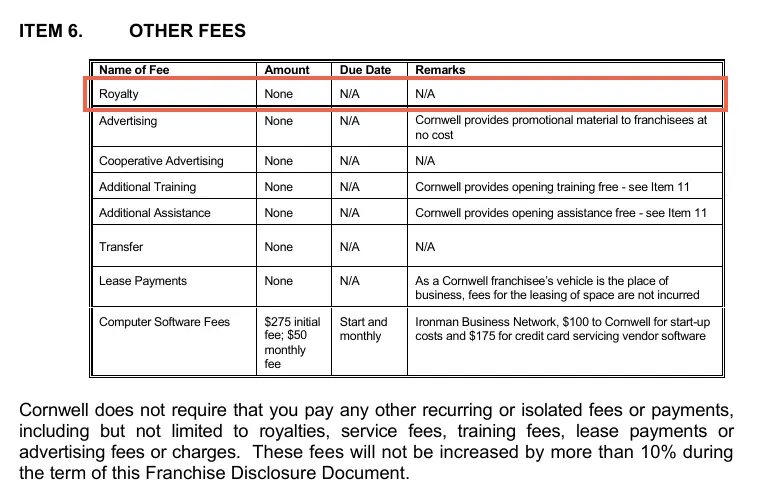
Royalty structure is the quickest tell. The table counts every royalty type in our 259-FDD dataset, published in full in our franchise royalty rates report.
| Royalty structure (Item 6) | FDDs | Share of 259 | Typical type |
|---|---|---|---|
| Percentage of sales | 116 | 44.8% | Business format |
| Greater of a percentage or a minimum | 86 | 33.2% | Business format |
| Tiered percentage | 37 | 14.3% | Business format |
| Other (revenue share, per-room fee) | 9 | 3.5% | Host site, professional service, hotels |
| No royalty | 6 | 2.3% | Product distribution |
| Flat fee | 5 | 1.9% | Host site, small service brands |
6 of 259 FDDs issued 2025 to 2026 charge no royalty, the mark of product distribution (Minnesota CARDS, Item 6, accessed October 2026).
Which franchises have their own federal law?
Gas stations, car dealerships and soft drink bottlers are the classic product and manufacturing franchise examples because Congress wrote a separate definition of franchise for each. The FTC Franchise Rule covers most other franchises and exempts fuel franchises already covered by the Petroleum Marketing Practices Act under 16 CFR 436.8(a)(4).
| Franchise example | Law | What the law calls a franchise | Source |
|---|---|---|---|
| Most franchises, from Club Pilates to Comfort Inn | FTC Franchise Rule | A continuing relationship with a trademark, significant control or assistance, and a required payment | 16 CFR 436.1(h) |
| Branded gas station | Petroleum Marketing Practices Act | A contract under which a refiner or distributor lets a retailer or distributor use a refiner’s trademark to sell motor fuel | 15 U.S.C. 2801(1) |
| New-car dealership | Automobile Dealers’ Day in Court Act | The written agreement between an automobile manufacturer engaged in commerce and an automobile dealer | 15 U.S.C. 1221(b) |
| Soft drink bottler | Soft Drink Interbrand Competition Act, 1980 | Trademark licences giving the sole right to manufacture, distribute and sell a soft drink in a defined area stay lawful if the product faces substantial and effective competition | 15 U.S.C. 3501 |
Coca-Cola Consolidated shows the manufacturing model in its Form 10-K for fiscal 2025. It calls itself “the largest Coca-Cola bottler in the United States”, serves about 60 million consumers in 14 states and the District of Columbia, makes Coca-Cola trademarked drinks under a Regional Manufacturing Agreement dated March 31, 2017, and buys concentrate at prices set by an incidence-based pricing agreement with The Coca-Cola Company.
What is a conversion franchise, and which sectors use it?
A conversion franchise rebrands a business that already operates, often with a fee cut: where an FDD states one, the median cut is 50% of the start-up fee. 77 of 259 FDDs (29.7%) set out conversion terms, but the share swings from 88.9% in lodging to 3.7% in food and beverage. Fee cuts, royalty ramps and the conditions behind them are in our conversion franchising report.
- Fix Auto: a shop “may be a conversion of an existing automobile repair facility” (Item 1); 212 franchised shops at the end of 2024 (Fix Auto FDD, issued June 13, 2025).
- Rodeway Inn: converting an existing hotel is estimated at $108,795 to $702,495, assuming 57 guestrooms (Item 7); 432 franchised hotels at the end of 2025, down from 503 at the start of 2023 (Rodeway Inn FDD, issued April 1, 2026).
- Sotheby’s International Realty: “Usually, franchises are granted to owners of existing real estate brokerage businesses” (Item 1); 672 franchised offices at the end of 2025 (Sotheby’s International Realty FDD, issued March 30, 2026).
- Jiffy Lube: the initial franchise fee for a converted center is $17,500 (Item 5) (Jiffy Lube FDD, issued March 27, 2026).
| Sector | FDDs with a conversion program | Share |
|---|---|---|
| Lodging | 16 of 18 | 88.9% |
| Automotive | 12 of 17 | 70.6% |
| Senior and in-home care | 9 of 18 | 50.0% |
| Retail | 8 of 18 | 44.4% |
| Home services | 7 of 18 | 38.9% |
| Health and wellness | 6 of 17 | 35.3% |
| Business services | 5 of 18 | 27.8% |
| Cleaning and restoration | 5 of 18 | 27.8% |
| Fitness | 2 of 18 | 11.1% |
| Personal services and beauty | 2 of 18 | 11.1% |
| Pet services | 2 of 18 | 11.1% |
| Education and children | 1 of 18 | 5.6% |
| Entertainment and recreation | 1 of 18 | 5.6% |
| Food and beverage | 1 of 27 | 3.7% |
Conversion franchising runs from 16 of 18 lodging FDDs to 1 of 27 food and beverage FDDs (Minnesota CARDS, 2025 to 2026, accessed October 2026).
What do franchises inside another business look like?
Host-site franchises, sometimes called nontraditional or store-within-a-store units, run inside a location someone else controls: a grocery store, a Walmart or a highway travel center. They file full FDDs like any other franchise. The FTC Rule separately exempts a leased department, where the seller buys no goods from the host retailer (16 CFR 436.1(l) and 436.8(a)(3)).
| Example | Host location | Franchised units (Item 20) | Source |
|---|---|---|---|
| Zenshi counters | Grocery store, retail center or other location someone else owns | 3,572 (FY to Mar 31, 2025) | Zenshi FDD, issued Jul 22, 2025, cover and Item 20 |
| Da Vi Nails | Usually inside Walmart stores; the franchisor obtains the sub-lease | 387 (end 2024) | Da Vi Nails FDD, issued Apr 14, 2025, Items 1 and 20 |
| Hardee’s travel center units | Travel center or gas and convenience location | 1,369 Hardee’s restaurants systemwide, all formats (FY2025); travel center units not split out | Hardee’s NT FDD, issued May 24, 2025, cover and Item 20 |
Zenshi’s Item 20 adds a caution: many AFC counters were rebranded to Zenshi in the fiscal year ending March 31, 2024, so the FDD itself calls the March 31, 2024 count of 2,217 franchised counters abnormally high.
What is a fractional franchise, really?
A fractional franchise is a legal category, not a business model. Under 16 CFR 436.1(g) it is a relationship where the franchisee or its officers have more than 2 years of experience in the same type of business, and the parties reasonably expect sales from the relationship to be 20% or less of the franchisee’s total sales in the first year. Such deals are exempt from FDD disclosure under 16 CFR 436.8(a)(2).
| What several guides say | What the primary source says | Source |
|---|---|---|
| A fractional franchise is a part-time or low-hours franchise | Hours are irrelevant; the test is prior experience of more than 2 years plus a 20% first-year sales ceiling | 16 CFR 436.1(g) |
| A fractional franchise sells fractional executive services, such as part-time CFOs | Focus CFO files a full FDD for its fractional CFO business; the label describes the service, not an exemption | Focus CFO FDD, issued Apr 14, 2026, cover |
| A fractional franchise means owning a fraction of a unit with other investors | Shared ownership is an investment structure; the FTC definition says nothing about ownership shares | 16 CFR 436.1(g) |
| Any add-on line in an existing store is exempt | Only if both tests are met when the relationship is created | 16 CFR 436.1(g) |
The 20% test is simple arithmetic on expected first-year sales. The illustration below uses round numbers per $100 of the franchisee’s total first-year sales, not any brand’s figures.
| Step | Input | Result |
|---|---|---|
| 1. Years the owner has run the same type of business | 6 years | Passes the more-than-2-years test |
| 2. Expected first-year sales from the franchised line | $15 of every $100 | 15% |
| 3. Compare with the ceiling | 15% vs 20% | Under the ceiling: fractional |
| 4. Same owner, line expected at $25 of every $100 | 25% vs 20% | Over the ceiling: full FDD rules apply |
How do area development and master franchises work?
Area development and master franchising are ownership structures, not separate business types: one party commits to open or sell several units of the same brand in a territory. In our dataset, 126 of 259 FDDs (48.6%) offer an area development agreement, while only 4 (1.5%) offer subfranchising inside the US. Our area development agreement study covers schedules, discounts and default remedies.
| Example | Minimum units | Development fee arithmetic | Source |
|---|---|---|---|
| Club Pilates Multi-Unit Agreement | 3 studios | 2 x $10,000 = $20,000, applied to later studio fees | Club Pilates FDD, issued Apr 17, 2026, Item 5 |
| Hardee’s travel center Development Agreement | 3 restaurants | 3 x $10,000 = $30,000 at the minimum, not refundable | Hardee’s NT FDD, issued May 24, 2025, Item 5 |
| Fix Auto Development Agreement | 10 shops | 10 x $10,000 = $100,000, credited against each shop’s fee | Fix Auto FDD, issued Jun 13, 2025, Items 1, 5 and 7 |
A master franchise adds a layer between the brand and the buyer. ActionCOACH’s Minnesota and Wisconsin FDD names Buji, LLC as “Master Licensee (subfranchisor)”, and $62,500 of the initial investment is paid to the master licensee for the initial franchise fee, franchisee training fee and initial reimbursable marketing fee. Its Item 20 counts only the region it supports: 25 franchised outlets at the end of 2025, excluding territories of other master licensees (ActionCOACH FDD, issued May 1, 2026, cover page and Item 20).
| Structure offered in the FDD | FDDs | Share of 259 |
|---|---|---|
| Area development agreement | 126 | 48.6% |
| Conversion program | 77 | 29.7% |
| Subfranchising (master franchise), any country | 23 | 8.9% |
| Area representative | 21 | 8.1% |
| No royalty (product distribution model) | 6 | 2.3% |
Area development agreements appear in 126 of 259 FDDs (48.6%); subfranchising in 23 (8.9%) (Minnesota CARDS, 2025 to 2026, accessed October 2026).
Which type of franchise fits which buyer?
The right type follows from what you already own and how you want the franchisor paid. A buyer with an operating business has conversion and fractional routes that a first-time buyer does not, and product distribution swaps a royalty for purchase minimums, such as Cornwell’s 90% of the national dealer average. The table and flowchart use the same 5 questions in the same order.
| If this describes you | Look at | Check in the FDD or law |
|---|---|---|
| No trademark licence, no significant control or help, or no required payment | Not a franchise under the FTC Rule | 16 CFR 436.1(h) |
| You want to sell motor fuel under a refiner’s trademark | PMPA fuel franchise (gas station) | 15 U.S.C. 2801; 16 CFR 436.8(a)(4) |
| You have run the same type of business for 2+ years and the new line is 20% or less of first-year sales | Fractional franchise, exempt from FDD rule | 16 CFR 436.1(g) and 436.8(a)(2) |
| You prefer purchase minimums to a royalty on sales | Product distribution: Ace Hardware, Cornwell | Item 6 royalty line, Item 8 purchase rules |
| You already run an independent shop, hotel or office | Conversion franchise: Fix Auto, Rodeway Inn | Items 1, 5 and 7 conversion terms |
| You are starting from scratch | Business format franchise: Club Pilates, Jiffy Lube, Visiting Angels | Items 6, 7 and 20 |
| You want to open 3 or more units | Area development agreement | Items 5, 12 and 17 |
Once the type is clear, budget is the next filter: Item 7 sets the total opening cost, which our franchise costs guide breaks down. Our franchise ideas page then narrows the field by hours, industry and lifestyle. The full purchase sequence, including the 14 calendar days you must hold the FDD before signing, is in our step-by-step guide to buying a franchise. A consultant can help shortlist brands across these 5 types, as our explainer on what a franchise consultant does sets out.
This page is general information, not legal, financial or investment advice. Whether a specific deal is a franchise, a fractional franchise or an exempt arrangement under 16 CFR 436.8 is a question to put to a franchise attorney with the contract in hand.
How we compiled this
We read 16 Franchise Disclosure Documents filed with the Minnesota Department of Commerce (CARDS) and issued between March 2025 and May 2026, one Form 10-K from SEC EDGAR, 16 CFR Part 436 on eCFR and 3 sections of Title 15 of the US Code, all accessed in October 2026. Shares across 259 FDDs come from our published datasets built from the same CARDS filings. We excluded Item 19 financial performance data, franchisee names and any ranking; unit counts are franchised outlets from each FDD’s Item 20 Table 1.
Frequently asked questions
What are 5 examples of a franchise?
Five franchise examples from different types: Club Pilates (business format, 1,179 franchised studios at the end of 2025), Ace Hardware (product distribution cooperative, 4,885 franchised stores at the end of 2024), a Coca-Cola bottler such as Coca-Cola Consolidated (manufacturing), Rodeway Inn (conversion hotel, 432 franchised) and Zenshi sushi counters inside grocery stores (host site). Each figure comes from Item 20 of the brand’s FDD or a Form 10-K.
What are the main types of franchises?
Five working types cover most franchise examples: business format (brand plus full system, paid by royalty), product distribution (franchisor paid through goods you buy), manufacturing (bottlers licensed to make the product), conversion (an existing business rebrands) and host site (a unit inside a store someone else owns). Area development and master franchising are ownership structures layered on top; 126 of 259 recent FDDs offer area development.
Is a car dealership a franchise?
Yes. Federal law defines a car dealer franchise as the written agreement between an automobile manufacturer engaged in commerce and an automobile dealer (15 U.S.C. 1221, the Automobile Dealers’ Day in Court Act). States add their own motor vehicle dealer statutes. It is a product distribution franchise: the dealer sells the manufacturer’s vehicles under its trademark, rather than paying a royalty on a business format.
Is a gas station a franchise?
A branded gas station usually is. The Petroleum Marketing Practices Act, 15 U.S.C. 2801, defines a franchise as a contract letting a retailer or distributor use a refiner’s trademark to sell motor fuel. Because the PMPA covers these deals, the FTC Franchise Rule exempts them from FDD disclosure under 16 CFR 436.8(a)(4). Food or store franchises inside the station, such as Hardee’s travel center units, file their own FDDs.
What is a fractional franchise?
Under 16 CFR 436.1(g), a fractional franchise is one where the franchisee or its officers have more than 2 years of experience in the same type of business, and expected sales from the franchise are 20% or less of total first-year sales. Such deals are exempt from FTC disclosure under 436.8(a)(2). The term does not mean a part-time franchise or a fractional CFO business.
Is Ace Hardware a franchise?
Yes. Ace Hardware files a Franchise Disclosure Document, and its FDD issued March 27, 2025 describes a retailer-owned cooperative formed in 1976. Item 6 has no royalty line; instead it lists charges such as a $100 bi-weekly low-volume fee when annual purchases fall below $200,000. Item 20 reports 4,885 franchised stores and 259 company-owned stores at the end of 2024.
What is an example of a conversion franchise?
Fix Auto, Rodeway Inn and Sotheby’s International Realty are conversion franchise examples. Fix Auto shops may convert an existing repair facility, Rodeway Inn estimates $108,795 to $702,495 to convert a 57-room hotel (Item 7), and Sotheby’s says franchises usually go to owners of existing brokerages. Across 259 FDDs, 77 (29.7%) offer conversion terms, led by lodging at 16 of 18.
Sources
Laws, filings and industry data
- 16 CFR Part 436, Disclosure Requirements and Prohibitions Concerning Franchising, eCFR, Federal Trade Commission, accessed October 20, 2026.
- 15 U.S.C. 2801, Petroleum Marketing Practices Act definitions, Legal Information Institute, Cornell Law School, accessed October 20, 2026.
- 15 U.S.C. 1221, Automobile Dealers’ Day in Court Act definitions, Legal Information Institute, Cornell Law School, accessed October 20, 2026.
- 15 U.S.C. 3501, Soft Drink Interbrand Competition Act, Legal Information Institute, Cornell Law School, accessed October 20, 2026.
- Coca-Cola Consolidated, Inc. Form 10-K for fiscal year 2025, US Securities and Exchange Commission, EDGAR, accessed October 20, 2026.
- 2026 Franchising Economic Outlook, FRANdata for the International Franchise Association, accessed October 20, 2026.
- Franchise registrations search (CARDS), Minnesota Department of Commerce, accessed October 20, 2026.
Franchise Disclosure Documents
- Club Pilates Franchise Disclosure Document, issued April 17, 2026, Club Pilates Franchise SPV, LLC, via Minnesota CARDS, accessed October 20, 2026.
- Jiffy Lube Franchise Disclosure Document, issued March 27, 2026, Jiffy Lube, LLC, via Minnesota CARDS, accessed October 20, 2026.
- Poop 911 Franchise Disclosure Document, issued May 21, 2025, Hounds Mounds, Inc., via Minnesota CARDS, accessed October 20, 2026.
- Visiting Angels Franchise Disclosure Document, issued April 20, 2026, Living Assistance Services, Inc., via Minnesota CARDS, accessed October 20, 2026.
- Focus CFO Group, LLC Franchise Disclosure Document, issued April 14, 2026, Focus CFO Group, LLC, via Minnesota CARDS, accessed October 20, 2026.
- Ace Hardware Franchise Disclosure Document, issued March 27, 2025, Ace Hardware Corporation, via Minnesota CARDS, accessed October 20, 2026.
- Cornwell Franchise Disclosure Document, issued April 1, 2025, Cornwell Quality Tools Company, via Minnesota CARDS, accessed October 20, 2026.
- The Human Bean Franchise Disclosure Document, issued February 25, 2026, Casey Hawkins, Inc., via Minnesota CARDS, accessed October 20, 2026.
- Fix Auto Franchise Disclosure Document, issued June 13, 2025, FUSA Franchisor SPV LLC, via Minnesota CARDS, accessed October 20, 2026.
- Rodeway Inn Franchise Disclosure Document, issued April 1, 2026, Choice Hotels International, Inc., via Minnesota CARDS, accessed October 20, 2026.
- Comfort Inn Franchise Disclosure Document, issued April 1, 2026, Choice Hotels International, Inc., via Minnesota CARDS, accessed October 20, 2026.
- Sotheby’s International Realty Franchise Disclosure Document, issued March 30, 2026, Sotheby’s International Realty Affiliates LLC, via Minnesota CARDS, accessed October 20, 2026.
- Zenshi Franchise Disclosure Document, issued July 22, 2025, Advanced Fresh Concepts Franchise Corp., via Minnesota CARDS, accessed October 20, 2026.
- Da Vi Nails Franchise Disclosure Document, issued April 14, 2025, Da Vi Nails Salon and Spa, L.L.C., via Minnesota CARDS, accessed October 20, 2026.
- Hardee’s (travel center) Franchise Disclosure Document, issued May 24, 2025, Hardee’s Restaurants LLC, via Minnesota CARDS, accessed October 20, 2026.
- ActionCOACH Franchise Disclosure Document, issued May 1, 2026, Buji, LLC (master licensee), via Minnesota CARDS, accessed October 20, 2026.