
A Mathnasium franchise costs $127,316 to $165,846 to open under the FDD issued April 30, 2026 (Item 7), then 10% of Gross Receipts plus a $650 base royalty each month (Item 6).
Key takeaways
- The $49,000 initial franchise fee drops by 25% for qualifying veterans and credentialed educators, to $26,500 for an additional center, and to $7,000 for a buyer of an operating center (Mathnasium FDD issued April 30, 2026, Item 5).
- The 10% royalty gains a floor in the 24th month of operation: from then on you pay the greater of 10% of Gross Receipts or $1,500 a month, on top of the $650 base royalty (Item 6).
- Item 12 assigns a territory of at least 2,500 children aged 5 to 19, but after the 16th month you must keep 75 enrolled students and stay above the 8th percentile of U.S. centers by gross revenue or risk losing it.
- A full-time Center Director who teaches, background checks through a designated vendor and two adults on site whenever children are present are contract duties (Item 15 and Franchise Agreement Sections 10.1 and 10.2).
- Item 20 shows franchised U.S. centers rising from 951 to 1,043 between January 1, 2023 and December 31, 2025, with 153 openings, 60 closures for other reasons and zero terminations (Mathnasium FDD issued April 30, 2026, Item 20).
What does Mathnasium collect before your center opens?
Before the first student walks in, Mathnasium Franchisor LLC collects $51,266 to $52,596, according to the cover page of the April 30, 2026 FDD. That sum is the $49,000 fee, one to six months of the $266 technology fee and $2,000 of digital and local advertising fees charged in the two months before opening. The other $76,050 to $113,250 of the Item 7 range goes to landlords, vendors, staff and travel.
Item 5 sets the fee schedule. The first-center fee is $49,000, paid in full at signing. Existing owners and Mathnasium Center Directors who meet eligibility rules in the Manuals pay $26,500, and Mathnasium may finance $15,000 of that over 20 months at 10% simple interest (Item 10). The fee for a first center falls by 25% for honorably discharged veterans, active-duty members and educators who meet the 3-year service tests, which works out to $36,750. Applicants must also submit to a criminal, civil and credit background check before Mathnasium countersigns.
| Item 7 line (first center) | Low | High | Paid to |
|---|---|---|---|
| Initial franchise fee | $49,000 | $49,000 | Mathnasium |
| Additional funds, first 4 months | $35,000 | $45,000 | Vendors, landlord, employees |
| Furniture, signs, equipment and supplies | $17,000 | $25,000 | Vendors |
| Paint, carpet and tenant improvements | $8,000 | $14,500 | Vendors |
| Rent, first and last month | $6,000 | $14,000 | Landlord |
| Pre-open advertising | $5,500 | $5,500 | Mathnasium and vendors |
| Expenses while training | $2,500 | $3,000 | Hotels, airfare, restaurants |
| Video surveillance and related equipment | $500 | $2,500 | Vendors |
| Professional services (legal, accounting) | $1,300 | $2,000 | Vendors |
| Insurance (annual) | $1,500 | $1,750 | Insurance agent |
| Technology fee before opening | $266 | $1,596 | Mathnasium |
| Business license, name registration | $250 | $1,000 | Municipality and state |
| Phone and utilities | $500 | $1,000 | Utilities |
| Total, first center | $127,316 | $165,846 | |
| Total, additional center | $104,816 | $143,346 |
The $49,000 fee and up to $45,000 of 4-month operating funds make up 57% of the $165,846 high estimate. Source: Mathnasium FDD issued April 30, 2026, Item 7.
The notes to Item 7 narrow what those lines buy. The space should be 1,200 to 1,600 square feet, a home or other residential property is not allowed, and the rent line excludes tenant improvements. The insurance line assumes 100 enrolled students and leaves out workers’ compensation. The 4-month additional funds line includes payroll for one employee but no pay for you and no royalties. All 13 lines, with payee, sit in the download file mathnasium-item7-2026.csv.
Which monthly charges apply once students enroll, and when does each start?
Item 6 of the April 30, 2026 FDD stacks five recurring charges: a 10% royalty on Gross Receipts, a $650 base royalty, a marketing fee of $250 plus 2%, a digital and local marketing fee of at least $1,000, and a $266 technology fee. Each starts on a different date, and two of them change after opening, which is why the timeline below matters more than any single rate.
| Charge (Item 6) | Amount | Starts |
|---|---|---|
| Monthly royalty | 10% of Gross Receipts; from the 24th month of operation, the greater of 10% or $1,500 | Opening |
| Base royalty | $650 per month, one per owner group (another $650 after each Base Royalty Acquisition) | 6 months after signing the first Franchise Agreement |
| Marketing fee | $250 plus 2% of Gross Receipts | Opening |
| Digital and local marketing fee | At least $1,000 per month, credited against local spend | 2 months before opening |
| Technology license fee (Radius) | $266 per center per month | First full month after signing |
| Annual convention | $550 per attendee; attendance required | Yearly, generally May |
| Transfer, renewal, training | $7,000 transfer; $7,000 renewal (or 14 payments of $500); $3,000 transferee training | On the event |
Fixed-dollar fees can rise each year by the greater of 3.0% or the change in the Consumer Price Index services series, and unused increases can be stacked for up to 3 years (Item 6, Note 1). The 10% and 2% rates are excluded from that clause. Gross Receipts covers tuition, registration and testing fees, materials and private tutoring, with no deduction for instructor pay (Note 4).
What do the fixed charges add up to before any percentage fee?
Some charges do not depend on enrollment. The table adds only dollar amounts printed in Items 6 and 7, so it shows the monthly floor a center carries before the 10% royalty and the 2% marketing share are applied. The $6,000 local advertising minimum per 3 consecutive months (Item 7, Note 9) averages $2,000 a month, and the $1,000 digital fee counts toward it.
| Fixed monthly item | Months 1 to 23 of operation | Month 24 onward | Source |
|---|---|---|---|
| Base royalty | $650 | $650 | Item 6 |
| Marketing fee, fixed part | $250 | $250 | Item 6 |
| Technology fee | $266 | $266 | Item 6 |
| Local advertising minimum, monthly average (includes the $1,000 digital fee) | $2,000 | $2,000 | Item 7, Note 9; Item 6 |
| Royalty floor | None | $1,500 | Item 6 |
| Floor before percentage fees | $3,166 | $4,666 | Sum |
From month 24, the $1,500 floor replaces the 10% royalty only when 10% of Gross Receipts would be lower; it is not an extra charge on top. Our study of royalty rates across filed FDDs shows how minimum royalties like this one compare with flat percentage models.
How large is a Mathnasium territory, and what can take it away?
Item 12 promises a territory drawn from demographic data to hold at least 2,500 children between 5 and 19 years old at signing. Inside it, Mathnasium will not place another center while you meet system standards, minimum enrollment and Gross Receipts requirements. The territory is not exclusive in other respects: online sales, school programs and other brands Roark-backed affiliates control can reach your families.
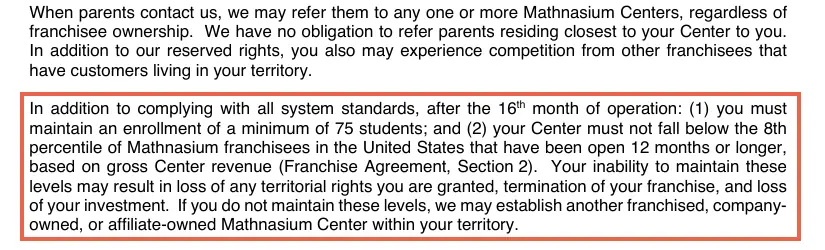
The performance clause starts after the 16th month of operation. From then on a center must keep at least 75 enrolled students and must not fall below the 8th percentile of U.S. Mathnasium centers open 12 months or longer, ranked by gross center revenue (Franchise Agreement, Section 2). Missing either test can cost the territory, the franchise and the investment, and Mathnasium may then place another franchised or affiliate-owned center inside your boundaries.
- Parents may enroll at any Mathnasium Center they choose, and Mathnasium has no duty to send local inquiries to you (Item 12).
- Mathnasium keeps exclusive rights to internet, mobile, text, email and social media marketing unless it authorizes you in writing.
- You may not teach students anywhere except the accepted center, including students’ homes.
- Relocation must stay inside the territory and needs written consent.
Our research on franchise territory rights in filed FDDs sets this kind of performance-conditioned protection against territories with no sales test.
Who must run the center, and what does the FDD require of instructors?
A Mathnasium Center needs a named Center Director who works there full time during normal business hours and personally teaches students, enrolls families, trains staff, gives student assessments and makes marketing decisions (Item 15; Franchise Agreement Section 10.1). The owner can hold that role or hire it, but Mathnasium says it does not license owners seeking a passive investment.
The FDD leaves instructor hiring standards to the Manuals rather than printing a degree or test requirement. What it does fix in writing:
- At least 2 adults must be present whenever children are in the center (Item 15).
- Every employee needs a background check through Mathnasium’s designated vendor, kept on file and shown on request (Item 8; Franchise Agreement Section 10.2).
- Required insurance includes business liability, corporal punishment and sexual or physical abuse and molestation cover, each at a minimum of $1,000,000 per occurrence (Item 8).
- Instructors must complete training courses set in the Manuals, and hired or promoted Center Directors must finish Center Director Training before opening (Item 11).
- Some states may require teaching certification or licenses, most require instructor background checks, and a center classed as a school or daycare may need separate restrooms, panic-bar exits and fire upgrades (Item 1).
For owners, the franchisor’s ideal candidate page lists a minimum of $112,936 in liquidity and $150,000 net worth and says no advanced math expertise is required (accessed November 10, 2026). Training runs in four stages within 180 days of signing: about 30 hours online, four virtual half-days, about 40 more hours online, then four virtual half-days plus 3 days in an operating center in Los Angeles 4 to 6 weeks before opening (Item 11).
| Item 11 training subject | Online hours | Virtual classroom hours | On-the-job hours |
|---|---|---|---|
| The Mathnasium Teaching Method | 20 | 6 | 12 |
| Assessing Students | 6 | 3 | 3 |
| Lead Generation (Marketing) | 6 | 4 | 1 |
| Customer Service: Driving Retention and Referrals | 4 | 2 | 6 |
| Hiring, Training, Team Management | 2 | 4 | 2 |
| Center Directors | 1 | 3 | 0 |
How fast is the U.S. Mathnasium system adding and losing centers?
Item 20 of the April 30, 2026 FDD counts 1,047 U.S. centers at December 31, 2025: 1,043 franchised and 4 company-owned in California. Franchised openings rose from 43 in 2023 to 63 in 2025 while closures for other reasons fell from 25 to 15, and the filing reports no terminations or non-renewals in any of the three years.
| Year | Franchised at start | Opened | Ceased, other reasons | Reacquired | Franchised at end | Transfers |
|---|---|---|---|---|---|---|
| 2023 | 951 | 43 | 25 | 1 | 968 | 93 |
| 2024 | 968 | 47 | 20 | 0 | 995 | 92 |
| 2025 | 995 | 63 | 15 | 0 | 1,043 | 69 |
Openings rose from 43 to 63 and closures fell from 25 to 15 between 2023 and 2025; transfers ran at 93, 92 and 69. Source: Mathnasium FDD issued April 30, 2026, Item 20.
Transfers to new owners outnumbered closures in every year: 254 transfers against 60 closures across 2023 to 2025, with 15 Minnesota transfers in 2025 alone. California held 184 franchised centers at the end of 2025 after 14 openings, Texas 108 and Florida 77. Arizona fell from 25 to 22 over the three years. At year end, 93 signed franchise agreements had no open center yet, 30 of them in California (Item 20, Table No. 5). The state-by-state rows for all 47 jurisdictions are in the download file mathnasium-item20-2023-2025.csv.
Item 1 adds 104 franchised centers in Canada and 108 outside the U.S. and Canada as of December 31, 2025. Item 19 does contain financial performance data: three tables for 2025 covering Gross Receipts by quartile, reported operating expenses and Gross Receipts by number of centers owned. We do not reproduce those figures; read them in Item 19 of the current FDD and compare them with our review of what Item 19 disclosures include.
How do Mathnasium’s Items 5, 6 and 7 compare with Huntington, Sylvan and The Tutoring Center?
Among four tutoring center FDDs filed in Minnesota, Mathnasium has the highest initial franchise fee at $49,000 but the second-lowest Item 7 top end at $165,846. The table lists brands alphabetically and quotes each filing; it is not a ranking. Fee bases differ: Huntington and Sylvan charge royalties on revenue with fixed minimums, while The Tutoring Center charges a flat monthly amount.
| Brand (FDD issued) | Initial fee (Item 5) | Royalty (Item 6) | Fund or marketing (Item 6) | Item 7 total | Source |
|---|---|---|---|---|---|
| Huntington Learning Center (April 16, 2026) | $42,000 | 9.5% of Gross Revenue; $2,000 monthly minimum | 2% (minimum $500 a month); $57,000 yearly advertising minimum | $191,992 to $340,632 | Huntington FDD, Items 5 to 7 |
| Mathnasium (April 30, 2026) | $49,000 | 10% of Gross Receipts plus $650 base; $1,500 floor from month 24 | $250 plus 2%; digital and local fee of at least $1,000 a month | $127,316 to $165,846 | Mathnasium FDD, Items 5 to 7 |
| Sylvan Learning (April 24, 2026) | $46,900 | 11% of Gross Sales (12% for Sylvan Edge and ACE IT!); $5,500 quarterly minimum | 5% national fund; local marketing of 6% or $1,500 a month, whichever is greater | $117,600 to $288,400 | Sylvan FDD, Items 5 to 7 |
| The Tutoring Center (March 21, 2025) | $32,000 plus $15,000 pre-opening training and support fee | Flat $500 a month for 3 months, then $1,500, rising $25 each January | None as a percentage; $250 to $400 digital minimum not currently required | $85,010 to $162,475 | The Tutoring Center FDD, Items 5 to 7 |
The Tutoring Center’s Item 7 table prints its total as “$85,101 to $162,4775”; the line items add to $85,010 to $162,475, which matches its cover page. The comparison rows are in the download file tutoring-fdd-items-5-6-7.csv. Kumon bills royalties per enrolled student instead, explained in our Kumon franchise cost breakdown, and category data sits in our education franchise statistics report, which draws on the 2017 Economic Census: 37.1% of U.S. exam preparation and tutoring establishments were franchised that year.
Which Mathnasium numbers online disagree with the April 2026 filing?
Several top-ranking pages for this query repeat figures that do not match the April 30, 2026 FDD. The corrections below describe each claim neutrally and set it against the filed text, with the item number, so a reader can check the primary source directly.
| Claim seen online | Where | What the April 30, 2026 FDD says |
|---|---|---|
| Startup cost “$112,000 to $153,000”; working capital “first 3 months, $20,000 to $40,000” | A lender guide updated July 2026 | $127,316 to $165,846; additional funds cover 4 months at $35,000 to $45,000 (Item 7) |
| Totals of $112,936 to $149,616 or $112,860 to $149,155 | Franchise listing and review sites | Neither matches Item 7 of the 2026 filing |
| Technology fee of $266 to $1,596 described as one-time | A sponsored cost article, October 2026 | $266 a month for the whole term; $266 to $1,596 is only the pre-opening portion (Items 5 and 6) |
| Minimum liquid assets of $127,316 | The same sponsored article | The franchisor’s candidate page lists $112,936 liquidity and $150,000 net worth |
| Annual convention fee of $225 | A search summary of third-party data | $550 per attendee, attendance required (Item 6, Note 6) |
| “1,200+” centers | Franchisor recruitment page | 1,047 U.S. centers; 1,259 including Canada and other countries (Items 1 and 20) |
Which entry route matches your capital and plans?
Mathnasium sells four routes in the 2026 FDD, and each carries a different upfront fee under Items 5 and 7. The flowchart and the table hold the same logic. This page is general information drawn from the filing, not legal or financial advice; a franchise attorney can confirm how the Franchise Agreement and any state addendum apply to you.
| If your situation is | Route | Upfront fee to Mathnasium | Watch for |
|---|---|---|---|
| First center, no discount | Single Franchise Agreement | $49,000 | Open within 6 months or face termination (Item 11) |
| Veteran, active duty or educator with 3 years in role | Single agreement with 25% discount | $36,750 | Discount applies to the first center only (Item 5) |
| Existing owner adding a center inside your territory by December 31, 2026 | Additional Center Incentive | $0 fee; up to $1,500 a month royalty waived for 12 months | Must open within 6 months of signing (Item 6, Note 1) |
| Existing owner, center outside your territory | Additional franchise | $26,500, of which $15,000 may be financed | 20-month note at 10% with spousal guaranty (Item 10) |
| Plan for 2 to 5 centers | Development Agreement | $75,500 to $129,000 ($63,250 to $116,750 discounted) | Missed schedule forfeits fees for unsigned centers (Item 1) |
| Buying an operating center | Transfer | $7,000 fee plus $3,000 training; seller pays a $7,000 transfer fee | Training must be done before consent (Item 11) |
Our guide to franchise opportunities for veterans compares VetFran discounts like the 25% cut here, and buyers weighing an existing center can start with our guide to buying a franchise for sale. Read Items 5 to 7, 12 and 20 together using our guide to reading a franchise disclosure document.
How we compiled this
We read the Mathnasium Franchisor LLC FDD issued April 30, 2026, as filed with the Minnesota Department of Commerce (CARDS document 36620-202605-05), plus the current Huntington, Sylvan and The Tutoring Center FDDs from the same database: 4 primary documents, accessed November 2026. We added up every Item 7 line and every Item 20 state row to check the printed totals, rendered the Item 12 page from the filed PDF, and read the franchisor’s candidate page. We excluded all Item 19 figures, franchisee names from Exhibits A-1 and A-2, and claims found only on third-party sites.
Frequently asked questions
How much does a Mathnasium franchise cost?
Item 7 of the Mathnasium FDD issued April 30, 2026 puts a first center at $127,316 to $165,846 and an additional center at $104,816 to $143,346. Of the first-center total, $51,266 to $52,596 goes to Mathnasium. A Development Agreement for 2 to 5 centers totals $153,816 to $245,846, covering the development fee plus the first center.
How much do Mathnasium franchise owners make?
Our site does not publish earnings figures. Item 19 of the April 30, 2026 FDD includes 2025 Gross Receipts by quartile, reported expenses and results by number of centers owned. What an owner keeps turns on the royalty, base royalty, marketing fees and the Item 7 costs, so read Item 19 alongside Items 6 and 7 and ask current owners listed in Item 20.
Do you need a teaching degree to own a Mathnasium franchise?
No degree is required by the FDD, and the franchisor’s candidate page says no advanced math expertise is needed. Teaching credentials do cut the first-center fee by 25%, to $36,750, if you taught or administered for at least 3 years within the last 5 or earned an education degree in the last 10 years (Item 5).
What is the Mathnasium royalty fee?
Item 6 sets a monthly royalty of 10% of Gross Receipts. From the 24th month of operation you pay the greater of 10% or $1,500. A separate $650 monthly base royalty starts 6 months after signing, and one base royalty covers all centers held by the same controlling owner unless centers are bought through a Base Royalty Acquisition.
Who owns Mathnasium?
Mathnasium Franchisor LLC, formed July 11, 2024, is the franchisor after an August 2024 securitization. Its ultimate parent is Mathnasium Holdings, LLC, in which an entity owned by Roark Capital Management, LLC acquired a majority interest in November 2021 (Item 1). Other Roark-affiliated brands appear in our private equity franchise ownership research.
Can you buy an existing Mathnasium center?
Yes. Item 20 reports 69 transfers to new owners in 2025, 92 in 2024 and 93 in 2023. A buyer pays a $7,000 initial franchise fee and a $3,000 training fee and must finish training before Mathnasium consents; the seller pays a $7,000 transfer fee (Items 5 and 6). Existing owners buying smaller centers may qualify for royalty rebates.
Is Mathnasium a good franchise?
We do not rate brands. The April 30, 2026 FDD lets you test the points that matter: zero terminations and 15 closures in 2025 (Item 20), a $1,500 royalty floor from month 24 (Item 6), and a 75-student minimum after month 16 (Item 12). Compare those with Huntington, Sylvan and The Tutoring Center filings before deciding.
Sources
- Mathnasium Franchisor LLC, Franchise Disclosure Document, issued April 30, 2026, Minnesota CARDS, accessed November 10, 2026.
- Huntington Learning Centers, Inc., Franchise Disclosure Document, issued April 16, 2026, Minnesota CARDS, accessed November 10, 2026.
- Sylvan Learning, LLC, Franchise Disclosure Document, issued April 24, 2026, Minnesota CARDS, accessed November 10, 2026.
- The Tutoring Center Franchise Corp., Franchise Disclosure Document, issued March 21, 2025, Minnesota CARDS, accessed November 10, 2026.
- Mathnasium, Ideal Candidate page, mathnasiumfranchise.com, accessed November 10, 2026.
- U.S. Census Bureau, 2017 Economic Census, franchise status tables, via our education franchise statistics report.