A pizza franchise costs $55,800 to $1,769,200 to open across eight brands’ current disclosure documents, and the bigger difference between brands sits in Item 8: who makes your dough, how much buying is locked in, and who pays for delivery.
Key takeaways
- The lowest Item 7 low end in this pizza dataset is $55,800 for a Pizza Hut Small Format license inside a host business; the highest low end is $1,001,223 for a MOD Pizza restaurant (Pizza Hut Non-Traditional License Disclosure Document, amended October 8, 2026; MOD Pizza FDD, April 30, 2024).
- Two brands name the dough maker outright: Domino’s buys fresh dough balls from its affiliate DPD, and Papa John’s requires dough and sauce “only from our affiliate PJ Food Service” (Item 8 of the Domino’s and Papa John’s 2026 FDDs).
- Required purchases reach 92% to 98% of a Marco’s store’s operating purchases and 90 to 100 percent at Little Caesars, against about 45% at Jet’s Pizza (Item 8 of the Marco’s FDD, April 18, 2026, the Little Caesars FDD and the Jet’s FDD).
- Delivery drivers usually use their own cars: Pizza Hut’s Item 7 excludes delivery vehicles “as typically these vehicles are personally owned,” while required auto liability runs from $1,000,000 (Papa John’s, Marco’s) to $5,000,000 (Pizza Hut FDD amended October 8, 2026, Items 7 and 8).
- Per-order digital fees in three 2026 FDDs: $0.36 at Little Caesars, $0.385 at Domino’s and $0.41 at Pizza Hut; Papa John’s charges 1.75% of digital Net Sales, including aggregator orders (Item 6; Little Caesars FDD, March 27, 2026).
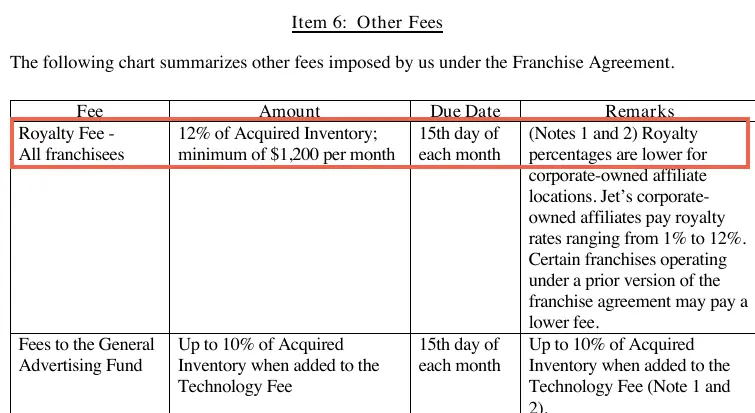
- Jet’s Pizza charges its royalty on purchases, not sales: 12% of Acquired Inventory, minimum $1,200 per month (Jet’s FDD, April 29, 2025, Item 6).
The pizza FDD dataset: eight brands, A to Z
The table below lists nine pizza disclosure documents from eight brands, in alphabetical order, with the issue date, the Item 5 initial fee, the Item 6 royalty and ad fund, and the Item 7 range for the main format. Every figure is quoted from a Minnesota CARDS filing as printed. The full file, with service format and Item 8 supply columns, is pizza_fdd_costs.csv.
| Brand | FDD issued | Initial fee (Item 5) | Royalty (Item 6) | Ad fund (Item 6) | Item 7 format | Item 7 range | Source |
|---|---|---|---|---|---|---|---|
| Blaze Pizza | April 30, 2026 | $30,000 | 5% of Gross Sales | Creative Fund currently 2% (up to 4%), plus 2% local | Single restaurant | $757,000 to $1,297,100 | CARDS 36377-202604-09 |
| Domino’s | April 1, 2026, amended July 29, 2026 | $0 to $10,000 | 5.5% of weekly Royalty Sales | 4% Advertising Fund (national plus local capped at 9%) | Traditional | $231,450 to $743,500 | CARDS 37073-202607-03 |
| Jet’s Pizza | April 29, 2025 | $30,000 ($15,000 military) | 12% of Acquired Inventory, minimum $1,200 per month | Up to 10% of Acquired Inventory combined with a Technology Fee | Single franchise | $572,500 to $786,000 | CARDS 34027-202505-09 |
| Little Caesars | March 27, 2026 | $20,000 | Greater of 6% of weekly Gross Sales or $300 per week | Up to 7% of Gross Sales | Single restaurant | $376,500 to $1,769,200 | CARDS 36134-202604-03 |
| Marco’s Pizza | April 18, 2026 | $25,000 | 5.5% of Net Royalty Sales (up to 6.0%) | 1% Brand Development Fund plus 4% National Advertising Fund | Single Store | $286,477 to $811,186 | CARDS 36186-202604-04 |
| MOD Pizza | April 30, 2024 | $30,000 | 5% of weekly Revenues | 2% Marketing Fees (up to 3%), plus 2% local | Single restaurant | $1,001,223 to $1,301,134 | CARDS 31547-202404-08 |
| Papa John’s | March 30, 2026 | $5,000 to $25,000 (Standard) | 5% (6% Small-Town) | 6% Marketing Fund to December 30, 2029 | Standard and Small-Town | $281,485 to $890,267 | CARDS 35810-202604-11 |
| Pizza Hut (Traditional) | March 25, 2026, amended October 8, 2026 | $25,000 | 6.0% of Gross Sales (6.5% in certain cases) | 4.75% System Advertising Fund | Inline/Endcap Delco (delivery and carryout) | $670,000 to $960,000 | CARDS 37386-202610-03 |
| Pizza Hut (Non-Traditional license) | March 25, 2026, amended October 8, 2026 | $5,000 ($10,000 to $20,000 for medium or larger pizzas) | 10% Monthly Service Fee | Marketing Fee $1,500 a year | Small Format inside a host business | $55,800 to $183,000 | CARDS 37388-202610-03 |
Pizza Hut prints eight totals across its two documents; the table shows the inline Delco store because it is the format closest in size to Domino’s, Marco’s and Jet’s storefronts. Its freestanding Delco runs $816,000 to $1,900,000 and an RBD or DBR dine-in unit $846,000 to $2,130,000, all excluding real property (Pizza Hut FDD cover, amended October 8, 2026). The line-by-line detail for the four largest brands lives on our Domino’s franchise cost breakdown, Pizza Hut cost page, Papa John’s cost page and Little Caesars cost page.
Item 7 low and high estimates for nine pizza formats, from $55,800 (Pizza Hut Small Format) to $1,769,200 (Little Caesars high end). Source: each brand’s FDD on Minnesota CARDS, accessed November 2026.
Two rows are older than the 2026 filing season. MOD Pizza’s newest Clean FDD on Minnesota CARDS is the April 30, 2024 document, and Jet’s Pizza’s is April 29, 2025, both checked on November 3, 2026. Hungry Howie’s returned no Clean FDD on Minnesota CARDS, so it is not in the table. Before relying on any row, ask the franchisor for its current FDD; the FTC Franchise Rule at 16 CFR 436 requires delivery at least 14 calendar days before you sign or pay.
Who makes the dough, and how much of your buying is locked in?
Item 8 of every FDD here restricts where the dough comes from. Domino’s and Papa John’s buy dough from a franchisor affiliate; Marco’s requires a dough pack made by one of two Approved Suppliers; MOD Pizza and Jet’s Pizza use approved third-party suppliers. Required purchases run from about 30% of a Pizza Hut restaurant’s operating costs to 90 to 100 percent at Little Caesars, by each brand’s own Item 8 estimate.
| Brand | Dough and core food rule (Item 8) | Required share of purchases (Item 8) | Franchisor or affiliate income from your buying |
|---|---|---|---|
| Blaze Pizza | Proprietary Products only from Blaze or an approved third party; training covers “Preparation of Dough” in the restaurant | 85% to 95% to open; 85% to 95% to operate | None in fiscal 2025, per Item 8 |
| Domino’s | Fresh dough balls from affiliate DPD; no third-party fresh dough suppliers | Franchisor and affiliates: 25% to 65% to open; generally 25% to 40% of ongoing operating expenses | DPD sales to franchisees $2.7 billion in fiscal 2025, 55.4% of DPL revenue |
| Jet’s Pizza | All food and supplies from approved suppliers; Jet’s and affiliates are not suppliers | About 100% to open; about 45% ongoing | Rebates $4,670,643.33 in 2024, about 15% of Jet’s revenue |
| Little Caesars | Blue Line, Pepsi-Cola and designated suppliers | 90 to 100 percent to open and operate | Blue Line sales to franchisees $2,139,409,252 in fiscal 2025 |
| Marco’s Pizza | Dough pack and sauce seasoning from an Approved Distributor, made by one of two Approved Suppliers | 36% to 63% to open; 92% to 98% to operate | Affiliate MPD sales to franchisees $58,875,242 in fiscal 2025 |
| MOD Pizza | All pizza dough, sauces and other food from designated or approved suppliers | Approximately 90% to 95% | $.015 to $.03 per dough ball from designated distributors |
| Papa John’s | Pizza dough and pizza sauce only from affiliate PJ Food Service | Up to 24% from franchisor or affiliates; approximately 79% from approved suppliers or specs (operating) | PJ Food Service revenue $854.2 million in fiscal 2025 |
| Pizza Hut (Traditional) | Proprietary items from PHLLC, RSCS or an Approved Distributor; McLane is principal distributor | 30% to 45% to open; 30% to 50% to operate | Delivery aggregator royalties about $12,141,676.03 in 2025 |
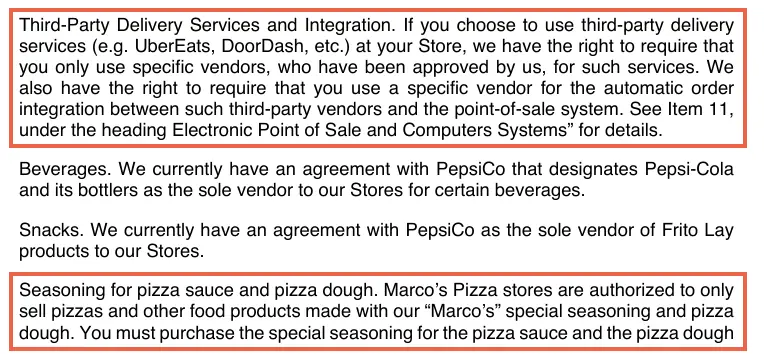
Marco’s states the dough rule in one paragraph of Item 8, on page 38 of its April 18, 2026 FDD. The same page reserves the right to name your third-party delivery vendors and the software that links those apps to the point-of-sale system.
What does a locked supply chain mean for a buyer?
A required supplier sets your food cost, and Item 8 tells you whether the franchisor earns on it. Marco’s says distributors pay it a fee averaging approximately 0.29% of your sales, and that it took $5,971,052 from required purchases in fiscal 2025, 10.5% of its $57,124,003 revenue.
Before you sign, ask for the current price list of the dough, sauce and cheese you must buy, and test it against the food cost line in your lender’s model.
Required purchases run from 30% to 50% of operating costs at Pizza Hut to 90 to 100 percent at Little Caesars, by each franchisor’s Item 8 estimate. Source: FDDs on Minnesota CARDS, 2024 to 2026 issues.
For context across all sectors, our study of supplier rebates in 259 FDDs found food and beverage FDDs had a median restricted share of 82.5% of ongoing purchases, coded from Minnesota CARDS filings.
Where does a pizza order’s money go before it reaches you?
A pizza order passes through three cost points that the FDD prices: the supply chain under Item 8, the order channel (carryout, your own drivers or a third-party app), and the fees in Item 6 that come off the top of sales. Royalty runs 5% to 6.5% of sales in the main formats here, ad funds 2% to 7%, and three brands add a fixed charge per digital order.
The diagram’s labels, as text:
- Dough and ingredients: commissary or approved distributor (Item 8); required share about 30% to 100% of purchases.
- Your store: kitchen, POS and delivery area.
- Fees taken from sales: royalty 5% to 6.5% of sales; ad fund 2% to 7% of sales; per digital order $0.36 to $0.41, or 1.75% of digital sales.
- Channel 3a, carryout: no driver or app cost; Little Caesars Pizza Portal; Domino’s Non-Traditional ordinarily carry-out only.
- Channel 3b, your own drivers: employee cars, usually outside the Item 7 total; auto liability $1,000,000 to $5,000,000 (Item 8); Marco’s: 6 to 12 vehicles.
- Channel 3c, third-party app: DoorDash, Uber Eats, Grubhub (Item 8); Little Caesars app service fee up to 25%, currently 18% to 22%.
- Exception, Jet’s Pizza: royalty is 12% of Acquired Inventory, minimum $1,200 per month, so the fee follows step 1 purchases rather than step 2 sales.
Who supplies the delivery car, and what insurance does it need?
In these FDDs the franchisee’s employees usually supply the delivery car, and the Item 7 totals leave vehicles out. Pizza Hut’s Item 7 note 10 says vehicles are “typically” personally owned, Domino’s states delivery cars are not required or included, and Marco’s assumes employees “provide their own transportation.” The franchisee still carries the auto liability: $1,000,000 to $5,000,000 per occurrence under Item 8.
| Brand | Vehicles in Item 7? | Required auto coverage (Item 8) | Delivery staffing or channel rule |
|---|---|---|---|
| Domino’s | Delivery cars not required and not included | $1,500,000 per occurrence automobile liability | Non-Traditional stores ordinarily carry-out only |
| Jet’s Pizza | Not listed; Item 7 insurance of $10,000 to $16,000 for three months includes delivery and non-owned auto cover for employee vehicles | Amount not stated in Item 8 | Online ordering technology from approved suppliers |
| Marco’s Pizza | No; “Most Stores need 6 to 12 delivery vehicles available” | Hired and non-owned auto $1,000,000 per occurrence; owned auto $1,000,000 if you own delivery vehicles | Franchise Agreement 12.13.1: buy or lease vehicles if delivery standards are not met |
| MOD Pizza | No | Automobile liability $2,000,000 per occurrence; umbrella $5,000,000 | Delivery or catering at the franchisor’s option (Franchise Agreement 10.2) |
| Papa John’s | Not stated in the items we read | Automobile liability including non-owned autos, $1,000,000 combined single limit; umbrella $1,000,000 | Coverage required “even if using third-party delivery services” |
| Pizza Hut (Traditional) | No; vehicles “typically” personally owned (note 10) | Business automobile liability $5,000,000 combined single limit | Delco stores offer only carryout and delivery |
Two practical checks follow from these clauses. First, price a hired and non-owned auto policy at the Item 8 limit before you finalize the Item 7 insurance line, because Marco’s Item 7 insurance estimate of $2,366 to $16,500 covers only the first 90 days. Second, if you lean on apps, Papa John’s Franchise Agreement Section 18(a) tells you to confirm that your non-owned auto policy covers a loss caused by the delivery service; take that clause to your insurance broker. Our franchise insurance requirements study compares required limits across 259 FDDs.
What do DoorDash, Uber Eats and digital orders cost under the FDD?
Only Little Caesars prints a full third-party app fee schedule in Item 6: a $3.99 delivery fee, a 12% service fee capped at $4.00, a $2.00 small-order fee, and third-party app service fees of up to 25%, currently 18% to 22%. The other FDDs either let the franchisor pick your app vendor (Marco’s, Blaze) or collect royalties from the apps themselves (Pizza Hut).
| Brand | Third-party app terms in the FDD | Per-order or digital fee (Item 6) | Other technology charges |
|---|---|---|---|
| Blaze Pizza | May require Uber Eats, Grubhub, DoorDash or EZCater; may require the national-contract service; no other platform without written approval | None per order | Technology Fee up to $300 per month |
| Domino’s | No app terms in the items we quote | Technology Transaction Fee $0.385 per digital order | Annual Software Enhancement Fee $819.25; PULSE license $4,200 |
| Jet’s Pizza | Approved supplier required for online ordering | Technology Fee up to 10% of Acquired Inventory with the ad fund; “currently not imposed” | Gift card and loyalty $30 to $99 a month |
| Little Caesars | DoorDash for app and website orders, exclusive until February 2029 unless extended | Digital transaction fee $0.36 (up to $0.40), plus up to $0.10 on aggregator orders | Caesar Vision support currently $3,120 a year |
| Marco’s Pizza | May require approved app vendors and a specific POS integration vendor; franchisor may sell through DoorDash, Grubhub and UberEats in your area (Item 12) | None per order | Technology Fee $27.96 per week; software support $430 per 4-week period |
| Papa John’s | Aggregator sales placed through its ordering system pay the Digital Fee | Digital Fee 1.75% of digital Net Sales | Software maintenance $375 and help desk $80 a month |
| Pizza Hut (Traditional) | Franchisee contracts with Grubhub, Uber Eats and DoorDash; Pizza Hut receives royalties from those aggregators | Digital Innovation Fee $0.41 per transaction | Restaurant Technology Fee $2,950 a year |
How do the fixed fees add up?
The arithmetic below uses only rates printed in Item 6 of the 2026 Marco’s, Domino’s, Pizza Hut and Little Caesars FDDs and applies no sales figure. It shows what the weekly, 4-week and per-order fees come to over a year or at 1,000 orders, round volumes you can swap for your own.
| Calculation | Inputs (Item 6) | Result |
|---|---|---|
| Marco’s fixed technology charges per year | $27.96 x 52 weeks; $430 x 13 Accounting Periods of 28 days | $1,453.92 + $5,590 = $7,043.92 |
| Per-order fee on 1,000 digital orders | Domino’s $0.385; Pizza Hut $0.41; Little Caesars $0.36 (plus up to $0.10 if via an aggregator) | $385; $410; $360 (up to $460) |
| Little Caesars DoorDash service fee cap | 12% service fee, maximum $4.00 | Cap reached at a $33.33 order subtotal ($4.00 / 0.12) |
| Pizza Hut fixed technology per year | Restaurant Technology Fee $2,950 | $2,950 before per-transaction fees |
Our franchise technology requirements report puts the median stated system cost at $3,236 to $4,800 a year across 259 FDDs, which places Marco’s $7,043.92 and Pizza Hut’s $2,950 on either side of the middle.
Why does Jet’s charge royalty on inventory instead of sales?
Jet’s Pizza bases its royalty on what you buy, not what you sell: 12% of Acquired Inventory, defined as your cost for food, beverages, boxes, cups, napkins and cleaning supplies, with a $1,200 monthly minimum. The April 29, 2025 FDD says royalty on Acquired Inventory was $13,172,520.00 of Jet’s $30,792,504.00 revenue in 2024, or 43%.
An inventory-based royalty changes the math a buyer runs. Waste, over-portioning and supplier price rises all raise the royalty, while menu price increases do not. The other seven brands charge on sales, so their percentages stack as follows (rates only).
| Brand | Royalty base | Royalty plus brand or ad fund | Extra marketing floor |
|---|---|---|---|
| Blaze Pizza | Gross Sales | 5% + 2% = 7% | 2% local advertising |
| Domino’s | Weekly Royalty Sales | 5.5% + 4% = 9.5% | National plus local capped at 9% |
| Jet’s Pizza | Acquired Inventory (purchases) | 12%, plus up to 10% combined ad fund and Technology Fee | Regional fund 25 cents per box or $0 to $1,000 a week |
| Little Caesars | Gross Sales | 6% + up to 7% = up to 13% | Royalty floor $300 per week |
| Marco’s Pizza | Net Royalty Sales | 5.5% + 1% + 4% = 10.5% | Total marketing at least 7% |
| MOD Pizza | Weekly Revenues | 5% + 2% = 7% | 2% local marketing |
| Papa John’s | Net Sales | 5% + 6% = 11% | 1.75% Digital Fee on digital sales |
| Pizza Hut (Traditional) | Gross Sales | 6.0% + 4.75% = 10.75% | $0.41 per digital transaction |
Carryout box, delivery store or fast-casual dining room: which pizza format fits your capital?
The format decides the Item 7 range more than the brand does. Host-site and carryout formats start under $200,000, delivery storefronts start between $231,450 and $572,500 (Marco’s and Papa John’s plan on 1,200 to 1,600 square feet), and fast-casual dining rooms of 1,800 to 2,900 square feet start at $757,000 or more. Match the low end you can fund, then check the eligibility rule.
| If your situation is | Formats whose Item 7 low end fits | Check before you commit |
|---|---|---|
| You can fund under $200,000 and run a counter inside a hotel, store or campus | Pizza Hut Small Format license, $55,800 to $183,000 | Excludes real property and signage; 10% Monthly Service Fee; you need a host site |
| You have 12 months as a Domino’s store general manager | Domino’s Traditional, $231,450 to $743,500 | Item 1 eligibility; multi-unit grants need 12 months as a store supervisor or above |
| You can fund $280,000 to $300,000 and will run delivery | Papa John’s $281,485; Marco’s $286,477 | Budget hired and non-owned auto at $1,000,000; Papa John’s dough and sauce from PJ Food Service |
| You can fund $375,000 to $600,000 | Little Caesars $376,500; Jet’s $572,500 | Little Caesars buys 90 to 100 percent through required sources; Jet’s royalty follows purchases |
| You can fund $650,000 to $1 million for a larger storefront | Pizza Hut inline Delco $670,000; Blaze $757,000 | Blaze sells mainly area development, $10,000 per added restaurant; Pizza Hut auto liability $5,000,000 |
| You can fund over $1 million and want beer and wine service | MOD Pizza $1,001,223 to $1,301,134 | Document dated April 30, 2024; 87 franchised and 465 company-owned US units at end of 2023 |
This table matches budgets to formats; it does not rate brands. For restaurant formats beyond pizza, our fast food franchise cost comparison of 22 FDDs sorts the same Item 7 data across burgers, chicken and sandwiches. Whether a store can carry these fees depends on sales, and Item 19 is where a franchisor may disclose them: Domino’s, Marco’s, Papa John’s and Pizza Hut include Item 19 data, while Little Caesars, MOD Pizza and Jet’s state they make no financial performance representations. Our Item 19 research explains how to read those tables.
What does each document leave out, and where do other guides go wrong?
Each FDD here has a gap a buyer should close in writing. Jet’s printed Item 7 totals of $572,500 to $786,000 do not equal its own line items, which sum to $627,000 to $843,000 with the fees shown. Marco’s Item 19 counts 1141 franchised Stores at December 28, 2025 while its Item 20 table shows 1,139. Ask the franchisor which figure governs.
| Claim in circulation | What the primary document says | Source |
|---|---|---|
| A sponsored brand comparison from June 2019, still ranking, gives Domino’s as $119,950 to $461,700 | Traditional $231,450 to $743,500 | Domino’s FDD amended July 29, 2026, Item 7 |
| The same 2019 comparison gives Pizza Hut as $297,000 to $563,000 | $670,000 to $2,130,000 across four Traditional formats, excluding real property | Pizza Hut FDD amended October 8, 2026, cover |
| A ranked pizza list updated October 2025 prints fees and investment ranges with no FDD year | Each figure belongs to a dated document; this dataset ranges from April 30, 2024 to October 8, 2026 | Minnesota CARDS filings in the dataset table |
| The same ranked list prints no royalty rate for any brand | Royalty bases differ: Jet’s charges 12% of Acquired Inventory, not sales; Little Caesars charges the greater of 6% or $300 per week | Item 6 of each FDD |
Read the full document, not a summary. The FTC’s Consumer’s Guide to Buying a Franchise lists the questions to put to existing franchisees, and our guide to the franchise disclosure document maps all 23 Items. This page is general information, not legal, financial or investment advice.
How we compiled this
We built the dataset from nine Franchise Disclosure Documents for eight pizza brands filed on Minnesota CARDS. We opened four in full for this article (Marco’s, MOD Pizza and Jet’s fetched on November 3, 2026, plus Blaze Pizza) and re-opened the Pizza Hut and Papa John’s documents for their Item 8 delivery and insurance text; Domino’s and Little Caesars figures come from our verified brand source packs with the original CARDS citation. Hungry Howie’s had no Clean FDD on CARDS, and we excluded two pizza brands we had only in coded form. We published no Item 19 figures and no franchisee names.
Frequently asked questions
How much does it cost to open a pizza franchise?
In the eight brands’ current FDDs, Item 7 starts at $55,800 for a Pizza Hut Small Format license inside a host business and reaches $1,769,200 at the top of the Little Caesars range. Delivery storefronts from Domino’s, Papa John’s and Marco’s start between $231,450 and $286,477. Fast-casual formats from Blaze and MOD Pizza start at $757,000 and $1,001,223.
Do pizza franchisees have to buy dough from the franchisor?
Often, yes. Papa John’s requires pizza dough and pizza sauce only from its affiliate PJ Food Service, and Domino’s fresh dough balls come from its affiliate DPD. Marco’s requires a dough pack made by one of two Approved Suppliers, while MOD Pizza and Jet’s Pizza require approved third-party suppliers. Item 8 of each FDD states the rule.
Are pizza franchises profitable?
Profit depends on sales, food cost and labor, and this site does not publish earnings figures. Item 19 is where a franchisor may disclose sales data: Domino’s, Marco’s, Papa John’s and Pizza Hut include it, while Little Caesars, MOD Pizza and Jet’s state they make no financial performance representations. Compare Item 6 fees, which run about 7% to 13% of sales here, against those Item 19 tables.
Do I need restaurant experience to buy a pizza franchise?
For Domino’s, yes: Item 1 of its 2026 FDD requires at least 12 months as a Domino’s Store general manager before a single-store franchise. The other FDDs in this dataset set no fixed experience period in the items we read, though Marco’s initial fee covers training for up to two Designated Franchise Operators, who must finish the program before opening.
Who pays for delivery drivers' cars and insurance?
Usually the drivers supply the cars and the franchisee buys the liability cover. Pizza Hut and Domino’s leave delivery vehicles out of Item 7, and Marco’s assumes employees use their own transportation. Item 8 then requires auto liability of $1,000,000 (Papa John’s, Marco’s), $1,500,000 (Domino’s), $2,000,000 (MOD Pizza) or $5,000,000 (Pizza Hut).
Can I use DoorDash or Uber Eats at a pizza franchise?
Usually on the franchisor’s terms. Little Caesars routes app and website orders to DoorDash under an exclusive deal running to February 2029. Blaze may require its national-contract delivery service, Marco’s may require approved vendors and an integration vendor, and Papa John’s charges its 1.75% Digital Fee on aggregator sales placed through its ordering system.
Sources
- Blaze Pizza, LLC Franchise Disclosure Document, Issuance Date April 30, 2026, Items 5 to 8 and 11, Minnesota CARDS 36377-202604-09 (accessed November 3, 2026)
- Domino’s Pizza Franchising LLC Franchise Disclosure Document, issued April 1, 2026, as amended July 29, 2026, Items 1 and 5 to 8, CARDS 37073-202607-03 (accessed October 20, 2026)
- Jet’s America, Inc. Franchise Disclosure Document, Issuance Date April 29, 2025, Items 5 to 8, 19 and 20, CARDS 34027-202505-09 (accessed November 3, 2026)
- Little Caesar Enterprises, Inc. Franchise Disclosure Document, issued March 27, 2026, Items 5 to 8, CARDS 36134-202604-03 (accessed October 20, 2026)
- Marco’s Franchising, LLC Franchise Disclosure Document, Issuance Date April 18, 2026, Items 5 to 8, 12, 19 and 20, CARDS 36186-202604-04 (accessed November 3, 2026)
- MOD Super Fast Pizza Franchising, LLC Franchise Disclosure Document, Issuance Date April 30, 2024, Items 5 to 8, 19 and 20, CARDS 31547-202404-08 (accessed November 3, 2026)
- Papa John’s Franchising, LLC Franchise Disclosure Document, issued March 30, 2026, Items 5 to 8 and Franchise Agreement Section 18, CARDS 35810-202604-11 (accessed November 3, 2026)
- Pizza Hut, LLC Franchise Disclosure Document (Traditional), issued March 25, 2026, as amended October 8, 2026, Items 1 and 5 to 8, CARDS 37386-202610-03 (accessed November 3, 2026)
- Pizza Hut, LLC Non-Traditional License Disclosure Document, as amended October 8, 2026, cover and Items 5 and 6, CARDS 37388-202610-03 (accessed November 2, 2026)
- Minnesota Department of Commerce, CARDS franchise registrations search (accessed November 3, 2026)
- 16 CFR 436.5, disclosure items (Legal Information Institute copy) (accessed November 3, 2026)
- Federal Trade Commission, A Consumer’s Guide to Buying a Franchise (accessed November 3, 2026)