Sonic franchise cost in the March 26, 2026 disclosure document runs $1,485,200 to $2,522,900 for a freestanding drive-in, $670,200 to $1,412,900 inside a C-Store and $679,200 to $1,250,900 for an urban in-line unit, all before land.
Key takeaways
- The freestanding canopy drive-in is the costliest Sonic build: building costs of $600,000 to $800,000 plus site work of $450,000 to $700,000 make up 59.5% to 70.7% of its Item 7 total (Sonic FDD, Item 7).
- The initial franchise fee is $15,000 for a Traditional Drive-In or Non-Drive-In Location and $11,250 for a C-Store or Non-Traditional site; the fees actually paid in fiscal 2025 ranged from $1,250 to $45,000 (Sonic FDD, Item 5).
- After opening, the standard load is a 5% royalty, a 0.90% Sonic Brand Fund fee and at least 3.25% for the advertising cooperative and System Marketing Fund (Sonic FDD, Item 6).
- A new Traditional Restaurant signed by March 31, 2027 can start at a 1% royalty and step up to 5% in Year 5, with the marketing fund at half rate through Year 5 (Sonic FDD, Item 6, Notes 2 and 4).
- Inspire Brands sets the entry bar at $500,000 in liquid assets and $1,000,000 in net worth (Inspire Brands franchising page, accessed November 2026).
- Franchised Sonic units fell from 3,220 to 3,120 between the start of 2023 and the end of 2025 (Sonic FDD, Item 20, Table No. 1).
Which Sonic format are you pricing: canopy drive-in, C-Store or urban in-line?
Sonic Franchising LLC prices three building types in Item 7 of its 2026 Franchise Disclosure Document, and the format decides most of the bill. A freestanding Traditional Drive-In needs a lot of 34,000 to 43,560 square feet for a 1,250 to 1,500 square-foot building with canopies over 6 to 12 drive-in stalls, a drive-thru lane and a patio (Item 7, Note 1). The two smaller formats skip the stall canopy and most of the site work.
| Format (Item 7 column) | Space the FDD describes | Stalls and lanes | Item 7 total | Source |
|---|---|---|---|---|
| Freestanding Traditional Drive-In, leased | Lot 34,000 to 43,560 sq ft; building 1,250 to 1,500 sq ft | 6 to 12 canopy stalls, drive-thru, patio | $1,485,200 to $2,522,900 | Item 7, Note 1 |
| C-Store (Non-Drive-In Location), leased | 1,200 to 2,500 sq ft inside a shopping center, convenience store or travel plaza | No stalls; high end assumes a drive-thru lane | $670,200 to $1,412,900 | Item 7, Notes 1 and 9 |
| Urban in-line, leased | 1,200 to 2,100 sq ft, ground-level street-facing space | Neither a drive-thru nor stalls | $679,200 to $1,250,900 | Item 7, Notes 1 and 9 |
The franchising page that Inspire Brands runs for Sonic lists four footprints in its own words: in-line at 1,500 to 2,000 square feet, endcap at 1,500 to 1,800, a small-format drive-thru of about 1,130 and a freestanding unit of 1,600 square feet with 6 to 12 stalls (Inspire Brands, Sonic franchising). Those sizes differ from Note 1 of Item 7; the FDD is the document a franchisee signs against, so use its figures when you build a budget.
Item 1 also defines Non-Traditional Locations such as military bases, universities, airports and stadiums, which sign a separate Non-Traditional Rider (Exhibit B-2). Item 7 Note 15 says its ranges do not price a Non-Traditional build at all, so anyone pursuing a campus or airport site gets no investment estimate from this filing.
Where does the money go on a freestanding Sonic Drive-In?
On the freestanding column, two lines dominate: building costs of $600,000 to $800,000 and site work of $450,000 to $700,000, together $1,050,000 to $1,500,000 (Sonic FDD, Item 7). Note 7 says both cover construction, the canopy, leasehold improvements and decor, and that they include the optional $1,200 site and kitchen layout fees if you ask Sonic’s affiliate to draw them. Every figure below is printed in the leased scenario; land or ground rent sits outside the total.
| Item 7 line | Freestanding | C-Store | Urban in-line | What the note says |
|---|---|---|---|---|
| Initial franchise fee | $15,000 | $15,000 | $15,000 | Note 2: paid at signing |
| Travel and living during training | $8,200 to $93,600 | $8,200 to $93,600 | $8,200 to $93,600 | Note 3: low end is 3 local trainees; high end flies and lodges 6 |
| Crew training | $15,200 to $42,500 | $15,200 to $42,500 | $15,200 to $42,500 | Note 4: a Friends and Family Day could add as much as $15,000 |
| Prepaid expenses | $2,000 to $125,000 | $2,000 to $15,000 | $2,000 to $15,000 | Note 5: freestanding high end reflects permitting |
| Real property and occupancy | Variable | $0 to $35,000 | Variable | Note 6: C-Store figure is a deposit plus 3 months’ rent |
| Building costs | $600,000 to $800,000 | $250,000 to $500,000 | $330,000 to $500,000 | Note 7 |
| Site work | $450,000 to $700,000 | $50,000 to $100,000 | $0 to $10,000 | Note 7 |
| Restaurant equipment | $175,000 to $310,000 | $175,000 to $310,000 | $175,000 to $295,000 | Note 8: package sized for 6 to 12 stalls, excludes freight and sales tax |
| POS, POPS digital menu housings and other technology | $105,000 to $160,000 | $70,000 to $80,000 | $60,000 to $70,000 | Note 9: excludes electrical, shipping and installation |
| External signage | $50,000 to $80,000 | $30,000 to $50,000 | $20,000 to $40,000 | Note 10: includes at least $14,000 of installation |
| Beginning inventory | $20,000 to $50,000 | $10,000 to $25,000 | $10,000 to $25,000 | Note 11: first 2 weeks of food and paper |
| Advertising funds | $2,000 to $5,000 | $2,000 to $5,000 | $2,000 to $5,000 | Pre-opening period |
| Insurance premiums | $11,000 to $22,000 | $11,000 to $22,000 | $10,000 to $20,000 | Note 12: multi-peril and workers’ compensation |
| Payroll | $26,800 to $94,800 | $26,800 to $94,800 | $26,800 to $94,800 | Note 13: managers attending training |
| Additional funds (3 months) | $5,000 to $25,000 | $5,000 to $25,000 | $5,000 to $25,000 | Note 14 |
| Total | $1,485,200 to $2,522,900 | $670,200 to $1,412,900 | $679,200 to $1,250,900 | Sonic FDD issued March 26, 2026, Item 7 |
We added each column line by line and every sum matches the printed total. The same 15 lines sit in a CSV in our working files for anyone who wants to rebuild the table.
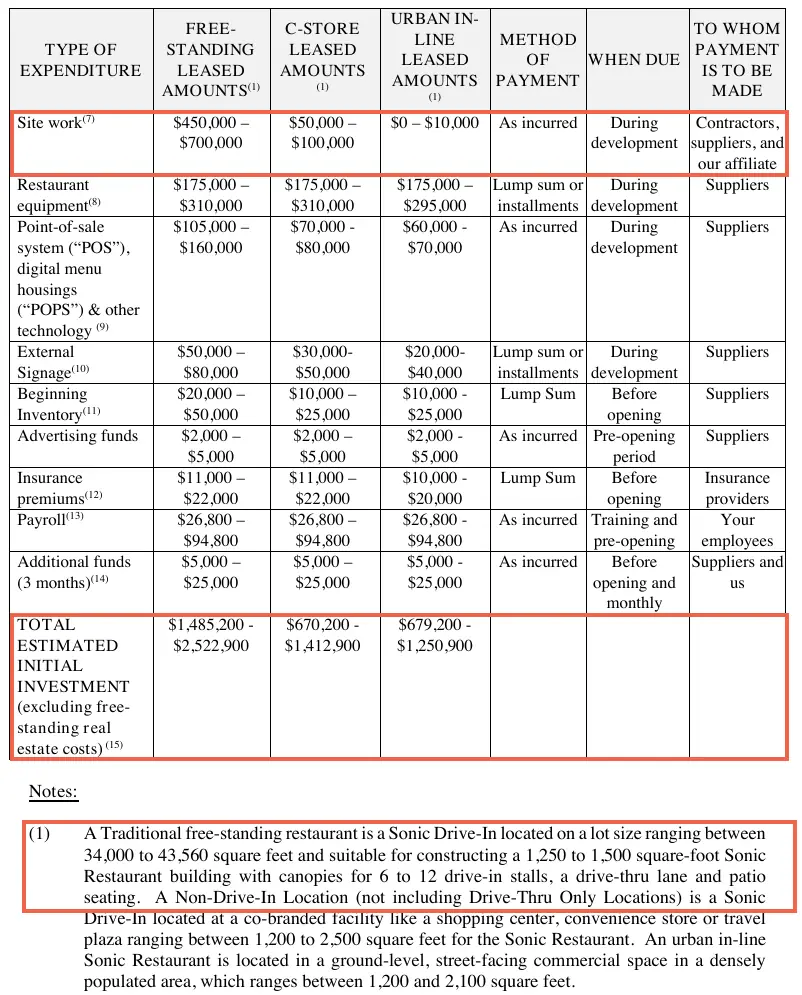
Three cost lines are absent from every column. Note 6 says Sonic cannot estimate rent or purchase costs for a freestanding or in-line site, and that freestanding leases are typically triple net, so taxes, insurance and repairs fall on you. Note 16 says the totals carry no finance charges or debt service, and Item 10 states that Sonic offers no direct or indirect financing.
High-end Item 7 totals: $2,522,900 freestanding, $1,412,900 C-Store, $1,250,900 urban in-line; site work explains most of the gap. Sonic FDD, March 26, 2026.
What do you hand Sonic Franchising LLC before the first car pulls in?
The FDD cover says $15,250 to $17,650 of the freestanding total goes to Sonic or an affiliate. The arithmetic comes from Item 5: the $15,000 franchise fee plus the $250 General Manager Leadership Class reaches $15,250, and adding the optional $1,200 preliminary site layout and $1,200 kitchen layout reaches $17,650. Everything else in Item 7 is paid to contractors, suppliers, landlords and your own staff.
| Payment to Sonic or its affiliate | Amount | When | Source |
|---|---|---|---|
| Initial franchise fee, Traditional Drive-In or Non-Drive-In | $15,000 | At signing | Item 5 |
| Fee to reopen a Sonic site closed within the last year | $12,500, or $5,000 for a franchisee in good standing | At signing | Item 5 |
| Fee for a C-Store or Non-Traditional Location | $11,250 ($1,125 per year of term, up to 10 years) | At signing | Item 5 |
| General Manager Leadership Class | $250 per attendee | On registration, at least 60 days before opening | Item 5 |
| Sonic Training Program, 4th and later trainee | $5,000 per person (first 3 included) | Before training | Item 5 |
| Training cancellation | $1,250 (8 to 14 days out) or $2,500 (7 days or fewer) | On cancellation | Item 5 |
| Preliminary site layout and kitchen layout (optional) | $1,200 each for a new unit | On request | Item 5 |
| Development fee | $10,000 per restaurant in the schedule, credited $10,000 against each franchise fee | At signing the Development Agreement | Item 5 |
Worked example: a three-unit Development Agreement
A developer committing to 3 restaurants pays a $30,000 development fee at signing (3 x $10,000). Each later Franchise Agreement credits $10,000, so the balance due per unit is $5,000 against the $15,000 fee, and the franchisor’s fee take across all 3 units stays at $45,000 (Item 5 and Item 11). The FDD cover prints $20,200 to $100,000 as the total paid to Sonic on signing a Development Agreement, and Note 2 of Item 7 says no other initial investment is due at that stage. More on how these contracts are structured sits in our study of area development agreements.
Monthly percentages after opening, and the five-year royalty ramp
Item 6 sets the standard post-opening load at 5% of Gross Sales for royalty, 0.90% for the Sonic Brand Fund and a 3.25% minimum for the advertising cooperative and System Marketing Fund, all due on the 10th of the following month. C-Store and Non-Traditional units pay a 1.625% minimum to the marketing fund instead. Sonic says it will not require more than 5% for co-op and SMF combined, though a co-op can vote to raise its own share.
| Recurring or event fee | Amount | Source |
|---|---|---|
| Royalty | 5% of Gross Sales, monthly | Item 6 |
| Sonic Brand Fund | 0.90% of Gross Sales, monthly | Item 6 |
| Advertising cooperative and SMF | 3.25% minimum (1.625% minimum for C-Store and Non-Traditional) | Item 6, Note 4 |
| Core, Developing and New market split | Core: 0.5% co-op plus 2.75% to 4.5% SMF; Developing: 0.5% plus 4.5%; New: 5% to SMF | Item 6, Note 4 |
| Inspire Payment Services | About $365 to $565 per month | Item 6 |
| Transfer fee | $1,000 (family, non-control or own entity) or $3,000 (other) | Item 6 |
| Renewal fee | $15,000 | Item 6 |
| Failed inspection retraining | $1,000 per occurrence | Item 6 |
| Late charge | 1.75% per month on the overdue amount | Item 6 |
The 2026 Standard Incentive lowers the royalty for new Traditional Restaurants signed on or before March 31, 2027, provided the unit is built to approved plans and its development costs are reported within 120 days of opening (Item 6, Note 2). Renewals, transfers, relocations and Non-Traditional sites are excluded. During the ramp years Sonic also collects an extra 0.5% of Gross Sales and passes it to your cooperative.
| Item 6 incentive | Royalty effect | Who qualifies |
|---|---|---|
| Standard Incentive | 1% to Year 1, 1.5% Year 2, 2% Year 3, 2.5% Year 4, 5% from Year 5; SMF 50% off through Year 5 | New Traditional Restaurant or Development Agreement signed by March 31, 2027, or a reopened unit closed 30+ days |
| Extended step-down | 2.5% royalty in Years 5 through 8 and SMF 50% off in Years 6 through 8 if a Gross Sales test set in Note 2 is failed at Years 3 and 4 | New Development Agreement only, unit open by December 31, 2028 |
| Relocation Incentive | 1% Year 1, 2% Year 2, 3% Year 3, 5% from Year 4 | Relocated Traditional Restaurant opened within the earlier of December 31 or 6 months of closing |
| Early Opening Incentive | 0% royalty from opening to the required opening date, up to 6 months | Standard Incentive units that open early |
| VetFran Program | $10,000 royalty credit per unit, up to $100,000 | First-time veteran franchisees building Traditional or Drive-Thru Only units |
| Pioneer Incentive | $50,000 royalty credit on each of the first 2 units | First Development Agreement for 2+ units in DC, Maine, New Hampshire or Vermont signed by March 31, 2027 |
Veterans comparing programs across brands can line this credit up against others in our page on franchise opportunities for veterans.
What does the drive-in technology stack cost to buy and keep running?
Sonic’s red-button ordering depends on a speaker at every stall, the POPS digital menu housings and mobile-order hardware, and Item 11 prices that system at approximately $72,000 for a unit with no stalls up to approximately $182,000 for a Traditional Sonic with 30 stalls. Ongoing POS maintenance is $4,000 to $8,000 a year, with field repairs and optional services adding about $1,000 to $5,000 (Item 11). Item 6 adds Inspire Payment Services at about $365 to $565 a month.
| Technology cost | Amount | Source |
|---|---|---|
| POS, POPS and other technology, freestanding (Item 7 line) | $105,000 to $160,000 | Item 7, Note 9 |
| System cost by stall count | About $72,000 (no stalls) to about $182,000 (30 stalls) | Item 11 |
| Mandatory POS software and hardware maintenance | $4,000 to $8,000 per year | Item 11 |
| Field repairs and optional services | About $1,000 to $5,000 per year | Item 11 |
| Inspire Payment Services, including cybersecurity | About $365 to $565 per month | Item 6 |
Item 11 also states that no contract limits how often Sonic can require upgrades or what they cost, and that Sonic has unlimited independent access to your POS sales data. The fiscal 2025 Brand Technology Fund drew $41,623,827 in supplier contributions before it stopped collecting at year end (Item 8). Our franchise technology requirements report compares those clauses across filings.
Who qualifies, and what does Sonic ask of an owner?
The Sonic page on Inspire Brands’ franchising site asks for $500,000 in liquid assets and a $1,000,000 net worth (Inspire Brands, accessed November 8, 2026). The FDD adds the contract conditions: every owner holding 10% or more signs a Personal Guaranty (Item 1 and Item 15), and a Principal owning more than 50% must take part in running the restaurant (Item 15).
| Requirement | Threshold or rule | Source |
|---|---|---|
| Liquid assets | $500,000 | Inspire Brands franchising page |
| Net worth | $1,000,000 | Inspire Brands franchising page |
| Personal guaranty | Every owner of 10% or more | Items 1 and 15 |
| Principal | Owns more than 50%, personally participates | Item 15 |
| Trained staff | Principal plus 2 others complete the 5-week Sonic Training Program (44 to 59 classroom hours, 120 to 135 on-the-job hours) | Item 11 |
| Food safety | All management personnel ServSafe certified, new hires within 120 days | Item 15 |
| Disclosure wait | FDD in hand at least 14 calendar days before signing or paying | FDD cover; 16 CFR 436.2(a) |
Inspire Brands lists 5 steps: apply online, a call with franchise sales, review of the FDD, an interview with franchise leadership, then signing. Under a Development Agreement Sonic can decline to issue each later Franchise Agreement if you no longer meet its then-current financial standards (Item 11), so the thresholds apply unit by unit, not once.
How fast must a Sonic open, and how big is the protected radius?
A single-unit franchisee has 90 days after signing to find a Site that Sonic accepts, and must open by the earlier of the development schedule date or 1 year after Site acceptance, or Sonic may terminate (Item 11). Sonic puts the typical gap from signing to opening at 6 to 12 months, with about 4 months of construction once permits are in hand.
| Milestone | Deadline or typical time | Source |
|---|---|---|
| Locate an accepted Site | Within 90 days after signing | Item 11 |
| Sonic site review | About 30 days after a complete site report | Item 11 |
| Construction and equipment install | About 4 months after permits | Item 11 |
| General Manager Leadership Class | No later than 60 days before opening | Item 5 |
| Opening | Earlier of the DA date or 1 year after Site acceptance | Item 11 |
| Development cost report | Within 120 days after opening | Item 11 |
| Development Agreement to first opening | Typically 1 to 2 years | Item 11 |
Item 12 measures the Protected Area as a radius from the restaurant’s front door, and it shrinks with density: 0.75 mile where more than 125,000 people live per square mile, and 1.5, 2 or 3 miles elsewhere depending on the population of the city, town or MSA. The radius never reaches into an older Sonic’s protected radius or an existing developer’s area.
| Where the restaurant sits | Protected radius | Source |
|---|---|---|
| Density over 125,000 people per square mile | 0.75 mile | Item 12 |
| City, town or MSA of 75,000 or more | 1.5 miles | Item 12 |
| More than 25,000 but under 75,000 | 2 miles | Item 12 |
| 25,000 or less, or outside a city, town or MSA | 3 miles | Item 12 |
How these radius rules compare with other brands’ filings is covered in our franchise territory rights research.
Is the drive-in count growing or shrinking under Inspire Brands?
An affiliate of Inspire Brands became Sonic’s indirect parent in a merger effective December 7, 2018, and the system is also tied through Roark Capital funds to Subway, Dave’s Hot Chicken and other franchisors (Item 1). At the end of fiscal 2025 there were 3,412 Sonic Drive-Ins in the United States and none abroad. Franchised units closed faster than new ones opened in each of the last 3 years.
Franchised openings of 23, 30 and 32 against exits of 49, 80 and 56 in 2023 to 2025. Sonic FDD, March 26, 2026, Item 20.
| Fiscal year | Franchised at start | Opened | Terminated | Ceased for other reasons | Franchised at end | Transfers |
|---|---|---|---|---|---|---|
| 2023 | 3,220 | 23 | 2 | 47 | 3,194 | 75 |
| 2024 | 3,194 | 30 | 12 | 68 | 3,144 | 334 |
| 2025 | 3,144 | 32 | 2 | 54 | 3,120 | 100 |
Company-owned units fell from 317 to 292 in 2025, with 21 closed and 4 sold to franchisees (Item 20, Table No. 4). Table No. 5 lists 12 signed agreements not yet open and 16 projected franchised openings in the next fiscal year, 4 of them in Texas. The 334 transfers in 2024 suggest that buying an operating drive-in is a common entry route, and our guide to buying a franchise resale covers how those deals differ from a new build. Private equity ownership context sits in our private equity franchise ownership report.
Which published Sonic numbers are out of date?
Several pages that rank for Sonic cost queries quote figures from earlier disclosure documents. Each row below sets a published claim beside the figure printed in the 2026 FDD, filed in Minnesota as CARDS document 35683-202603-13.
| Claim in circulation | Where it appears | 2026 FDD figure | Source |
|---|---|---|---|
| $45,000 traditional franchise fee; $22,500 nontraditional | A food-media feature, 2020 | $15,000 traditional; $11,250 C-Store or Non-Traditional | Item 5 |
| Total investment $1,676,000 to $3,140,900 | A franchise profile updated January 2026, citing the 2025 FDD | $1,485,200 to $2,522,900 freestanding | Item 7 |
| Building $800,000 to $1,100,000; site work up to $1,000,000 | Same profile | Building $600,000 to $800,000; site work $450,000 to $700,000 | Item 7 |
| External signage up to $150,000 | Same profile | $50,000 to $80,000 | Item 7 |
| 0.25% Brand Technology Fund fee | Same profile | Not in the Item 6 table; the fund stopped collecting at fiscal 2025 year end | Items 6 and 8 |
Item 19 of the 2026 FDD does exist and reports historical Gross Sales for groups of franchised restaurants for fiscal 2025. We do not reprint those figures; read them in the document itself, and see our Item 19 research for how to read that kind of table.
Matching your capital to a Sonic route
The route that fits depends on how much cash and net worth you bring and whether you control land. The thresholds below come from Item 7 and the Inspire Brands requirement of $500,000 liquid and $1,000,000 net worth; they are not advice, and a lender or franchise attorney should test them against your own balance sheet.
| If your situation is | Route to price first | Why, with the number |
|---|---|---|
| You own a convenience store or travel plaza | C-Store Non-Drive-In Location | Item 7 total from $670,200; rent and deposit can be $0 if you own the building (Note 6); fee $11,250 |
| You have a street-facing lease in a dense city | Urban in-line | Site work only $0 to $10,000; total $679,200 to $1,250,900 |
| You want the full canopy drive-in and can sign by March 31, 2027 | Freestanding Traditional under the Standard Incentive | $1,485,200 to $2,522,900 before land, royalty starting at 1% |
| You plan 2 or more units | Development Agreement | $10,000 per unit up front, credited to each $15,000 fee; Sonic re-checks your finances per unit |
| You are a first-time franchisee and an honorably discharged veteran | Traditional or Drive-Thru Only with VetFran | $10,000 royalty credit per unit up to $100,000, stackable with the Standard Incentive |
| Your liquidity is below $500,000 | Partner capital or a resale | Inspire Brands’ stated minimum is $500,000 liquid; 100 franchised units changed hands in 2025 (Item 20) |
For a wider look at drive-thru brands with lower entry points, our fast food franchise cost comparison sets Sonic beside other drive-thru filings, and the FDD reading guide explains each of the 23 Items cited here.
How we compiled this
We read the Sonic Franchising LLC disclosure document issued March 26, 2026, downloaded from the Minnesota CARDS registry, plus the Sonic page on the Inspire Brands franchising site and the Cornell LII copy of 16 CFR 436.2, all in November 2026. Every column total in Item 7 was re-added by script. We excluded all Item 19 sales figures and any profit estimate under this site’s editorial rules, and nothing here is legal, financial or investment advice.
Frequently asked questions
Is Sonic a franchise?
Yes. Sonic Franchising LLC, a Delaware company formed on March 23, 2011, grants Sonic Drive-In franchises, and its predecessors have franchised since 1974. At the end of fiscal 2025, 3,120 of the 3,412 Sonic Drive-Ins in the United States were franchised (Sonic FDD issued March 26, 2026, Items 1 and 20).
How much does a Sonic franchise cost?
The 2026 Sonic FDD prices a leased freestanding drive-in at $1,485,200 to $2,522,900, a C-Store unit at $670,200 to $1,412,900 and an urban in-line unit at $679,200 to $1,250,900 (Item 7). None of those totals includes buying or leasing land for a freestanding site, and Sonic offers no financing (Item 10).
What are the requirements to own a Sonic?
Inspire Brands asks for $500,000 in liquid assets and $1,000,000 in net worth. The FDD adds that owners of 10% or more sign a personal guaranty, a Principal owning more than 50% takes part in operations, and three people finish the Sonic Training Program before opening (Items 11 and 15).
How much is the Sonic franchise fee?
Item 5 of the 2026 FDD sets the fee at $15,000 for a Traditional Drive-In or Non-Drive-In Location and $11,250 for a C-Store or Non-Traditional site. Reopening a Sonic site closed within the last year costs $12,500, or $5,000 for an existing franchisee in good standing. Relocations pay $0.
How much do Sonic franchise owners make?
This site does not publish income or sales estimates. Item 19 of the 2026 Sonic FDD reports historical Gross Sales for groups of franchised units in fiscal 2025, without costs or profit. What an owner keeps depends on rent, labor, the 5% royalty and roughly 4.15% in fund fees (Item 6), and debt on the Item 7 build.
Are there Sonic franchises for sale?
Yes, existing units change hands regularly. Item 20 of the 2026 FDD counts 75 transfers in 2023, 334 in 2024 and 100 in 2025, and Sonic sold 4 company units to franchisees in 2025. A transfer costs $1,000 or $3,000 under Item 6, and the buyer usually signs Sonic’s current agreement.
Who owns Sonic Drive-In?
An affiliate of Inspire Brands, Inc. became Sonic’s indirect parent in a merger effective December 7, 2018 (Item 1). Inspire Brands also owns Arby’s, Buffalo Wild Wings, Jimmy John’s, Dunkin’ and Baskin-Robbins, and Sonic is affiliated with other franchisors through private equity funds managed by Roark Capital Management.
Sources
- Sonic Franchising LLC, Franchise Disclosure Document, issued March 26, 2026, Items 1, 5, 6, 7, 8, 10, 11, 12, 15, 17, 19 and 20 (Minnesota CARDS document 35683-202603-13). Accessed November 8, 2026.
- Inspire Brands, SONIC franchising page. Accessed November 8, 2026.
- 16 CFR 436.2, Legal Information Institute, Cornell Law School. Accessed November 8, 2026.