
The US franchise definition has three parts: you get the right to use the seller’s trademark, the seller exerts significant control or assistance, and you pay at least $735 by six months after opening (16 CFR 436.1(h), 436.8).
The contract’s label does not decide it. The federal rule covers an arrangement “whatever it may be called,” and of the 8 state statutes compared below only South Dakota copies the federal words, so one deal can be a franchise in New York and not under the FTC test.
Key takeaways
- The Federal Trade Commission defines a franchise by three elements in 16 CFR 436.1(h): trademark, significant control or assistance, and a required payment to the franchisor or an affiliate.
- Since July 12, 2024, deals whose required payments through month six total less than $735 are exempt from the FTC Franchise Rule (89 FR 57077). The floor was $500 in 2007.
- New York General Business Law 681(3) needs only two elements: a franchise fee plus either a marketing plan or a trademark association.
- Minnesota swaps “control or assistance” for a “community of interest” and excludes deals requiring less than $100 a year (Minn. Stat. 80C.01); Virginia requires a written contract and a fee of $500 or more (Va. Code 13.1-559).
- If the federal definition is met and no exemption applies, the seller must deliver the Franchise Disclosure Document at least 14 calendar days before you sign or pay (16 CFR 436.2(a)).
| Number | What it marks | Source |
|---|---|---|
| 3 | Elements in the federal franchise definition | 16 CFR 436.1(h) |
| $735 | Required payments through month six below which the FTC Rule does not apply (since July 12, 2024) | 16 CFR 436.8(a)(1) |
| $1,469,600 | Large-investment exemption, excluding unimproved land and franchisor financing | 16 CFR 436.8(a)(5)(i) |
| $7,348,000 | Net worth for the large-franchisee exemption (entity in business 5 years or more) | 16 CFR 436.8(a)(5)(ii) |
| 14 calendar days | Minimum time between FDD delivery and signing or paying | 16 CFR 436.2(a) |
| 14 states | States with franchise registration laws | GAO-23-105338, p. 7 |
| 498,234 | US franchise establishments in the 2017 Economic Census, 11.4% of establishments in covered industries | Census EC1700FRAN |
What is a franchise? The three-part legal test
Under the FTC Franchise Rule, a franchise is “any continuing commercial relationship or arrangement, whatever it may be called,” in which the seller promises three things: the buyer may run a business identified with the franchisor’s trademark, the franchisor will exert significant control or give significant assistance, and the buyer makes a required payment to the franchisor or an affiliate (16 CFR 436.1(h)).
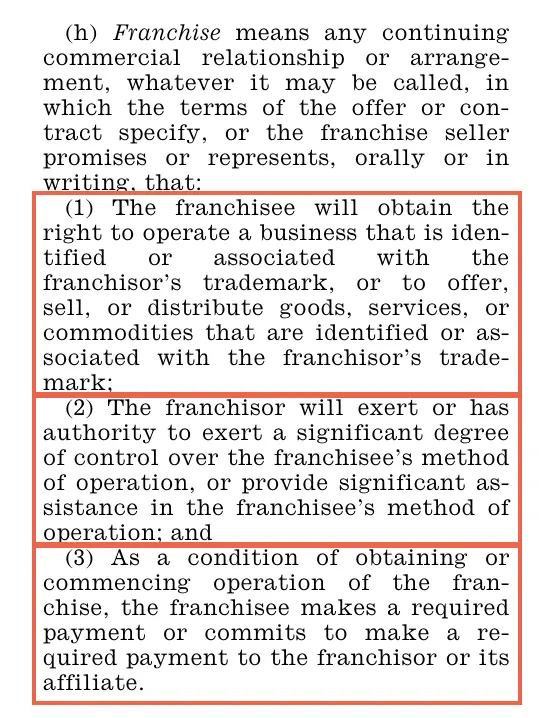
Promises count, not only signed terms. The test turns on what the offer or contract specifies “or the franchise seller promises or represents, orally or in writing.” The FTC’s Franchise Rule Compliance Guide (May 2008, p. 1) says a seller promising a mark and assistance is covered “even if, for example, the seller, in fact, has no trademark.”
The trademark element is read broadly. The Compliance Guide (p. 2) says it covers service marks, trade names and any “other advertising or commercial symbol,” and the franchisor need only hold the right to license the mark. A supplier stays outside the rule by expressly barring a distributor from using its mark. How brands disclose their marks in FDD Item 13 is shown in our franchise trademark index of 259 FDDs.
The rule covers “business format and product franchises” alike (Compliance Guide, p. 1): a business format franchise licenses a whole operating system, while a product franchise licenses the right to sell the franchisor’s trademarked goods. Named brands in both groups are listed on our franchise examples page.
What counts as significant control or assistance?
Control or assistance is “significant” when it relates to the franchisee’s whole method of operation, not one product line, and when buyers reasonably rely on it. The FTC Compliance Guide (pp. 2 to 4) lists 9 types of significant control and 6 types of significant assistance, and says reliance is greatest when buyers are new to the business or take a large financial risk.
| Significant control (Guide p. 3) | Significant assistance (Guide p. 3) | Not significant on its own (Guide p. 4) |
|---|---|---|
| Site approval for unestablished businesses | Formal sales, repair or business training | Point-of-sale displays, sales kits, samples |
| Site design or appearance requirements | Setting up accounting systems | Radio and TV advertising, alone or cooperative |
| Hours of operation | Management, marketing or personnel advice | Trademark controls that only protect ownership of the mark |
| Production techniques; accounting practices | Selecting site locations | Health or safety rules required by law |
| Personnel policies | Systemwide networks and website | Bank credit card interchange agreements |
| Promotions requiring participation or money; customer and area restrictions | A detailed operating manual | Help obtaining financing |
Washington’s statute reaches further. RCW 19.100.010(11) defines a “marketing plan” as a plan “concerning an aspect of conducting business” and names 6 items, any one of which can qualify, including price specifications, training and “operational, managerial, technical, or financial guidelines or assistance.” A thin support package can therefore fail the FTC test and still meet Washington’s.
What counts as a required payment, and where is the $735 line?
A required payment is “all consideration that the franchisee must pay to the franchisor or an affiliate, either by contract or by practical necessity,” minus reasonable inventory bought at bona fide wholesale prices for resale (16 CFR 436.1(s)). If those payments, from before opening to six months after, total less than $735, the FTC Rule does not apply (436.8(a)(1)).
The payment does not have to be called a franchise fee. The Compliance Guide (p. 5) lists 11 kinds that count, including rent, training, security and escrow deposits, bookkeeping charges, equipment rental and continuing royalties. Equipment sold only by the franchisor or its affiliate counts “by practical necessity.” Royalty terms across 259 FDDs are compared in our franchise royalty rates report.
Worked examples: is the payment element met?
The four hypothetical deals below show the arithmetic. Only payments to the franchisor or an affiliate count, wholesale-price inventory for resale is left out, and the large-investment test subtracts unimproved land and franchisor financing before comparing the total with $1,469,600 (16 CFR 436.8(a)(5)(i)). The figures are illustrations, not quotes from any brand’s FDD.
| Scenario | Inputs (hypothetical) | Counted | Test | Result |
|---|---|---|---|---|
| A. Training and signage | $400 training fee + $450 signage from the franchisor’s affiliate, both before month 6 | $850 | $850 vs $735 | Payment element met; Part 436 can apply |
| B. Low entry fee | $600 start-up fee, no other payments to the franchisor | $600 | $600 vs $735 | Exempt under 436.8(a)(1); Minnesota’s $100 a year floor and Virginia’s $500 fee test can still be met |
| C. Inventory only | $5,000 of resale inventory at bona fide wholesale price, no fee | $0 | $0 vs $735 | Not a required payment (436.1(s)) |
| D. Large investment | $1,600,000 total, minus $250,000 unimproved land, minus $100,000 franchisor financing | $1,250,000 | $1,250,000 vs $1,469,600 | Large-investment exemption not available |
How the dollar thresholds have moved
The FTC resets the three dollar thresholds every fourth year using the Consumer Price Index for all urban consumers (16 CFR 436.8(b)). The minimum payment rose from $500 in 2007 to $735 on July 12, 2024, a 47% increase, and the next scheduled reset falls in 2028.
The FTC minimum payment threshold rose from $500 (2007) to $540, $570, $615 and $735 (effective July 12, 2024). Source: Federal Register notices 2007 to 2024, checked October 20, 2026.
| Effective | Minimum payment | Large investment | Large franchisee net worth | Federal Register |
|---|---|---|---|---|
| July 1, 2007 | $500 | $1,000,000 | $5,000,000 | 72 FR 15444 |
| July 1, 2012 | $540 | $1,084,900 | $5,424,500 | 77 FR 36149 |
| July 1, 2016 | $570 | $1,143,100 | $5,715,500 | 81 FR 31500 |
| July 1, 2020 | $615 | $1,233,000 | $6,165,000 | 85 FR 38790 |
| July 12, 2024 | $735 | $1,469,600 | $7,348,000 | 89 FR 57077 |
How do state franchise definitions differ from the FTC’s?
State franchise laws write their own definitions, and California’s 1970 law predates the 1979 federal rule by 9 years. Of the 8 state statutes quoted below, only South Dakota repeats the FTC’s three elements word for word; California, Maryland, Michigan, Virginia and Washington test for a marketing plan, Minnesota for a “community of interest,” and New York accepts a marketing plan or a trademark.
| Jurisdiction and section | Brand element (quoted) | System element (quoted) | Payment element and floor | Source |
|---|---|---|---|---|
| Federal, 16 CFR 436.1(h) | “identified or associated with the franchisor’s trademark” | “significant degree of control” or “significant assistance” | “required payment”; exempt under $735 by month 6 (436.8(a)(1)) | eCFR |
| California, Corp. Code 31005(a) | “substantially associated with the franchisor’s trademark” | “marketing plan or system prescribed in substantial part” | “franchise fee,” directly or indirectly; no dollar floor in 31005 or 31011 | 31005, 31011 |
| Maryland, Bus. Reg. 14-201(e) | “associated substantially with the trademark” | “marketing plan or system prescribed in substantial part” | “franchise fee”; 9 listed exclusions (14-201(f)(3)) | Md. General Assembly |
| Michigan, MCL 445.1502(3) | “substantially associated with the franchisor’s trademark” | “marketing plan or system prescribed in substantial part” | “franchise fee”; notice state, $250 a year | Michigan Attorney General |
| Minnesota, 80C.01 subd. 4 | “using the franchisor’s trade name, trademark” | “community of interest in the marketing of goods or services” | “franchise fee”; excludes under $100 a year (subd. 4(c)) | Revisor of Statutes |
| New York, GBL 681(3) | (b) “substantially associated with the franchisor’s trademark” | (a) “marketing plan or system prescribed in substantial part” | “franchise fee” with (a) or (b); fee up to $500 a year repaid in sales materials excluded (681(7)(e)) | NY Senate |
| South Dakota, SDCL 37-5B-1(11) | Same words as 436.1(h) | Same words as 436.1(h) | “required payment,” as in the FTC text | SD Legislature |
| Virginia, Code 13.1-559 | “substantially associated with the franchisor’s trademark” | “marketing plan or system” for sales “at retail”; “written contract” only | “franchise fee of $500 or more” | Virginia LIS |
| Washington, RCW 19.100.010(6) | “substantially associated with a trademark” | “marketing plan prescribed or suggested in substantial part” | “franchise fee”; mandatory purchases from the franchisor count (19.100.010(8)) | WA Legislature |
That gives four models. The FTC model (Trademark + Significant control or assistance + Required payment) covers federal law and South Dakota; the Marketing plan model (Trademark + Marketing plan + Franchise fee) covers California, Maryland, Michigan, Virginia and Washington; the Community of interest model covers Minnesota 80C.01; and New York’s Either-or model needs a Franchise fee + Marketing plan or trademark. Two elements are enough in New York.
Three differences change outcomes. New York needs no trademark if a fee buys a marketing plan (GBL 681(3)(a)); Washington counts a plan the seller only “suggested”; and Virginia covers only written contracts with a fee of $500 or more, while the FTC test reaches oral promises. Minnesota also sweeps in some vending machine and rack route sales with location help (80C.01 subd. 4(a)(3)).
All 8 states sit on the list of 14 that require registration or a notice filing before an offer (GAO-23-105338, p. 7). Fees, review periods and exemptions for each are in our franchise registration states tracker. Termination and renewal rules use yet other definitions in 18 states and Puerto Rico, compared in our franchise relationship laws tracker.
Which deals meet the definition but are exempt?
A deal can meet all 3 elements and still be exempt from the federal disclosure duty. 16 CFR 436.8(a) lists 7 exemptions, from small payments to experienced buyers, and the rule applies unless “the franchisor can establish” one of them. State registration exemptions are separate and must be checked state by state.
| Exemption | Test | Section |
|---|---|---|
| Minimum payment | Required payments through month 6 under $735 | 436.8(a)(1) |
| Fractional franchise | Buyer or its officers have 2+ years in the same type of business, and franchise sales are expected to stay at or under 20% of total sales in year 1 | 436.1(g); 436.8(a)(2) |
| Leased department | Seller operates inside a retailer’s location and buys no goods from the retailer or its required suppliers | 436.1(l); 436.8(a)(3) |
| Petroleum marketing | Covered by the Petroleum Marketing Practices Act, 15 U.S.C. 2801 | 436.8(a)(4) |
| Large investment | $1,469,600 or more, excluding unimproved land and franchisor financing, plus a signed acknowledgment | 436.8(a)(5)(i) |
| Large franchisee | Entity in business 5+ years with net worth of $7,348,000 or more | 436.8(a)(5)(ii) |
| Insiders | Buyer of 50%+ who, within 60 days of the sale, had 2+ years as an officer, director or franchise sales manager of the franchisor, or owned 25%+ of it | 436.8(a)(6) |
| No written document | Nothing in writing describes any material term | 436.8(a)(7) |
A federal exemption does not switch off state law. A $600 deal exempt under 436.8(a)(1) can still meet Virginia’s $500 fee element, and Minnesota’s floor is $100 a year (80C.01 subd. 4(c)).
Is it a franchise, a license or a business opportunity?
The name does not decide coverage: the Compliance Guide (p. 1) says a self-described “distributorship” is a franchise if it meets the 3 elements. What separates the arrangements is which elements are present, and the FTC regulates business opportunities under a separate rule, 16 CFR Part 437, with its own disclosure form.
| Arrangement | Trademark | Control or assistance | Payment | Federal treatment |
|---|---|---|---|---|
| Franchise | Yes | Significant | $735+ by month 6 | 16 CFR Part 436: FDD 14 days ahead |
| Single trademark license | One licensee only | Not required | Royalty possible | Excluded (Compliance Guide p. 16) |
| Distributorship barred from using the mark | No | Any | Any | Outside Part 436 (Guide p. 2) |
| Business opportunity | Not required | Seller promises locations, outlets, accounts or customers, or buy-back | Required payment | 16 CFR 437.1(c) |
The two rules meet at the payment floor. 16 CFR 437.8 returns a franchise to the Business Opportunity Rule when it is exempt because payments were “less than $500,” and as of the eCFR text dated October 15, 2026 that section still prints $500 while 436.8(a)(1) prints $735. A seller with required payments between $500 and $734 would want counsel’s reading of which rule applies.
Other legal meanings of franchise
Outside commercial franchising, the word also names government grants and fuel supply contracts. Federal cable law defines a franchise as an authorization “issued by a franchising authority” to build or operate a cable system (47 U.S.C. 522(9)), and the Petroleum Marketing Practices Act uses it for a refiner or distributor contract to sell motor fuel under a trademark (15 U.S.C. 2801(1)).
What do common franchise definitions get wrong?
Most definitions in circulation are paraphrases, and some carry figures that have since changed. The table sets claims found in widely read guides, glossaries and older FTC material against the current primary text, checked on eCFR and the Federal Register on October 20, 2026.
| What several sources say | What the primary source says | Source |
|---|---|---|
| “A required payment of at least $500 in the first six months” (the FTC’s 2008 Compliance Guide, FTC staff advisory opinions, many guides) | The floor is $735 since July 12, 2024; $500 applied until July 1, 2012 | 436.8(a)(1); 89 FR 57077 |
| “A fee of $600 or more during the first six months” (a law-firm guide) | No federal floor has been $600: $500, $540, $570, $615, then $735 | 77 FR 36149 to 89 FR 57077 |
| “Franchisees pay an initial fee and royalties” (several glossaries, one dated 2023) | Any required payment counts, including rent, training, deposits or equipment from an affiliate; royalties are not required | 436.1(s); Compliance Guide p. 5 |
| “It is a franchise if the contract calls it one” | Coverage applies “whatever it may be called,” and a deal labelled a franchise is outside the rule if an element is missing | 436.1(h); Compliance Guide p. 1 |
Is your deal a franchise? A decision table
Run the federal test in order: trademark, then control or assistance, then the $735 payment floor, then the 7 exemptions. Then check the state where the outlet will sit, because the 8 state statutes above can give a different answer. The flowchart holds the same logic as the table.
| If | Then | Rule |
|---|---|---|
| No right to use the seller’s trademark | Not a franchise under 16 CFR 436.1(h); check state law and the Business Opportunity Rule | 436.1(h)(1); Guide p. 2 |
| No significant control or assistance (help limited to displays, samples or advertising) | Not a franchise under 16 CFR 436.1(h) | 436.1(h)(2); Guide p. 4 |
| Required payments of $735 or more by month 6: no | Exempt from Part 436; check state law (Minnesota $100 a year, Virginia $500 fee) | 436.8(a)(1) |
| Any other 436.8 exemption applies (large investment, large franchisee, fractional, insider, no written document) | Exempt from the FTC disclosure duty | 436.8(a)(2) to (7) |
| Outlet in New York, fee paid for a marketing plan, no trademark | Can still be a franchise | GBL 681(3)(a) |
| All 3 elements met, no exemption | Franchise: FDD at least 14 calendar days before signing or paying | 436.2(a) |
If the answer is yes, the 23 items of the FDD are explained in our Franchise Disclosure Document guide. Under 16 CFR 436.1(j), a “franchise seller” includes third-party brokers involved in the sale, and their state registration status is tracked in our franchise broker registration report. The 8 steps from shortlist to signing are in our guide to buying a franchise.
How has the legal definition changed since 1970?
California placed its 1970 Franchise Investment Law in Title 4, Securities, of its Corporations Code; the FTC rule followed on October 21, 1979, and its payment floor has moved with inflation every 4 years since 2012. The Compliance Guide (p. 1) says the 2007 amendments kept the three elements “as under the original Rule.”
- 1970: California Franchise Investment Law enacted (Stats. 1970, Ch. 1400)
- 1973: Minnesota franchise law enacted (1973 c 612)
- October 21, 1979: FTC Franchise Rule takes effect
- July 1, 2007: Amended FTC Rule available; $500 payment floor
- July 1, 2008: Amended Rule mandatory for all franchisors
- July 1, 2012: Floor $540
- July 1, 2016: Floor $570
- July 1, 2020: Floor $615
- July 12, 2024: Floor $735 (current)
- 2028: Next scheduled adjustment (every fourth year)
How we compiled this
We read the current text of 16 CFR Parts 436 and 437 through the eCFR versioner (as of October 15, 2026), 5 Federal Register threshold notices from 2007 to 2024, the FTC’s 2008 Compliance Guide, and the definition sections of 7 state statutes on official legislature sites, plus the Michigan Attorney General’s quotation of MCL 445.1502(3). Illinois, Wisconsin, Hawaii, Rhode Island, North Dakota and Indiana are left out because their official statute sites did not load for us in October 2026. The worked examples are hypothetical arithmetic. This page is general information, not legal advice: ask a franchise attorney how your contract reads under your state’s definition and whether any 436.8 exemption applies.
Frequently asked questions
What is the simple definition of a franchise?
A franchise is a deal in which a business pays to operate under another company’s trademark and system. Under federal law it takes 3 things: the right to use the franchisor’s mark, significant control or assistance from the franchisor, and required payments of at least $735 between signing and six months after opening (16 CFR 436.1(h) and 436.8(a)(1), as of October 2026).
What are the 3 elements of a franchise?
The FTC Franchise Rule names them in 16 CFR 436.1(h): a trademark element (the business is identified or associated with the franchisor’s mark), a control or assistance element (significant control over, or significant assistance with, the method of operation), and a payment element (a required payment to the franchisor or an affiliate). All 3 must be present for the federal rule to apply.
Is a franchise the same as a license?
Not always. A trademark license lets someone use a mark; it becomes a franchise under federal law only when the licensor also exerts significant control or gives significant assistance and requires payments of $735 or more by month six. The FTC excludes licenses granted to a single licensee, such as collateral product licensing on clothing (Franchise Rule Compliance Guide, 2008, p. 16).
What is the minimum fee for a business to be a franchise?
Under the FTC Rule, a deal is exempt when required payments to the franchisor or an affiliate, from before opening to six months after, total less than $735 (16 CFR 436.8(a)(1), effective July 12, 2024). States draw their own lines: Virginia requires a franchise fee of $500 or more, and Minnesota excludes deals requiring less than $100 a year.
What is the difference between a franchise and a business opportunity?
A business opportunity under 16 CFR 437.1(c) is a deal in which the seller promises locations, outlets, accounts or customers, or to buy back what you produce, in return for a required payment. It needs no trademark. A franchise needs a trademark plus significant control or assistance, and franchises covered by Part 436 are carved out of Part 437 by 16 CFR 437.8.
Do all states use the FTC franchise definition?
No. Of 8 state statutes we compared in October 2026, only South Dakota copies the federal wording (SDCL 37-5B-1(11)). California, Maryland, Michigan, Virginia and Washington test for a marketing plan, Minnesota for a community of interest, and New York needs only a fee plus either a marketing plan or a trademark (GBL 681(3)).
Which states register franchises?
Fourteen states have franchise registration laws: California, Hawaii, Illinois, Indiana, Maryland, Michigan, Minnesota, New York, North Dakota, Rhode Island, South Dakota, Virginia, Washington and Wisconsin (GAO-23-105338, p. 7). Fees, review periods and exemptions for each state are compared in our franchise registration states tracker.
Sources
- 16 CFR 436.1, Definitions, eCFR, accessed 2026-10-20
- 16 CFR 436.2, Obligation to furnish documents, eCFR, accessed 2026-10-20
- 16 CFR 436.8, Exemptions, eCFR, accessed 2026-10-20
- 16 CFR 437.1 and 437.8, Business Opportunity Rule, eCFR, accessed 2026-10-20
- 16 CFR 436.1, annual edition revised as of January 1, 2026, GovInfo, accessed 2026-10-20
- Federal Register: 72 FR 15444, 77 FR 36149, 81 FR 31500, 85 FR 38790, 89 FR 57077, accessed 2026-10-20
- Franchise Rule Compliance Guide (May 2008), Federal Trade Commission, accessed 2026-10-20
- California Corporations Code 31005 and 31011, accessed 2026-10-20
- Maryland Code, Business Regulation 14-201, accessed 2026-10-20
- Michigan Department of Attorney General, Franchises, accessed 2026-10-14
- Minnesota Statutes 80C.01, accessed 2026-10-20
- New York General Business Law 681, accessed 2026-10-20
- South Dakota Codified Laws 37-5B-1, accessed 2026-10-20
- Code of Virginia 13.1-559, accessed 2026-10-20
- Revised Code of Washington 19.100.010, accessed 2026-10-20
- 47 U.S.C. 522 and 15 U.S.C. 2801, Cornell LII, accessed 2026-10-20
- GAO-23-105338, FTC: Actions Needed to Improve Education Efforts, accessed 2026-10-07
- 2017 Economic Census, Franchise Status (EC1700FRAN), U.S. Census Bureau, accessed 2026-10-04