
How to franchise a business: form a franchisor entity, protect the trademark, write a 23-Item FDD under 16 CFR Part 436, add audited financials, and register in any of 14 registration states before selling there.
Key takeaways
- The FTC’s own paperwork estimate puts a new franchisor’s first disclosure document at about 30 attorney hours at $450 an hour, or $13,500, and each yearly update at 3 hours, or $1,350 (91 FR 24236, May 5, 2026).
- A brand-new franchisor may start selling with an unaudited opening balance sheet under the Item 21 phase-in in 16 CFR 436.5(u)(2), yet all 39 start-up FDDs in our 259-FDD sample attached audited statements, per our franchisor financial statements review.
- 14 states require registration before you offer or sell there (GAO-23-105338, p. 7); statutory initial fees run from $250 in Hawaii, Michigan, North Dakota and South Dakota to $1,865 in California, $7,615 for all 14.
- The USPTO charges $350 per class for an electronic trademark application (USPTO fee schedule, effective January 19, 2025); 247 of 259 recent FDDs (95.4%) list a Principal Register registration for the brand name.
- The federal rule does not reach a deal whose required payments through six months after opening total under $735 (16 CFR 436.8(a)(1), as set by 89 FR 57077 on July 12, 2024).
- In 2025, Minnesota attached a fee deferral condition to 103 of 203 new franchise registrations (50.7%), read from orders on Minnesota CARDS, so a first-time franchisor may wait until opening to collect its initial fee there.
When is licensing your business legally a franchise?
Under 16 CFR 436.1(h), a deal is a franchise when three things are true: the buyer operates under your trademark, you exert or may exert significant control or give significant assistance, and the buyer makes a required payment to you or an affiliate. Calling the contract a license changes nothing if all three elements are present.
Once the three elements line up, selling without a current disclosure document is an unfair or deceptive practice under Section 5 of the FTC Act (16 CFR 436.2). States add their own penalties: Minnesota sets civil fines of up to $2,000 per violation and, for willful violations, fines of up to $10,000 or prison of up to five years (Minn. Stat. 80C.16).
The three elements, and how state definitions differ from the federal one, are set out in our guide to the definition of a franchise. The rest of this page assumes your deal meets all three and is not exempt.
What are the steps to franchise a business?
Franchising a business takes 8 steps, and each one has a rule behind it: prove the model, form the franchisor entity, file the trademark, write the FDD and franchise agreement, audit the financials, register or file in states, sell under the disclosure rules, and reissue the FDD every year. The list gives each step’s rule and a dated figure.
- Prove the model in a unit you run. Item 1 must say whether you operate businesses of the type you franchise (16 CFR 436.5(a)(6)(i)), and the Item 20 tables count company-owned outlets (436.5(t)). Of 45 brands franchising under 5 years in our emerging franchise brands index, 34 reported at least one company-owned outlet.
- Form the franchisor entity. Item 1 discloses the entity type and the state where it was organized (436.5(a)(5)), and Item 21 presents that entity’s statements. A spin-off of a franchisor that already has audited statements cannot use the audit phase-in (FTC Franchise Rule Compliance Guide, May 2008, p. 115).
- File the trademark. An electronic USPTO application costs $350 per class, plus $150 per class for a statement of use if you file on intent to use (37 CFR 2.6). Item 13 must give the registration number, or print the federal warning that the mark has no federal registration (436.5(m)(4)).
- Write the FDD and the franchise agreement. The FDD answers 23 Items set by 436.5(a) to (w), and the franchise agreement is attached as Item 22 (436.5(v)). FTC staff assume about 30 hours of attorney time for a new franchisor’s first document.
- Get the financial statements audited. Item 21 requires statements under US GAAP, audited by an independent CPA (436.5(u)(1)), with a three-year phase-in for start-ups (436.5(u)(2)).
- Register or file in states. Register before offering in any of the 14 registration states, at initial fees from $250 to $1,865, and file a notice where one of 6 filing states asks for it.
- Sell under the disclosure rules. Deliver the FDD at least 14 calendar days before the buyer signs or pays (436.2(a)), give 7 calendar days for any agreement you change on your own (436.2(b)), and make earnings claims only in Item 19 with written substantiation (436.9(c)).
- Reissue the FDD every year. Prepare a revised FDD within 120 days after each fiscal year ends, add quarterly revisions for material changes (436.7(a) and (b)), and renew each state registration, for example at $1,245 a year in California.
| Key number | What it governs | Source |
|---|---|---|
| 23 Items | Required FDD contents | 16 CFR 436.5(a) to (w) |
| 30 hours at $450 | FTC staff estimate of attorney time for a new franchisor’s FDD ($13,500) | 91 FR 24236 (May 5, 2026) |
| 14 calendar days | Minimum gap between delivering the FDD and signing or payment | 16 CFR 436.2(a) |
| 120 days | Deadline to reissue the FDD after fiscal year end | 16 CFR 436.7(a) |
| $735 | Required payments through month six below which the federal rule does not apply | 16 CFR 436.8(a)(1); 89 FR 57077 |
| 14 states | Registration before offer or sale | GAO-23-105338, p. 7, note 18 |
| $350 per class | USPTO electronic base application fee | 37 CFR 2.6(a)(1)(iii); USPTO fee schedule |
| $1,865 | California initial registration fee, highest of the 14 | Cal. Corp. Code 31500 |
What does your FDD need from you as a new franchisor?
Most of the 23 FDD Items are facts you look up, such as litigation in Item 3 or outlet counts in Item 20. A new franchisor makes real choices in about seven: the initial fee (Item 5), recurring fees (Item 6), the investment estimate (Item 7), territory (Item 12), trademarks (Item 13), any earnings claim (Item 19) and financial statements (Item 21).
The table pairs each decision with its rule section in 16 CFR 436.5 and what 259 FDDs issued in 2025 and 2026 show. The buyer-side reading of all 23 Items is in our franchise disclosure document guide.
| Item | What you decide | Rule | What 259 recent FDDs show |
|---|---|---|---|
| Item 5 | Initial fee amount and any refund terms | 436.5(e) | Median initial fee $49,500 (royalty rates report) |
| Item 6 | Royalty, brand fund and other recurring fees | 436.5(f) | Median royalty 6% of sales in 239 FDDs with a percentage royalty |
| Item 7 | Low and high investment estimate, including additional funds | 436.5(g) | 91.5% budget additional funds for exactly 3 months |
| Item 12 | Whether to protect a territory | 436.5(l) | 85.3% print “You will not receive an exclusive territory” |
| Item 13 | Which marks to license; registration status | 436.5(m) | 95.4% registered on the Principal Register; 4.6% pending only |
| Item 19 | Whether to make a financial performance representation | 436.5(s); 436.9(c) | 77.2% include one (optional) |
| Item 21 | Audited statements, or the start-up phase-in | 436.5(u) | 15.1% are start-ups; all 39 attach audited statements |
Item 19 is optional, but any earnings figure you share with a prospect must sit in Item 19 and rest on written substantiation (436.9(c)). The share of FDDs that include one, and what kind of data they report, is in our Item 19 disclosure index.
When do your financial statements have to be audited?
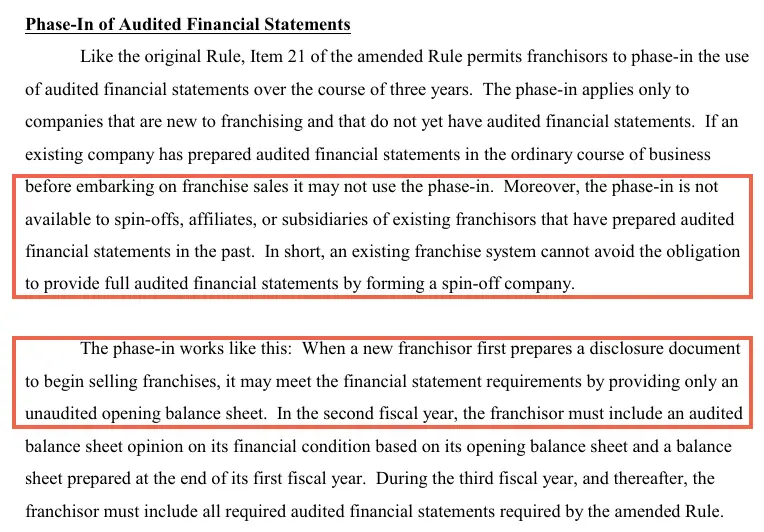
Item 21 requires audited GAAP statements: balance sheets for the last 2 fiscal year-ends and operations, equity and cash flows for 3 years (16 CFR 436.5(u)(1)). A franchisor new to franchising may phase this in over three fiscal years, starting with an unaudited opening balance sheet, under 436.5(u)(2).
| Fiscal year selling franchises | Minimum financial statements | Rule |
|---|---|---|
| First partial or full year | Unaudited opening balance sheet | 16 CFR 436.5(u)(2)(i) |
| Second year | Audited balance sheet opinion as of the end of the first year | 16 CFR 436.5(u)(2)(ii) |
| Third year and later | All required audited statements | 16 CFR 436.5(u)(2)(iii) |
The phase-in has limits. A company that already prepared audited statements in the ordinary course of business may not use it, and neither may a spin-off, affiliate or subsidiary of an existing franchisor with audited statements, as the FTC states on page 115 of its 2008 compliance guide.
Practice runs stricter than the federal floor. In our review of 259 Minnesota-filed FDDs issued in 2025 and 2026, 39 (15.1%) said the franchisor could not yet include three years of statements, and all 39 still attached audited statements, often an audited opening balance sheet. Budget for an audit before your first registration filing, not in year two.
Weak numbers do not block registration, but they draw conditions. Of the 259 FDDs, 28.6% showed negative equity, and registration states answered with fee deferral, escrow or a surety bond. Minnesota attached a fee deferral to 103 of 203 new registrations in 2025, which means the franchisor collects the initial fee only after it meets its pre-opening obligations (Minn. Stat. 80C.05).
Which states make you register before you sell?
Fourteen states require registration or a registration-style filing before you offer or sell a franchise there: California, Hawaii, Illinois, Indiana, Maryland, Michigan, Minnesota, New York, North Dakota, Rhode Island, South Dakota, Virginia, Washington and Wisconsin (GAO-23-105338, note 18). In 9 a regulator reviews the filing; in 5 it takes effect on filing.
| State | Initial fee | Renewal or annual fee | Takes effect | Statute |
|---|---|---|---|---|
| California | $1,865 | $1,245 | 30th business day | Corp. Code 31500, 31116 |
| New York | $750 | $150 | On acceptance | Gen. Bus. Law 694 |
| Washington | $600 | $100 | 15th business day | RCW 19.100.240 |
| Rhode Island | $600 | $300 | 30th business day | R.I. Gen. Laws 19-28.1-29 |
| Maryland | $500 | $250 | 30th business day | Bus. Reg. 14-215, 14-219 |
| Virginia | $500 | $250 | On Commission findings | Va. Code 13.1-561 |
| Illinois | $500 | $100 | 21st day after filing | 815 ILCS 705/40, 705/10 |
| Indiana | $500 | $250 | On receipt | IC 23-2-2.5 |
| Minnesota | $400 | $200 | On the commissioner’s order | Minn. Stat. 80C.04, 80C.08 |
| Wisconsin | $400 | $400 | On receipt | Wis. Stat. 553.72 |
| Hawaii | $250 | $250 | Filed 7 days before a sale | HRS 482E-3 |
| Michigan | $250 | $250 | On filing (annual notice) | MCL 445.1507a |
| North Dakota | $250 | $100 | On entry in the register | N.D.C.C. 51-19 |
| South Dakota | $250 | $150 | On receipt | SDCL 37-5B |
| All 14 | $7,615 | $3,995 | Sum of statutory fees |
Initial statutory registration fees in the 14 registration states, $7,615 in total; California’s rose from $675 to $1,865 on July 1, 2025. State statutes, checked October 2026.
Fees above are statutory filing fees only, as checked at each statute for our franchise registration states tracker on October 7, 2026; we re-read the New York, Washington, Maryland, Virginia and Minnesota texts on October 26, 2026. California’s $1,865 took effect on July 1, 2025 under AB 137, up from $675.
Six more states ask for a notice rather than a registration: Connecticut, Florida, Kentucky, Nebraska, Texas and Utah, with fees from none stated to $100 a year. Connecticut’s filing is a copy of the federal trademark certificate, which ties step 3 to state compliance. Larger franchisors may qualify for state exemptions, for example a $5 million net worth test in California, Indiana, New York and Washington.
Anyone who sells for you may need a license too. New York and Washington register franchise brokers, at $150 under Gen. Bus. Law 694(1)(c) and $50 under RCW 19.100.240(4); the state-by-state rules are in our franchise broker registration tracker.
How much does it cost to franchise your business?
Government sources price four parts of franchising your business: attorney time for the FDD (the FTC assumes 30 hours at $450), USPTO filing ($350 per class), state registration ($250 to $1,865 per state) and FDD delivery ($5 electronic, $40 on paper). No government source prices the audit, operations manual or sales budget, so we leave those out rather than guess.
The worked example below is arithmetic from those dated unit figures, for a franchisor that files one trademark class on intent to use, registers in California, New York and Illinois, and sends 100 FDDs electronically in year one, the FTC’s per-franchisor average. It is a floor, not a quote.
| Line | Inputs | Arithmetic | Amount | Source |
|---|---|---|---|---|
| FDD preparation | 30 attorney hours at $450 | 30 x $450 | $13,500 | 91 FR 24236 |
| Trademark, 1 class | Base application plus statement of use | $350 + $150 | $500 | 37 CFR 2.6; USPTO fee schedule |
| State registration | California, New York, Illinois | $1,865 + $750 + $500 | $3,115 | Corp. Code 31500; GBL 694; 815 ILCS 705/40 |
| FDD delivery | 100 electronic disclosures at $5 | 100 x $5 | $500 | 91 FR 24236 |
| Year-one sourced total | $13,500 + $500 + $3,115 + $500 | $17,615 | Our arithmetic | |
| Each later year | 3 update hours at $450, plus 3 state renewals | $1,350 + $1,245 + $150 + $100 | $2,845 | 91 FR 24236; registration states tracker |
The $450 rate is the FTC’s assumption for in-house counsel; its footnote 3 says franchisors often use outside counsel, “typically compensated at a higher rate than in-house attorneys.” Registering in all 14 states instead of 3 raises the state line from $3,115 to $7,615. This is general information, not legal or financial advice; ask your franchise attorney for a written estimate of hours by FDD Item.
Fees are only half the cost question. How franchisors recover these costs, through royalties, initial fees, rent and supply sales, is compared across 26 public companies in our report on how franchisors make money.
How long does it take before you can sell your first franchise?
The fixed waits are set by rule: a trademark application took 4.45 months to a first USPTO action in the first half of fiscal 2026, state registrations take effect between the day of filing and the 30th business day, and every buyer gets the FDD at least 14 calendar days before signing (USPTO, May 5, 2026; 16 CFR 436.2(a)).
| Event | Waiting period | Rule or source |
|---|---|---|
| USPTO first examiner action | 4.45 months (first half of FY2026; 5.6 months in FY2025) | USPTO, May 5, 2026 |
| USPTO total processing | 10.03 months (first half of FY2026; 11.7 months in FY2025) | USPTO, May 5, 2026 |
| Washington registration | 15th business day | RCW 19.100 |
| Illinois registration | 21st day after filing | 815 ILCS 705/10 |
| California, Maryland, Rhode Island | 30th business day | Corp. Code 31116; Bus. Reg. 14-218; R.I. Gen. Laws 19-28.1 |
| Hawaii | File 7 days before a sale | HRS 482E-3 |
| Each buyer | FDD at least 14 calendar days before signing or payment | 16 CFR 436.2(a) |
| Each year | Revised FDD within 120 days after fiscal year end | 16 CFR 436.7(a) |
You do not need a registered mark to sell: 12 of 259 recent FDDs (4.6%) sold under a mark with only a pending application, and 11 of them printed the full federal warning, per our franchise trademark index. A registration can therefore follow the first sale, but the warning must appear until it issues.
Timing also depends on the annual cycle. A franchisor with a December 31 fiscal year end must have its revised FDD ready by April 30 under the 120-day rule in 436.7(a), so a first registration filed in late autumn may need an amendment within months.
Do you need an FDD at all, and when must you register first?
You need an FDD for every sale unless an exemption in 16 CFR 436.8 applies, and you must register first wherever a registration state’s law reaches the buyer or the outlet. The decision table gives the federal thresholds, set on July 12, 2024 and adjusted every fourth year by CPI-U (436.8(b)).
| If | Then | Rule |
|---|---|---|
| The deal lacks the trademark, control or assistance, or required payment element | It is not a franchise under the federal rule; check state definitions | 16 CFR 436.1(h) |
| Required payments through 6 months after opening total under $735 | Federal rule does not apply to the deal | 16 CFR 436.8(a)(1) |
| The buyer invests at least $1,469,600, excluding unimproved land and your financing, and signs the acknowledgment | That sale is exempt from federal disclosure | 16 CFR 436.8(a)(5)(i) |
| The buyer entity has 5 years in business and $7,348,000 net worth | That sale is exempt from federal disclosure | 16 CFR 436.8(a)(5)(ii) |
| A buyer of at least 50% has been your officer for 2 years, or a 25% owner for 2 years | Insider sale is exempt | 16 CFR 436.8(a)(6) |
| You are new and have no audited statements | You may use the 3-year phase-in, but budget for an audit if you register | 16 CFR 436.5(u)(2) |
| You spun off from a franchisor that has audited statements | No phase-in; full audited statements | FTC Compliance Guide, p. 115 |
| Your principal mark is not on the Principal Register | Print the no-federal-registration statement in Item 13 | 16 CFR 436.5(m)(4) |
| The buyer or outlet is in one of the 14 registration states | Register or file before you offer there | State statute (fee $250 to $1,865) |
Federal exemptions do not carry over to the states automatically. Illinois exempts franchisors with an audited $15 million net worth from registration but still requires disclosure, and Minnesota’s 80C.03 has no net worth exemption at all, per our registration states tracker.
What do popular franchising guides get wrong?
We compared the top-ranking “how to franchise” guides with the primary sources and found 4 repeated errors: an undercount of registration states, a claim that audits must come before any sale, a state fee floor taken from renewal fees, and cost totals with no government source. Each correction below names the rule that settles it.
| What a guide says | What the primary source says | Source |
|---|---|---|
| A law-firm guide updated August 2026 says 13 states require registration | The FTC and NASAA list 14 | GAO-23-105338, note 18 |
| A law-firm cost page updated July 2026 says audited statements are required before franchises can be offered | A start-up may begin with an unaudited opening balance sheet (though registration-state practice favors an audit) | 16 CFR 436.5(u)(2)(i) |
| The same page puts state registration fees at $100 to $1,865 per state | The lowest statutory initial fee is $250; $100 is a renewal or annual fee in Illinois, Washington and North Dakota | 815 ILCS 705/40; RCW 19.100.240; N.D.C.C. 51-19 |
| Several guides quote total franchising budgets with no source | The only government cost figure is the FTC’s 30 hours at $450 for a new FDD | 91 FR 24236 |
How we compiled this
We read the eCFR text of 16 CFR Part 436 (version of October 1, 2026), the FTC’s May 5, 2026 paperwork notice, the FTC’s 2008 compliance guide, GAO-23-105338, the USPTO fee schedule and 5 state statutes in October 2026, and reused statute checks and 259-FDD counts from our own research reports. We excluded vendor cost estimates and any figure we could not open at its source.
Frequently asked questions
How much does it cost to franchise your business?
Government sources price only part of it. The FTC assumes 30 attorney hours at $450, or $13,500, for a new franchisor’s first FDD (91 FR 24236, May 5, 2026). USPTO filing costs $350 per class, and state registration costs $250 to $1,865 per state, $7,615 for all 14. Audit, operations manual and sales costs have no government benchmark.
Do I need audited financial statements before I sell my first franchise?
Not under the federal rule. 16 CFR 436.5(u)(2) lets a franchisor new to franchising start with an unaudited opening balance sheet, add an audited balance sheet in year two and full audits from year three. Spin-offs of audited franchisors cannot use it. In practice, all 39 start-up FDDs in our 259-FDD Minnesota sample attached audited statements.
Which states require franchise registration?
Fourteen: California, Hawaii, Illinois, Indiana, Maryland, Michigan, Minnesota, New York, North Dakota, Rhode Island, South Dakota, Virginia, Washington and Wisconsin, per the FTC and NASAA list in GAO-23-105338. Statutory initial fees run from $250 to $1,865 in California. Connecticut, Florida, Kentucky, Nebraska, Texas and Utah ask for a notice filing instead.
Do I need a registered trademark to franchise my business?
No federal rule requires one, but Item 13 must disclose the status. If the principal mark is not on the USPTO Principal Register, the FDD must print a warning that the mark lacks federal registration benefits (16 CFR 436.5(m)(4)). 12 of 259 recent FDDs sold under a pending application only. An electronic application costs $350 per class.
How long does it take to franchise a business?
The rule-set waits are short; drafting and the audit take longer. State registrations take effect from the day of filing to the 30th business day, each buyer needs the FDD 14 calendar days before signing, and a USPTO application reached first action in 4.45 months in early fiscal 2026. The FDD must then be reissued within 120 days of each fiscal year end.
Can I sell franchises without an FDD?
Only if an exemption in 16 CFR 436.8 applies: required payments under $735 through six months after opening, a buyer investing at least $1,469,600, a buyer entity with $7,348,000 net worth and 5 years in business, or an insider purchase. State laws can still require registration or disclosure when the federal rule does not.
Sources
- 16 CFR Part 436, Disclosure Requirements and Prohibitions Concerning Franchising, eCFR, accessed October 26, 2026
- Federal Trade Commission, Agency Information Collection Activities, Franchise Rule, 91 FR 24235 to 24237, May 5, 2026, accessed October 26, 2026
- Federal Trade Commission, Franchise Rule threshold adjustments, 89 FR 57077, July 12, 2024, accessed October 26, 2026
- Federal Trade Commission, Franchise Rule Compliance Guide, May 2008, p. 115, accessed October 26, 2026
- U.S. Government Accountability Office, GAO-23-105338, April 2023, p. 7 and note 18, accessed October 26, 2026
- USPTO fee schedule, effective January 19, 2025, last revised August 14, 2026, accessed October 26, 2026
- USPTO, Reducing trademark pendency, May 5, 2026, accessed October 26, 2026
- New York General Business Law 694, accessed October 26, 2026
- Revised Code of Washington 19.100.240, accessed October 26, 2026
- Maryland Business Regulation 14-215, accessed October 26, 2026
- Code of Virginia 13.1-561, accessed October 26, 2026
- Minnesota Statutes chapter 80C, accessed October 26, 2026
- California Corporations Code 31500, read for our registration tracker October 7, 2026
- Illinois Franchise Disclosure Act, 815 ILCS 705/40, read for our registration tracker October 7, 2026
- Minnesota Department of Commerce, CARDS franchise registrations, FDDs issued 2025 to 2026 and registration orders 2024 to 2026, read for our research reports in October 2026