A commercial cleaning franchise usually sells you a promised volume of monthly customer billing: 2026 FDDs price it at $2.88 to $8.75 per dollar of monthly billing, then deduct 15% to 18% of every invoice.
Key takeaways
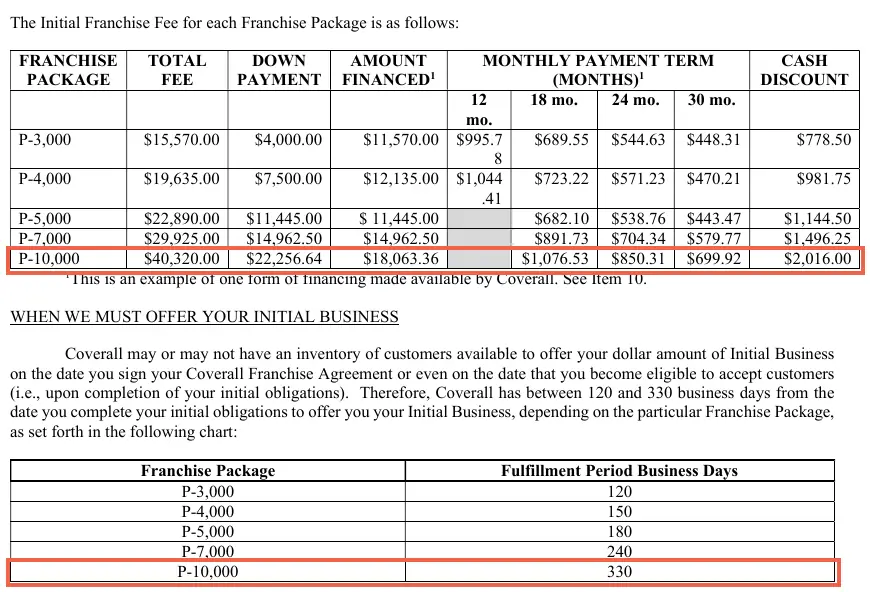
- Coverall charges $40,320 for its P-10,000 package, Jani-King of Minnesota $40,250 for its E-10 plan and OpenWorks $33,000 for OW 10, each promising $10,000 of monthly customer billing (Item 5 of the Coverall FDD, the Jani-King of Minnesota FDD and the OpenWorks FDD, 2026).
- If the accounts never arrive, the refund is 3 times the undelivered monthly billing at Coverall, Anago of Minneapolis and Jani-King of Minnesota and 2.56 to 2.71 times at OpenWorks, below the list price per billing dollar of every package compared here (Item 5 and Item 11 of each FDD).
- Mandatory deductions take 15% of billing at Coverall, 17% at Jani-King of Minnesota and 18% at Anago of Minneapolis and OpenWorks before supplies, payroll or insurance (Item 6 of each FDD, including the Anago of Minneapolis FDD).
- “All contracts will be the property of Jani-King,” states Item 11 of the Jani-King of Minnesota FDD, while Coverall assigns accepted service agreements to the franchisee except National Accounts, multi-location contracts and contracts that bar assignment (Coverall FDD, Item 5).
- A regional developer territory is a different purchase: Jan-Pro’s costs $130,000 to $421,500 to open and pays Jan-Pro 4% of revenue plus 10% of unit franchise fees (cover page and Item 6 of the Jan-Pro Franchising International FDD, issued February 11, 2026).
What does a commercial cleaning franchise actually sell you?
In janitorial franchising the core product is customer billing, not a storefront. You pay an initial fee sized to a promised monthly billing volume, the franchisor or a regional office signs the cleaning contracts and collects the invoices, and you clean the buildings and receive what remains after fees. Four of the six 2026 FDDs reviewed here use that design; Jan-Pro’s sells the master tier and System4’s a management model.
The structure has up to 3 tiers above the building being cleaned. Each tier has its own contract and its own fee, and the unit buyer signs only with the tier directly above it (16 CFR 436.1(k) calls the middle tier a subfranchisor):
- Brand franchisor. Owns the marks and sells master territories. Anago Franchising, Inc. had 44 subfranchises at December 31, 2025 and “does not sell unit franchises, like the one you will operate, directly to unit franchisees” (Anago of Minneapolis FDD, Item 1).
- Master or regional office. Sells unit franchises, signs customers, bills and collects every invoice, and pays the brand a royalty (Jan-Pro: 4% of revenue plus 10% of unit fees).
- Unit franchisee. Buys a package of monthly billing, cleans the assigned buildings and receives billing minus 15% to 18% in fees.
- Customer building. An office, school or clinic under a cleaning contract; its monthly invoice is paid to the office, not to you.
Coverall and OpenWorks skip the middle tier: the franchisor sells the package and bills the customer itself (Coverall FDD, Item 6, note 1; OpenWorks FDD, Item 1).
Franchising is the minority route in this trade. The 2017 Economic Census franchise file counted 60,337 janitorial establishments (NAICS 561720), of which 7,484, or 12.4%, were franchise establishments; franchise locations averaged 13.9 employees against 18.6 at non-franchise ones. Our home service franchise statistics report sets that 12.4% beside 21 other home service industries.
| System (filer) | What is sold | Item 7 initial investment | Term (Item 17) | Franchised outlets, end of 2025 (Item 20) | Item 19 content | Source |
|---|---|---|---|---|---|---|
| Coverall North America | Unit package, sold direct | $17,986 to $64,280 | 20 years | 5,669 | Package fulfillment data | FDD issued Mar 30, 2026 |
| Anago of Minneapolis (NTGY, Inc.) | Unit package, sold by a subfranchisor | $12,750 to $68,250 | 5 years | 45 | None | FDD issued May 1, 2026 |
| Jani-King of Minnesota | Unit plan, sold by a regional company | $49,754 to $137,887 | 10 years | 4,731 (US system) | None | FDD issued Apr 30, 2026 |
| OpenWorks (O.P.E.N. America) | Unit package, sold direct | $4,250 to $134,480 | 10 years | 402 | None | FDD issued Apr 9, 2026 |
| Jan-Pro Franchising International | Regional developer (master) territory | $130,000 to $421,500 | 10 years | 108 (fiscal year to Sept 30, 2025) | Regional developer revenue data | FDD issued Feb 11, 2026 |
| System4 | Management model, no unit sales | $128,000 to $377,000 | 20 years | 61 | Revenue data | FDD issued Mar 26, 2026 |
Item 20 tells two different stories. Coverall’s franchised count rose by 81 in 2025 to 5,669, Jani-King’s US system fell by 128 to 4,731, and OpenWorks went from 654 franchised outlets at the start of 2023 to 402 at the end of 2025. Anago of Minneapolis held at 45 after it “acquired 20 existing Outlets from another subfranchisor” in 2025 (Item 20, Table 3 note).
How much does a dollar of monthly billing cost in each package?
Divide each Item 5 fee by the monthly billing it promises and the 2026 packages run from $2.88 per billing dollar (OpenWorks OW 25) to $8.75 (Anago of Minneapolis Program I). Small packages cost the most per dollar in every system: the starter tier costs 29% more per dollar than the $10,000 tier at Coverall and 182% more at Anago of Minneapolis.
| Package | Promised monthly billing | Initial fee | Fee per $1 of monthly billing | Offering period | Source |
|---|---|---|---|---|---|
| Coverall P-3,000 | $3,000 | $15,570 | $5.19 | 120 business days | Coverall FDD, Item 5 |
| Coverall P-5,000 | $5,000 | $22,890 | $4.58 | 180 business days | Coverall FDD, Item 5 |
| Coverall P-10,000 | $10,000 | $40,320 | $4.03 | 330 business days | Coverall FDD, Item 5 |
| Anago of Minneapolis Program I | $1,000 | $8,750 | $8.75 | 120 days | Anago of Minneapolis FDD, Item 5 |
| Anago of Minneapolis Program III | $3,000 | $14,000 | $4.67 | 150 days | Anago of Minneapolis FDD, Item 5 |
| Anago of Minneapolis Program V | $5,000 | $18,000 | $3.60 | 180 days | Anago of Minneapolis FDD, Item 5 |
| Anago of Minneapolis Program X | $10,000 | $31,000 | $3.10 | 210 days | Anago of Minneapolis FDD, Item 5 |
| Jani-King of Minnesota E-10 | $10,000 | $40,250 | $4.03 | 210 days | Jani-King of Minnesota FDD, Item 5 |
| Jani-King of Minnesota E-25 | $25,000 | $92,750 | $3.71 | 390 days | Jani-King of Minnesota FDD, Item 5 |
| OpenWorks OW 7 | $7,000 | $24,850 | $3.55 | 240 days | OpenWorks FDD, Items 5 and 11 |
| OpenWorks OW 10 | $10,000 | $33,000 | $3.30 | 330 days | OpenWorks FDD, Items 5 and 11 |
| OpenWorks OW 25 | $25,000 | $72,000 | $2.88 | 780 days | OpenWorks FDD, Items 5 and 11 |
Anago of Minneapolis fees above are the financing-option prices; paying cash cuts them by 15%, to $7,437.50 for Program I and $26,350 for Program X, and financing runs 42 months at 14% (Item 5, notes 1 and 2). Coverall takes 5% off for cash, and veterans get 10% off at Coverall, Anago of Minneapolis and OpenWorks and 25% at Jani-King of Minnesota (Item 5 of each). Our veteran franchise discount research compares those programs across more systems.
Smallest packages cost $3.55 to $8.75 per dollar of promised monthly billing; $10,000 packages cost $3.10 to $4.03 (Item 5, 2026 FDDs; Jani-King’s smallest plan is E-10, OpenWorks’ smallest with accounts is OW 7).
The fee buys the right to service accounts, not a revenue level. Coverall’s Item 5 states in capitals that “THE SIZE OF THE FRANCHISE PACKAGE DOES NOT REPRESENT HOW MUCH MONEY YOU WILL NET (RECEIVE) EACH MONTH” and that once the package is filled “COVERALL IS NOT OBLIGATED TO REPLACE LOST CUSTOMERS.” OpenWorks explains its own sliding scale in Item 5: “the cost per dollar of initial account volume decreases as the size of the package increases.”
Some offered accounts are second-hand. Coverall says package customers “may be existing customers that become available for resale” after asking to replace the previous franchisee, and that they “may be dissatisfied with their prior service and may be difficult to please” (Item 5, page 23). Ask the seller what share of the last 12 months of package accounts were resale accounts.
What if the office never delivers the promised accounts?
Each FDD gives the seller a window to offer the package: 120 to 330 business days at Coverall, 120 to 210 days at Anago of Minneapolis, 210 to 390 days at Jani-King of Minnesota and 240 to 780 days at OpenWorks. If it closes short, the remedy is a refund of 2.56 to 3 times the missing monthly billing, below the list price per billing dollar of every package compared here.
The clock does not start at signing. Jani-King of Minnesota starts it only after seven conditions, including equipment, certification, proof of insurance, an IRS Form W-9 and a business checking account (Item 11, note 1-1); Coverall lists four, ending with an approved background screening (Item 5). A month spent on paperwork is a month added to the wait.
Declining accounts also counts against you. At Jani-King of Minnesota “all accounts offered will apply toward the Initial Business… whether you accept or decline” (Item 11, note 1-5); at Coverall a rejected customer satisfies the offer for that amount during the offering period (Item 5); OpenWorks lets you refuse 2 accounts, each adding 30 days to its deadline (Item 11).
| FDD’s own example | Promised billing | Billing offered | Shortfall | Price paid for the shortfall | Refund or credit | Gap | Source |
|---|---|---|---|---|---|---|---|
| Jani-King of Minnesota E-10 | $10,000 | $8,500 | $1,500 | $6,037.50 ($4.025 x $1,500) | $4,500 (3 x $1,500) | $1,537.50 | Jani-King of Minnesota FDD, Item 5 |
| Coverall P-5,000 | $5,000 | $4,500 | $500 | $2,289 ($4.578 x $500) | $1,500 (3.0 x $500) | $789 | Coverall FDD, Item 5 |
| OpenWorks OW 7 | $7,000 | $6,000 | $1,000 | $3,550 ($3.55 x $1,000) | $2,710 (2.71 x $1,000) | $840 | OpenWorks FDD, Item 5 |
Each example and multiplier is printed in the FDD; the “price paid” and “gap” columns are our arithmetic from the same Item 5 fee schedules. All three systems apply the refund first to any balance you owe them, OpenWorks shows its $2,710 refund reducing a $10,000 note to $7,290, and Coverall makes a general release a condition of the refund (Item 5 of each). Anago of Minneapolis pays 3.00 times the shortfall, close to its $3.10 Program X list price and above its $2.64 cash price (Items 5 and 11).
Who owns the cleaning contract, and what happens when a building cancels?
Ownership differs more than fees do. Jani-King of Minnesota keeps every contract as its property, OpenWorks and Anago of Minneapolis sign the customer and then assign or join you to the account while billing for you, Coverall assigns accepted service agreements to you outside National Accounts, and Jan-Pro’s template unit agreement says unit owners hold accounts that can be “immediately repossessed” after listed events (Item 11 and Exhibit K, section 9.2).
| System | Who holds the customer contract | Who bills and collects | If an initial account cancels at no fault of yours | Source |
|---|---|---|---|---|
| Coverall | Coverall signs; the Service Agreement is assigned to you after acceptance, except National Accounts, multi-location contracts and contracts that bar assignment | Coverall, with “the exclusive right to bill and collect” | One-time replacement within 12 months of first service; 6 months for Additional Business; Coverall decides fault | Coverall FDD, Items 5, 6 and 11 |
| Anago of Minneapolis | Accounts “initially be between us and the Client,” then assigned to you or joined by you | The subfranchisor, as your agent | Remaining annual value of the account replaced, no C-Fee, if lost beyond your control in year one | Anago of Minneapolis FDD, Items 1 and 11 |
| Jani-King of Minnesota | “All contracts will be the property of Jani-King” | Jani-King, for a 3% accounting fee | Full monthly value replaced if cancelled before 12 full months of service | Jani-King of Minnesota FDD, Items 6 and 11 |
| OpenWorks | OpenWorks contracts with the client; you get exclusive rights to service it | OpenWorks, paying you within 45 days after month end | OpenWorks chooses a replacement within 150 days or a pro-rated refund, first year only | OpenWorks FDD, Items 1 and 11 |
| Jan-Pro (template unit agreement) | Unit franchisees own accounts bought from the regional developer; ownership can be repossessed for misconduct or a customer’s transfer request | The regional developer, if the unit buys its Support Services | Set in each regional developer’s own unit FDD | Jan-Pro FDD, Item 1 and Exhibit K, section 9.2 |
Replacement rules count time differently. Anago of Minneapolis replaces the remaining dollars, not the monthly rate: its example has a $1,000-a-month account lost after 6 months, leaving $6,000 owed, replaced by $500 a month for a year (Unit Franchise Agreement, section 2.1(c)). Jani-King of Minnesota replaces the full $1,000 monthly value and re-replaces it until 12 months of service are reached (Item 11, note 1-7).
No system here grants a protected area. Coverall says it will “endeavor to offer” customers within a 30-mile radius, OpenWorks draws a non-exclusive 60-mile radius, and Anago of Minneapolis offers accounts in 13 Minnesota counties but says you “will not receive any protected territory” (Item 12 of each). Our franchise territory rights research shows how unusual fully non-exclusive territories are across other sectors.
Can you sell the business later, and what does a transfer cost?
Because the asset is a book of contracts, a sale moves accounts the office controls. Item 6 transfer fees are $1,500 at Coverall, the lesser of $4,000 or 10% of the price at Jani-King of Minnesota, the greater of $2,000 or 10% at Anago of Minneapolis, and $2,500 at OpenWorks for a majority sale, plus $50 per single account moved.
Coverall, Jani-King of Minnesota and OpenWorks all cap the charge at $4,000 or less, well under the $10,000 median fixed transfer fee across 245 FDDs issued in 2025 and 2026 in our franchise transfer fee research; Anago of Minneapolis takes 10% of the price with no cap.
How much of each invoice is deducted before you are paid?
Every unit system here routes the customer’s payment through the office, which keeps a percentage before paying you. Current mandatory deductions are 15% of billing at Coverall, 17% at Jani-King of Minnesota and 18% at Anago of Minneapolis and OpenWorks, before supplies, payroll, insurance, note payments or add-on account fees, per Item 6 of each 2026 FDD.
| Percentage of billing (Item 6) | Coverall | Anago of Minneapolis | Jani-King of Minnesota | OpenWorks |
|---|---|---|---|---|
| Royalty | 5% | 10% | 10% | 15% |
| Support, administration or accounting fee | 10% support fee | 6% administration fee | 3% accounting fee | None |
| Advertising | None in Item 6 | 2% | 1.5% | 2.5% (up to 3%) |
| Technology | None in Item 6 | Up to 1.5%, not assessed now | 2.5% | 0.5% (up to 2%) |
| Mandatory total now | 15% | 18% | 17% | 18% |
| Optional percentage programs | Accident program 2.4%, capped at $600 a month | Guaranteed payment 5%; insurance 9% or a 3% verification charge | Business Protection Plan 6.5% | Special project fee 0%, 15% or 30% |
Mandatory deductions total 15% of billing at Coverall, 17% at Jani-King of Minnesota and 18% at Anago of Minneapolis and OpenWorks (Item 6, 2026 FDDs).
For scale, royalty plus brand fund plus other percentage fees had a median of 8% across 239 FDDs filed in Minnesota in 2025 and 2026, according to our franchise royalty rate research. Janitorial units pay roughly twice that, partly because billing, collection and customer service sit inside the support or administration fee.
Collection risk is priced separately. Coverall advances up to 60 days of a customer’s billings and takes them back if the customer has not paid after 90 days (Item 6, note 2); Jani-King of Minnesota debits receivables more than 2 months past the invoice date; Anago of Minneapolis charges a $25 fee plus 18% a year to lend uncollected funds, or 5% of all revenue for its guaranteed payment option (Item 6 of each).
What do accounts cost after the first package?
Growth beyond the starter package is sold again, priced as a multiple of one month’s billing on each new account: 3.0 times at Anago of Minneapolis and OpenWorks, 4.5 times at Coverall, and 4.55 to 4.80 times at Jani-King of Minnesota once its finder’s fee installments run their full schedule, per Item 6 of the 2026 FDDs.
| System | Fee name | Current price | When paid | Source |
|---|---|---|---|---|
| Coverall | Sales and Marketing Fee for Additional Business | 4.5 x one month’s billing (cap 5.0) | When you accept the customer; financing offered | Coverall FDD, Item 6 |
| Anago of Minneapolis | C-Fee | 3.0 x gross monthly billing (can rise to 5.0 on 30 days’ notice) | At assumption of the account; may be financed | Anago of Minneapolis FDD, Item 6 |
| OpenWorks | Marketing fee | 3 x one month’s billing; none on accounts you find yourself | On contracting, unless financed | OpenWorks FDD, Items 1 and 6 |
| Jani-King of Minnesota | Optional finder’s fee | Down payment plus monthly percentage, by billing band | Deducted from the monthly franchisee report | Jani-King of Minnesota FDD, Item 6, note 8 |
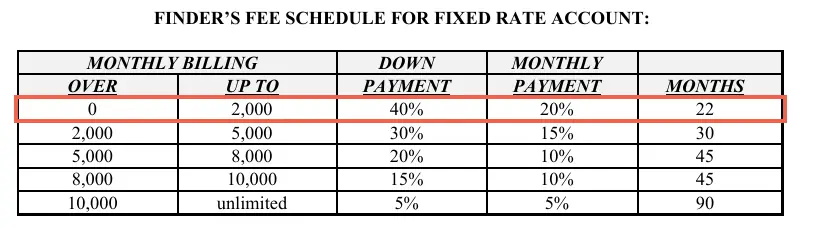
The Jani-King of Minnesota schedule in Item 6, note 8 hides its total in installments. Adding the down payment to the monthly percentage times the number of months gives the full charge as a multiple of one month’s billing, assuming the billing stays constant and the account lasts the whole schedule:
| Account type and monthly billing band | Down payment | Monthly payment x months | Total, in months of billing |
|---|---|---|---|
| Fixed rate, $0 to $2,000 | 40% | 20% x 22 | 4.80 |
| Fixed rate, $2,000 to $5,000 | 30% | 15% x 30 | 4.80 |
| Fixed rate, $5,000 to $8,000 | 20% | 10% x 45 | 4.70 |
| Fixed rate, $8,000 to $10,000 | 15% | 10% x 45 | 4.65 |
| Fixed rate, over $10,000 | 5% | 5% x 90 | 4.55 |
| Variable rate, $0 to $3,000 | 30% | 5% x 90 | 4.80 |
| Variable rate, $3,000 to $6,000 | 15% | 5% x 90 | 4.65 |
| Variable rate, over $6,000 | 5% | 5% x 90 | 4.55 |
Three rules change that total. The fee drops by up to 50% if you were “substantially involved” in winning the added location; payments may stop if the customer cancels for reasons you did not contribute to, but credit goes only toward future accounts, never as cash; and cancellations for non-performance make the whole unpaid balance due (Item 6, note 8). Credit is 100% for cancellation in the first 30 days and 50% from day 31 to 120.
How is buying a master or regional territory different?
A master, regional developer or subfranchisor buys the right to sell unit franchises in a territory and runs the office the units depend on. Jan-Pro’s regional developer franchise costs $130,000 to $421,500 to open, carries a $50,000 to $250,000 fee set by the business count of the territory, and makes the buyer a franchisor with its own disclosure document to prepare.
Federal law treats that buyer as a franchisor. 16 CFR 436.1(k) defines a subfranchisor as “a person who functions as a franchisor by engaging in both pre-sale activities and post-sale performance.” Jan-Pro’s Item 1 says the regional developer must “annually prepare and furnish” its own unit FDD, using a template in Exhibit K, and pay its own registration and attorney costs.
The master’s revenue sources mirror the unit’s costs. Jan-Pro’s regional developer pays a 4% Contract Services Royalty on all revenue it or its unit franchisees collect, a 10% Sales Royalty on unit initial fees, upgrade fees, transfer fees and note collections, and the lesser of 0.5% or $3,500 a month to the brand fund, with a $450 monthly minimum (Item 6). At September 30, 2025 there were 108 Jan-Pro regional developer outlets (Item 20).
For the unit buyer, the middle tier is the counterparty that matters. The Anago of Minneapolis FDD states that Anago Franchising, Inc. “does not guarantee the performance of Our obligations to You. Your Unit Franchise Agreement is a contract solely between You and Us. AFI has no liability to You” (Item 1). Read the master’s own Item 21 financial statements, not only the brand’s.
Is there a model with no account package at all?
System4 sells a Facility Services Management franchise delivered “through employees, and/or… through subcontractors,” and its franchisees are “prohibited from offering or selling any subfranchises or unit franchises” (cover page). The fee is $1,200 per 10,000 population with a $96,000 minimum (Item 5).
Its royalty runs from 1% to 6.2% of Gross Sales Revenue depending on monthly net margin, and self-performed accounts pay 4% (Item 6). The term is 20 years, and 61 franchised outlets operated at the end of 2025 (Items 17 and 20).
Why do janitorial FDDs disclose worker classification lawsuits?
Because the office signs the customer, sets the price, bills, collects and can move accounts, plaintiffs and regulators have argued that unit franchisees are employees. Jan-Pro’s 2026 FDD warns that “a few states have attempted to re-classify Unit Franchisees as employees of the franchisor,” and the Coverall and Jani-King of Minnesota FDDs list such cases in Item 3.
- Gonzalez v. Coverall North America (C.D. Cal., filed November 2, 2016): a putative class action claiming Coverall misclassified franchisees as independent contractors and improperly deducted franchise and additional business fees; the court compelled arbitration on April 13, 2017 (Coverall FDD, Item 3).
- U.S. Department of Labor v. Jani-King of Oklahoma (W.D. Okla., filed September 29, 2016): alleges franchisees were mischaracterized as independent contractors under Fair Labor Standards Act recordkeeping rules; the 10th Circuit reversed a dismissal on October 3, 2018, and summary judgment motions were still pending as of April 1, 2026. Jani-King denies the allegations (Jani-King of Minnesota FDD, Item 3).
- Fuller v. Syatt Franchising (D.R.I., filed October 19, 2015): unit franchisees of a Jani-King regional franchisor in Massachusetts alleged misclassification; the defendants agreed to a $450,000 class settlement without admitting liability, approved August 17, 2017 (Jani-King of Minnesota FDD, Item 3).
The issue matters to buyers because it touches the fee model itself: Jan-Pro’s Item 1 says reclassification, if adopted, “may also make unlawful certain deduction of fees for Support Services.” Ask a franchise attorney how your state’s employee test treats a franchisor that bills your customers, and read Item 3 in full. Our franchise litigation disclosure research explains how Item 3 is structured.
Which published cleaning franchise numbers mix up the tiers?
Several top-ranking guides quote a royalty or an investment range without naming the tier or the fees beside it. Checked against the 2026 FDDs, the common slips are a single royalty shown without the fees charged on the same base, conflicting royalty figures within one guide, and Item 7 ranges from older filings.
| What a guide says | What the 2026 FDD says | Source |
|---|---|---|
| A brand roundup published March 2026 lists Coverall’s royalty as 5.0% in its comparison table | 5% royalty plus a 10% support fee on the same Gross Dollar Volume, both deducted monthly | Coverall FDD, Item 6 |
| The same roundup gives Coverall’s investment as $17,917 to $62,908 | $17,986 to $64,280 | Coverall FDD, cover page and Item 7 |
| The same roundup gives Jan-Pro’s royalty as “up to 13%” in one place and “up to 24%” in another | The template unit agreement sets a 10% royalty plus a 5% support fee on Gross Billings; each regional developer issues its own unit FDD | Jan-Pro FDD, Exhibit K, section 5.1 |
| A brand roundup published March 2026 lists Anago’s royalty as 5% | A unit from Anago of Minneapolis pays a 10% royalty, a 6% administration fee and 2% advertising, and costs $12,750 to $68,250 to open | Anago of Minneapolis FDD, cover page and Item 6 |
| Package sizes are presented as the size of the business | “THE SIZE OF THE FRANCHISE PACKAGE DOES NOT REPRESENT HOW MUCH MONEY YOU WILL NET (RECEIVE) EACH MONTH” | Coverall FDD, Item 5 |
Which commercial cleaning franchise model matches your plan?
Match the model to three facts about you: whether you will clean, how long you can carry costs while billing arrives, and how much cash you can tie up. The decision table uses each 2026 FDD’s own thresholds, and the flowchart below it shows the same logic. Unit packages sit among the lowest entry costs in franchising, alongside the categories in our franchises under $100k guide.
| If this describes you | Consider | FDD threshold to check |
|---|---|---|
| You will clean yourself and have under $10,000 for a down payment | A small unit package | Anago of Minneapolis Program I: $2,250 down on an $8,750 fee for $1,000 of billing, 120 days. Coverall P-3,000: $4,000 down on $15,570, 120 business days |
| You want $10,000 or more of billing and can carry costs for 7 to 16 months | A larger unit plan | Jani-King of Minnesota E-10: 210 days; E-25: 390 days. Coverall P-10,000: 330 business days |
| You already have commercial cleaning customers | Independent, or a package without initial accounts | OpenWorks OW P: $2,500 fee, no initial billing; accounts you find still pay the 15% royalty but no marketing fee |
| You need to hold the customer contract yourself | Compare ownership clauses before price | Jani-King of Minnesota keeps contracts as its property; Coverall assigns accepted service agreements to you |
| You have $130,000 or more and want to sell franchises | Master or regional developer | Jan-Pro: $130,000 to $421,500; 4% of revenue plus 10% of unit fees to the brand; your own unit FDD each year |
| You want to manage crews or subcontractors, not sell franchises | Management model | System4: $96,000 minimum fee; royalty 1% to 6.2% by net margin; unit sales prohibited |
Before signing any of these, request the Item 20 list of current and former franchisees from the same office and ask 3 questions: how many days the full package took, how many package accounts cancelled in the first 12 months, and whether replacements came at no charge. Our guide to reading a franchise disclosure document shows where each answer sits.
How we compiled this
In October 2026 we read six franchise disclosure documents issued in 2026 and filed with the Minnesota Department of Commerce: four unit offerings (Coverall, Anago of Minneapolis, Jani-King of Minnesota, OpenWorks), one regional developer offering (Jan-Pro) and one management model (System4), plus 16 CFR 436.5 and the Census Bureau’s 2017 franchise file; per-dollar prices, refund gaps and finder’s fee multiples are our arithmetic on Item 5 and Item 6 figures. Item 19 figures are excluded by site policy, and other regional offices of the same brands may set different unit fees. This is general information, not legal or financial advice.
Frequently asked questions
How does a commercial cleaning franchise work?
In most janitorial systems you pay an initial fee for a promised amount of monthly customer billing. The franchisor or a regional office signs the cleaning contracts, offers them to you within a set period, bills the customers and pays you after deducting 15% to 18% in fees, according to Item 6 of the Coverall, Anago of Minneapolis, Jani-King of Minnesota and OpenWorks 2026 FDDs.
How much does a commercial cleaning franchise cost?
Item 7 of four 2026 unit FDDs ranges from $4,250 at OpenWorks to $137,887 at Jani-King of Minnesota, with Coverall at $17,986 to $64,280 and Anago of Minneapolis at $12,750 to $68,250. A Jan-Pro regional developer territory costs $130,000 to $421,500, and a System4 management franchise $128,000 to $377,000.
Do commercial cleaning franchises give you customers?
Package systems promise to offer customers, not to keep them. Coverall must offer its package within 120 to 330 business days and Jani-King of Minnesota within 210 to 390 days; if they fall short you get about 3 times the missing monthly billing back. Coverall’s Item 5 says it is not obligated to replace lost customers once the package is filled.
Do you own the accounts in a janitorial franchise?
It depends on the contract. Jani-King of Minnesota states that all contracts are its property, OpenWorks and Anago of Minneapolis sign customers first and bill as your agent, and Coverall assigns accepted service agreements to you except National Accounts. Jan-Pro’s template unit agreement lets the office repossess an account after misconduct or a customer transfer request.
How much do commercial cleaning franchise owners make?
This site does not publish earnings figures. Owner income depends on how much billing is actually delivered and kept, the 15% to 18% deducted under Item 6, payroll, supplies and insurance. Coverall’s Item 19 covers package fulfillment, not revenue, and the 2026 OpenWorks, Anago of Minneapolis and Jani-King of Minnesota FDDs make no Item 19 representation. See our Item 19 research.
What is the difference between a unit and a master cleaning franchise?
A unit franchisee buys accounts and cleans them. A master, regional developer or subfranchisor buys a territory, sells unit franchises, signs customers and bills them. Jan-Pro’s regional developers pay 4% of revenue and 10% of unit fees to Jan-Pro, and 16 CFR 436.1(k) treats a subfranchisor as a franchisor with its own disclosure duties.
Sources
- Coverall North America, Inc. Franchise Disclosure Document, issued March 30, 2026, Minnesota CARDS, accessed October 27, 2026.
- NTGY, Inc. d/b/a Anago of Minneapolis Franchise Disclosure Document, issued May 1, 2026, Minnesota CARDS, accessed October 27, 2026.
- Jani-King of Minnesota, Inc. Franchise Disclosure Document, issued April 30, 2026, Minnesota CARDS, accessed October 27, 2026.
- Jan-Pro Franchising International, Inc. Franchise Disclosure Document (regional developer), issued February 11, 2026, Minnesota CARDS, accessed October 27, 2026.
- O.P.E.N. America, Inc. d/b/a OpenWorks Franchise Disclosure Document, issued April 9, 2026, Minnesota CARDS, accessed October 27, 2026.
- System4, LLC Franchise Disclosure Document, issued March 26, 2026, Minnesota CARDS, accessed October 27, 2026.
- 16 CFR 436.1, Definitions, Federal Trade Commission Franchise Rule, eCFR, accessed October 27, 2026.
- 16 CFR 436.5, Disclosure items, Federal Trade Commission Franchise Rule, eCFR, accessed October 27, 2026.
- 2017 Economic Census, franchise file EC1700FRAN, U.S. Census Bureau, accessed October 27, 2026.