Franchise opportunities in California are legal to sell only if the offer is registered with the DFPI or exempt (Corp. Code 31110), and you must receive the FDD and every proposed agreement 14 days before signing or paying (31119).
Key takeaways
- California has required every franchise offer in the state to be registered with the Department of Financial Protection and Innovation (DFPI) or exempt since April 15, 1971 (Corp. Code 31110).
- A franchisor with a net worth of at least $5 million can file a notice of exemption under Corp. Code 31101 instead of registering: the DFPI record for Dunkin' Donuts Franchising LLC lists 10 such notices from 2016 to 2024 and no registration application in the 10 years it covers.
- The FDD and a copy of all proposed agreements must reach you at least 14 days before you sign a binding agreement or pay, whichever comes first (Corp. Code 31119).
- Of 259 FDDs issued from January 2025 to August 2026 on Minnesota CARDS, 211 (81.5%) cite the California Franchise Relations Act and 37 (14.3%) say initial fees from California buyers wait until the unit opens.
- DFPI published 150 franchise-law orders from 2015 to October 2, 2026, and 76 of them (50.7%) involved an unregistered offer or sale, based on DFPI's actions and orders list.
- Franchise broker registration under SB 919 costs $450 a year and is expected to start July 1, 2027; the 2026-27 enacted budget for DFPI lists $125,000 to build the system.
The California buyer’s checklist in nine steps
Nine checks cover the California law a buyer meets between the first sales call and the signature. Steps 1 to 3 use the franchisor’s public DFPI record, steps 4 to 7 use the FDD and its California addendum, and steps 8 and 9 cover published enforcement orders and the broker rules SB 919 adds. Each row names the statute so you can read the text yourself.
| Step | What to check | California rule | Where to look |
|---|---|---|---|
| 1 | An effective registration, or a filed exemption notice, under the franchisor’s legal name | Corp. Code 31110 | DFPI record, found through Search Franchises with the legal name from FDD Item 1 |
| 2 | Which route the franchisor used: registration or exemption notice | Corp. Code 31101, 31111, 31121 | Filing Type column on the DFPI record |
| 3 | Whether the FDD you hold matches the newest filing | Registration lasts one year (Corp. Code 31120) | Effective Date and Download link on the record |
| 4 | That 14 days have passed since the FDD and all proposed agreements arrived | Corp. Code 31119(a) | Item 23 receipt you signed, and the date the final agreements came |
| 5 | Every numbered item in the California addendum | Corp. Code 31512, 31125; B&P 20040.5 | State addenda exhibit of the FDD |
| 6 | Noncompete, venue and choice-of-law clauses | B&P 16600, 20040.5 | Franchise agreement and the addendum |
| 7 | Any fee deferral, escrow or surety condition | Corp. Code 31113 | California addendum and FDD Item 5 |
| 8 | Published orders against the franchisor or its sellers | Corp. Code 31406 | Actions and Orders on the record; DFPI order list |
| 9 | Who pays the broker or consultant who introduced the brand | SB 919 (Stats. 2024, ch. 518) | Ask in writing; after July 1, 2027 (expected) ask for the broker disclosure document |
The list covers state law only. The federal FTC Franchise Rule, with its 23 disclosure Items in 16 CFR 436.5, applies in California at the same time, and its Item-by-Item contents are set out in our franchise disclosure document guide.
Who may sell a franchise in California, and does DFPI review it?
Only a franchisor whose offer is registered with DFPI, or exempt, may offer or sell a franchise in California (Corp. Code 31110). A registration application is reviewed and becomes effective at noon on the 30th business day after it is complete, absent a stop order (31116). A franchisor with at least $5 million in net worth can file a notice of exemption under 31101 and skip registration.
| Route | Who can use it | What DFPI does | State fee (paid by the franchisor) | Source |
|---|---|---|---|---|
| Registration, first filing | Any franchisor that is not exempt | Reviews the application; effective at noon on the 30th business day after a complete filing unless a stop order issues | $1,865 (was $675 before AB 137) | Corp. Code 31116, 31500(b) |
| Registration renewal | Registered franchisors, every year | Processes the renewal application; each registration lasts one year | $1,245 (was $450) | Corp. Code 31120, 31121, 31500(c) |
| Notice of exemption | Net worth of at least $5 million, or $1 million with a $5 million parent, plus experience conditions | Accepts a notice; no registration order | $1,245 first notice; $415 each later notice | Corp. Code 31101, 31500(f) |
| Neither | Nobody | The offer or sale is unlawful | None | Corp. Code 31110, 31300 |
Registration is not an endorsement. The California addendum in the ECHO Suites Extended Stay by Wyndham FDD, issued March 31, 2025, says registration or exemption “DOES NOT CONSTITUTE APPROVAL, RECOMMENDATION, OR ENDORSEMENT BY THE COMMISSIONER”, and 125 of the 259 FDDs we scanned carry that sentence. DFPI can also require a franchisor to escrow or impound initial fees, or post a surety bond at its option, under Corp. Code 31113.
AB 137 (Stats. 2025, ch. 20) raised the initial registration fee by 176.3%, from $675 to $1,865, and DFPI applied the new fees from July 1, 2025. Those are franchisor costs, not buyer costs, and our franchise registration states report sets them beside the other 13 registration states.
How do you read a franchisor’s DFPI record?
Each franchisor has one DFPI record page that lists its California filings from the past 10 years in two tables: Applications, for registrations and amendments, and Notices, for exemption filings. The Filing Type column shows which route the franchisor used, and each Download link returns “a ZIP file containing all publicly available documents for that record”, in DFPI’s words.
- Copy the franchisor’s legal name from Item 1 of the FDD; the Patrice + Associates brand, for example, files as Patrice Franchising, LLC.
- Open Search Franchises from DFPI's franchise pages and select the entity’s record.
- Read the table headed Applications (Includes Order of Effectiveness), then the Notices table, newest row first.
- Compare the newest Effective Date with the issue date on your FDD cover page; a registration lasts one year under Corp. Code 31120.
- Scroll to Actions and Orders; all 4 records we read in October 2026 said “DFPI has no published actions or orders against this entity.”
- For filings older than 10 years, DFPI asks for a Public Records Act request.
| Filing Type label on the record | Statute | What it tells a buyer |
|---|---|---|
| Reg. – Initial/Late Renewal (31111) | Corp. Code 31111 | A first registration, or a renewal filed after the old one lapsed |
| Reg Renewal (31121) | Corp. Code 31121 | The yearly renewal of an existing registration |
| Post Eff./Amend. (31123) | Corp. Code 31123 | An amendment filed after the registration took effect |
| Net Worth/Exp Exemption (31101) | Corp. Code 31101 | An exemption notice: no registration application sits behind this offer |
How long did real filings take to become effective?
We subtracted Date Filed from Effective Date on six filings from four DFPI records captured October 18, 2026. The gap ran from 22 to 214 calendar days. The 30-business-day clock in Corp. Code 31116 starts only once an application is complete, and the record does not show comment letters or amendments in between, so the gap describes file history, not a breach.
| Franchisor (DFPI record) | Filing type | Date filed | Effective date | Calendar days |
|---|---|---|---|---|
| Crumbl Franchising, LLC | Reg Renewal (31121) | Apr 7, 2026 | Jul 31, 2026 | 115 |
| Crumbl Franchising, LLC | Post Eff./Amend. (31123) | Jul 2, 2026 | Sep 28, 2026 | 88 |
| Atwork Franchise, Inc. | Reg Renewal (31121) | Mar 31, 2026 | May 27, 2026 | 57 |
| Patrice Franchising, LLC | Reg Renewal (31121) | Apr 21, 2025 | May 13, 2025 | 22 |
| Patrice Franchising, LLC | Reg. – Initial/Late Renewal (31111) | May 6, 2024 | Dec 6, 2024 | 214 |
| Dunkin' Donuts Franchising LLC | Net Worth/Exp Exemption (31101) | Dec 23, 2024 | Feb 10, 2025 | 49 |
The buyer’s rule is simpler than the arithmetic: under Corp. Code 31110 a franchisor may not offer a franchise in California while its record shows an application with no effective date, unless an exemption applies. If a seller says registration is “pending”, ask for the effective date in writing before any deposit.
Where other guides send you, and what DFPI’s pages show
Two claims in other California guides no longer match DFPI’s own pages. One sends buyers to DocQNet for public filing searches, but DocQNet’s home page now offers only filer sign-in and points new franchise filings to FRANSES. Another still names the Department of Business Oversight, a name that 30 of the 259 FDDs in our scan also still print.
| What a guide says | What the primary source shows (checked October 2026) |
|---|---|
| A franchise law firm’s guide says to search DocQNet by corporate name and select “Uniform Franchise Registration Application” | DocQNet's home page offers sign-in, account registration and designated email, and sends new franchise filings to FRANSES; the public records sit on dfpi.ca.gov |
| A law firm’s state-by-state page sends California filers to the Department of Business Oversight | The regulator is DFPI; 225 of 259 FDDs we scanned use the DFPI name, while 30 still print the Department of Business Oversight |
California is one of 4 states whose regulator posts FDDs online, with Indiana, Minnesota and Wisconsin, according to FTC staff; our franchise disclosure database report explains how those state archives differ.
What has to reach you 14 days before you sign?
California requires the franchise disclosure document together with a copy of all proposed agreements at least 14 days before you sign any binding agreement or the franchisor receives any consideration, whichever comes first (Corp. Code 31119(a)). The FTC rule sets the same 14 calendar days in 16 CFR 436.2(a) and adds a 7-day rule for agreements the franchisor changes on its own.
| Point | California (Corp. Code 31119) | Federal (16 CFR 436.2) |
|---|---|---|
| What must arrive | The FDD plus a copy of all proposed agreements relating to the sale | The franchisor’s current disclosure document |
| Deadline | At least 14 days before you sign any binding agreement or pay any consideration, whichever is first | At least 14 calendar-days before you sign or make any payment to the franchisor or an affiliate |
| Agreements changed later | No separate period in 31119 | Revised agreement 7 calendar-days before signing if the franchisor altered it unilaterally and materially (436.2(b)) |
| Electronic delivery | Allowed under rules or orders of the commissioner (31119(b)) | Email or internet access directions count (436.2(c)) |
| If the rule is broken | Damages; rescission if willful (Corp. Code 31300) | Unfair or deceptive practice under Section 5 of the FTC Act |
| Source | Cal. Corp. Code 31119 | 16 CFR 436.2 |
Count from the day the last required document reaches you. On a plain reading of 31119, a buyer who receives the FDD on March 2 and the final form of the agreements on March 10 should not sign or pay before March 24, which is 14 days after March 10.
| Event | Date | Days counted |
|---|---|---|
| FDD received | March 2 | Clock not complete: agreements missing |
| All proposed agreements received | March 10 | Day 0 of the 31119 period |
| Earliest signature or deposit | March 24 | Day 14 |
Late or missing delivery is a common enforcement ground: 47 of DFPI’s 150 published franchise orders from 2015 to October 2026 (31.3%) concerned an FDD that was not delivered or arrived late, according to our franchise enforcement tracker.
What does the California addendum change in your agreement?
The California addendum is a state exhibit in the FDD that overrides parts of the franchise agreement for California sales. Across 259 FDDs issued from January 24, 2025 to August 18, 2026, the most frequent California items were the Franchise Relations Act notice (211 FDDs), the 31512 waiver rule (203) and the 31125 notice on material modifications (200).
| Addendum provision | FDDs citing it | Share of 259 |
|---|---|---|
| Franchise Relations Act rights on termination, transfer and nonrenewal (B&P 20000 to 20043) | 211 | 81.5% |
| Release or waiver of California rights is void (Corp. Code 31512) | 203 | 78.4% |
| Approved disclosure before any material modification (Corp. Code 31125) | 200 | 77.2% |
| All proposed agreements delivered with the FDD | 167 | 64.5% |
| Venue outside California (B&P 20040.5) | 163 | 62.9% |
| Franchisor website not reviewed by DFPI | 131 | 50.6% |
| Liquidated damages limits (Civil Code 1671) | 123 | 47.5% |
| Out-of-state choice of law may not be enforceable | 121 | 46.7% |
| No waiver of claims by questionnaire or acknowledgment (Corp. Code 31512.1) | 87 | 33.6% |
| Restraint of trade (B&P 16600) | 53 | 20.5% |
| 10% maximum interest rate statement | 40 | 15.4% |
| Initial fees deferred until the franchisee opens | 37 | 14.3% |
211 of 259 FDDs (81.5%) cite the California Franchise Relations Act and 37 (14.3%) defer initial fees for California buyers. Source: our scan of Minnesota CARDS FDDs, October 2026.
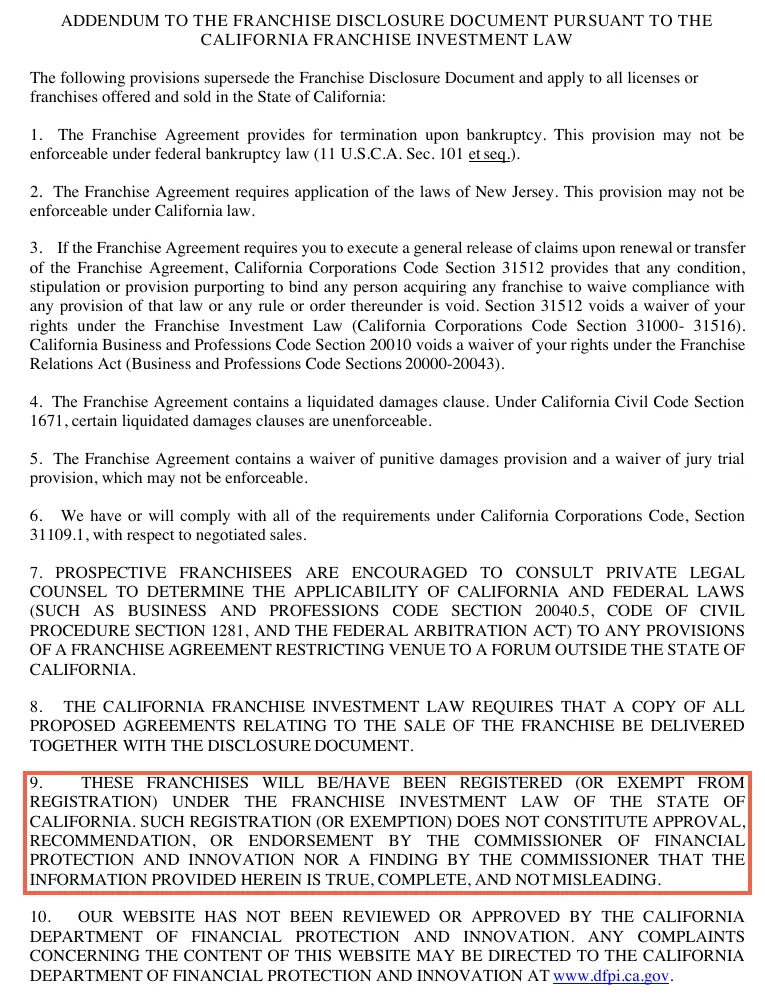
Restraint-of-trade language varies most. B&P Code 16600(a) says every contract restraining anyone from a lawful profession, trade or business “is to that extent void”, yet only 53 of the 259 FDDs (20.5%) cite section 16600. If your agreement has a post-term noncompete, ask a California franchise attorney whether it, and any in-term restriction, would bind you.
Fee deferral is the clause that changes cash timing. The Steamatic FDD issued April 17, 2025 states that DFPI “requires that the franchisor defer the collection of all initial fees from California franchisees until the franchisor has completed all its pre-opening obligations and franchisee is open for business”; 37 FDDs in the scan carry a California deferral.
Two items limit what you can sign away: Corp. Code 31512 voids any waiver of the Franchise Investment Law, and 87 FDDs cite 31512.1 on questionnaires and acknowledgments. Our franchise attorney checklist lists the 12 clauses a lawyer typically reviews.
Which Franchise Relations Act rules protect you after opening?
The California Franchise Relations Act (B&P Code 20000 to 20043) limits how a franchisor can end, refuse to renew or block the sale of a franchise. Termination needs good cause, at least 60 days’ notice and a cure period of 60 to 75 days (20020); a nonrenewal needs 180 days’ written notice plus one condition listed in 20025.
| Rule | Section | What the statute says | Source |
|---|---|---|---|
| Good cause | B&P 20020 | No termination before the term ends except for good cause | B&P 20020 |
| Notice and cure | B&P 20020 | Notice at least 60 days ahead; cure period not less than 60 days and need not exceed 75 days unless separately agreed | B&P 20020 |
| Immediate termination | B&P 20021 | Immediate notice allowed for the events listed in the section | Chapter 5.5 |
| Nonrenewal | B&P 20025 | 180 days’ written notice plus one listed condition, such as letting the franchisee sell in the last 180 days | Chapter 5.5 |
| Transfer | B&P 20028 | No blocking a sale to a buyer who meets the franchisor’s then-existing standards | Chapter 5.5 |
| Heirs | B&P 20027 | Heirs may participate in the franchise | Chapter 5.5 |
| Buyback | B&P 20022 | On lawful termination or nonrenewal, repurchase of inventory, supplies, equipment, fixtures and furnishings at the price paid less depreciation | Chapter 5.5 |
| Venue | B&P 20040.5 | A clause restricting venue to a forum outside California is void for a franchise operating in California | Chapter 5.5 |
| Waivers | B&P 20010 | A waiver of the chapter is void | Chapter 5.5 |
The Act uses its own three-part definition in B&P 20001: a marketing plan prescribed in substantial part by the franchisor, a business substantially associated with its trademark, and a franchise fee paid directly or indirectly. Our franchise relationship laws tracker compares these periods across 19 jurisdictions.
Will franchise brokers and consultants register with DFPI?
Yes, once SB 919’s registration program starts, which the Department of Finance placed at July 1, 2027 after the 2026-27 budget funded it. DFPI’s broker page, last updated May 7, 2026, still says the program “is not operational”, adds that DFPI cannot accept broker filings until one year after funding, and says the parts of the law not tied to registration already apply.
This publication is paid by franchise consultants, so this rule covers the businesses that fund it, as set out in our disclosures.
| SB 919 term | Rule | Source |
|---|---|---|
| Who counts | Anyone paid to help sell franchises for a franchisor, whatever the title; DFPI names franchise consultant, coach, broker network and franchise sales organization | DFPI broker page |
| Fee | $450 registration; $50 amendment | SB 919 |
| Term | Expires December 31 of the year it takes effect; renewed annually | SB 919 |
| Disclosure | Uniform Franchise Broker Disclosure Document before discussing a registrable franchise: compensation, services, 5 years of experience, legal actions, brands sold last calendar year | SB 919 |
| Records | Books and records of offers kept for 5 calendar years | SB 919 |
| Liability | A broker who sells in violation is liable to the franchisee and to the franchisor (Corp. Code 31300(b)), in the statute since January 1, 2025 | Corp. Code 31300 |
| Start date | Later of July 1, 2026 or one year after an appropriation; budget signed June 29, 2026 with $125,000; expected start July 1, 2027 | 2026-27 budget, DFPI 1701; Department of Finance |
Until registration runs, ask any broker in writing which franchisors pay them and how much per sale. DFPI’s own page warns that broker compensation “can vary and may influence what brands a broker recommends.” Our franchise broker registration report tracks the July 1, 2027 date against New York and Washington rules.
What remedies apply when a seller breaks California franchise law?
A buyer sold a franchise in breach of the registration, delivery or anti-fraud sections can sue the seller for damages, and for rescission if the breach was willful (Corp. Code 31300). DFPI can also issue a citation with a desist-and-refrain order and a penalty of up to $2,500 per violation (31406), and it published 150 franchise-law orders from 2015 to October 2026.
| Measure, California DFPI orders dated June 17, 2015 to October 2, 2026 | Count | Share |
|---|---|---|
| All published franchise-law orders | 150 | 100% |
| Defective FDD or filing | 101 | 67.3% |
| Unregistered offer or sale | 76 | 50.7% |
| FDD not delivered or late | 47 | 31.3% |
| Misrepresentation in offer or sale | 43 | 28.7% |
| Earnings claim | 9 | 6.0% |
| Broker or seller violation | 9 | 6.0% |
| Resolving orders with a penalty (of 114) | 84 | 73.7% |
| Resolving orders with a rescission offer (of 114) | 12 | 10.5% |
Among resolving orders with a penalty, the median California penalty was $7,500 and the largest was $450,000 (2024); penalties totalled $1,939,225. Paperwork dominates: 19 orders, 12 of them in 2021, concerned audited financial statements signed by an auditor who was not licensed or qualified. Search the franchisor’s name on DFPI's actions and orders list before you sign.
Section 31201 makes it unlawful to offer or sell a franchise with an untrue statement or a misleading omission of a material fact, in writing or orally (Corp. Code 31201). Keep every sales email and text: in a 31300 claim over an untrue statement or omission, the seller can defend by proving you knew the facts or that it used reasonable care.
How does California’s franchise market compare with the US?
Franchising is a smaller share of California’s businesses than of the nation’s. The Census Bureau’s 2024 Annual Business Survey puts franchise firms at 3.7% of responding California employer firms in 2023, against 4.7% for the United States, and California’s share was 3.6% in each of 2019 to 2022. SBA franchise lending per resident also trails the median state.
| Measure | California | Source |
|---|---|---|
| Franchise share of responding employer firms, 2023 | 3.7% (US 4.7%) | Census ABS 2024, AB2300CSCB01 |
| Responding employer firms operating as franchises, 2023 | 14,303 | Census ABS 2024 |
| Franchise share in accommodation and food services (NAICS 72), 2023 | 15.4% | Census ABS 2024 |
| Change in franchise share, 2019 to 2023 | +0.1 percentage points (not significant) | Census ABS 2020 to 2024 |
| Franchise-coded SBA 7(a) loans per 100,000 residents per year | 1.52 (median state 1.87) | SBA 7(a) FOIA data |
| Median franchise-coded 7(a) loan | $410,000 | SBA 7(a) FOIA data |
| Franchise-coded share of the state’s 7(a) loans | 10.4% | SBA 7(a) FOIA data |
| Resident population, July 1, 2025 | 39,355,309 | Census Vintage 2025 |
The SBA figures cover 1,385 franchise-coded 7(a) loans in two clean windows, October 2021 to April 2023 and fiscal 2026 through June 30, 2026, and our SBA franchise loans by state report explains why the gap years are excluded.
Franchise firms were 3.7% of responding California employer firms in 2023 versus 4.7% nationally; metro shares ran from 1.7% (Yuba City) to 8.1% (Stockton-Lodi). Source: Census ABS 2024.
| Metro area (California) | Franchise share of responding employer firms, 2023 | Std. error (pp) |
|---|---|---|
| Stockton-Lodi | 8.1% | 1.9 |
| Salinas | 7.5% | 1.9 |
| Sacramento-Roseville-Folsom | 5.2% | 0.9 |
| United States | 4.7% | 0.1 |
| San Jose-Sunnyvale-Santa Clara | 4.6% | 0.4 |
| Riverside-San Bernardino-Ontario | 4.0% | 0.6 |
| San Francisco-Oakland-Fremont | 3.9% | 0.5 |
| San Diego-Chula Vista-Carlsbad | 3.9% | 0.5 |
| California | 3.7% | 0.1 |
| Los Angeles-Long Beach-Anaheim | 3.0% | 0.1 |
| Yuba City | 1.7% | 0.1 |
Within the state, Sacramento-Roseville-Folsom (5.2%) runs above the US figure and Los Angeles-Long Beach-Anaheim (3.0%) below it, while Stockton-Lodi (8.1%) carries a standard error of 1.9 points. Our franchise statistics by state report covers 108 reliably measured metro areas.
Which California rule decides your next step?
Start at the first row that matches your situation. Every threshold comes from a California statute or a field on the DFPI record, and the first 7 of the 9 actions happen before money changes hands. The last two rows apply after you open, when the 60-day and 180-day clocks in B&P 20020 and 20025 run.
| If | Then | Rule |
|---|---|---|
| The DFPI record shows no effective registration and no 31101 notice | Do not sign or pay; ask the seller for its exemption basis in writing and call DFPI at (866) 275-2677 | Corp. Code 31110 |
| The Filing Type reads Net Worth/Exp Exemption (31101) | DFPI did not register the offer; check the Item 21 financial statements for the net worth the notice relies on: at least $5 million, or $1 million with a $5 million parent | Corp. Code 31101 |
| Fewer than 14 days have passed since the last proposed agreement arrived | Wait, and pay no deposit either | Corp. Code 31119 |
| The agreement sets venue outside California | Ask counsel how 20040.5 and any arbitration clause interact for your unit | B&P 20040.5 |
| The addendum defers initial fees | Expect to pay initial fees only after pre-opening obligations are done and you open | Corp. Code 31113 |
| The agreement has a post-term noncompete | Ask a franchise attorney whether it binds you | B&P 16600 |
| A broker or consultant introduced the brand | Ask who pays them; from July 1, 2027 (expected) ask for their registration and disclosure document | SB 919 |
| You receive a notice of default | You have at least 60 days to cure, capped at 75 unless extended, except for 20021 events | B&P 20020, 20021 |
| A nonrenewal notice gives fewer than 180 days | Ask which 20025 condition the franchisor relies on | B&P 20025 |
This page is general information about California statutes and DFPI records, not legal, financial or investment advice; a California franchise attorney can apply sections 31110, 31119 and 20020 to your own agreement.
How we compiled this
We read 9 California code sections and 16 CFR 436.2 in official text (Wayback Machine captures or saved copies, because leginfo blocks automated access), 4 DFPI franchisor records captured October 18, 2026, DFPI’s broker page and the 2026-27 DFPI budget. We scanned 259 FDDs issued January 24, 2025 to August 18, 2026 on Minnesota CARDS for 12 California addendum provisions, and took market and enforcement figures from our research reports, which cite Census, SBA and DFPI data. Brand earnings claims, rankings and law-firm summaries we could not confirm in statute text were excluded.
Frequently asked questions
Is California a franchise registration state?
Yes. California is one of 14 states that require franchisors to register their FDD before offering or selling, according to a 2023 GAO report. Under Corp. Code 31110 the offer must be registered with DFPI or exempt. A first registration costs the franchisor $1,865 and lasts one year, and a large franchisor can file a 31101 exemption notice instead.
How do I look up a franchisor's filings in California?
On dfpi.ca.gov, use Search Franchises and enter the franchisor’s legal name from Item 1 of its FDD. The record lists applications and notices from the past 10 years, each with a filing date, an effective date and a Download link for a ZIP of public documents. DocQNet is a sign-in portal for filers, not the public search.
Can a California franchisee be held to a noncompete?
Business and Professions Code 16600 voids contracts that restrain anyone from a lawful trade or business to that extent, and California addenda often warn that a post-term noncompete may not be enforceable. In our scan, 53 of 259 FDDs cite section 16600. Ask a California franchise attorney how it applies to the in-term and post-term clauses in your agreement.
Do franchise consultants have to register in California?
Not yet. SB 919 requires franchise brokers, including people titled consultant or coach, to register with DFPI for $450 a year, but DFPI cannot accept filings until one year after funding. The 2026-27 budget includes $125,000 for the system, and the Department of Finance expects registration to begin July 1, 2027.
Is the California Franchise Tax Board about buying a franchise?
No. It is California’s tax agency, and its LLC page says every LLC doing business or organized in California must pay an annual tax of $800, first due by the 15th day of the 4th month after filing with the Secretary of State. An LLC formed to own a franchise owes it like any other LLC, separate from DFPI franchise registration.
What can I do if a California franchise seller misled me?
Corporations Code 31300 lets a buyer sue for damages caused by a sale that broke the registration, 14-day delivery or anti-fraud sections, and for rescission if the violation was willful. You can also complain to DFPI, which can issue a citation with a desist-and-refrain order and a penalty of up to $2,500 per violation under section 31406.
Sources
- California Corporations Code 31110, 31119, 31201, 31300, 31512, California Legislative Information, accessed 2026-10-27.
- California Corporations Code 31101, 31113, 31116, 31120, 31121, 31500 (via our registration states report), California Legislative Information, accessed 2026-10-07.
- Business and Professions Code 16600, California Legislative Information, accessed 2026-10-27.
- Business and Professions Code 20000 to 20043 (Franchise Relations Act), California Legislative Information, accessed 2026-10-08.
- SB 919 (Stats. 2024, ch. 518), bill text, California Legislative Information, accessed 2026-10-03.
- 16 CFR 436.2, Obligation to furnish documents, eCFR, accessed 2026-10-27.
- Franchise Brokers page (updated May 7, 2026), California DFPI, accessed 2026-10-27.
- Franchises and franchise brokers, California DFPI, accessed 2026-10-18.
- Actions and orders, California DFPI, accessed 2026-10-14.
- Records: Crumbl Franchising, LLC; Atwork Franchise, Inc.; Patrice Franchising, LLC; Dunkin’ Donuts Franchising LLC, California DFPI, accessed 2026-10-18.
- DocQNet self-service portal, California DFPI, accessed 2026-10-27.
- 2026-27 Enacted Budget, 1701 Department of Financial Protection and Innovation, California Department of Finance, accessed 2026-10-27.
- 2026-27 May Revision, Business and Consumer Services, California Department of Finance, accessed 2026-10-03.
- Limited liability company (annual tax), California Franchise Tax Board, accessed 2026-10-27.
- ECHO Suites Extended Stay by Wyndham FDD, issued March 31, 2025, Exhibit A, Minnesota Department of Commerce (CARDS), accessed 2026-10-27.
- Steamatic FDD, issued April 17, 2025, Minnesota Department of Commerce (CARDS), accessed 2026-10-27.
- Annual Business Survey 2024 (data year 2023), AB2300CSCB01, U.S. Census Bureau, accessed 2026-10-03.
- 7(a) and 504 FOIA loan data, U.S. Small Business Administration, accessed 2026-10-08.
- GAO-23-105338, FTC: Actions Needed to Improve Education Efforts, U.S. Government Accountability Office, accessed 2026-10-07.
- Issue Spotlight: Risks to Small Business Success in Franchising (staff report, July 12, 2024), U.S. Federal Trade Commission, accessed 2026-10-07.