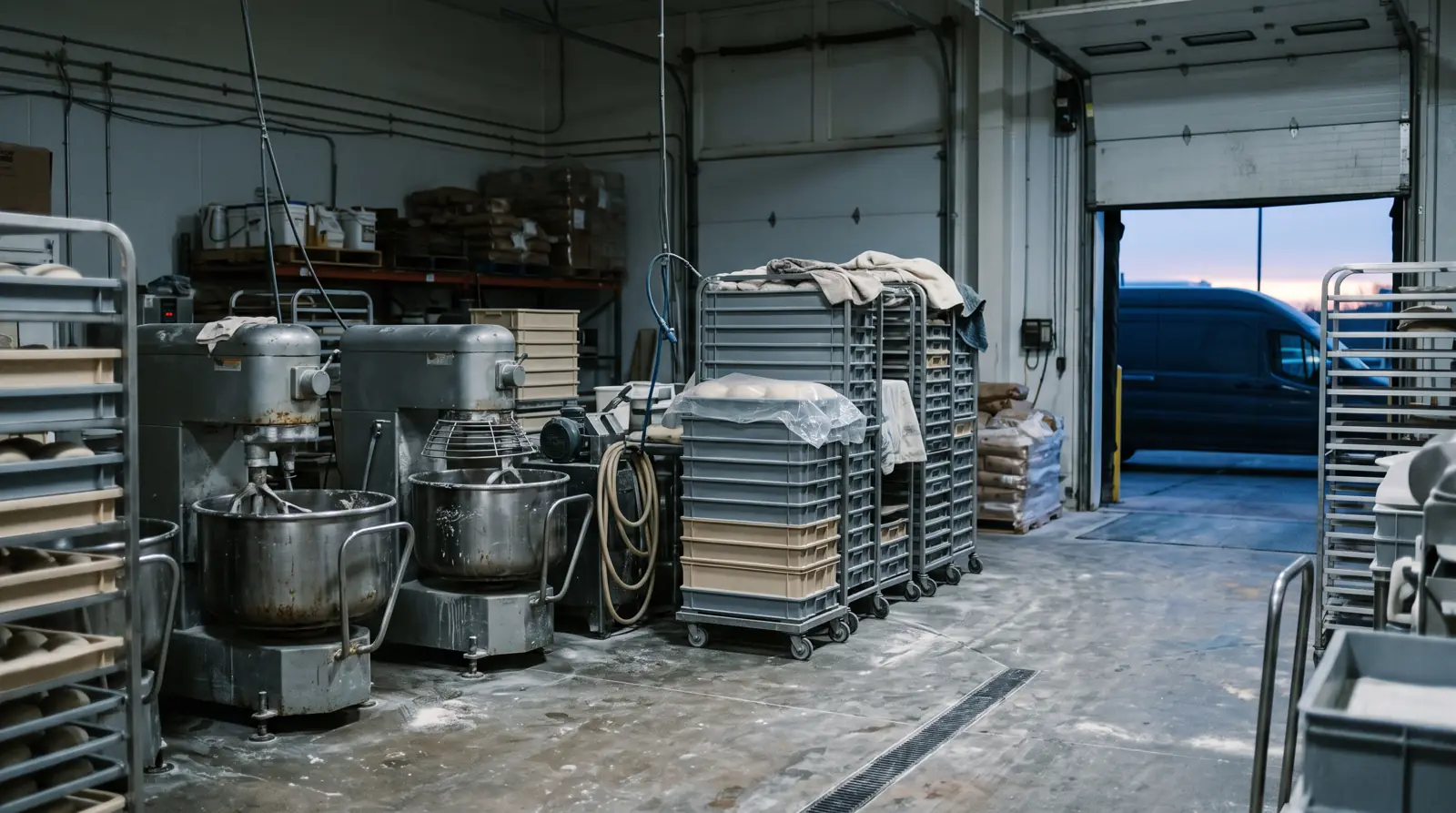
The Papa John’s franchise cost is $281,485 to $890,267 for a Standard or Small-Town restaurant ($125,000 to $423,302 Non-Traditional) in the March 30, 2026 FDD, and dough and sauce must be bought from PJ Food Service.
Key takeaways
- Item 7 of the Papa John’s Franchise Disclosure Document, issued March 30, 2026 puts a Standard or Small-Town restaurant at $281,485 to $890,267 and a Non-Traditional restaurant at $125,000 to $423,302, covering pre-opening and the first 3 months.
- Item 8 says Papa John’s “presently require[s]” that pizza dough and pizza sauce be bought only from its affiliate PJ Food Service, which runs 11 regional Quality Control Centers in the United States according to the Papa John’s Form 10-K for fiscal 2025.
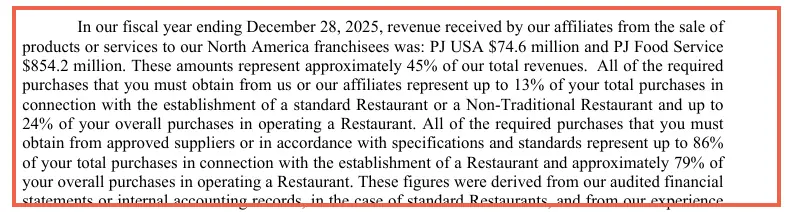
- In the fiscal year ended December 28, 2025, PJ Food Service received $854.2 million and PJ USA $74.6 million from North America franchisees, about 45% of total revenues (FDD Item 8).
- Required purchases from Papa John’s or its affiliates are up to 13% of opening purchases and up to 24% of operating purchases; spec-controlled purchases reach up to 86% and approximately 79% (FDD Item 8).
- A Standard restaurant pays a 5% royalty plus a 6% Marketing Fund contribution, 11% of Net Sales before the 1.75% Digital Fee on online orders (FDD Item 6).
- Cheese is optional from PJ Food Service, but a franchisee who skips the Cheese Purchase Agreement pays $0.10 per pound more than program participants (FDD Item 8 and Exhibit G).
| Key number | Figure as printed | Where it is |
|---|---|---|
| Total initial investment, Standard and Small-Town | $281,485 to $890,267 | Item 7 |
| Total initial investment, Non-Traditional | $125,000 to $423,302 | Item 7 |
| Paid to Papa John’s or affiliates before opening, Standard | $38,376 to $80,426 | Item 5 |
| Initial Franchise Fee, Standard | $5,000 to $25,000 | Item 5 |
| Initial Franchise Fee, Small-Town and Non-Traditional | $5,000 | Item 5 |
| Royalty | 5% (Small-Town 6%) | Item 6 |
| Marketing Fund, Standard | 6% until December 30, 2029 | Item 6, note 7 |
| Affiliate revenue from North America franchisees, FY2025 | $854.2 million (PJ Food Service) and $74.6 million (PJ USA) | Item 8 |
| Franchise term | 10 years Standard; 5 years Non-Traditional and Small-Town | Item 17 |
What must a Papa John’s franchisee buy from PJ Food Service and PJ USA?
Two affiliates of the franchisor are mandatory vendors. Item 8 of the March 30, 2026 FDD requires pizza dough and pizza sauce from PJ Food Service, Inc., and names PJ USA as the only approved supplier of the Information System and Designated Software. Section 12(b) of the Franchise Agreement (Exhibit B) widens the dough rule to “prepared pizza crusts.” Everything else may come from any approved supplier, subject to Papa John’s specifications.
The “Required Purchases” row of Item 6 splits the list in two. The first half is mandatory: the Information System and related services, Designated Software, pizza dough and pizza sauce. The second half is optional from affiliates: cheese, pizza toppings, garlic butter sauce, cheese flavored sauce, the equipment and smallwares package, uniforms, promotional items, printed materials, financing and certain accounting services. Item 8 adds that PJ Food Service “also sells packaging and paper products and most other food products used in a Papa Johns Restaurant.”
| Item | Seller | Status in the 2026 FDD | Source |
|---|---|---|---|
| Pizza dough, prepared crusts, pizza sauce | PJ Food Service (Quality Control Centers) | Required, only source | Item 8; Franchise Agreement 12(b) |
| Information System and Designated Software | PJ USA | Required, only approved supplier | Item 8; Item 7 note 3 |
| Help desk, on-site support, installation | Papa John’s or affiliate | Required if you use the Information System | Item 7 note 3 |
| Cheese | PJ Food Service or approved supplier | Optional; Cheese Program pricing applies if bought from PJ Food Service | Item 6; Item 8; Exhibit G |
| Toppings, garlic butter sauce, cheese flavored sauce | PJ Food Service or approved supplier | Optional from affiliate; must meet specifications | Item 6 Required Purchases row |
| Equipment and smallwares package, uniforms, printed materials | Affiliate or approved supplier | Optional from affiliate | Item 6 Required Purchases row |
| Soft drinks | Designated soft drink supplier | Contract extended in 2024; expires June 30, 2034 | Item 8 |
| Construction, signage, insurance | Outside suppliers and carriers rated B+ or better by A.M. Best | To specification | Item 8 |
The franchisor does not hand out its supplier-approval criteria. A franchisee who wants a new vendor submits a written request, Papa John’s may inspect the vendor’s facility and lab-test samples at “the reasonable cost of the inspection and the actual cost of the tests,” and Item 8 promises only to begin the review within 30 days. Purchases from affiliates are pulled from the franchisee’s bank account under the Authorization form in Exhibit F.
Delivery terms also set the price. Footnote 2 to Item 6 says PJ Food Service pricing assumes “regular twice weekly deliveries” by large tractor-trailer trucks, and a site that cannot take those trucks, or needs deliveries at irregular times, may be put on “a different, higher pricing schedule.” For Non-Traditional restaurants, Papa John’s says it may lower or waive the royalty to offset that. If the PJ Food Service supply stops for reasons other than your default, Item 8 says the franchisor will give you names of alternative approved suppliers.
How much does the Papa John’s side collect from franchisee purchases?
More than it collects in royalties. The fiscal 2025 Form 10-K reports $929,944 thousand of commissary revenues against $190,952 thousand of franchise royalties and fees, and Item 8 of the 2026 FDD says PJ Food Service took in $854.2 million from North America franchisees. Federal rule 16 CFR 436.5(h)(6) is the reason this figure appears in the FDD at all.
The FTC Franchise Rule at 16 CFR 436.5(h) requires every franchisor to state whether it or its affiliates “will or may derive revenue or other material consideration from required purchases,” the affiliates’ revenues from those sales, and “the estimated proportion” of required purchases to all purchases. Papa John’s answers in the paragraph shown below, on page 26 of its FDD.
| Papa John’s revenue line, FY2025 | Amount ($ thousands) | Source |
|---|---|---|
| Commissary revenues | 929,944 | Form 10-K, fiscal year ended December 28, 2025 |
| Company-owned restaurant sales | 675,657 | Form 10-K |
| Franchise royalties and fees | 190,952 | Form 10-K |
| Advertising funds revenue | 166,729 | Form 10-K |
| Other revenues | 90,526 | Form 10-K |
| Total revenues | 2,053,808 | Form 10-K |
Papa John’s earned $929.9 million from commissary sales and $191.0 million from royalties and fees in fiscal 2025. Source: Form 10-K, SEC EDGAR, accessed November 2, 2026.
Commissary revenue was 4.9 times the royalty and fee line in fiscal 2025 ($929,944 thousand divided by $190,952 thousand). The 10-K describes the commissary segment as 11 full-service regional dough production and distribution centers in the United States plus one in Canada, delivering “pizza sauce, dough, food products, paper products, smallwares and cleaning supplies twice weekly.” Separately, Item 8 reports that designated suppliers paid Papa John’s or its affiliates $5.9 million in 2025 “because of their transactions with our franchisees and with us,” and that no purchasing cooperative exists.
The purchase shares sit close to other food brands. Our study of Item 8 in 259 FDDs filed in Minnesota found a median restricted share of 70% of startup and 50% of ongoing purchases across all sectors, and 90.0% and 82.5% across 27 food and beverage FDDs.
| Measure | Papa John’s (2026 FDD) | 259 FDDs, all sectors | 27 food and beverage FDDs | Source |
|---|---|---|---|---|
| Restricted share of opening purchases | Up to 86% | Median 70% | Median 90.0% | Item 8; Minnesota CARDS FDDs issued 2025 to 2026 |
| Restricted share of operating purchases | Approximately 79% | Median 50% | Median 82.5% | Item 8; Minnesota CARDS FDDs |
| Bought from franchisor or affiliates, opening | Up to 13% | Not measured | Not measured | Item 8 |
| Bought from franchisor or affiliates, operating | Up to 24% | Not measured | Not measured | Item 8 |
| Franchisor side reports revenue from required purchases | Yes: $854.2 million and $74.6 million | 77.2% of FDDs | Not measured | Item 8; Minnesota CARDS FDDs |
For how commissary income compares with royalty income at 25 other listed franchisors, see our analysis of how franchisors make money.
Should you sign the Cheese Purchase Agreement?
Signing trades price stability for a commitment. Under the Cheese Program in Item 8, PJ Food Service fixes the cheese price for a whole fiscal Period of four or five weeks, so promotions avoid a mid-Period price jump. The Cheese Purchase Agreement in Exhibit G binds you to keep buying cheese from PJ Food Service while the program runs a deficit, or to pay your pro-rata share of that deficit if you stop.
Item 6 footnote 4 defines the Period on a 4-4-5 calendar: two 4-week Periods and one 5-week Period per quarter, repeated 4 times a year. Deficits build when market cheese rises during a Period and surpluses build when it falls; Item 8 says the next Period’s price is set to draw down a surplus, so participants pay close to market over time and deficits and surpluses “balance to zero.”
| Choice | Price basis | Obligation | Source |
|---|---|---|---|
| Sign Exhibit G and buy from PJ Food Service | Fixed for each 4- or 5-week Period | Keep buying while the program is in deficit, or pay a pro-rata share of the deficit | Item 8; Exhibit G |
| Do not sign, still buy from PJ Food Service | $0.10 per pound above the participant price, as of the FDD date | No deficit commitment | Item 8 |
| Buy from another supplier | That supplier’s price | Supplier must be approved; inspection and test costs may be charged | Item 6 Alternative Supplier Fees row; Item 8 |
The $0.10 premium is set “as of the date of this Disclosure Document,” so ask PJ Food Service for the current non-participant price and the program’s current deficit or surplus balance before you choose. The pro-rata exit clause matters most to a franchisee planning to test an outside cheese supplier within the first year.
What does each Papa John’s format cost to open under Item 7?
A Standard or Small-Town restaurant shares one Item 7 table totaling $281,485 to $890,267, and a Non-Traditional restaurant has its own table at $125,000 to $423,302. Both run from signing through the first 3 months of operation. Construction and equipment, paid to outside suppliers, make up $179,000 of the Standard low end and $604,000 of the high end, or 63.6% and 67.8%.
| Item 7 line | Standard and Small-Town | Non-Traditional | Paid to |
|---|---|---|---|
| Initial Franchise Fee or Development Fee Deposit | $5,000 to $25,000 | $5,000 | Papa John’s |
| GIS New Store Map Package | $1,071 | $0 to $1,071 | Papa John’s |
| Construction and leasehold improvements | $102,000 to $365,000 | $25,000 to $125,000 | Outside suppliers |
| Furniture, fixtures and equipment | $77,000 to $239,000 | $37,000 to $87,000 | Outside suppliers |
| Information System | $20,000 to $30,000 | $0 to $30,000 | Papa John’s or affiliates |
| On-Site Support Fee | $2,500 | $0 to $2,500 | Papa John’s or affiliate |
| On-Site Installation Fee | $2,000 to $5,000 | $0 to $5,000 | Papa John’s or affiliate |
| Help Desk Service Fee (3 months) | $240 | $0 to $240 | Papa John’s or affiliate |
| Software Maintenance Fee (3 months) | $1,125 to $1,491 | $0 to $1,491 | Papa John’s or affiliate |
| PapaNet (3 months) | $1,200 to $1,350 | Not listed | Papa John’s or affiliate |
| Hot Schedules (3 months) | $99 to $165 | Not listed | Outside supplier |
| Signage | $7,300 to $30,000 | $8,000 to $30,000 | Outside suppliers |
| Test Fit Fee | $950 | Not listed | Papa John’s or affiliate |
| First month’s rent | $2,500 to $8,500 | $0 to $5,000 | Landlord |
| Security and other deposits, insurance premium | $2,500 to $10,000 | $1,000 to $6,000 | Landlord |
| Opening inventory and supplies | $6,000 to $15,000 | $4,000 to $15,000 | Papa John’s, affiliates or outside suppliers |
| Opening advertising | $10,000 to $30,000 | $10,000 to $15,000 | Third parties |
| Training expenses | $15,000 to $50,000 | $10,000 to $20,000 | Third parties |
| Miscellaneous opening costs | $5,000 to $25,000 | $5,000 to $25,000 | Third parties |
| Additional funds, 3 months | $20,000 to $50,000 | $20,000 to $50,000 | Third parties |
| Total | $281,485 to $890,267 | $125,000 to $423,302 | Item 7 |
Construction and equipment are $179,000 of the $281,485 low end and $604,000 of the $890,267 high end. Source: Papa John’s FDD, Item 7, issued March 30, 2026.
What sits behind the construction and equipment lines?
Note 1 to Item 7 says the construction range is already net of an average tenant improvement allowance of $42,000, for a 1,200 to 1,600 square foot space. Papa John’s estimates in-line leasehold improvements at $120,000 to $493,000 with an average of $335,000, an average architect fee of $33,000, a free-standing conversion up to $700,000 and a new building up to $2,000,000.
Note 2 puts the average equipment package for a 1,400 square foot restaurant at $170,000; the $239,000 high end assumes all new equipment with two ovens.
The training line assumes one person, a seven-week program and travel to a certified training restaurant, but note 12 warns the program can run “more than 16 weeks” for a trainee without pizza or restaurant experience. The grand opening line carries a $10,000 minimum spend in Item 7 note 11, while Item 6 footnote 11 cites $5,000 for Small-Town restaurants; ask which figure your Small-Town agreement uses.
How much of the opening budget goes to Papa John’s itself?
Item 5 totals the pre-opening payments to Papa John’s or its affiliates at $38,376 to $80,426 for a Standard restaurant, which is 13.6% of the Item 7 low end and 9.0% of the high end. The rest goes to landlords, contractors, equipment vendors and the trainee’s own travel, so most of the opening budget is negotiated with third parties.
| Item 5 payment | Standard | Small-Town | Non-Traditional |
|---|---|---|---|
| Initial Franchise Fee and/or Development Fee Deposit | $5,000 to $25,000 | $5,000 | $5,000 |
| Information System | $20,000 to $30,000 | $20,000 to $30,000 | $0 to $30,000 |
| On-Site Support plus On-Site Installation | $4,500 to $7,500 | $4,500 to $7,500 | $0 to $7,500 |
| GIS map, Test Fit, Help Desk, Software, PapaNet (one month) | $2,876 to $2,926 | $2,876 to $2,926 | $400 to $2,926 |
| Opening inventory incl. pizza dough and sauce | $6,000 to $15,000 | $6,000 to $15,000 | $4,000 to $15,000 |
| Total to Papa John’s or affiliates | $38,376 to $80,426 | $38,376 to $60,426 | $9,400 to $60,426 |
Which Item 6 charges hit every Period, and on what day?
A Standard restaurant pays 11% of Net Sales in royalty and Marketing Fund before any technology fees: 5% royalty due on the 10th and debited on the 11th, and 6% to Papa John’s Marketing Fund, Inc. debited on the 25th. Online and aggregator orders add a 1.75% Digital Fee debited on the 20th, and the fixed technology invoices run $888 to $960 a month.
| Percentage fee | Standard | Small-Town | Non-Traditional | Source |
|---|---|---|---|---|
| Royalty | 5% of Net Sales | 6% of Net Sales | 5% of Net Sales | Item 6 |
| Marketing Fund | 6% until December 30, 2029 | Included in the 6% royalty | 1.50% (25% of the standard rate) | Item 6, note 7 |
| Royalty plus Marketing Fund | 11% | 6% | 6.5% | Arithmetic from Item 6 |
| Digital Fee | 1.75% of digital Net Sales | 1.75% of digital Net Sales | 1.75% of digital Net Sales | Item 6, note 6 |
| Papa Card | Up to 2% of redemptions | Up to 2% of redemptions | Generally not required | Item 6, note 8 |
| Cooperative and local advertising | Voluntary until December 30, 2029 | Voluntary until December 30, 2029 | Voluntary until December 30, 2029 | Item 6, notes 10 to 12 |
The marketing terms come from the “NMF Initiative” members of the Marketing Fund approved for April 1, 2024 through December 30, 2029. If the initiative is repealed, or after that date, a “Mandatory Period” can begin: a minimum Cooperative contribution of 2%, a combined Cooperative and Marketing Fund cap of 7% where Papa John’s controls the Cooperative, and a minimum aggregate marketing spend of 8% of Net Sales. Item 6 footnote 2 also lets Papa John’s raise the royalty up to 6% if the then-current agreement for new franchisees carries the higher rate, in which case the Marketing Fund rate reverts to 5%. For context on these rates across brands, see our studies of franchise royalty rates and franchise advertising funds.
| Fixed charge (Item 6) | Per month | Per year (x 12) |
|---|---|---|
| Software Maintenance Fee | $375 | $4,500 |
| Help Desk Service Fee | $80 | $960 |
| PapaNet | $400 to $450 | $4,800 to $5,400 |
| Hot Schedules | $33 to $55 | $396 to $660 |
| Training Fee | Invoiced annually | $150 |
| Total | $888 to $960 | $10,806 to $11,670 |
Each of the first three charges carries the words “We may increase this fee,” and the Item 7 budget already allows Software Maintenance of $375 to $497 a month. Event-driven charges sit on top: $4,000 to transfer a restaurant, $4,000 to renew a Standard agreement or $1,000 for Non-Traditional and Small-Town, $2,200 for a 2-day software installation plus $1,100 per extra day, and 12% annual interest on late amounts.
One Item 6 line deserves a lawyer’s read before signing: liquidated damages on termination for default equal “the average royalty for the twelve (12) month period preceding termination or breach multiplied by twenty-four (24).” Item 11 also describes a Development Incentive under which qualifying Standard restaurants opened in 2025 pay no Marketing Fund contributions for 3 years from opening; the FDD describes it for 2025 openings, so ask in writing whether a version applies to 2026 or 2027 openings.
How do the development deposit and the 48-month equipment lease change the cash plan?
Papa John’s requires a Development Agreement even for a single restaurant (Item 7 note 17). The Development Fee Deposit is $5,000 to $25,000 per restaurant, paid in one lump sum when the agreement is signed, non-refundable, and credited against each restaurant’s Initial Franchise Fee. Item 10 adds an optional 48-month equipment lease worth $30,000 to $125,000 with no interest charge.
| Restaurants in the Development Agreement | Deposit at $5,000 per restaurant | Deposit at $25,000 per restaurant | Source |
|---|---|---|---|
| 1 | $5,000 | $25,000 | Item 5 rate |
| 3 | $15,000 | $75,000 | Item 7 note 17 example |
| 5 | $25,000 | $125,000 | Item 5 rate x 5 |
The deposit is due at signing for every unit on the schedule, before any site is approved, and Item 5 makes it non-refundable. Item 5 says the per-restaurant figure depends on the format, the unit count, “your financial condition, your operational experience” and whether you qualify for an incentive, so the number is negotiated. Our study of area development agreements covers how other brands price and enforce schedules.
The equipment lease in Item 10 works as a reimbursement. You buy the equipment, which may include approved ovens and the Information System, then sign a Bill of Sale transferring it to PJI or an affiliate and lease it back from PJ USA; PJ USA reimburses you within 60 days. There are no periodic payments, a single $50 payment ends the 48-month term, and Papa John’s keeps a filed security interest. If the restaurant misses its scheduled opening date, Papa John’s may rescind the reimbursement or require it to be repaid.
Lenders face one limit. Item 10 says it is Papa John’s “policy not to approve any pledge of any franchise or development rights” sought by SBA or bank lenders, though a lien on restaurant assets is “generally outside the scope” of that restriction. The brand is listed in the SBA Franchise Directory under code S1273, and SBA FOIA data show 63 SBA 7(a) loans approved under that code from fiscal 2020 to June 30, 2026, per our SBA franchise directory analysis.
What do Items 19 and 20 reveal, and what do they leave out?
Item 19 of the 2026 FDD presents average and median restaurant-level sales and weekly per-store figures for fiscal 2025, for traditional US restaurants only; this site does not reproduce those numbers. Item 20 shows the franchised count rising from 2,752 to 2,832 in 2025 while company-owned restaurants fell from 539 to 462, for a system total of 3,294.
| Outlet type (US) | End of 2023 | End of 2024 | End of 2025 | 2025 net change |
|---|---|---|---|---|
| Franchised | 2,689 | 2,752 | 2,832 | +80 |
| Company-owned | 531 | 539 | 462 | -77 |
| Total | 3,220 | 3,291 | 3,294 | +3 |
The company-owned drop lines up with the 10-K, which reports 85 company restaurants refranchised in a transaction completed November 24, 2025. Item 20 Table 2 counts 125 franchise-to-franchise transfers in 2025, up from 74 in 2023 and 106 in 2024, and Table 3 shows 162 franchised openings and 82 restaurants that ceased operations for other reasons in 2025. Table 5 projects 5 Small-Town, 35 traditional and 4 Non-Traditional franchised openings in the next fiscal year.
Item 19 explicitly excludes Non-Traditional and Small-Town restaurants: Papa John’s says it does not furnish sales, cost or profit information for those two formats at all. A buyer of either format therefore has no franchisor sales figure to test against the Item 7 budget. Our Item 19 study explains how to read the tables that are published, and the franchise disclosure document guide walks through the other 22 Items.
Which Papa John’s cost claims online are out of date?
Several ranking pages still quote the 2023 FDD or round the 2026 terms into figures the document does not contain. The table compares each claim with the March 30, 2026 FDD, item by item; the claims are paraphrased and the pages are not named. Net worth and liquid capital minimums quoted online ($250,000 to $1,000,000) do not appear in the 2026 FDD at all.
| Claim seen in a top-ranking guide | What the 2026 FDD says | Item |
|---|---|---|
| Franchise fee is $25,000 | $5,000 to $25,000 for a Standard restaurant; $5,000 for Small-Town and Non-Traditional | Item 5 |
| Advertising fund is 8% of sales | Marketing Fund is 6% until December 30, 2029; 8% is a minimum aggregate marketing spend only in a future Mandatory Period | Item 6, notes 7 and 12 |
| Total investment of $188,615 to $975,415 | $281,485 to $890,267 (Standard and Small-Town); $125,000 to $423,302 (Non-Traditional) | Item 7 |
| Marketing Fund of 5% | 6% from April 1, 2024; reverts to 5% only if the royalty is raised | Item 6, note 7 |
| Digital fee of 1.50% | 1.75% of Net Sales through online and aggregator ordering | Item 6, note 6 |
| Total investment of $130,000 to $840,000 | No 2026 format total matches this range | Item 7 |
Which Papa John’s format and supply setup matches your plan?
The format decides the fee, the royalty, the term and whether the Information System is required, and the site decides what PJ Food Service charges to deliver. Use the table below as a checklist of the thresholds the 2026 FDD itself sets, then confirm each one against the agreement you are offered. This page is general information, not legal, financial or investment advice.
| If your situation is | Then the 2026 FDD points to | Item |
|---|---|---|
| A trading area with fewer than about 6,000 households | Small-Town Program: $5,000 fee, 6% royalty that includes marketing, 5-year term with two 5-year renewals | Items 1, 5, 6, 17 |
| A stadium, arena, college, airport or convenience store site | Non-Traditional: $125,000 to $423,302; Information System often not required; rent may be a percentage of sales | Item 7 notes 3 and 16 |
| A loading dock that cannot take a tractor-trailer, or event-only trading | Ask PJ Food Service for its higher pricing schedule in writing before signing the lease | Item 6 note 2; Item 8 |
| Plans for 3 or more restaurants | Deposit of $15,000 to $75,000 at signing for 3; ask whether the 48-month equipment lease ($30,000 to $125,000) is offered | Items 5, 7, 10 |
| An SBA 7(a) loan as the main funding | Lender cannot take a pledge of the franchise rights; collateral must be restaurant assets | Item 10 |
| Cheese cost stability matters more than switching suppliers | Sign the Cheese Purchase Agreement; otherwise budget $0.10 per pound more from PJ Food Service | Item 8; Exhibit G |
| Taking over a space with equipment already installed | Equipment can sit near the $77,000 low end; a new building can reach $2,000,000 | Item 7 notes 1 and 2 |
| A need for sales data to test your budget | Item 19 covers traditional restaurants only; call owners listed in Exhibit M and former owners in Exhibit N | Items 19, 20 |
A buyer comparing pizza systems can set this page beside our Domino’s franchise cost breakdown, which reads the same Item 8 disclosure for a brand that also runs its own dough supply chain. The FTC’s Consumer’s Guide to Buying a Franchise lists the questions to put to existing owners.
How we compiled this
We read the full 588-page Papa John’s Franchise Disclosure Document issued March 30, 2026, filed with the Minnesota Department of Commerce (CARDS document 35810-202604-11), and quoted every fee and range as printed with its Item number. We added the Papa John’s Form 10-K for fiscal 2025 from SEC EDGAR, the FTC Franchise Rule text at 16 CFR 436.5 (via Cornell’s Legal Information Institute, because eCFR returned a bot check), and two of our own studies built on 259 Minnesota FDDs and SBA data, all accessed in November 2026. We excluded the Item 19 figures, the 10-K’s unit sales figure and every net worth claim found only on listing sites.
Frequently asked questions
How much is the Papa John's franchise fee?
For a Standard restaurant the Initial Franchise Fee is $5,000 to $25,000, set by negotiation and incentives, and the Development Fee Deposit paid at signing is credited against it. Small-Town and Non-Traditional restaurants pay a flat $5,000. Both figures are non-refundable and come from Item 5 of the Papa John’s FDD issued March 30, 2026.
Can a Papa John's franchisee buy cheese or toppings from another supplier?
Yes, with conditions. Only pizza dough, prepared crusts and pizza sauce must come from PJ Food Service. Cheese and toppings may come from any approved supplier, but a new supplier needs Papa John’s approval, inspection and lab tests at your cost (Item 8). Buying cheese from PJ Food Service without the Cheese Purchase Agreement costs $0.10 per pound more.
Does Papa John's offer financing for a new restaurant?
Only in a narrow form. Item 10 describes a 48-month equipment lease worth $30,000 to $125,000, offered at Papa John’s discretion with multi-unit Development Agreements, with no interest and a $50 buyout. Papa John’s does not finance the build-out and, by stated policy, does not approve pledges of franchise rights to SBA or bank lenders.
What net worth do you need for a Papa John's franchise?
The March 30, 2026 FDD does not state a net worth or liquid capital minimum. Figures online range from $250,000 to $1,000,000 and come from listing sites, not the disclosure document. Item 5 says the fee and deposit depend partly on your financial condition, so ask the development team for its written qualification thresholds.
Does the FDD say how much Papa John's owners earn?
Item 19 of the 2026 FDD presents average and median restaurant-level sales and weekly per-store figures for fiscal 2025, for traditional US restaurants only. It gives no figures for Small-Town or Non-Traditional formats. This site does not republish Item 19 numbers; read them in Item 19 of the current FDD and test them with owners listed in Exhibit M.
Where can I find Papa John's franchise reviews from owners?
Exhibit M of the FDD lists every current franchisee with outlet phone numbers, and Exhibit N lists those who left in the last fiscal year. Item 20 counts 125 transfers in 2025. Ask owners about PJ Food Service delivery pricing, Cheese Program balances and how long the 7-week training actually ran.
Sources
- Papa John’s Franchising, LLC, Franchise Disclosure Document, issued March 30, 2026, Items 1, 5, 6, 7, 8, 10, 11, 17, 19 and 20 and Franchise Agreement Section 12(b), Minnesota Department of Commerce CARDS, accessed November 2, 2026.
- Papa John’s International, Inc., Form 10-K for the fiscal year ended December 28, 2025, SEC EDGAR accession 0001628280-26-011965, accessed November 2, 2026.
- 16 CFR 436.5, Disclosure items (Franchise Rule Items 7 and 8), Legal Information Institute, Cornell Law School, accessed November 2, 2026.
- A Consumer’s Guide to Buying a Franchise, Federal Trade Commission, accessed November 2, 2026.
- Franchise Supplier Rebates and Required Purchases: What Item 8 Shows in 259 FDDs, Franchise Consultants and Brokers, built from Minnesota CARDS FDDs issued 2025 to 2026, accessed November 2, 2026.
- SBA Franchise Directory analysis, Franchise Consultants and Brokers, built from the SBA Franchise Directory and SBA 7(a) and 504 FOIA loan data, accessed November 2, 2026.