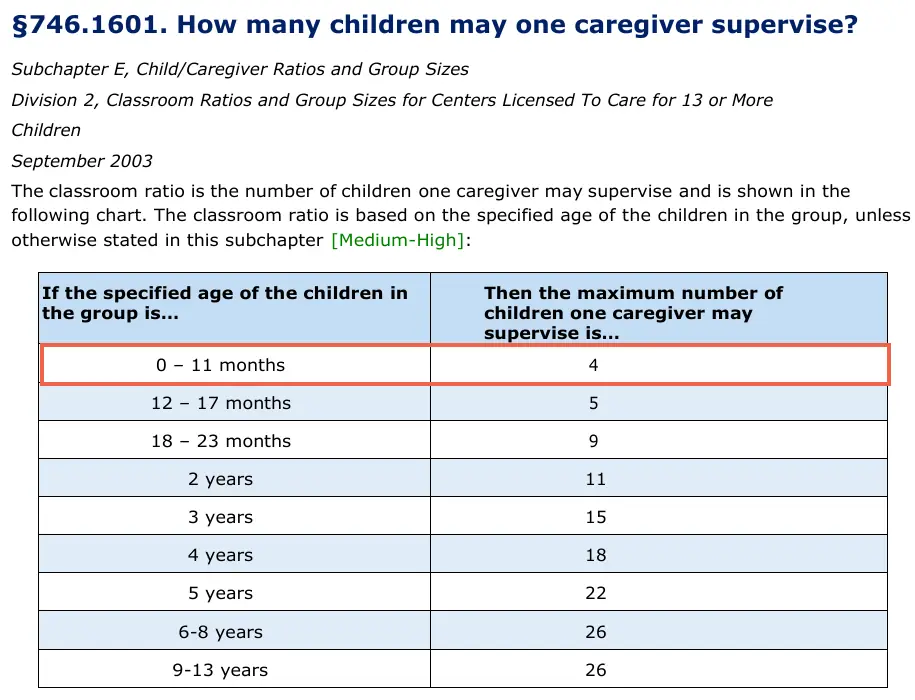
A daycare franchise is sized by state licensing first: Texas lets one caregiver supervise 4 infants, Georgia 6, and the four child care FDDs reviewed start Item 7 at $590,000 and reach $8,908,000.
Key takeaways
- Texas caps infant rooms at 4 children per caregiver and 10 per group under 26 TAC §746.1601 and §746.1609; Georgia allows 6 per caregiver and 12 per group under Rule 591-1-1-.32.
- Licensed capacity follows floor area: 30 square feet of indoor activity space per child in Texas (§746.4201), 35 in Georgia (Rule 591-1-1-.19) and 35 in Florida for centers licensed after October 1, 1992 (section 402.305(6), Florida Statutes).
- Item 7 in the Kiddie Academy FDD issued March 27, 2026 runs $590,000 to $1,010,000 for a leased Academy; the Goddard School FDD issued April 30, 2026 tops out at $8,908,000 when the franchisee buys land and builds.
- Goddard’s Item 15 bars owners from the director job and Primrose’s bars it without written approval, so each center budgets for a director who meets the state rule.
- Kiddie Academy and Lightbridge Academy state in Item 15 that a director will, in most cases, need a degree in education; Texas, Georgia and Florida all accept a credential path that needs no degree (Rule 591-1-1-.31).
How many children can one teacher watch in Texas, Georgia and Florida?
Staff-to-child ratios are the first licensing rule that turns into money, because they fix the number of paid teachers in every classroom. For infants, Texas and Florida both require 1 caregiver per 4 children, while Georgia allows 1 per 6. By age 5 the limits spread to 22 in Texas, 20 in Georgia and 25 in Florida per adult, as of November 2026.
| Age group | Texas: children per caregiver (max group) | Georgia: children per staff (max group) | Florida: children per staff |
|---|---|---|---|
| Infants | 4 (10) for 0 to 11 months | 6 (12) under 1 year, or under 18 months and not walking | 4, birth through 1 year |
| Young toddlers | 5 (13) for 12 to 17 months; 9 (18) for 18 to 23 months | 8 (16) for walking 1 year olds | 6, 1 year to under 2 |
| 2 years | 11 (22) | 10 (20) | 11 |
| 3 years | 15 (30) | 15 (30) | 15 |
| 4 years | 18 (35) | 18 (36) | 20 |
| 5 years | 22 (35) | 20 (40) | 25 (5 and older) |
| Rule | 26 TAC §746.1601, §746.1609 (centers for 13 or more children) | Ga. Comp. R. & Regs. 591-1-1-.32(1), amended effective September 20, 2020 | §402.305(4)(a), F.S. (2026 statutes) |
Infant ratios split the states: 4 per adult in Texas and Florida, 6 in Georgia. Sources: 26 TAC §746.1601, Rule 591-1-1-.32, §402.305(4), accessed November 2, 2026.
Texas sets the ratio by the specified age of a group, which §746.1603 defines as the age of the middle child when the group is listed youngest to oldest. Florida bases a mixed group of children aged 2 and older on the largest age group present, per §402.305(4)(a). Those counting rules matter when a franchise model blends ages in one room.
How many teachers does a four-room center need at the minimum ratio?
A worked example shows where the states split. Take four classrooms sized to fit both the Texas and Georgia group caps: 10 infants, 20 two-year-olds, 30 three-year-olds and 35 four-year-olds, 95 children in all. Divide each room by its ratio and round up. The totals below count teachers on the floor at one time only, before the director, breaks and early and late shifts.
| Classroom | Children | Texas teachers | Georgia teachers | Florida teachers |
|---|---|---|---|---|
| Infants | 10 | 3 (10 / 4) | 2 (10 / 6) | 3 (10 / 4) |
| 2 year olds | 20 | 2 (20 / 11) | 2 (20 / 10) | 2 (20 / 11) |
| 3 year olds | 30 | 2 (30 / 15) | 2 (30 / 15) | 2 (30 / 15) |
| 4 year olds | 35 | 2 (35 / 18) | 2 (35 / 18) | 2 (35 / 20) |
| Total on the floor | 95 | 9 | 8 | 9 |
The one-teacher gap comes entirely from the infant room. In this example every other classroom needs 2 adults in all three states, so the share of enrollment under 12 months old is the line that moves a payroll budget most when the same franchise model crosses a state border.
How much floor space and playground does each child need?
Square footage per child sets the licensed capacity, which caps enrollment for the life of the building. Texas requires 30 square feet of indoor activity space per child, Georgia and Florida 35. Outdoors, Texas asks 80 square feet per child using the play area at one time, Georgia 100 and Florida 45, according to the rules opened in November 2026.
| Rule | Texas | Georgia | Florida |
|---|---|---|---|
| Indoor space per child | 30 sq ft of indoor activity space per licensed child (§746.4201) | 35 sq ft of usable space per child (591-1-1-.19) | 35 sq ft of usable floor space for facilities not licensed on October 1, 1992; 20 sq ft for those that were (§402.305(6)) |
| What does not count | Measured as indoor activity space | Kitchens, bathrooms, closets, halls, storage, offices, staff rooms, single-use areas and adult furniture are excluded | Usable floor space only |
| Outdoor space per child | 80 sq ft per child outside at one time, and enough to equal 25% of licensed indoor capacity (§746.4301) | 100 sq ft per child in the play area at any one time; groups may rotate (591-1-1-.26) | 45 sq ft of usable outdoor play area per child (§402.305(6)) |
What does 4,200 square feet of classroom space license?
The arithmetic runs from countable space to children, not from the building’s gross area. The example below uses 4,200 square feet of space that the state counts, divides it by each state’s per-child minimum, and sizes a playground for a schedule of 40 children outside at once.
| Input | Texas | Georgia | Florida |
|---|---|---|---|
| Countable indoor space | 4,200 sq ft | 4,200 sq ft | 4,200 sq ft |
| Square feet per child | 30 | 35 | 35 |
| Indoor capacity | 140 children | 120 children | 120 children |
| Playground for 40 children at once | 3,200 sq ft (40 x 80) | 4,000 sq ft (40 x 100) | 1,800 sq ft (40 x 45) |
Franchise buildings are much larger than the countable space because halls, kitchens, offices and bathrooms do not count. The Goddard FDD, Item 7 note 5, gives a typical building of 10,000 to 12,500 square feet and says that because of the requirements of licensing authorities and local ordinances, most of its schools are build-to-suit projects. Kiddie Academy’s Item 7 note 4 gives approximately 10,000 square feet, and the Lightbridge Academy FDD’s Item 7 note 5 gives 8,000 to 14,600.
Which director credentials do the three states accept?
Every licensed center needs a qualified director on site, and none of the three states requires a four-year degree. Texas accepts a Child Development Associate (CDA) credential plus 6 college credit hours in management and 2 years in a licensed center. Georgia accepts a CDA plus 6 months of experience. Florida requires its own Director Credential, renewed every five years.
| State | Minimum age | Shortest path without a degree | Degree path | Source |
|---|---|---|---|---|
| Texas (13 or more children) | 21, plus high school diploma or equivalent | CDA or Certified Child-Care Professional credential, 6 college credit hours in management, 2 years in a licensed center (option 5) | Bachelor degree with 12 credit hours in child development and 6 in management, 1 year in a licensed center (option 1) | 26 TAC §746.1015 |
| Georgia | 21 | CDA credential plus 6 months of qualifying child care experience; one of 13 options | Bachelor’s in early childhood education or child development; other bachelor’s plus 3 months of experience | Rule 591-1-1-.31(1)(b) |
| Florida | Not stated on the DCF credential page | Level I: active Staff Credential, high school diploma or GED, 30-hour Part I DCF course, 8 hours on children with disabilities, approved Overview of Child Care Management course | Advanced Level adds 2 years as an on-site director and an associate degree or two 3-credit courses | Florida DCF Director Credential; §402.305(2)(f) |
Georgia’s rule also says the director must be on the center’s premises, with an officially designated person in charge whenever the director is away. Florida’s Level II adds 1 year as an on-site director in a licensed facility, which matters if a franchise brand asks for an experienced hire before opening.
Can the franchise owner also be the director?
In two of the four FDDs, not without written permission. Goddard’s Item 15 requires the full-time director to be someone other than a franchisee or owner, and Primrose’s Item 15 says the On-Site Owner may not serve as Director unless the franchisor agrees in writing. All four also require an owner or principal to take part in daily operations, and each center still needs its own director, so the payroll carries both roles.
| Brand (FDD issue date) | Owner presence rule | Director rule | Source |
|---|---|---|---|
| The Goddard School (April 30, 2026) | Designated On-Site Owner works full time and holds at least 10% equity | At least 1 full-time director who is not a franchisee or owner; Director Initial Training Cohort Program currently $500 | Item 15 |
| Primrose Schools (April 24, 2026) | One owner full time for the 6 months before opening; On-Site Owner holds at least 5% | On-Site Owner may not serve as Director without written agreement; an assistant director or education coach also required on premises | Item 15 |
| Kiddie Academy (March 27, 2026) | You or a principal devote full time and best efforts | Full-time Director qualified in your state; not required to be a principal; franchisor approval not required | Item 15 |
| Lightbridge Academy (April 17, 2024) | Operating Principal, an equity owner, personally participates | Center Director plus a full-time Assistant Director, both meeting state requirements | Item 15 |
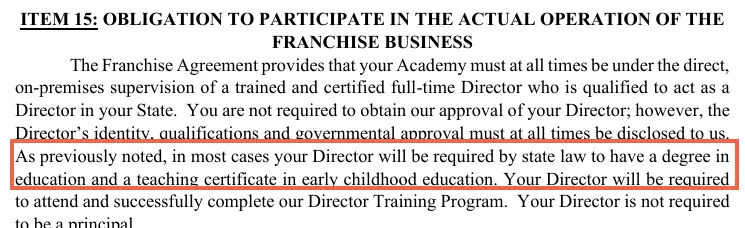
The Kiddie Academy and Lightbridge Item 15 sections both say the director will, in most cases, be required by state law to hold a degree in education and a teaching certificate in early childhood education. In the three states compared here, the written rules are lower: Texas option 5, Georgia’s CDA option and Florida’s Level I credential all work without a degree. Hiring above the state minimum can still be a brand standard, so ask each franchisor whether its manual sets a higher bar than the state’s rule. Item 15 also links to the guarantee question: Kiddie Academy requires a married individual franchisee’s spouse to guarantee the agreement, a clause our review of personal guarantees in franchise agreements compares across systems.
Owners who want to keep another job will find no semi-absentee route in these four Item 15 sections; our report on semi-absentee franchise rules lists the systems that do allow a manager-run model.
What do four child care FDDs list in Item 7 when you lease versus build?
Item 7 of the Franchise Disclosure Document gives the estimated initial investment, and in child care it splits by real estate route. The lowest printed figure among the four is $590,000 for a leased Kiddie Academy; the highest is $8,908,000 for a Goddard School on purchased land. Every brand also charges a 7% royalty on gross revenue or receipts in Item 6.
| Brand and scenario | Item 7 low | Item 7 high | Initial fee (Item 5) | Typical building | Source |
|---|---|---|---|---|---|
| Kiddie Academy, leased | $590,000 | $1,010,000 | $150,000 standard; $70,000 low in Item 7 under reduced-fee programs | About 10,000 sq ft | FDD issued March 27, 2026, Items 5 and 7 |
| Kiddie Academy, purchased | $4,935,000 | $8,530,000 | Same | About 10,000 sq ft | Same FDD, Item 7 |
| Goddard, leased, landlord builds | $1,003,500 | $1,503,000 | $135,000 | 10,000 to 12,500 sq ft | FDD issued April 30, 2026, Items 5 and 7 |
| Goddard, leased building that needs improvements | $1,736,500 | $5,032,000 | $135,000 | 10,000 to 12,500 sq ft | Same FDD, Item 7 |
| Goddard, buy land and build | $5,493,500 | $8,908,000 | $135,000 | 10,000 to 12,500 sq ft | Same FDD, Item 7 |
| Primrose, adaptive reuse of an existing building | $2,152,500 | $7,265,300 | $80,000 new franchisee; $50,000 VetFran | One-story School (no size printed) | FDD issued April 24, 2026, Items 5 and 7 |
| Primrose, new build | $5,016,600 | $7,960,300 | Same | Same | Same FDD, Item 7 (excludes land) |
| Lightbridge Academy, single leased center | $1,067,233 | $3,120,400 | $40,000 | 8,000 to 14,600 sq ft | FDD issued April 17, 2024, Items 5 and 7 |
| Lightbridge Academy, single purchased center | $2,624,400 | $4,885,000 | $40,000 | Same | Same FDD, Item 7 |
Leasing is the low route at Kiddie Academy and Goddard: $590,000 to $1,010,000 for Kiddie Academy, $1,003,500 to $1,503,000 for Goddard. Source: Item 7 of four FDDs on Minnesota CARDS, accessed November 2, 2026.
Three notes change how these ranges read. Primrose’s development costs exclude all land acquisition, and its Table B low figure already nets out a $1,219,050 tenant improvement allowance, the top of the 2025 range in note 3. Kiddie Academy’s note 4 prices 2025 construction of a new building at $330 to $480 per square foot. Lightbridge’s most recent clean FDD on Minnesota’s CARDS database is the April 2024 issue, so its figures are older than the other three. Our study of Item 7 initial investment by sector shows where these child care ranges sit against other industries.
Which published daycare franchise figures differ from the filings?
| Claim in a top-ranking guide | What the filed FDD says | Source |
|---|---|---|
| A daycare listicle gives Goddard an investment of $698,300 to $873,600 | The lowest Goddard scenario is $1,003,500 to $1,503,000, for a leased school the landlord builds | Goddard FDD, April 30, 2026, Item 7 |
| The same listicle gives Lightbridge Academy a low of $621,000 | The single leased center low is $1,067,233 | Lightbridge FDD, April 17, 2024, Item 7 |
| A consultant network guide says the franchise fee is typically $30,000 to $50,000 | Standard initial fees run from $40,000 (Lightbridge, 2024) to $150,000 (Kiddie Academy, 2026) | Item 5 of the four FDDs |
The royalty is the same 7% in all four Item 6 tables, but the marketing charge differs: 4% of gross receipts at Goddard, 2% brand building at Kiddie Academy, a 2% Primrose Brand Fund that can rise to 3%, and up to 3% at Lightbridge. Our franchise royalty rate research sets these against 259 filed FDDs.
Which payments fall due before the state licenses the center?
In the Goddard, Kiddie Academy and Primrose FDDs, initial fees fall due by occupancy, before the center is licensed to enroll children. Kiddie Academy collects its $150,000 Initial Fee in four installments tied to signing, site acceptance, the building permit and occupancy, and Goddard invoices its $105,000 license fee balance at about the time a Certificate of Occupancy is issued. Capacity is the state agency’s call, per Kiddie Academy’s Item 1.
- Sign the agreement. Goddard: $30,000 deposit at the Preliminary Agreement and $55,000 of the initial marketing fee at the Franchise Agreement. Kiddie Academy: $30,000. Primrose: the $80,000 Initial Fee and $25,000 of the Real Estate Fee.
- Site accepted, lease or purchase signed. Kiddie Academy: $50,000. Primrose: $35,000 of the Real Estate Fee at closing, where applicable.
- Building permit or construction start. Kiddie Academy: $35,000 at the earliest of permit, construction start or loan funding. Kiddie Academy Item 11 says the state may require meetings with licensing representatives before and during construction for orientations, applications and site inspections.
- Certificate of Occupancy. Goddard Opening Invoice: $105,000 license fee balance, $35,000 site development fee and the $35,000 to $42,000 training and opening support fee. Kiddie Academy: the last $35,000 at loan funding or occupancy documents.
- State child care license, then enrollment. Kiddie Academy Item 1: a child care license is required before opening, and the state decides capacity under its square feet per child rule.
Licensing fees themselves are small lines in Item 7: $4,000 to $7,000 for licenses and permits at Primrose and $3,000 to $5,000 at Kiddie Academy, whose note 15 says the line includes child care license fees. Goddard’s Item 7 note 5 says its $35,000 site development fee covers help obtaining state or local licenses.
What can Item 19 tell you about a child care center’s results?
All four FDDs include an Item 19 financial performance representation: Goddard and Primrose report 2025 results for operating schools, Kiddie Academy reports a 2025 reporting period from franchisee-owned outlets, and the 2024 Lightbridge filing reports 2023 results for mature centers. We do not reprint those figures; read them in Item 19 of each current FDD, with the notes on which units were excluded.
Two filters make the Item 19 tables comparable. Check how each brand defines a mature location (Goddard uses more than 18 months open, Lightbridge at least 24 months) and whether the table counts franchised and affiliate-run units together, as Lightbridge’s 2024 table does with 46 franchised and 16 affiliate centers. Our analysis of Item 19 disclosures explains what each disclosure format can and cannot show.
Franchising is a small slice of child care. The 2017 Economic Census franchise tables counted 3,301 franchise establishments among 77,366 child day care services establishments (NAICS 624410), a 4.3% share, and our education and child care franchise statistics track how that compares with tutoring and enrichment.
Licensing-first decision table: state, building and role
Work through these rows in order, because each one rests on a rule or FDD clause that is hard to change after a lease is signed. Thresholds come from 26 TAC Chapter 746, Ga. Comp. R. & Regs. 591-1-1, section 402.305 of the Florida Statutes and Items 7 and 15 of the four FDDs.
| If this is true | Then do this | Rule or item |
|---|---|---|
| Your plan includes an infant room in Texas or Florida | Staff 1 adult per 4 infants (Texas groups capped at 10) and test the payroll before signing; in Georgia use 1 per 6, groups of up to 12 | §746.1601, §746.1609; §402.305(4)(a); 591-1-1-.32 |
| The site has under 3,500 sq ft of countable classroom space | Expect a licensed capacity under 117 in Texas and 100 in Georgia or Florida, and compare that with the franchisor’s enrollment model | §746.4201; 591-1-1-.19; §402.305(6) |
| The playground cannot hold 4,000 sq ft in Georgia | Plan rotating outdoor groups so each child present has 100 sq ft, as the rule permits | 591-1-1-.26 |
| You want to be the director yourself | Rule out Goddard and Primrose unless the franchisor agrees in writing, then confirm your credential path (Texas option 5 needs 2 years in a licensed center) | Item 15; §746.1015 |
| You will not work in the business full time | None of these four fits: each Item 15 requires an owner or principal to take part personally, full time at Goddard and Kiddie Academy | Item 15 of all four FDDs |
| Your liquid capital and loan approval sit below $590,000 | No scenario in the four FDDs opens at that level; look at the SBA lending data before any discovery day | Item 7 |
| Your interest is a dog daycare franchise | Use a pet-care comparison instead; Chapter 746, Rule 591-1-1 and §402.305 regulate care of children only | Rule scope |
For the financing row, our SBA franchise loan data shows how 7(a) and 504 loans are used for franchise real estate, and Primrose’s Item 7 sets financing costs at $55,000 to $310,000. For the pet row, our dog grooming franchise guide covering daycare and boarding formats compares those filings. A franchise consultant can screen brands by state, but the state rule and Item 15 answers come from the documents above.
How we compiled this
We read the Texas HHSC minimum standards for child-care centers (revised December 2025), five Georgia DECAL rules through the Cornell Legal Information Institute copy because the official Georgia rules site renders its text only with JavaScript, section 402.305 of the 2026 Florida Statutes and the Florida DCF Director Credential page. We opened four clean FDDs from Minnesota CARDS (Goddard, Primrose, Kiddie Academy and Lightbridge Academy) and quoted Items 1, 5, 6, 7, 11 and 15 as printed, all accessed November 2, 2026. Item 19 figures were excluded by site policy. This page is not legal, financial or investment advice; a state licensing consultant or the state agency’s pre-application orientation should confirm each rule for a specific address.
Frequently asked questions
How much does it cost to open a daycare franchise?
In the four child care FDDs reviewed, Item 7 starts at $590,000 for a leased Kiddie Academy (March 2026 FDD) and reaches $8,908,000 for a Goddard School built on purchased land (April 2026 FDD). Leasing is the lowest route at Kiddie Academy, Goddard and Lightbridge; at Primrose it is converting an existing building. Standard initial fees in Item 5 run from $40,000 to $150,000, and each brand charges a 7% royalty.
Do you need a teaching degree to own a daycare franchise?
The owner usually does not; the director does need state qualifications. Goddard and Primrose expect the owner to run the business while a separate full-time director meets the state rule. In Texas a director can qualify with a CDA credential, 6 college credit hours in management and 2 years in a licensed center under 26 TAC §746.1015, and Georgia accepts a CDA plus 6 months of experience.
Is a daycare franchise profitable?
Profit depends on enrollment against licensed capacity, staffing at the state ratio and occupancy cost, and this site does not publish earnings figures. Goddard, Primrose, Kiddie Academy and Lightbridge each include an Item 19 financial performance representation, so the place to check reported results is Item 19 of each brand’s current FDD, read alongside the Item 7 range and the 7% royalty in Item 6.
How many square feet per child does a daycare center need?
Texas requires at least 30 square feet of indoor activity space per licensed child (26 TAC §746.4201) and 80 square feet outdoors per child using the play area at once. Georgia requires 35 square feet of usable space and 100 square feet outdoors. Florida requires 35 square feet of usable floor space and 45 outdoors for centers not licensed on October 1, 1992.
Does a dog daycare franchise need a child care license?
No. The child care rules compared here, Texas 26 TAC Chapter 746, Georgia Rule 591-1-1 and Florida section 402.305, govern care of children, so ratios, director credentials and square feet per child do not carry over to a dog daycare. Check your state and city pet-care rules separately; the dog grooming franchise guide compares daycare and boarding filings.
What does it take to start a preschool franchise in Georgia?
A Georgia child care learning center must meet Rule 591-1-1: 35 square feet of usable space per child, 100 square feet per child on the playground at one time, ratios from 1:6 for infants to 1:20 for 5 year olds, and a director at least 21 who meets one of 13 education options, such as a CDA plus 6 months of experience.
Sources
- Texas Health and Human Services Commission, Minimum Standards for Child-Care Centers, 26 TAC Chapter 746 (revised December 2025), accessed 2026-11-02.
- Georgia DECAL via Legal Information Institute, Ga. Comp. R. & Regs. 591-1-1-.32 Staff: Child Ratios and Supervision, accessed 2026-11-02.
- Georgia DECAL via Legal Information Institute, Ga. Comp. R. & Regs. 591-1-1-.19 License Capacity, accessed 2026-11-02.
- Georgia DECAL via Legal Information Institute, Ga. Comp. R. & Regs. 591-1-1-.26 Playgrounds, accessed 2026-11-02.
- Georgia DECAL via Legal Information Institute, Ga. Comp. R. & Regs. 591-1-1-.31 Staff, accessed 2026-11-02.
- Florida Legislature, Section 402.305, Florida Statutes (2026): Licensing standards; child care facilities, accessed 2026-11-02.
- Florida Department of Children and Families, Director Credential, accessed 2026-11-02.
- Goddard Franchisor LLC via Minnesota CARDS, The Goddard School Franchise Disclosure Document, issued April 30, 2026, accessed 2026-11-02.
- Primrose School Franchising SPE, LLC via Minnesota CARDS, Primrose Schools Franchise Disclosure Document, issued April 24, 2026, accessed 2026-11-02.
- Kiddie Academy Domestic Franchising, LLC via Minnesota CARDS, Kiddie Academy Educational Child Care Franchise Disclosure Document, issued March 27, 2026, accessed 2026-11-02.
- Lightbridge Franchise Company, LLC via Minnesota CARDS, Lightbridge Academy Franchise Disclosure Document, issued April 17, 2024, accessed 2026-11-02.
- U.S. Census Bureau, 2017 Economic Census, Franchise Statistics (EC1700FRAN), accessed 2026-10-14.