A vending machine franchise is a legal category, not a sales label: an offer qualifies only if it passes the FTC’s three-part franchise test, and most vending route packages fall under the Business Opportunity Rule, 16 CFR Part 437, instead.
Key takeaways
- A franchise needs a trademark right, significant control or assistance, and a required payment (16 CFR 436.1(h)); payments under $735 in the first 6 months exempt the seller from the Franchise Rule (16 CFR 436.8(a)(1)).
- A seller that promises locations for vending machines, directly or through a locator it names, sells a business opportunity and owes a one-page disclosure at least 7 calendar days before you sign or pay (16 CFR 437.2).
- The FTC says it brought over 80 law enforcement actions in more than ten sweeps against business opportunity scams, vending machines among them, from 1995 to 2011 (76 FR 76816).
- In 12 FTC vending cases that state a package price, 10 entry packages cost less than $10,000, from $2,840 to $9,495 (FTC, 1998; FTC, 2001).
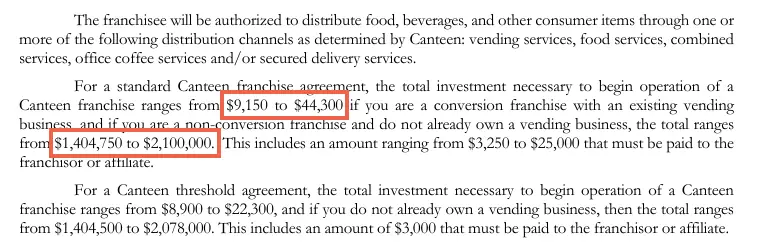
- Canteen, a division of Compass Group USA, Inc., lists $9,150 to $44,300 for operators who already own a vending business and $1,404,750 to $2,100,000 for everyone else (Canteen FDD, Item 7).
| Rule or figure | Number | Source |
|---|---|---|
| FDD delivery before signing or paying | 14 calendar days | 16 CFR 436.2(a) |
| Business opportunity disclosure before signing or paying | 7 calendar days | 16 CFR 437.2 |
| Franchise Rule payment floor (first 6 months) | $735 | 16 CFR 436.8(a)(1) |
| Business Opportunity Rule payment floor | None stated | 16 CFR 437.1(c)(2) |
| Lawsuit look-back on the one-page form | 10 years | 16 CFR 437.3(a)(3) |
| References the seller must list | At least 10 nearest buyers from the last 3 years | 16 CFR 437.3(a)(5) |
| Seller record retention | 3 years | 16 CFR 437.7 |
| Business Opportunity Rule effective date | March 1, 2012 | 76 FR 76816 |
Is a vending machine franchise legally a franchise or a business opportunity?
The answer turns on what the seller promises, and both tests are written into federal regulations. Under 16 CFR 436.1(h), a franchise exists when you get the right to use the seller’s trademark, the seller exerts significant control or gives significant help, and you make a required payment. A vending seller that sells machines plus a location promise, with no trademark license, usually sits under 16 CFR Part 437 instead.
Vending has a long history as the FTC’s test case for this line. The Commission’s 2011 rule notice says the original Franchise Rule targeted “vending machines, rack displays, and similar opportunities” because sellers so often promised help securing locations, and it built that location element into the rule’s definitions (76 FR 76816, December 8, 2011). The amended Franchise Rule that took effect on July 1, 2007 moved non-franchise opportunities into an interim Part 437 (72 FR 15444), and the current Business Opportunity Rule replaced it on March 1, 2012.
The two rules can overlap at the low end. Section 437.8 exempts any deal that is a franchise under Part 436, but it pulls a franchise back into Part 437 when the franchise escaped the FDD requirement through the small-payment exemption or because nothing was written down. As of the eCFR text dated October 1, 2026, 437.8(a) still prints the old “less than $500” wording while 436.8(a)(1) reads $735. Our page on the three-part legal definition of a franchise covers the general test in depth.
Which seller promises pull a vending offer under 16 CFR Part 437?
Three promises trigger the rule when you make a required payment to start a new business, and the first one is written for vending: a seller representing that it, or a “designated person,” will “provide locations for the use or operation of equipment, displays, vending machines, or similar devices” (16 CFR 437.1(c)(3)(i)). The promise can be oral or written, express or implied. The other two are customers or accounts, and a buy-back.
Section 437.1(m) spells out what “providing locations” means, and most vending pitches hit at least one item on the list:
- furnishing existing or potential locations, or offering to furnish a list of them;
- requiring, recommending or suggesting one or more locators or lead generating companies;
- handing over a list of locator companies, or collecting a fee on a locator’s behalf;
- otherwise helping you obtain your own locations.
Advertising and general business advice or training do not count as providing locations under 437.1(m). The designated person definition in 437.1(d) closes the outsourcing route: the FTC wrote that a “fraudulent vending machine route seller would not be able to circumvent the final Rule” by saying a specific locator will place the machines (76 FR 76816).
Two definitions narrow the rule. A required payment excludes “reasonable amounts of inventory at bona fide wholesale prices” (437.1(p)), so a candy order alone is not the trigger, but the machine package price is. A new business is one “in which the prospective purchaser is not currently engaged” (437.1(j)), so an operator already running vending routes who buys more machines may fall outside Part 437 for that purchase.
What paperwork does each federal rule hand a vending buyer?
A franchise seller owes a Franchise Disclosure Document with 23 Items at least 14 calendar days before you sign or pay (16 CFR 436.2(a)). A business opportunity seller owes one page, in the fixed form in Appendix A to Part 437, at least 7 calendar days before you sign or pay (16 CFR 437.3(a)). The page covers five topics plus a receipt, and it leaves out cost tables and financial statements.
| What you receive | Vending franchise (Part 436) | Vending business opportunity (Part 437) | Source |
|---|---|---|---|
| Core document | FDD with 23 Items | One-page form: seller identity, earnings claim box, legal actions, refund policy, references, receipt | 16 CFR 436.5; 437.3(a)(1) to (6) |
| Deadline | 14 calendar days before signing or paying | 7 calendar days before signing or paying | 436.2(a); 437.2 |
| Startup cost table | Item 7, estimated initial investment | Not required | 436.5(g); 437.3(a) |
| Lawsuit history | Item 3 litigation | Yes or no box; list actions for fraud, misrepresentation or FTC rule violations in the past 10 years | 436.5(c); 437.3(a)(3) |
| Earnings | Item 19, optional, with a reasonable basis | Yes or no box; any claim needs an “EARNINGS CLAIM STATEMENT REQUIRED BY LAW” with the number and percentage of buyers who reached it | 436.5(s); 437.4(a)(4) |
| Other buyers | Item 20 outlet tables and franchisee lists | Name, state and phone of buyers from the last 3 years, at least the 10 nearest | 436.5(t); 437.3(a)(5) |
| Financial statements | Item 21 | Not required | 436.5(u) |
| Updates | Within 120 days after fiscal year end | Quarterly; monthly until the seller has 10 buyers | 436.7(a); 437.3(b) |
Because the one-page form has no Item 7, a vending business opportunity buyer has to build the cost list alone: machine price, locator fees, product, vehicle and any machine licenses. Our explainer on the 23 Items of the Franchise Disclosure Document shows what a full FDD adds, and Section 437.6(c) bars sellers from stuffing extra material, video or pop-ups into the one-page document (16 CFR 437.6).
What has the FTC sued vending machine sellers for since 1995?
Four charges repeat across the FTC’s vending cases: no disclosure document, earnings claims without substantiation, false promises that a locator would find profitable sites, and paid references posing as happy buyers. Until 2007 the FTC brought these as Franchise Rule cases, because the original rule covered vending opportunities. The agency counts over 80 actions in more than ten sweeps from 1995 to 2011 (76 FR 76816).
The sweeps in the timeline, each from an FTC release:
- 1995, Project Telesweep: 34 FTC cases and nearly 100 marketers of vending opportunities, with 20 state agencies (FTC, April 1996).
- 1996, Operation Missed Fortune: more than 75 actions by the FTC and 25 states (FTC, July 1997).
- 1998, Operation Vend Up Broke: 40 actions, 4 by the FTC and 36 by 10 states (FTC, September 1998).
- 2001, Project Biz-illion$ settlements: 68 actions in the sweep and 22 FTC cases referred to the Department of Justice (FTC, January 2002; FTC, March 2001).
- 2002, Project Busted Opportunity: the FTC, the Department of Justice and 17 state agencies (FTC, March 2003).
- 2006, Project Fal$e Hope$: more than 100 actions with 11 states (FTC, December 2006).
- 2007, 2012 and 2024: the amended Franchise Rule, the Business Opportunity Rule and the $735 payment floor.
The table lists 18 vending matters with the company names the FTC used on its case pages and releases. Package prices are the ones the FTC reported; the earnings figures sellers promised are left out under this site’s rule against publishing income claims.
Vending cases announced from 1996 to 2001
| Year | Company as named by the FTC | What was sold | Package price (FTC) | What the FTC alleged | Outcome | Source |
|---|---|---|---|---|---|---|
| 1996 | Fresh-O-Matic Corporation | Canned soft-drink machines | $8,950 to more than $40,000 | No disclosures; earnings and site location help misrepresented | $100,000 settlement | FTC release |
| 1996 | Li’l Snacks, Inc. | Turnkey vending (Project Telesweep) | Not stated | Franchise Rule disclosure failures | Injunction; $20,000 civil penalty | FTC release |
| 1996 | Pro-Plastic Design & Marketing, Inc. | Mint machines | $5,496 for 24 machines | No earnings substantiation; incomplete disclosure | Injunction | FTC release |
| 1996 | Worldwide Marketing and Distribution Company, Inc. (Hollywood Pop) and related firms | Popcorn machines | Not stated | Misrepresentations; no disclosures or earnings documentation | About $1,400,000 redress | FTC release |
| 1997 | Georgia International Export Co., Inc. (Creative Technologies International) | Disposable camera machines | Not stated | Phony references; locator ability; false Eastman Kodak partnership | Lifetime ban on franchise and business opportunity sales | FTC release |
| 1998 | Vendors Financial Services, Inc. | Snack and soda machines with locations | $2,840 (1 machine) to $42,800 (20) | Locations, earnings, exclusive territories, paid references | Charged in Vend Up Broke | FTC release; 1999 release |
| 1998 | Hi Tech Mint Systems, Inc. | Peppermint patty machines | $6,800 to $14,999 | False earnings claims; no substantiation; locator promised for a fee | Charged in Vend Up Broke | FTC release |
| 2001 | Great Pacific Vending Corporation | Snack and soda machines | From $4,934 for 1 machine | No pre-sale disclosures; no earnings claim document | $60,000 redress | FTC release |
| 2001 | North American Marketing Systems, Inc. | Gumball machines | $9,495 (8) to $32,000 (32) | No earnings claim document; no buyer references | $33,000 civil penalty | FTC release |
| 2001 | Pathway Merchandising, Inc.; Four Vend, Inc. | Candy machines with display boxes | $7,995 to $20,000 | False earnings claims; no disclosure documents | Asset freeze | FTC release |
Vending cases announced from 2002 to 2009
| Year | Company as named by the FTC | What was sold | Package price (FTC) | What the FTC alleged | Outcome | Source |
|---|---|---|---|---|---|---|
| 2002 | Marketing & Vending Concepts, L.L.C. | Candy machines | Not stated | Profitability, machine quality, placement help; late disclosures | More than $44,000 redress; $1 million bond requirement | FTC release |
| 2003 | Univend, LLC | Bulk candy machines with locator | Not stated | Franchise Rule earnings and disclosure violations | $11,000 civil penalty | FTC release |
| 2003 | Accent Marketing, Inc.; Monarch Vending, Inc.; Vend 1 One, Inc. | Bulk candy and coin-operated game | $9,000 to $35,000 | False location promises; phony references | Ban; $18 million judgment against the companies | FTC release |
| 2003 | Turnkey Vending, Inc. | Tabletop coin shooter machines | Not stated | Incomplete disclosure; earnings claims without basis | $22,000 civil penalty | FTC release |
| 2004 | Vendco, LLC | Vending machine package | $3,300 for 8 machines | False earnings and location claims | $10,000 redress | FTC release |
| 2004 | Inspired Ventures, Inc. | Candy machines | About $14,000 for 30 machines | False earnings claims; shill references | Ban on marketing business ventures | FTC release |
| 2008 | Lifestyle Vending, Inc. | 30 candy machines | $5,995 to $9,895 | Incomplete disclosures; unsubstantiated earnings claims | Barred from violating the Franchise Rule or Business Opportunity Rule | FTC case page |
| 2009 | Westbrook Marketing Associates, LLC and related companies | Medical supply, soda and snack machines | Not stated | Earnings claims without basis; cancellations not honored | $4,059,235 litigated judgment; $250,000 settlement | FTC case page |
10 of 12 entry packages in FTC vending cases cost under $10,000, from $2,840 to $9,495. Source: FTC press releases, 1996 to 2011, accessed November 2026.
The largest vending recovery on the FTC’s current case index involves DVD rental machines. American Entertainment Distributors, Inc. sold them for $28,000 to $37,500 each, a court entered a $19.2 million judgment equal to what the operation took in, and by February 2014 the FTC had returned more than $5.7 million to buyers (FTC, February 2011; FTC, February 2014; case page, Civil Action 04-22431).
On the FTC’s current case index, the vending trail ends in 2014. The index for “Franchises, Business Opportunities, and Investments” listed 135 matters on November 2, 2026, and 3 of those case pages mention vending, the newest last updated on February 12, 2014 (FTC case listing). The index is not the full history, since most of the 1990s matters above appear only as press releases. Our franchise fraud research codes the matters in that index by type, and the franchise enforcement actions report covers state orders.
What does an actual vending franchise FDD contain?
Canteen, a division of Compass Group USA, Inc., files one with Minnesota, issued December 15, 2025 and amended April 24, 2026 (Canteen Franchise Disclosure Document). It is written for operators who already run vending routes. The cover lists $9,150 to $44,300 for a conversion franchise and $1,404,750 to $2,100,000 for a buyer starting without a vending business.
Who the FDD is written for (Item 1)
Item 1 says Canteen has operated businesses of the type it franchises since June 1994, has franchised since April 1996, and, “except in extraordinary circumstances,” offers the franchise only to people with existing vending or food service operations or recent experience. A second contract, the Threshold Franchise Agreement, protects only accounts with $25,000 or less in annual gross revenue and does not include the right to use the CANTEEN mark.
Item 1 also lists licenses a vending operator pays outside the franchise: machine licenses of approximately $50 per machine per year in some states, food permits of about $75 per permit per year (up to $1,500 for self-checkout markets) and tobacco resale certificates of $50 to $100 per account per year.
What Canteen charges (Items 5 and 6)
| Fee | Amount as printed | FDD Item |
|---|---|---|
| Initial franchise fee, Canteen agreement | $3,250 to $25,000; $3,250 for operators with gross revenues of $2,000,000 or less, 10 or fewer counties and a 5 to 8 year term | Item 5 |
| Initial franchise fee, Threshold agreement | $3,000, deducted from quarterly rebate payments | Item 5 |
| Training fee | Approximately $3,000, including the $1,000 optional Sales Funnel 101 course | Items 5 and 6 |
| Royalty | Up to 5.25% of Gross Sales; 3.25% if you meet Canteen’s operational and purchasing standards | Item 6 |
| Royalty on internal branded products | 0% to 3% of Gross Sales | Item 6 |
| Referral fee | 2% of estimated annual Gross Sales of each referred account, once | Item 6 |
| Administrative fee on purchasing rebates | 15% of VISTAR rebates and 25% of other rebates | Item 6 |
| National or multiple facilities accounts | 1.0% to 5.0% of Gross Sales, plus account commissions of 0% to 40% | Item 6 |
| Assignment fee | $12,500 under the Canteen agreement | Item 6 |
How the Item 7 totals add up
Each chart total matches the sum of its lines. Chart 1 assumes you already own the vehicles and sets no warehouse requirement, so it carries only the fee, purchasing-program costs and training travel. Chart 2 prices a 50-account operation from scratch.
| Item 7 line | Chart 1: conversion (low to high) | Chart 2: non-conversion (low to high) |
|---|---|---|
| Initial franchise fee | $3,250 to $25,000 | $3,250 to $25,000 |
| Training fee | Not listed | $3,000 |
| Inventory and equipment (computer, plan-o-gram) | $3,400 to $14,300 | Not listed |
| Real estate and improvements | Not listed | $22,000 to $73,000 |
| Vehicles | Not listed | $434,000 to $464,000 |
| Equipment | Not listed | $780,000 to $1,300,000 |
| Opening costs | Not listed | $25,000 to $50,000 |
| Opening inventory | Not listed | $60,000 to $80,000 |
| Travel and living while training | $2,500 to $5,000 | $2,500 to $5,000 |
| Additional funds (12 weeks) | None | $75,000 to $100,000 |
| Total, Canteen agreement | $9,150 to $44,300 | $1,404,750 to $2,100,000 |
The notes explain the two biggest lines. Vehicles are 5 route trucks at $70,000 to $76,000 plus 2 maintenance vehicles at $42,000, which is $350,000 to $380,000 plus $84,000, or $434,000 to $464,000. Equipment assumes about 250 machines for 50 accounts at an average of $5,100 each, which is $1,275,000, inside the $780,000 to $1,300,000 range. Canteen does not finance any of it, and none of it is refundable (Item 7, notes 2, 3 and 6).
Litigation, earnings data and outlet counts (Items 3, 19 and 20)
Item 3 discloses consumer class actions alleging that Canteen machines added 10 cents to card purchases without enough notice; Canteen agreed to a $6,940,000 settlement in April 2025 without admitting liability. Item 19 contains a historic financial performance representation about purchasing rebate returns, which this site does not reproduce; read it in the FDD and compare it with our Item 19 research.
Item 20 shows a system tilting toward company operation. Franchised outlets fell from 111 to 108 to 100 at the ends of fiscal 2023, 2024 and 2025 (years ending September 30), while company-owned outlets rose from 150 to 156 to 161, for totals of 261, 264 and 261 (Item 20, Table No. 1). Canteen’s conversion model is one form of what our conversion franchising report measures across 77 programs.
Canteen franchised outlets fell from 111 to 100 while company-owned outlets rose from 150 to 161, fiscal 2023 to 2025. Source: Canteen FDD, Item 20.
Is there a real vending machine franchise under $10k?
In the one vending FDD we could open, the sub-$10,000 figures exist only for people who already own a vending business. Canteen’s Threshold chart starts at $8,900 and its conversion chart at $9,150, and both assume the buyer already has the vehicles (Item 7, Chart 1, note 1). A newcomer’s Canteen estimate starts at $1,404,500 under the Threshold agreement.
The FTC’s case record shows where most sub-$10,000 vending offers came from. Ten of the 12 package prices in the price chart sit below $10,000, from Vendors Financial Services at $2,840 to North American Marketing Systems at $9,495, and FTC release titles called several of these sellers “vending machine franchisors.” If a sub-$10,000 offer comes with a location promise, ask for the Part 437 form; if it comes with a trademark license and $735 or more in payments to the seller, ask for the FDD. Our list of franchise categories that fit under $100,000 covers storefront and service systems in the next price band.
Which state laws reach vending deals the FTC rules miss?
Part 437 does not override state business opportunity laws that give buyers equal or greater protection (16 CFR 437.9(b)). Minnesota goes further than the FTC: its franchise definition includes selling or leasing equipment for more than $500 when the seller promises to provide or help find locations for “vending machines, racks, display cases, or similar devices” (Minn. Stat. 80C.01, subd. 4(a)(3)).
Under that wording, a $5,000 machine package with a locator could be a franchise under Minnesota law even when it is only a business opportunity under federal law, so Minnesota’s franchise statute, not only the FTC rule, would govern the sale. Other states run separate business opportunity statutes with their own filing or bond rules; our state franchise registration report lists the 14 registration states and the business opportunity notice states.
Which red flags in a vending pitch match a rule section?
Section 437.6 lists 18 prohibited practices, labeled (a) through (r), and the FTC’s earlier vending releases describe the same conduct. Each line pairs a phrase a buyer might hear with the section it may breach and the case where the FTC alleged it (16 CFR 437.6). Each listed practice is also an unfair or deceptive act under Section 5 of the FTC Act (437.6).
| What you hear | Rule section | What to ask for | Where the FTC alleged it |
|---|---|---|---|
| “Our locator will place your machines in high-traffic spots” | 437.6(j); 437.1(m) | The locator’s placement record in writing, and which locations are already signed | Creative Technologies International, 1997; Marketing & Vending Concepts, 2002 |
| A dollar income figure on the phone or in an ad | 437.4(a), (b); 437.6(d) | The “EARNINGS CLAIM STATEMENT REQUIRED BY LAW” with the number and percentage of buyers who reached it | North American Marketing Systems, 2001; Lifestyle Vending, 2008 |
| “Call these happy operators” | 437.3(a)(5); 437.6(q), (r) | The list of at least 10 nearest buyers from the last 3 years, and whether any reference is paid | Vendors Financial Services, 1998; Inspired Ventures, 2004 |
| “Sign today to hold your territory” | 437.2; 437.6(n), (o) | The disclosure dated at least 7 calendar days before any signature or deposit, and the territory terms in writing | Vendors Financial Services, 1998 |
| “Full refund if the machines do not arrive” | 437.3(a)(4); 437.6(k), (l) | The refund policy as an attachment to the disclosure | Westbrook Marketing Associates, 2009 |
| “We partner with a national brand” | 437.6(p) | Written proof of the relationship from the brand | Creative Technologies International (Eastman Kodak claim), 1997 |
| A clause saying you did not rely on anything the seller said | 437.6(a) | Removal of the clause; a seller may not require you to waive reliance | Not stated in these releases |
Where does your vending deal land? A decision table by seller promise
Match the seller’s promise to a row. The thresholds come from 16 CFR Parts 436 and 437 and Minnesota’s franchise statute, and the same logic runs in the flowchart near the top of this page. This page is general information, not legal, financial or investment advice; a franchise attorney can apply 437.1(c) to the contract you were given.
| If the seller | Then expect | Rule |
|---|---|---|
| Licenses its trademark, controls or supports your operation, and takes $735 or more in the first 6 months | An FDD at least 14 calendar days before you sign or pay | 436.1(h); 436.2(a); 436.8(a)(1) |
| Sells machines and promises locations, directly or through a locator it names, for any required payment | The one-page disclosure at least 7 calendar days before you sign or pay | 437.1(c), (d); 437.2 |
| Is a franchise but takes less than $735 in the first 6 months, and promises locations | The one-page Part 437 disclosure | 437.8(a); 436.8(a)(1) |
| States any income figure | A written earnings claim statement, or an Item 19 in the FDD | 437.4(a); 436.9(c) |
| Wants you to convert an existing vending business to its brand | A conversion Item 7, as in Canteen’s $9,150 to $44,300 Chart 1 | 436.5(g); Canteen FDD Item 7 |
| Sells only machines, with no location help, trademark or buy-back | No federal disclosure document; state law and the FTC Act still apply | 437.1(c); 437.9(b) |
| Sells in Minnesota for more than $500 with location help | Treatment as a franchise under state law | Minn. Stat. 80C.01, subd. 4(a)(3) |
How we compiled this
We read 16 CFR Parts 436 and 437 through the eCFR versioner (text dated October 1, 2026), the 2011 Business Opportunity Rule notice at 76 FR 76816, and Minnesota Statutes 80C.01. We opened all 135 FTC case pages listed under the franchise and business opportunity tag, 24 FTC press releases on vending matters, and Canteen’s Minnesota-filed FDD; 3 other CARDS searches for vending systems returned no filing. We excluded every seller earnings claim, Item 19 figures and the names of individual defendants. Sources were accessed in November 2026.
Frequently asked questions
Is a vending machine business a franchise?
Only if the deal meets all three parts of 16 CFR 436.1(h): a trademark right, significant control or assistance, and a required payment of $735 or more in the first 6 months. Most vending packages sold with a location promise are business opportunities under 16 CFR 437.1(c), which come with a one-page disclosure instead of an FDD.
How much does a vending machine franchise cost?
In Canteen’s FDD issued December 15, 2025 and amended April 24, 2026, Item 7 lists $9,150 to $44,300 for an operator converting an existing vending business and $1,404,750 to $2,100,000 for a buyer starting from scratch with about 50 accounts, 250 machines and 7 vehicles. The initial fee is $3,250 to $25,000 (Item 5).
Is there a vending machine franchise under $10,000?
In Canteen’s FDD, yes, but only for buyers who already own a vending business: the Threshold chart starts at $8,900 and the conversion chart at $9,150. Ten of 12 vending packages priced in FTC cases from 1996 to 2011 also cost under $10,000, so a low price alone says nothing about legal status.
Are ice vending machine franchises covered by the same rules?
Yes. Neither 16 CFR 436.1(h) nor 437.1(c) depends on the product inside the machine. An ice vending offer is a franchise if it carries a trademark right, control or assistance and $735 or more in payments, and a business opportunity if the seller promises locations or accounts for a required payment.
Can a vending seller tell me how much I will make?
Only with paperwork. Under 16 CFR 437.4, any earnings claim needs a reasonable basis, written substantiation and a separate “EARNINGS CLAIM STATEMENT REQUIRED BY LAW” showing the number and percentage of past buyers who reached it. A franchisor may make the claim only in Item 19 of its FDD (436.9(c)).
What can I do if a vending seller skipped the disclosure?
Do not sign or pay until 7 calendar days after you receive the Part 437 form, or 14 days after an FDD. Skipping the form is a violation of 16 CFR 437.2 and of Section 5 of the FTC Act. The FTC takes reports at 1-877-FTC-HELP, the number printed on FDD covers such as Canteen’s.
Sources
Regulations, statutes and the FDD
- 16 CFR Part 437, Business Opportunity Rule (437.1 to 437.10), eCFR, National Archives, accessed November 2, 2026.
- 16 CFR 436.1, 436.2, 436.5, 436.7 and 436.8 (Franchise Rule), eCFR, National Archives, accessed November 2, 2026.
- Business Opportunity Rule, final rule, 76 FR 76816 (December 8, 2011), Federal Register, accessed November 2, 2026.
- Disclosure Requirements and Prohibitions Concerning Franchising, 72 FR 15444 (March 30, 2007), Federal Register, accessed November 2, 2026.
- Minnesota Statutes 80C.01, Definitions, Minnesota Revisor of Statutes, accessed November 2, 2026.
- Canteen Franchise Disclosure Document, issued December 15, 2025 as amended April 24, 2026 (CARDS document 36226-202604-02), Minnesota Department of Commerce, CARDS, accessed November 2, 2026.
FTC case pages
- Cases and Proceedings: Franchises, Business Opportunities, and Investments, Federal Trade Commission, accessed November 2, 2026.
- Essex Marketing Group, Inc., Westbrook Marketing Group, Inc., et al. (case page), Federal Trade Commission, accessed November 2, 2026.
- American Entertainment Distributors, Inc., et al. (case page), Federal Trade Commission, accessed November 2, 2026.
- Lifestyle Vending, Inc. (case page), Federal Trade Commission, accessed November 2, 2026.
FTC press releases, 1996 to 2001
- Soft Drink Dispensing Machines Franchisor to Pay $100,000 to Settle FTC Charges (1996), Federal Trade Commission, accessed November 2, 2026.
- FTC Announces Two More Settlements in Project Telesweep Vending Machine Business Opportunity Cases (1996), Federal Trade Commission, accessed November 2, 2026.
- Seller of Candy Vending Machine Business Opportunity Agrees To Settle FTC Charges (1996), Federal Trade Commission, accessed November 2, 2026.
- Ten Defendants in FTC Popcorn Vending Machine Case To Pay $1,400,000 for Redress (1996), Federal Trade Commission, accessed November 2, 2026.
- Camera Vending Machine Business Scheme Defendants Banned from Selling Franchises (1997), Federal Trade Commission, accessed November 2, 2026.
- FTC Announces Operation Vend Up Broke (1998), Federal Trade Commission, accessed November 2, 2026.
- FTC Charges New York City Vending Machine Company with Fraud (1998), Federal Trade Commission, accessed November 2, 2026.
- Singer Defendant Banned from Business Opportunity Industry (1999), Federal Trade Commission, accessed November 2, 2026.
- California Vending Machine Franchisor Settles FTC Charges (2001), Federal Trade Commission, accessed November 2, 2026.
- Colorado Vending Machine Franchisor Pays Civil Penalty To Settle FTC Charges (2001), Federal Trade Commission, accessed November 2, 2026.
- New York City Vending Machine Business Opportunity Made False and Unsubstantiated Earnings Claims (2001), Federal Trade Commission, accessed November 2, 2026.
FTC press releases, 2002 to 2014
- New York Marketer of Candy Machine Business Opportunities Barred from Falsely Stating Profitability Prospects (2002), Federal Trade Commission, accessed November 2, 2026.
- Alabama Vending Machine Franchisor Settles FTC Charges (2003), Federal Trade Commission, accessed November 2, 2026.
- Alabama Defendants Settle FTC Charges of Selling Fraudulent Business Opportunities (2003), Federal Trade Commission, accessed November 2, 2026.
- Turnkey Vending Defendants to Pay $22,000 Civil Penalty (2003), Federal Trade Commission, accessed November 2, 2026.
- FTC Cracks Down on Bogus Business Opportunities (2004), Federal Trade Commission, accessed November 2, 2026.
- Miami-Based Vending Machine Franchisors Banned from Marketing Business Ventures (2004), Federal Trade Commission, accessed November 2, 2026.
- Federal, State Law Enforcers Complete Bogus Business Opportunity Sweep (2006), Federal Trade Commission, accessed November 2, 2026.
- Business Opportunity Marketers Settle with FTC (Lifestyle Vending, 2008), Federal Trade Commission, accessed November 2, 2026.
- FTC Obtains $250,000 Settlement Against Participant in Vending Machine Scheme (2009), Federal Trade Commission, accessed November 2, 2026.
- FTC Recovers More Than $3 Million from Operators of DVD Vending Machine Scam (2011), Federal Trade Commission, accessed November 2, 2026.
- FTC Returns Additional $1.8 Million to Consumer Victims in DVD Vending Scam (2014), Federal Trade Commission, accessed November 2, 2026.