
The FTC Franchise Rule, 16 CFR Part 436, requires a franchisor to hand a US buyer its disclosure document 14 calendar days before signing or paying, unless an exemption in section 436.8 applies.
Key takeaways
- A sale is a franchise under 16 CFR 436.1(h) when three things are present: a trademark link, significant control or assistance, and a required payment to the franchisor or an affiliate.
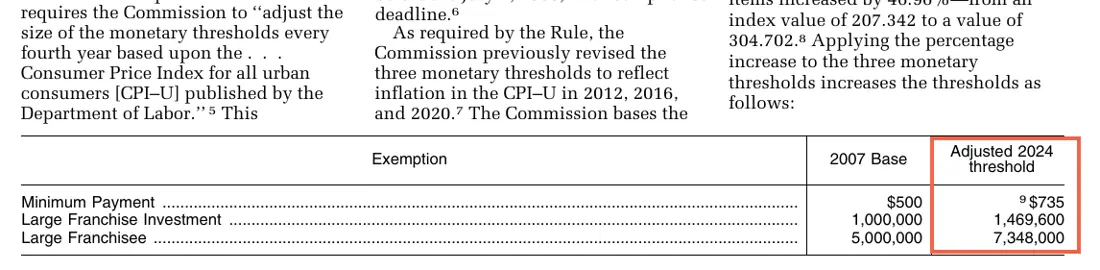
- Since July 12, 2024 the dollar exemptions are under $735 in payments through month six, an initial investment of $1,469,600 or more, and a buyer net worth of $7,348,000 or more (89 FR 57077).
- GAO found no private right to sue under the rule and 1 FTC franchise enforcement action from July 2008 through 2022 (GAO-23-105338, April 2023).
- Three more Franchise Rule cases followed from October 2024 to October 2026, including a $17 million judgment for redress against Xponential Fitness (FTC, March 18, 2026).
- Knowing violations can draw civil penalties of up to $53,088 each under Section 5(m)(1)(A) of the FTC Act, for penalties assessed after January 17, 2025 (16 CFR 1.98(d)).
- As of November 3, 2026, Part 436 was last amended on July 12, 2024; the 2026 Federal Register items are paperwork renewals that estimate about 4,000 franchise sellers (91 FR 24235).
What does the FTC Franchise Rule actually regulate?
The FTC Franchise Rule regulates the sale of a franchise, not the relationship that follows it. Its 11 sections in 16 CFR Part 436 set who is covered (436.1), when the disclosure document is due (436.2), what it must contain (436.3 to 436.7), who is exempt (436.8) and which sales statements are banned (436.9). Under section 436.10(a), the FTC does not approve what a franchisor discloses.
The presale focus has a practical edge. GAO-23-105338 records FTC officials explaining that the rule governs disclosure before the sale and is not designed for problems that arise after the contract is executed, such as later fee or operating disputes (GAO, April 2023). The document’s contents, Item by Item, sit in our guide to the 23 Items of the franchise disclosure document.
| Measure | Figure | Rule or source |
|---|---|---|
| Disclosure window | 14 calendar days before signing or any payment | 16 CFR 436.2(a) |
| Unilateral, material contract change | Revised agreement 7 calendar days before signing | 16 CFR 436.2(b) |
| Paper copy by first-class mail | Mailed at least 3 calendar days before the deadline | 16 CFR 436.2(c)(3) |
| Minimum payment exemption | Under $735, from before opening to 6 months after | 16 CFR 436.8(a)(1) |
| Large investment exemption | $1,469,600 or more, plus a signed acknowledgment | 16 CFR 436.8(a)(5)(i) |
| Large franchisee exemption | $7,348,000 net worth, 5 years in business | 16 CFR 436.8(a)(5)(ii) |
| Maximum civil penalty | $53,088 per violation | 16 CFR 1.98(d) |
| Franchise sellers covered (FTC staff estimate) | About 4,000, of which 240 are new each year | 91 FR 24235, May 5, 2026 |
| Disclosure documents handed out per year (estimate) | About 400,000; 320,000 electronic, 80,000 on paper | 91 FR 24235 |
| Yearly paperwork burden (estimate) | 22,480 hours | 91 FR 24235 |
The same 2026 notice prices the paperwork: 3 attorney hours a year to update an existing document, 30 hours to write a first one, and $450 an hour, for $8,400,040 in yearly labor across covered sellers. Its footnote warns that the 4,000 count may overstate coverage, since some sellers qualify for a 436.8 exemption (FTC, 91 FR 24235).
Does your deal fall under 16 CFR 436, or outside it?
Five questions settle coverage: one on location in the United States or a US territory (436.2), one on the three franchise elements (436.1(h)) and three on the exemptions in section 436.8. A sale that clears all five owes the full rule. A sale exempt for low payments or for having no paperwork can fall under the Business Opportunity Rule instead (16 CFR 437.8).
The three-part definition, the exemptions one by one and the state tests that differ are worked through in our guide to the legal definition of a franchise. The table here asks a different question: once a sale is in view, who in the deal owes what under Part 436.
| Your position in the deal | What Part 436 asks of you | Section |
|---|---|---|
| Franchisor selling a new US outlet, no exemption | FDD 14 calendar days before any signature or payment; keep each signed receipt 3 years and each materially different FDD version 3 years after last use | 436.2(a); 436.6(h), (i) |
| Franchisor after fiscal year end | Revised FDD within 120 days, then only the revised one may be used; quarterly revisions for material changes | 436.7(a), (b) |
| Franchisor changing the attached agreement on its own | Send the revised agreement 7 calendar days before signing; buyer-initiated changes do not restart a clock | 436.2(b); 436.9(g) |
| Broker, sales agent or franchise sales organization | Counts as a franchise seller: every 436.9 ban applies, including no performance figures outside Item 19 | 436.1(j); 436.9 |
| Current franchisee selling its own outlet, franchisor not significantly involved | Not a franchise seller and not a sale; franchisor approval alone does not change that | 436.1(j), (t) |
| Franchisee renewing with no break in operation and no materially different terms | Not a sale, so no new FDD is owed under Part 436 | 436.1(t) |
| Buyer paying the franchisor or affiliates under $735 through month 6, or with nothing in writing | No FDD owed; the seller may owe the one-page Part 437 disclosure instead | 436.8(a)(1), (7); 437.8 |
| Investor group claiming the $1,469,600 exemption | At least one individual must invest at that level, and the buyer signs the acknowledgment text set out in the rule | 436.8(a)(5)(i), note 11 |
| Outlet located outside the United States and its territories | Part 436 does not apply | 436.2 |
Two transactions are not a sale at all under section 436.1(t): a renewal with no break in operation, unless the new agreement differs materially, and a resale by a current franchisee where the franchisor had no significant involvement. Our franchise agreement clause guide shows how renewal and transfer terms read in filed contracts.
Which dollar lines switch the rule off, and how does the FTC recalculate them?
The three dollar exemptions began in 2007 at $500, $1,000,000 and $5,000,000. Section 436.8(b) requires an adjustment every fourth year by the Consumer Price Index for all urban consumers, always measured from the 2007 base. The July 12, 2024 notice applied a 46.96% rise in that index, from 207.342 to 304.702, which produced today’s $735, $1,469,600 and $7,348,000 (89 FR 57077).
| Effective | CPI-U value used | Rise from 2007 | Minimum payment | Large investment | Large franchisee | Federal Register |
|---|---|---|---|---|---|---|
| July 1, 2007 | 207.342 | Base | $500 | $1,000,000 | $5,000,000 | 72 FR 15444 |
| July 1, 2012 | 224.939 | 8.49% | $540 | $1,084,900 | $5,424,500 | 77 FR 36149 |
| July 1, 2016 | 237.017 | 14.31% | $570 | $1,143,100 | $5,715,500 | 81 FR 31500 |
| July 1, 2020 | 255.657 | 23.3% | $615 | $1,233,000 | $6,165,000 | 85 FR 38790 |
| July 12, 2024 | 304.702 | 46.96% | $735 | $1,469,600 | $7,348,000 | 89 FR 57077 |
The large-investment line rose from $1,000,000 to $1,469,600 between 2007 and July 12, 2024, tracking a 46.96% CPI-U rise. Sources: Federal Register, 2007 to 2024.
The arithmetic below reproduces the 2024 figures from the published index values. The Federal Register prints only the rounded results; in earlier rounds it noted the rounding of the minimum payment, for example $616.50 to $615 in 2020.
| Step | Minimum payment | Large investment | Large franchisee |
|---|---|---|---|
| 2007 base in 436.8 | $500 | $1,000,000 | $5,000,000 |
| Multiply by 304.702 / 207.342 = 1.46956 | $734.78 | $1,469,562 | $7,347,812 |
| Published threshold, rounded (89 FR 57077) | $735 | $1,469,600 | $7,348,000 |
Two follow-ons matter for a 2026 or 2027 deal. If the pattern of 2012, 2016, 2020 and 2024 holds, the next adjustment would come in 2028; no notice had appeared as of November 3, 2026. The Business Opportunity Rule did not move with the 2024 change: section 437.8 still says a franchise exempt for payments of less than $500 falls under Part 437.
What sales conduct does section 436.9 ban?
Section 436.9 lists nine things a franchise seller covered by Part 436 may not do, and the definition of franchise seller in 436.1(j) reaches employees, agents, subfranchisors and third-party brokers involved in sales, not only the franchisor. The bans cover statements that contradict the FDD, earnings figures outside Item 19, fake references, waivers of reliance and deposits that are not returned.
| Section | What a seller may not do | Alleged in an FTC complaint since 2008 |
|---|---|---|
| 436.9(a) | Make any claim that contradicts the disclosure document | BurgerIM, Count IV |
| 436.9(b) | Misrepresent that someone bought or ran a franchise, or can give an independent report | None of the 4 cases |
| 436.9(c) | Give financial performance representations without a reasonable basis, written substantiation and inclusion in Item 19 | BurgerIM, Count III; Premier Franchising Group, Count VII |
| 436.9(d) | Withhold the written substantiation for Item 19 when asked | None |
| 436.9(e) | Refuse a reasonable request for the FDD earlier than 14 days out | None |
| 436.9(f) | Refuse the latest FDD and quarterly updates when asked before signing | None |
| 436.9(g) | Present a materially different agreement without 7 days’ notice of the differences | None |
| 436.9(h) | Disclaim, or make the buyer waive reliance on, the FDD | None |
| 436.9(i) | Keep funds or deposits contrary to the disclosed conditions | None; BurgerIM’s refund promises were pleaded under Section 5 (Count I) |
The broker reach is no longer theoretical. In October 2026 the FTC sued Franchise Fastlane LLC, the former sales organization for a martial arts franchisor, alongside the franchisor, quoting the 436.1(j) definition and calling both companies franchise sellers (complaint, E.D. Tenn. 3:26-cv-00487). State broker rules are a separate layer, tracked in our franchise broker registration research.
Referral consultants paid by franchisors when a sale closes can sit in the same sales chain, a model laid out in our explainer on what a franchise consultant does.
Which cases has the FTC brought under the rule since 2008?
Four federal cases since July 2008 charge Franchise Rule violations: BurgerIM (filed 2022), Qargo Coffee (2024), Xponential Fitness (2026) and Premier Franchising Group with its former sales firm (2026). Business opportunity sellers draw more cases; the 5 recent complaints opened for this page each cite 16 CFR 437.3(a), 437.4 and 437.6(d). Every outcome listed is a court order or a settlement the FTC announced.
Franchise Rule cases (16 CFR 436)
Each row lists the counts as pleaded in the complaint, with the 16 CFR sections each count cites, because the FTC press releases describe the conduct without section numbers. BurgerIM ended in a default judgment against the companies; the other three were resolved by stipulated or proposed orders that the FTC announced with 5-0 or 2-0 votes.
| Filed | Case, court and number | Sections alleged by count | Outcome | Source |
|---|---|---|---|---|
| Feb 7, 2022 | United States v. BurgerIM Group USA, Inc. et al., C.D. Cal. 2:22-cv-00825 | Section 5(a) refund promises; 436.3, 436.5, 436.6 disclosure failures; 436.9(c); 436.9(a) | Default judgment, Jan 19, 2024: $7,750,000 civil penalty and $48,476,689 consumer redress against the companies | case page; judgment |
| Oct 16, 2024 | FTC v. Qargo Coffee, Inc. et al., S.D. Fla. 1:24cv23978 | Section 5 misrepresentations and unfair omissions; 436.2(a), no FDD for California buyers labeled licensees; 436.5(b), (d), (k)(2); 436.6 | Proposed order: $1,258,575 judgment suspended on payment of $30,000; rescission notices; no noncompete enforcement against buyers who rescind; 5-0 vote | case page; release |
| Mar 18, 2026 | FTC v. Xponential Fitness, C.D. Cal. 8:26-cv-00610 | Section 5 claims about time to open; 436.5(b), (c), (d), (k)(2), (t)(5); 436.2(a) | $17 million monetary judgment for redress; ban on misrepresentations; 2-0 vote | release; complaint |
| Oct 5, 2026 | FTC v. Premier Franchising Group LLC and Franchise Fastlane LLC, E.D. Tenn. 3:26-cv-00487 | Section 5 semi-absentee and performance claims; 436.5(s)(3) and 436.6(a); 436.9(c); 436.5(b) | Proposed orders: $3,875,424 judgment against the franchisor suspended on $650,000; $1.2 million from the sales firm; cancellation offers; 2-0 vote | release; complaint |
Orders in the four Franchise Rule cases since 2008 range from $30,000 (Qargo) to $56,226,689 (BurgerIM, default judgment). Sources: FTC releases and court orders, 2024 to 2026.
The amounts are orders, not collections. BurgerIM’s $56,226,689 is a default judgment against companies, and the FTC case page does not report what was recovered. Qargo’s payment was set at $30,000 because of the defendants’ inability to pay the full $1,258,575, per the FTC release. The FTC described the Xponential payment as the largest return to consumers in a franchise case.
The disclosure counts cluster on a few Items. All four complaints cite 436.5(b), the Item 2 business experience of the people running the company, and Qargo and Xponential both cite 436.5(d), Item 4 bankruptcy history. Xponential also cites 436.5(c), Item 3 litigation, and Item 20’s list of former franchisees under 436.5(t)(5).
Business Opportunity Rule cases (16 CFR 437), 2024 to 2026
These five matters are not franchise cases. Each complaint pleads counts under Part 437: no one-page disclosure document (437.3(a)), earnings claims without the required statement (437.4) and misrepresented earnings (437.6(d)). Vending matters are left out here; our vending machine franchise rules guide covers 18 of them.
| Filed | Case, court and number | Part 437 sections cited | What was sold, per the FTC | Outcome |
|---|---|---|---|---|
| Jun 3, 2024 | FTC v. TheFBAMachine, Inc., Passive Scaling et al., D.N.J. 2:24-cv-06635 | 437.3(a); 437.4(a), (b), (c); 437.6(d) | Online storefronts run with AI software; FTC alleged over $15 million taken | Stipulated order, Jul 30, 2025; turnover of accounts and real estate for redress |
| Sep 25, 2024 | FTC v. Empire Holdings Group LLC (Ecommerce Empire Builders), E.D. Pa. 2:24-cv-04949 | 437.3(a); 437.4(a), (b); 437.6(d) | Training costing almost $2,000 and done-for-you online stores | Stipulated order, May 9, 2025: ban on selling business opportunities; asset turnover |
| Oct 28, 2024 | FTC v. Ecom Genie Consulting LLC et al., S.D. Fla. 1:24-cv-23976 | 437.3(a); 437.4(a), (b); 437.6(d), (k) | Amazon and Walmart stores; FTC alleged more than $12 million taken | Stipulated orders, Mar 24 and Jul 17, 2025, with permanent bans |
| Mar 2025 | FTC v. Click Profit, LLC et al., S.D. Fla. 1:25-cv-20973 | 437.3(a); 437.4(a), (b); 437.6(d) | AI-powered online stores; FTC alleged at least $14 million taken | Stipulated orders, Aug 25, 2025: permanent industry ban |
| Mar 7, 2025 | FTC v. Growth Cave, LLC et al., C.D. Cal. 2:25-cv-01115 | 437.3(a); 437.4(a), (b); 437.6(d), (i) | Business opportunity and credit repair programs; FTC alleged about $50 million taken | Stipulated orders, Jan 27, 2026: ban on selling business opportunities and credit repair |
The FTC’s own index undercounts franchise matters. Its Franchises, Business Opportunities, and Investments case listing showed 132 entries on November 3, 2026, and neither the Xponential nor the Premier case appeared in it. Our franchise fraud research codes that index by matter type, and the state franchise enforcement registry covers 562 orders from 8 state regulators.
Who can enforce the rule, and what can a franchise buyer do on their own?
Only government agencies enforce the FTC Franchise Rule. GAO found that neither the FTC Act nor the rule creates a private right of action for a franchisee (GAO-23-105338). The FTC sues in federal court for injunctions and redress, and where the knowledge standard of Section 5(m)(1)(A) is met, for civil penalties of up to $53,088 per violation (16 CFR 1.98(d)).
BurgerIM shows the penalty route: the Department of Justice filed the suit on the FTC’s behalf in February 2022, and the court entered the $7,750,000 civil penalty in January 2024 (default judgment). The three later cases were filed by the FTC and resolved with redress, rescission or cancellation offers, and bans on the conduct alleged.
Buyers keep state tools the federal rule lacks. According to the FTC, as reported by GAO, 14 states require a franchisor to register its FDD before selling there, and section 436.10(b) leaves in place any state law that gives buyers equal or greater protection. Our franchise registration states tracker lists the 14, and the franchise attorney guide covers what a lawyer checks before signing.
The rule’s own text gives a buyer six checks to run before signing:
- Ask for the FDD early in talks; a seller may not refuse a reasonable request for an earlier copy (436.9(e)).
- Write down the delivery date and count 14 calendar days to any signature or payment; a paper copy by mail must be sent 3 calendar days before that deadline (436.2(a), (c)(3)).
- Compare the agreement you are asked to sign with the form attached to the FDD; a unilateral, material change needs 7 calendar days (436.2(b), 436.9(g)).
- Treat any sales or profit figure that is not in Item 19 as barred by 436.9(c), and ask for the written substantiation behind Item 19 (436.9(d)).
- Refuse any questionnaire or clause that has you waive reliance on the FDD (436.9(h)).
- Ask for the latest FDD and any quarterly updates before you sign (436.9(f)).
What has changed from 1978 to the latest 2026 news?
The rule has had one full rewrite since 1978. The amended rule published March 30, 2007 took effect July 1, 2007, replaced the old first-personal-meeting and 10-business-day timing with 14 calendar days, and moved business opportunities to Part 437 (72 FR 15444). Since then, the only Federal Register amendments to Part 436 have been 4 threshold updates, while guidance and lawsuits carried policy (Federal Register search, accessed November 3, 2026).
| Date | Event | Document |
|---|---|---|
| Dec 21, 1978 | Original Franchise Rule promulgated; interpretive guides followed Aug 24, 1979 | 43 FR 59614; 44 FR 49966 (as cited in 72 FR 15444) |
| Mar 30, 2007 | Amended rule; Part 436 covers franchises; in force July 1, 2007 | 72 FR 15444 |
| Jul 1, 2008 | Original rule may no longer be used | 72 FR 15444 |
| Dec 8, 2011 | Business Opportunity Rule published as Part 437 | 76 FR 76816 |
| 2012, 2016, 2020 | Thresholds raised to $540, $570 and $615 (minimum payment) | 77 FR 36149; 81 FR 31500; 85 FR 38790 |
| Mar 13, 2019 | Regulatory review opens, Matter No. R511003; online workshop Nov 10, 2020 | 84 FR 9051; 85 FR 55850 |
| Feb 7, 2022 | BurgerIM complaint, the one FTC franchise action GAO found from 2008 to 2022 | FTC case page |
| Mar 10, 2023 | Request for information, docket FTC-2023-0026 | FTC release |
| Jul 12, 2024 | Thresholds of $735, $1,469,600 and $7,348,000; policy statement on contract clauses; staff guidance on undisclosed fees | 89 FR 57077; FTC release |
| Oct 16, 2024 | Qargo Coffee complaint and proposed order | FTC release |
| Mar 18, 2026 | Xponential Fitness: $17 million judgment for redress | FTC release |
| May 5 and Aug 18, 2026 | Paperwork renewal notices for OMB control number 3084-0107 | 91 FR 24235; 91 FR 53415 |
| Oct 5, 2026 | Premier Franchising Group and Franchise Fastlane settle | FTC release |
What is the latest FTC Franchise Rule news?
As of November 3, 2026, the newest federal items are the October 5, 2026 Premier Franchising Group settlement, the March 18, 2026 Xponential judgment, and two Paperwork Reduction Act notices asking OMB to extend the rule’s information collection for 3 years past its August 31, 2026 expiry. The August notice says the FTC received no germane comments on the May notice (91 FR 53415).
The 2023 request for information asked about non-disparagement clauses, franchisors’ power to change the system after signing, payments from suppliers tied to franchisee purchases, and franchise marketing in languages other than English; the FTC said it was separate from the rule review (FTC, March 10, 2023). On July 12, 2024 the FTC reported more than 2,000 comments, adopted a policy statement on contract clauses by a 3-2 vote, and issued staff guidance that franchisors cannot impose fees not disclosed in advance (FTC release).
We found no Federal Register proposal to amend Part 436 in 2025 or 2026. A search of FTC documents on federalregister.gov that mention the rule, through the August 18, 2026 notice, turned up none, and eCFR lists July 12, 2024 as the last change to Part 436. We also found no ftc.gov notice withdrawing the 2024 policy statement as of November 3, 2026.
Which common readings of the rule does the text contradict?
Six claims recur in sales pitches and secondary guides, and the rule text settles each one. The table pairs each claim with the section that decides it and a question that turns the section into a check. A seller who repeats one of these claims is a reason to read the cited section yourself, or to put that exact question to a franchise lawyer.
| Claim heard | What the primary source says | Section | Question to ask |
|---|---|---|---|
| The FTC reviewed and approved this FDD | The FTC does not approve or express an opinion on what a franchisor discloses | 436.10(a) | Which state, if any, registered this FDD, and on what date? |
| You get 10 business days to review | That was the original rule; since 2007 the window is 14 calendar days | 436.2(a); 72 FR 15444 | On what date did I receive the FDD, and how was it delivered? |
| Our broker is independent, so the rule does not cover what they say | Third-party brokers involved in sales are franchise sellers bound by 436.9 | 436.1(j); 436.9 | Does Item 2 list the people who run franchise sales? |
| The minimum payment exemption is $500 | $735 under Part 436 since July 12, 2024; $500 survives only in the text of 437.8 | 436.8(a)(1); 437.8 | What will I pay you or an affiliate before opening and in the first 6 months? |
| You can sue under the FTC rule if this goes wrong | Neither the FTC Act nor the rule gives a franchisee a private right of action | GAO-23-105338 | Which state law and which forum does the agreement choose? |
| The FTC overhauled the rule in 2026 | No 2025 or 2026 Federal Register amendment; Part 436 last changed July 12, 2024 | eCFR, Part 436 | Which Federal Register citation are you relying on? |
How we compiled this
We read the current text of 16 CFR Parts 436 and 437 and section 1.98 through the eCFR API (Title 16 current to October 30, 2026), 10 Federal Register documents from 2007 to 2026, GAO-23-105338, 5 FTC press releases and 9 FTC complaints with their case pages, all in November 2026. Outcomes are as the FTC and the courts state them; we contacted no parties. We left out individual defendants’ names, vending cases covered elsewhere, and blog claims about rule changes that no primary document supports. This is general information, not legal, financial or investment advice.
Frequently asked questions
What is the FTC Franchise Rule?
The FTC Franchise Rule is the federal regulation at 16 CFR Part 436 that makes it an unfair or deceptive practice to sell a franchise in the United States without giving the buyer a current Franchise Disclosure Document at least 14 calendar days before signing or paying. It also bans 9 kinds of sales conduct in section 436.9. The FTC adopted it in 1978 and rewrote it in 2007.
Does the FTC Franchise Rule apply to franchise brokers?
Yes. Section 436.1(j) defines a franchise seller to include third-party brokers involved in franchise sales, alongside the franchisor, its employees, agents and subfranchisors. The section 436.9 bans, such as giving performance figures outside Item 19, apply to every franchise seller. In October 2026 the FTC sued a former franchise sales organization together with the franchisor it sold for (E.D. Tenn. 3:26-cv-00487).
What is exempt from the FTC Franchise Rule?
Section 436.8(a) sets out the exemptions in seven paragraphs: required payments under $735 through the first 6 months, fractional franchises, leased departments, petroleum dealers under the PMPA, investments of $1,469,600 or more with a signed acknowledgment, buyers worth $7,348,000 with 5 years in business, insider buyers, and deals with nothing in writing. The dollar figures date from July 12, 2024 (89 FR 57077).
Can a franchisee sue a franchisor for violating the FTC Franchise Rule?
Not under the rule itself. GAO reported in April 2023 that neither the FTC Act nor the Franchise Rule creates a private right of action (GAO-23-105338). A franchisee can report the conduct to the FTC, which sues in federal court, and may have claims under state franchise or contract law. Fourteen states also require franchisors to register their FDD before selling.
When was the FTC Franchise Rule last updated?
The last change to the rule text took effect July 12, 2024, when the FTC raised the three exemption thresholds to $735, $1,469,600 and $7,348,000 (89 FR 57077). The last full rewrite was the amended rule of March 30, 2007, in force from July 1, 2007. In 2026 the FTC published only paperwork renewal notices, on May 5 and August 18.
What are the 23 Items the FTC Franchise Rule requires?
Section 436.5 lists them as paragraphs (a) through (w), from Item 1 on the franchisor and its affiliates to Item 23 on the receipt the buyer signs. Item 19 covers financial performance representations and Item 20 covers outlet counts and openings. Each Item, with its rule paragraph, is explained in our franchise disclosure document guide.
Sources
Rule text and Federal Register
- 16 CFR Part 436, Disclosure Requirements and Prohibitions Concerning Franchising, eCFR. Accessed November 3, 2026.
- 16 CFR Part 437, Business Opportunity Rule, eCFR. Accessed November 3, 2026.
- 16 CFR 1.98, Adjustment of civil monetary penalty amounts, eCFR. Accessed November 3, 2026.
- 72 FR 15444, Disclosure Requirements and Prohibitions Concerning Franchising, final rule (Mar. 30, 2007), Federal Register. Accessed November 3, 2026.
- 76 FR 76816, Business Opportunity Rule (Dec. 8, 2011), Federal Register. Accessed November 3, 2026.
- 77 FR 36149, threshold adjustment (June 18, 2012), Federal Register. Accessed November 3, 2026.
- 81 FR 31500, threshold adjustment (May 19, 2016), Federal Register. Accessed November 3, 2026.
- 85 FR 38790, threshold adjustment (June 29, 2020), Federal Register. Accessed November 3, 2026.
- 89 FR 57077, threshold adjustment (July 12, 2024), govinfo PDF, Federal Register / GPO. Accessed November 3, 2026.
- 84 FR 9051, Franchise Rule regulatory review (Mar. 13, 2019), Federal Register. Accessed November 3, 2026.
- 85 FR 55850, Public Workshop Examining Franchise Rule (Sept. 10, 2020), Federal Register. Accessed November 3, 2026.
- 91 FR 24235, Franchise Rule information collection (May 5, 2026), Federal Register. Accessed November 3, 2026.
- 91 FR 53415, Franchise Rule information collection (Aug. 18, 2026), Federal Register. Accessed November 3, 2026.
GAO, FTC releases and court records
- GAO-23-105338, FTC Franchise Oversight (April 2023), U.S. Government Accountability Office. Accessed November 3, 2026.
- FTC Seeks Public Comment on Franchisors Exerting Control Over Franchisees and Workers (Mar. 10, 2023), Federal Trade Commission. Accessed November 3, 2026.
- FTC Takes Action to Ensure Franchisees’ Complaints are Heard and to Protect Against Illegal Fees (July 12, 2024), Federal Trade Commission. Accessed November 3, 2026.
- U.S. v. BurgerIM, case page, Federal Trade Commission. Accessed November 3, 2026.
- BurgerIM default judgment (Jan. 19, 2024), Federal Trade Commission. Accessed November 3, 2026.
- FTC v. Qargo Coffee, case page, Federal Trade Commission. Accessed November 3, 2026.
- FTC Takes Action Against Qargo Coffee for Franchise Rule Violations (Oct. 16, 2024), Federal Trade Commission. Accessed November 3, 2026.
- FTC Secures Settlement Against Xponential Fitness for Franchise Rule Violations (Mar. 18, 2026), Federal Trade Commission. Accessed November 3, 2026.
- Xponential Fitness complaint, C.D. Cal. 8:26-cv-00610, Federal Trade Commission. Accessed November 3, 2026.
- Premier Martial Arts Franchisor and its Former Franchise Sales Organization Settle FTC Charges (Oct. 5, 2026), Federal Trade Commission. Accessed November 3, 2026.
- Premier Franchising Group and Franchise Fastlane complaint, E.D. Tenn. 3:26-cv-00487, Federal Trade Commission. Accessed November 3, 2026.
- FTC v. Empire Holdings Group, case page, Federal Trade Commission. Accessed November 3, 2026.
- FTC v. FBA Machine / Passive Scaling, case page, Federal Trade Commission. Accessed November 3, 2026.
- FTC v. Ecom Genie, case page, Federal Trade Commission. Accessed November 3, 2026.
- FTC v. Click Profit, case page, Federal Trade Commission. Accessed November 3, 2026.
- FTC v. Growth Cave, case page, Federal Trade Commission. Accessed November 3, 2026.
- Cases and Proceedings: Franchises, Business Opportunities, and Investments, Federal Trade Commission. Accessed November 3, 2026.