
A travel agency franchise is usually a home-based agency whose franchisor collects supplier commissions and takes a 1.5% to 3% royalty on the fare before paying you. Three FDDs print startup totals of $1,795 to $21,000.
Key takeaways
- Cruise Planners’ FDD issued April 27, 2026 prints an Item 7 total of $1,945 to $20,505, of which $695 to $12,205 goes to the franchisor or its affiliates (Cruise Planners FDD, cover and Item 7).
- Under the Cruise Planners and CruiseOne (Dream Vacations) contracts, suppliers pay commissions to the franchisor, which deducts its royalty and remits the rest; the CruiseOne FDD says you have no right to collect commissions from a supplier directly (CruiseOne FDD issued April 1, 2022, Item 6 note 2).
- California charges a seller of travel $100 per business location per year and exempts an individual agent only if all six conditions in Business and Professions Code section 17550.20(g) are met (California Attorney General copy of B&P Code 17550 et seq.).
- Florida requires a performance bond of up to $25,000 and a $300 annual fee from a basic seller of travel, plus a $50 yearly filing from each independent agent (Fla. Stat. 559.928).
- Travel Leaders licenses existing agencies on flat monthly fees of $612 to $1,285 by level rather than a percentage royalty, and prints an Item 7 total of $2,270 to $17,910 (Travel Leaders Network FDD issued March 13, 2026, Items 6 and 7).
Where does the money go when your client books a cruise?
In the two home-based systems we read, the money skips you on the way in. The client pays the cruise line, the cruise line pays the commission to the franchisor, and the franchisor deducts its royalty and fees you owe before sending you the balance. Cruise Planners pays only after three things happen: the booking is on its CRM, the trip has departed and the supplier has paid in full (Item 6, note 2).
The payout calendar is written into the fee table. Cruise Planners remits on the 15th for commissions that clear between the 1st and 12th of a month, and on the 1st of the next month for those clearing from the 13th to month end; bookings left off its CRM for any 6-month period forfeit their held commissions (Cruise Planners FDD, Item 6 note 2). CruiseOne remits weekly by direct deposit and reserves the right to switch to bi-weekly.
| Mechanic | Cruise Planners (FDD April 27, 2026) | Dream Vacations / CruiseOne (FDD April 1, 2022) | Travel Leaders (FDD March 13, 2026) |
|---|---|---|---|
| Who receives supplier commissions | Franchisor, then remits (Item 6 note 2) | Franchisor has the exclusive right to collect (Item 6 note 2) | Not routed through TLN; TLN may keep all or part of supplier overrides and rebates, balance credited to you (Item 8) |
| Royalty basis | 1.5% to 3% of Gross Commissionable Fares | 1.5% to 3.0% of Annual Commissionable Sales | Flat Continuing License Fee, $612 to $1,285 a month by level |
| When you are paid | 15th or 1st of the month, after departure | Weekly by direct deposit | Fees drafted on the 1st business day of each month |
| Accreditation numbers | Seasoned tier requires your own current IATAN card or CLIA certification (Item 5) | You must use CruiseOne’s CLIA and IATA numbers (Item 1) | You must maintain your ARC appointment (Item 1) |
That routing is what separates these franchises from simply joining a network. Travel Leaders’ own financial statement note counts 188 Travel Leaders franchise locations and 3,190 US affiliate agencies at December 31, 2025, so most agencies in that network sit outside the franchise (Travel Leaders Network FDD, financial statement note 1(a), unaudited). For other systems that let owners work from a spare room, our list of franchises that allow a home office in their FDD covers 48 filings.
How does the royalty track the supplier’s commission rate?
Both commission-routed systems set the royalty as a percentage of the fare, then pick the percentage by the commission the supplier pays. Cruise Planners charges 3% of the Gross Commissionable Fare when the supplier pays 6% or more and 1.5% below 6%. CruiseOne’s 2022 schedule uses three steps, with 3% applying at supplier commissions of 10% and greater (Item 6, note 4 in each FDD).
| Supplier commission (or markup) | Royalty on the fare | Franchisor and item |
|---|---|---|
| 6% or more | 3% of Gross Commissionable Fare | Cruise Planners, Item 6 note 4(a) |
| Less than 6% | 1.5% of Gross Commissionable Fare | Cruise Planners, Item 6 note 4(b) |
| Non-commissionable booking with your markup | 20% to 30% of the markup | Cruise Planners, Item 6 note 4(e) |
| Bundled package with no itemized commission | 3% of the total gross amount paid | Cruise Planners, Item 6 note 4(d) |
| 4.9% or less | 1.5% of Annual Commissionable Sales | CruiseOne (2022), Item 6 note 4(i) |
| 5% to 9.99% | 2% | CruiseOne (2022), Item 6 note 4(ii) |
| 10% and greater | 3% | CruiseOne (2022), Item 6 note 4(iii) |
| Travel insurance sales | 3% | CruiseOne (2022), Item 6 |
Because the royalty is charged on the fare, the share of your commission it consumes equals the royalty rate divided by the commission rate. The arithmetic below uses only the thresholds printed in the two schedules, so it applies to any fare size.
| Threshold case | Calculation | Royalty as share of the commission |
|---|---|---|
| Cruise Planners, supplier pays exactly 6% | 3% / 6% | 50% |
| CruiseOne (2022), supplier pays exactly 5% | 2% / 5% | 40% |
| CruiseOne (2022), supplier pays exactly 10% | 3% / 10% | 30% |
Cruise Planners adds that sales incentive programs may lower the royalty to as low as 0% at certain volume levels, without printing the volumes. Ask for the current incentive schedule in writing before you compare it with the royalty table in our study of royalty rates in filed FDDs.
Which states require a seller of travel registration, and what does each demand?
Four states named in the Cruise Planners FDD, California, Florida, Hawaii and Washington, have seller of travel statutes with registration plus a bond or trust account. Each statute also says when an agent selling under someone else’s registration is excused, and those carve-outs decide whether you file in your own name. The table quotes each code section as published by the state (RCW 19.138, Fla. Stat. 559.928).
| State and statute | Who must register | Fee printed in the statute | Consumer money protection | Carve-out for an agent of a registered seller | Source |
|---|---|---|---|---|---|
| California, B&P Code 17550.20 | Any seller soliciting purchasers in California or soliciting from California locations; apply 10 days before doing business | $100 per location per year; late fee $5 a day up to $500 | Trust account, bond or another approved plan; Travel Consumer Restitution Fund if the principal place of business is in California | 17550.20(g): individual, single-member LLC or single-shareholder S corporation meeting six conditions | CA AG statute copy; CA AG registration FAQ |
| Florida, Fla. Stat. 559.928 and 559.929 | Any seller with a Florida location or offering travel in Florida | $300 a year (basic certification); $1,000 or $2,500 for the other two certifications | Performance bond up to $25,000, or $50,000 with vacation certificates | 559.928(3): independent agent files yearly and pays $50; 559.935(2)(a) exempts ARC sellers with 3 consecutive years under the same ownership | 559.928; 559.929; 559.935; FDACS Sellers of Travel |
| Hawaii, HRS 468L-2 and 468L-5 | Any “travel agency” acting for compensation as intermediary between buyer and seller | Set by the director under 468L-3; renew by December 31 of each odd-numbered year | Trust account at a federally insured Hawaii institution within five business days; card charges submitted within five days count as compliance | None found in 468L-1, -2, -3, -5 or -7 | HRS 468L-2 (archived copy); HRS 468L-5 (archived copy) |
| Washington, RCW 19.138.100 and 19.138.140 | Any seller transacting business with Washington consumers, expressly including independent contractors and outside agents | Set by rule under 19.138.110(3) | Trust account in Washington for sums held over five business days, or a bond of $10,000 to $50,000 | 19.138.100(5): no separate registration if you sell in the registered seller’s name and all money is collected in its name | RCW 19.138 |
California’s carve-out is the strictest of the four. Under 17550.20(g) you must hold a written contract with a registered seller, act only on its behalf for that passenger, sell under its official agency appointment, take no money from the passenger, have the passenger pay the carrier or the registered seller directly, and disclose the registered seller’s name, address, phone number and registration number in writing and on your website home page. Accepting a deposit by check made out to you breaks condition (4).
Washington draws the line by name and money. RCW 19.138.021(6)(a) defines an independent contractor or outside agent as a seller of travel, and 19.138.100(5) excuses that person only while the business runs in the registered seller’s name and every dollar is collected in that name. Hawaii’s 468L-7(a)(7) separately requires a refund within fourteen calendar days for services not performed, which applies to the registered agency.
State franchise law is a separate filing track from these travel statutes. Our guides to California franchise rules for buyers and Florida’s franchise exemption filings cover the franchise sale itself.
Does the franchisor register for you, or do you?
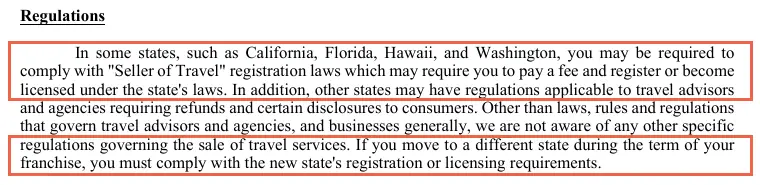
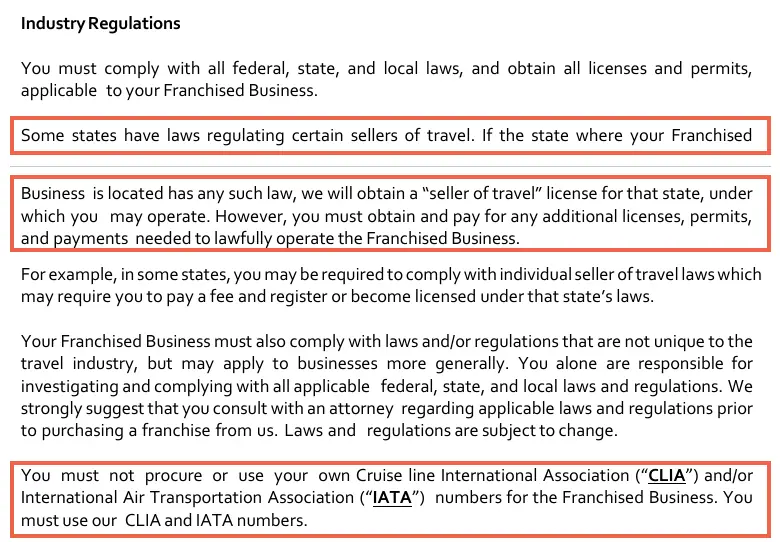
Item 1 of each FDD answers this, and the three answers differ. CruiseOne’s 2022 FDD says it will obtain the seller of travel license for the state where your business is located and that you operate under it. Cruise Planners’ 2026 FDD says you may be required to register and pay a fee yourself. Travel Leaders puts the duty on the licensee, along with keeping its ARC appointment.
| Franchisor (FDD date) | Item 1 language on seller of travel laws | Accreditation rule | If you move states |
|---|---|---|---|
| Cruise Planners (April 27, 2026) | “In some states, such as California, Florida, Hawaii, and Washington, you may be required to comply with ‘Seller of Travel’ registration laws which may require you to pay a fee and register or become licensed” | Seasoned tier needs your own IATAN card or CLIA certification (Item 5) | “you must comply with the new state’s registration or licensing requirements” |
| Dream Vacations / CruiseOne (April 1, 2022) | “we will obtain a ‘seller of travel’ license for that state, under which you may operate”; you pay for any additional licenses | “You must use our CLIA and IATA numbers” | Relocation outside the original five-digit ZIP code needs written approval and a $149 fee (Item 6) |
| Travel Leaders (March 13, 2026) | California, Florida and Washington named; you must obtain and keep all licenses and permits | “You must maintain all Airline Reporting Corporation (‘ARC’) … appointments” | Not addressed in Item 1 |
A franchisor’s registration covers you only if your conduct fits the state carve-out. A CruiseOne franchisee in California who collected client payments directly would fall outside 17550.20(g)(4) and (5) even though the franchisor holds a California registration. Ask the franchise development team for its registration numbers in all four states and for the written procedure on client payments, then match both against the table above.
What do Items 5, 6 and 7 charge at three travel franchisors?
The three filings print initial investments between $1,795 and $21,000, with no rent line because Cruise Planners and CruiseOne both say most franchisees work from home. The CruiseOne figures come from its April 1, 2022 FDD, the newest Dream Vacations Clean FDD that Minnesota’s CARDS database returned in November 2026, so the current offer may differ. The table lists franchisors alphabetically and quotes each figure as printed in the Franchise Disclosure Document.
| Item | Cruise Planners | Dream Vacations / CruiseOne | Travel Leaders | Source |
|---|---|---|---|---|
| FDD issuance date | April 27, 2026 | April 1, 2022 | March 13, 2026 | Cover page |
| Item 5 initial fee | $695 to $10,995 by experience tier; $4,000 off for veterans and first responders who are New Travel Advisors | $495, $3,195 or $10,500 by tier; 30% military discount for new franchisees | $2,500 per location; $0 to $2,500 charged in 2025 | Item 5 |
| Item 6 royalty | 1.5% to 3% of Gross Commissionable Fares | 1.5% to 3.0% of Annual Commissionable Sales; 3% on travel insurance | Continuing License Fee $612, $886 or $1285 a month | Item 6 |
| Item 6 marketing or service fee | Administrative Service Fee $80 a month | Service Fee $25 to $150 a month | Marketing Fee $203 to $340 a month; publication fee $82 a month; local marketing $0 to $461 where assessed | Item 6 |
| Item 6 E&O insurance | $180 per person a year (first person’s first year in the fee) | $150 per person a year | Insurance $1,000 to $2,100 a year | Items 5, 6 |
| Item 6 transfer fee | $695 to $7,500 | $3,500 | Not a listed fee; termination fee equals license fees for the rest of the term | Item 6 |
| Item 7 total | $1,945 to $20,505 | New: $11,800 to $21,000; intermediate or experienced: $1,795 to $13,695 | $2,270 to $17,910 for the first or main office | Item 7, cover |
| Item 10 financing | None offered | Up to $7,300 of the fee over 24 months at Prime plus 6%, $3,500 down | None offered | Item 10 |
| Item 17 initial term | 3 years after Commencement of Operations | 5 years, no renewal right | 3 years | Item 17 |
High Item 7 estimates run from $13,695 (an experienced CruiseOne franchisee, 2022) to $21,000 (a new CruiseOne franchisee, 2022); Cruise Planners prints $1,945 to $20,505 for 2026.
In the two start-up systems, about half of the high Item 7 estimate is the franchise fee. At the Cruise Planners high end, the $10,995 fee is 53.6% of $20,505; at CruiseOne’s new-franchisee level the $10,500 fee is 50% of $21,000. Travel Leaders’ range is driven by signage ($200 to $6,000) and internet and email setup ($0 to $2,000), because it converts an agency that already has an office.
Several fee figures still circulating are out of date against the current filings. The corrections below describe the claim neutrally and give the primary figure.
| Claim in circulation | What the FDD prints | Source |
|---|---|---|
| A guide published in 2024 gives Travel Leaders’ initial fee as “up to $1,500” and its royalty as “up to $1,000 per month” | Initial license fee $2,500 ($0 to $2,500 charged in 2025); Continuing License Fee $612 to $1,285 a month plus a $203 to $340 marketing fee | Travel Leaders FDD, March 13, 2026, Items 5 and 6 |
| A 2023 comparison table lists Cruise Planners’ startup cost as “$0 to $10,495” | Item 7 total $1,945 to $20,505 | Cruise Planners FDD, April 27, 2026, Item 7 |
For travel and other systems with an Item 7 low end under six figures, our guide to franchises under $100k sets these ranges beside other models.
How much does prior booking volume cut the franchise fee?
Both commission-routed franchisors price the Item 5 fee by your booking history, and the top discount needs a current CLIA or IATAN card plus at least $100,000 of departed commissionable revenue in the prior 12 months. At that level Cruise Planners charges $695 and CruiseOne’s 2022 FDD charges $495, against $10,995 and $10,500 for a newcomer.
| Franchisor | Tier | Qualification printed in Item 5 | Initial fee |
|---|---|---|---|
| Cruise Planners | New Travel Advisor | No previous travel advisor experience | $10,995 |
| Cruise Planners | Some Experience in Travel Industry (SETI) | Working for or with an Approved Travel Entity, with knowledge the franchisor deems satisfactory | $6,995 |
| Cruise Planners | Retail Experience in Travel Industry (RET) | Direct retail travel sales within the previous 18 months | $3,995 |
| Cruise Planners | Seasoned Travel Advisor | Current IATAN card or CLIA certification and $100,000 of Departed Commissionable Revenue in 12 months, or $5,000 earned commissions last calendar year | $695 |
| CruiseOne (2022) | New | Under $50,000 annual commissionable departed revenues (need not be verified) | $10,500 |
| CruiseOne (2022) | Intermediate | Verifiable $50,000 to $99,999 plus a current CLIA or IATAN card | $3,195 |
| CruiseOne (2022) | Experienced | Verifiable $100,000 or more plus a current CLIA or IATAN card | $495 |
Tiering also shifts later costs. Cruise Planners’ Seasoned advisors pay a $2,000 annual maintenance fee in years 1 and 2 if departed commissionable revenue stays under $75,000, against $500 for a new advisor under $15,000 (Item 6, note 5). Veterans comparing the $4,000 Cruise Planners discount with other brands can use our veteran franchise discount data.
What fixed fees arrive before the first commission check?
Fixed monthly fees start whether or not a client has travelled, and Cruise Planners pays commissions only after departure. The table multiplies each FDD’s printed monthly fee by 12 for one owner with no staff, before royalties, local marketing or CPI adjustments. It uses no sales assumptions.
| Franchisor and level | Monthly fees printed in Item 6 | Arithmetic | Fixed fees for 12 months |
|---|---|---|---|
| Cruise Planners | Administrative Service Fee $80 | $80 x 12 | $960, plus $500 maintenance at the first anniversary if departed commissionable revenue is under $15,000 |
| Dream Vacations / CruiseOne (2022) | Service Fee $25 to $150 | $25 x 12 to $150 x 12 | $300 to $1,800, plus $150 E&O at the first anniversary |
| Travel Leaders, Level 3 Professional | $612 license + $203 marketing + $82 publication = $897 | $897 x 12 | $10,764 |
| Travel Leaders, Level 2 Executive | $886 + $272 + $82 = $1,240 | $1,240 x 12 | $14,880 |
| Travel Leaders, Level 1 Enterprise | $1,285 + $340 + $82 = $1,707 | $1,707 x 12 | $20,484 |
CruiseOne’s Service Fee begins on the 1st day of the 4th calendar month after training and no later than 150 days after signing, so a first contract year carries fewer than 12 payments. Travel Leaders may raise these fees with the Consumer Price Index each September 1 and by up to 50% at renewal (Item 6, note 3). None of this is financial or legal advice; take the table to an accountant with your own booking plan.
How many travel franchisees open and leave each year?
Cruise Planners’ Item 20 shows a network that adds hundreds of outlets a year and loses well over a hundred. In 2025 it opened 325 franchised outlets, terminated 124 and did not renew 33, ending at 3,124 franchised outlets plus 1 company-owned. Its note says the 52 outlets that ceased for other reasons in 2025 were franchisees who moved their businesses to other states.
| Year | Cruise Planners opened | Terminations | Non-renewals | Ceased, other reasons | Franchised outlets at year end |
|---|---|---|---|---|---|
| 2023 | 458 | 145 | 67 | 44 | 2,796 |
| 2024 | 432 | 128 | 42 | 50 | 3,008 |
| 2025 | 325 | 124 | 33 | 52 | 3,124 |
Cruise Planners opened 325 franchised outlets in 2025 while terminating 124 and not renewing 33. Source: Cruise Planners FDD issued April 27, 2026, Item 20 Table 3.
The other two filings are smaller or older. Travel Leaders reports 187 franchised outlets at the end of 2025, down from 188 a year earlier, and 1 company or TLG owned outlet. CruiseOne’s 2022 FDD reports 1,577 franchised outlets at the end of 2021, up from 1,483, and no company-owned outlets.
On earnings, the three documents differ in what they disclose. Cruise Planners’ 2026 Item 19 presents historical sales data for a defined subset of its franchised outlets; the CruiseOne 2022 and Travel Leaders 2026 Item 19 sections state that the franchisor makes no financial performance representations. Read the Cruise Planners Item 19 yourself, including which outlets were left out, and compare it with how other franchisors build theirs in our review of Item 19 disclosures.
Which travel franchise route matches your starting point?
Your booking history, whether you already hold an ARC appointment, and the states your clients live in narrow the choice more than brand does. Each row below ties a starting point to the FDD or statute section that decides it. Treat it as a checklist for questions to the franchisor and a travel attorney, not as a recommendation of any company.
| If your situation is | Then check | Threshold or rule |
|---|---|---|
| No travel sales history and no CLIA or IATAN card | The new-advisor fee, financing and training cost | Fee $10,995 (Cruise Planners 2026) or $10,500 (CruiseOne 2022); only CruiseOne’s FDD offers fee financing, up to $7,300 over 24 months |
| Current CLIA or IATAN card and $100,000 or more departed commissionable revenue in 12 months | The seasoned or experienced tier, then the maintenance fee schedule | Fee $695 (Cruise Planners) or $495 (CruiseOne 2022); Cruise Planners Seasoned maintenance $2,000 in years 1 and 2 under $75,000 |
| You already run an agency with its own ARC appointment | A conversion license rather than a start-up franchise | Travel Leaders Item 7 $2,270 to $17,910; flat fees $897 to $1,707 a month including publication; 30 to 90 days to convert |
| Your agency is in Florida and has held an ARC contract for 3 consecutive years under the same owners | The Florida exemption from registration and bond | Fla. Stat. 559.935(2)(a); FDACS says you still need its statement of exemption to obtain an occupational license |
| You live in California and plan to sell under the franchisor’s registration | All six 17550.20(g) conditions | Any client payment made to you breaks (g)(4); otherwise register yourself at $100 per location per year |
| You sell to Washington residents | Whose name is on the booking and who collects the money | RCW 19.138.100(5): both must be the registered seller’s, or you register |
| You want to keep your own CLIA or IATA number | Item 1 of the specific FDD | CruiseOne’s 2022 FDD forbids it |
If you would rather keep every commission dollar and set your own prices, a franchise may cost more than it returns, because the royalty applies to every commissionable fare for the 3 to 5 year term. Our guide to conversion franchising explains how existing businesses weigh a brand change like Travel Leaders’.
How we compiled this
We read three Franchise Disclosure Documents filed with the Minnesota Department of Commerce (CARDS) in November 2026: Cruise Planners (April 27, 2026), CruiseOne for Dream Vacations (April 1, 2022, the newest the database returned) and Travel Leaders Network (March 13, 2026); a search for an Expedia Cruises FDD returned none. We opened the seller of travel statutes of California (Attorney General copy), Florida, Washington and Hawaii (Internet Archive copies, because the state site refused our requests), plus the California and Florida program pages. We excluded all Item 19 figures, unit revenue claims and third-party profit estimates.
Frequently asked questions
How much does a travel agency franchise cost?
Item 7 totals run $1,945 to $20,505 at Cruise Planners (FDD issued April 27, 2026), $2,270 to $17,910 for a Travel Leaders conversion (March 13, 2026), and $11,800 to $21,000 for a new CruiseOne (Dream Vacations) franchisee in its April 1, 2022 FDD. At Cruise Planners and CruiseOne the franchise fee is about half of the high estimate, and neither includes rent because both models run from home.
Do I need a seller of travel license to run a travel franchise from home?
It depends on where your clients live and how payments flow. California, Florida, Hawaii and Washington require registration. California excuses an individual agent only under the six conditions in B&P Code 17550.20(g), Washington only if bookings and money stay in the registered seller’s name (RCW 19.138.100(5)), and Florida still requires a $50 yearly independent agent filing.
Is Dream Vacations a franchise or a host agency?
Dream Vacations is sold as a franchise. CruiseOne, Inc. files an FDD for businesses operating under the CruiseOne and Dream Vacations marks; its April 1, 2022 FDD charges a $495 to $10,500 initial fee, a 1.5% to 3.0% royalty, and requires you to use CruiseOne’s CLIA and IATA numbers. Ask for the current FDD, since 2022 is the newest copy on Minnesota’s CARDS database.
What royalty does Cruise Planners charge?
Cruise Planners’ 2026 FDD charges 3% of the Gross Commissionable Fare when the supplier pays a commission of 6% or more and 1.5% below 6%. Non-commissionable bookings with your markup carry a 20% to 30% royalty on the markup. The royalty is deducted before the franchisor remits your commission on the 15th or the 1st of the month (Item 6).
Can I keep my own CLIA or IATA number in a travel franchise?
Not under every contract. CruiseOne’s April 1, 2022 FDD says you must not procure or use your own CLIA or IATA numbers and must use the franchisor’s. Cruise Planners’ 2026 FDD instead uses a current IATAN card or CLIA certification as one test for its $695 Seasoned tier. Travel Leaders requires you to keep your own ARC appointment.
How much do travel agency franchise owners make?
We do not publish income figures. What you keep depends on supplier commission rates, the royalty bracket in Item 6, fixed monthly fees, and how fast trips depart, since Cruise Planners pays only after departure. Cruise Planners’ Item 19 contains historical sales data for a subset of outlets; the CruiseOne 2022 and Travel Leaders 2026 FDDs make no financial performance representation.
Which travel franchise is best for beginners?
We do not rank franchises. For someone with no bookings, compare the new-advisor fee ($10,995 at Cruise Planners in 2026, $10,500 at CruiseOne in 2022), whether the fee can be financed (only CruiseOne’s FDD offers up to $7,300), who holds the seller of travel registration in your state, and the fixed monthly fees in Item 6.
Sources
- Minnesota Department of Commerce CARDS, document 36239-202604-12: Cruise Planners Franchise Disclosure Document, issued April 27, 2026 (CP Franchising, LLC), accessed November 3, 2026.
- Minnesota Department of Commerce CARDS, document 23297-202204-02: CruiseOne, Inc. (CruiseOne and Dream Vacations) Franchise Disclosure Document, issued April 1, 2022, accessed November 3, 2026.
- Minnesota Department of Commerce CARDS, document 35537-202603-07: Travel Leaders Network, LLC Franchise Disclosure Document, issued March 13, 2026, accessed November 3, 2026.
- California Office of the Attorney General: Seller of Travel Laws/Statute, Business and Professions Code 17550 et seq., accessed November 3, 2026.
- California Office of the Attorney General: Seller of Travel Registration FAQs, accessed November 3, 2026.
- Florida Legislature, Online Sunshine: Florida Statutes 559.928, Registration, accessed November 3, 2026.
- Florida Legislature, Online Sunshine: Florida Statutes 559.929, Security requirements, accessed November 3, 2026.
- Florida Legislature, Online Sunshine: Florida Statutes 559.935, Exemptions, accessed November 3, 2026.
- Florida Department of Agriculture and Consumer Services: Sellers of Travel, accessed November 3, 2026.
- Washington State Legislature: RCW 19.138, Sellers of travel, accessed November 3, 2026.
- Hawaii State Legislature: HRS 468L-2, Registration and renewal (Internet Archive capture of Feb. 24, 2025), accessed November 3, 2026.
- Hawaii State Legislature: HRS 468L-5, Client trust accounts (Internet Archive capture, 2025), accessed November 3, 2026.