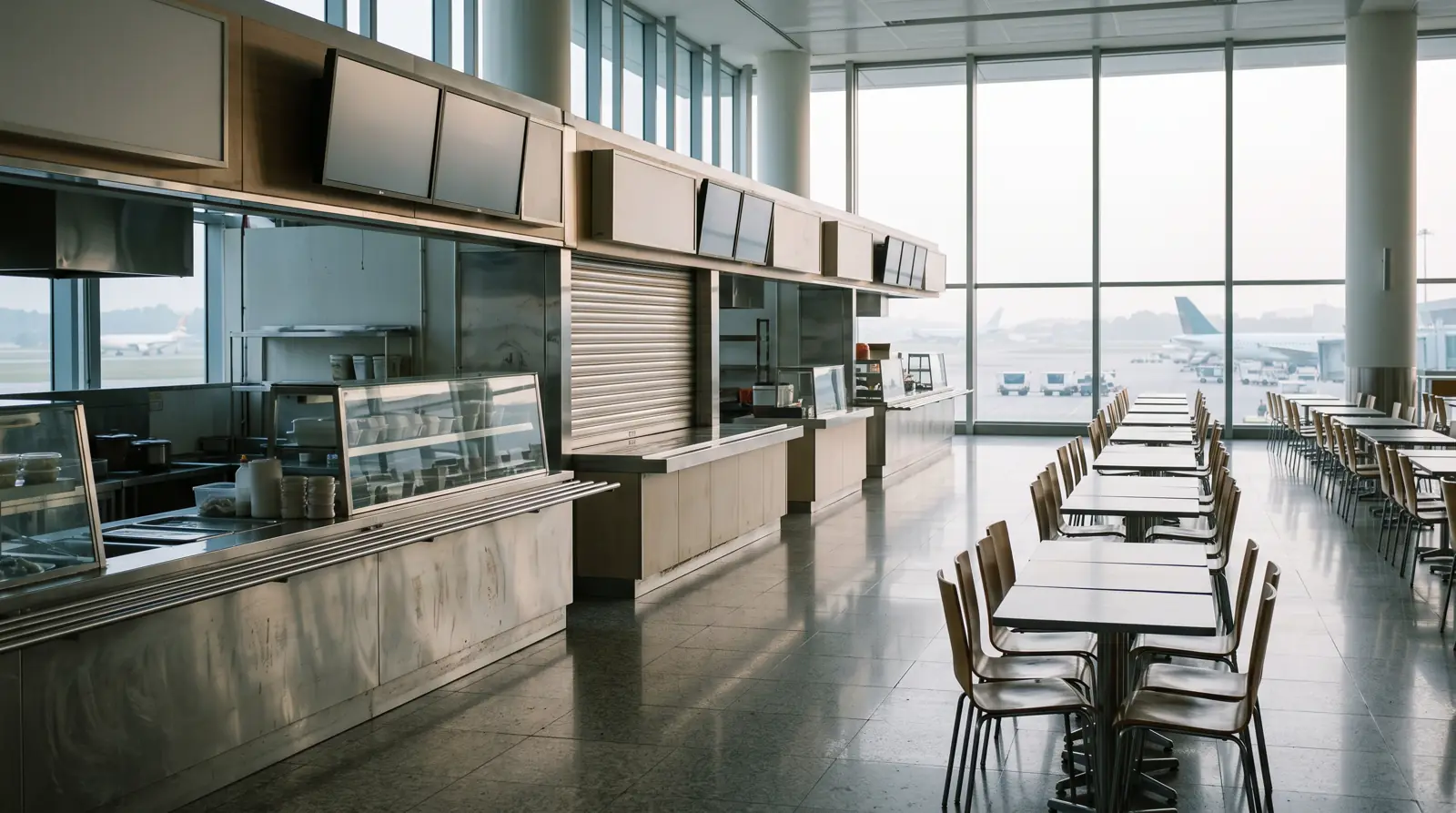
A Panda Express franchise is sold only as a license: the April 17, 2026 disclosure document from Citadel Panda Express, Inc. offers it to qualified applicants, mostly for airports, military bases, universities and other captive venues.
Key takeaways
- The 2026 Citadel Panda Express FDD calls the deal “a license (or ‘franchise’ under this Disclosure Document)” and expects most licensed restaurants to sit in captive venues (Item 1).
- The Initial License Fee is $25,000, due within 5 days of Panda’s written site authorization; the total Item 7 estimate is $514,500 to $3,275,500 for one restaurant (Items 5 and 7).
- After opening, the royalty is 8% per Royalty Period with a minimum Royalty currently set at $4,000, plus a 10% surcharge on Proprietary Products in captive venues (Items 6 and 8).
- Licensees ran 184 Panda Express restaurants at the end of fiscal 2025, against 2,423 owned by Panda affiliates; 63 of the 184 are joint ventures with a Panda affiliate as minority owner (Item 20).
- Item 12 grants no exclusive territory, and Item 16 bars licensees from selling competing Chinese, Japanese, Thai or Korean-style food inside the same facility.
Does Panda Express sell franchises, or only licenses?
Panda Express does sell franchise rights, but it frames them as licenses for captive venues. Citadel Panda Express, Inc., a California company incorporated on October 25, 1990, files a Franchise Disclosure Document in Minnesota; the 2026 edition, received by the state on April 20, 2026, says it “offers licenses to qualified applicants to develop and operate a Panda Express restaurant” (cover page and Item 1).
The word “license” does not take the deal outside franchise law. The FTC defines a franchise in 16 CFR 436.1(h) as a relationship “whatever it may be called” that combines a trademark, significant control or assistance, and a required payment. Panda’s FDD meets all three: the Panda Express marks, its System Standards and Manuals, and a $25,000 fee. That is why Item 1 treats “licensee” and “franchisee” as the same person.
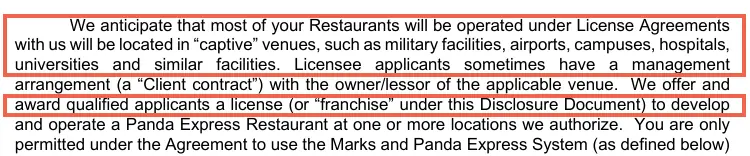
Item 1 also lays out the corporate chain. Citadel Panda Express is a wholly owned subsidiary of Panda Express, Inc. (PEI), which is wholly owned by Panda Restaurant Group, Inc. (PRG), all at 1683 Walnut Grove Avenue in Rosemead, California. PEI runs the affiliate-owned restaurants: 2,423 of them as of December 27, 2025. The franchisor itself says it has registered Panda Express franchises in various states since 1995 and has used license agreements like the current one since 2004.
| Question | What the 2026 FDD says | Source |
|---|---|---|
| Who sells the license? | Citadel Panda Express, Inc., Rosemead, California; no other affiliate offers Panda Express franchises | Item 1 |
| What is the agreement called? | License Agreement, also called the Franchise Agreement in the FDD (Exhibit A) | Item 1 |
| Where are licensed restaurants expected? | “captive” venues such as military facilities, airports, campuses, hospitals and universities | Item 1 |
| Is a traditional street site possible? | A limited pilot covers free-standing drive-thru sites of about 2,600 sq. feet | Item 7, note 13 |
| Can you buy a running restaurant? | PEI “occasionally sells” one; price negotiated case by case (Exhibit F) | Item 1 |
| International rights? | Licenses granted “internationally in select jurisdictions” | Item 1 |
Which venues can host a licensed Panda Express?
Licensed Panda Express restaurants sit mostly inside facilities whose owner controls who sells food there. Item 1 names military facilities, airports, campuses, hospitals and universities; Item 11 adds sports arenas, casinos and travel plazas. Panda’s own licensing page, in a November 2, 2025 archive capture, lists 12 venue types, including theme parks, stadiums, food courts and train stations.
The licensee list in Exhibit G names the restaurants by store, which shows how the model works in practice. The examples below are venue names only, taken from the 121 independently licensed and 63 joint-venture restaurants listed as of December 27, 2025; we do not reproduce licensee names or contacts.
| Venue type | Where Panda names it | Example store names in Exhibit G (state) |
|---|---|---|
| Airports | Item 1, Item 11, licensing page | Los Angeles International Airport (CA); Tampa International Airport (FL) |
| Colleges and universities | Item 1, Item 11, licensing page | Temple University (PA); Longwood University (VA) |
| Military bases | Item 1, Item 11, licensing page | Norfolk Naval Station (VA); Camp Pendleton (CA, joint venture list) |
| Casinos | Item 11, licensing page | Isleta Resort and Casino (NM); Lone Butte Casino (AZ) |
| Travel plazas | Item 11, licensing page | Molly Pitcher Travel Plaza (NJ); Commodore Perry Travel Plaza (OH) |
| Corporate campuses | Licensing page | State Farm South Campus Building H (IL) |
| Hospitals | Item 1, licensing page | Named as a venue type; no Exhibit G store name uses the word hospital |
Item 7 sizes these sites: a typical captive-venue Panda Express covers about 500 to 1,500 square feet, and “a few” occupy about 3,000. Item 1 warns that the market “will likely be limited to those persons using or frequenting your facility”, which can include rival food concepts in the same terminal or student union.
Who signs a Panda Express license, and on what terms?
The FDD describes applicants who already hold a food-service position at a venue. Item 1 says licensee applicants “sometimes have a management arrangement (a ‘Client contract’) with the owner/lessor of the applicable venue.” Exhibit G bears that out: most listed licensees are contract food-service companies, airport concessionaires, travel-plaza operators, universities and gaming enterprises rather than single-unit owner-operators.
- Hold or win the venue relationship (Client contract with the owner or lessor), per Item 1.
- Sign the License Agreement; it expires after 2 years if no Restaurant location has been authorized (Item 17, section a).
- Propose a site and get Panda’s advance written authorization; Panda “is not obligated to provide any authorization” (Items 1 and 12).
- Pay the $25,000 Initial License Fee within 5 days of that authorization; it is fully earned and non-refundable (Item 5).
- Schedule initial training no less than three months before opening and finish it at least 1 week before; the typical span from site approval to opening is “not more than 365 days” (Item 11).
- Operate under a 10-year operating term per restaurant, paying the 8% royalty, the $4,000 minimum Royalty and the 10% Proprietary Product surcharge (Items 6, 8 and 17).
Joint ventures with Panda Restaurant Group
PRG is a minority owner in joint ventures that run Panda Express restaurants at captive venues such as military bases and airports, the first of which opened in 2010 (Item 1). Of the 184 licensed restaurants at the end of 2025, 63 were joint ventures. Item 1 says licensees “are not required to participate” and may reject a proposal; a sample operating agreement is Exhibit I, and a joint venture still pays the Initial License Fee (Item 5).
Territory, exclusivity and leaving a venue
Item 12 gives a licensee no protected territory: “You will not receive an exclusive territory,” and Panda may place other Panda Express restaurants or channels anywhere. The restriction runs the other way inside your facility, where Item 16 bars you from selling competing Asian-style food items. If the venue’s food-service contract ends without your default, you can close a restaurant on 90 days’ notice, but Item 12 then requires the minimum Royalty for 90 days after closing plus an amount equal to 24 months of Royalties. Our franchise territory rights research shows how other FDDs handle Item 12.
| Milestone | Rule | Source |
|---|---|---|
| Year 0 | Operating term starts when the Restaurant opens to serve food to the public | Item 17, section a |
| Year 5 | Brand Refresh to current design and trade dress, at your expense | Item 16 |
| Years 9 to 9.5 | Written notice of a successor term due 6 to 12 months before expiry | Item 17, section c |
| Year 10 | Operating term ends; successor term costs $10,000 and can require a complete update | Items 6, 16 and 17 |
| Year 15 | Single 5-year successor term ends “without any further term” | Item 17, section b |
How much does a Panda Express franchise cost before the doors open?
The 2026 FDD puts the cost of opening one licensed Panda Express at $514,500 to $3,275,500, covering pre-opening spending and the first 3 months of operation (Item 7). The $25,000 Initial License Fee is 4.9% of the low total and 0.8% of the high total; build-out and rent decide most of the spread, and airport rent drives the top of the lease line.
| Item 7 line | Low | High | Paid to |
|---|---|---|---|
| Initial License Fee | $25,000 | $25,000 | Citadel Panda Express |
| Lease of premises (initial 3 months’ rent) | $10,000 | $425,000 | Lessor |
| Leasehold improvements | $100,000 | $1,500,000 | Lessor, contractors, Panda or affiliates |
| Furniture, fixtures, equipment and supplies | $120,000 | $650,000 | Approved suppliers, Panda or affiliates |
| Initial inventory | $11,000 | $18,000 | Approved suppliers |
| Computer hardware and software | $16,500 | $27,000 | Approved suppliers |
| Non-resettable cash registers | $6,000 | $8,000 | Outside vendor |
| Insurance (annual premium) | $94,500 | $157,500 | Insurance carrier |
| Expenses during initial training | $13,000 | $29,000 | Travel, hotels, restaurants |
| Architectural and design fees | $35,000 | $120,000 | Architects and designers |
| Construction supervision | $20,000 | $150,000 | General contractor |
| Sales tax deposits | $4,500 | $10,000 | State revenue department |
| Telephone, fax and communication fees | $500 | $1,000 | Outside suppliers |
| Licenses and permits | $1,500 | $60,000 | Government agencies |
| Payroll and related taxes (one month) | $39,000 | $65,000 | Employees |
| Additional funds (3 months) | $18,000 | $30,000 | Vendors, utilities, employees |
| Total | $514,500 | $3,275,500 | Item 7 total, which matches the sum of the lines |
Leasehold improvements ($100,000 to $1,500,000) and rent ($10,000 to $425,000, airports at the top) drive most of the $514,500 to $3,275,500 range. Source: Citadel Panda Express FDD, April 17, 2026, Item 7.
What sits outside the Item 7 total?
- Drive-thru pilot: a free-standing restaurant of about 2,600 sq. feet can add “up to $1,500,000” to the Item 7 estimate (note 13), which would take the high end to $4,775,500 by our arithmetic.
- Buying a running restaurant from PEI: the asset price is negotiated and “is not reflected in the above chart” (note 1).
- Joint-venture capital: owners of a joint venture with a Panda affiliate may make capital contributions under the operating agreement (note 1).
- Insurance minimums that drive the $94,500 to $157,500 premium line: $10,000,000 general liability per occurrence, $3,000,000 auto, $10,000,000 cyber (note 8). Compare other systems in our franchise insurance requirements research.
Item 10 adds that a Panda affiliate occasionally lends to licensees, mostly for construction, with loans under $100,000 for 1 to 2 years at 7% in the preceding 3 fiscal years. For how these line items compare with other brands, see the franchise costs guide.
Which payments continue after a licensed restaurant opens?
The main ongoing charges are the royalty and the product surcharge. Item 6 sets the royalty at 8% of Gross Volume for each Royalty Period, currently four weeks, with a minimum Royalty of $4,000 that Panda can adjust once a year by the Consumer Price Index. Item 8 adds a 10% surcharge on Proprietary Products for restaurants in casinos, universities, military bases, airports and other captive venues.
| Fee | Amount in the 2026 FDD | Item |
|---|---|---|
| Royalty | 8% per Royalty Period, or the minimum Royalty, currently $4,000, if higher | Item 6 |
| Proprietary Product surcharge | 10% on sales of Proprietary Products in captive venues; some licensees pay none or a different amount | Item 8 |
| Marketing fund | None: “You are not currently required to contribute to any marketing fund” | Item 11 |
| Quarterly promotional materials | $300 to $1,000 per year | Item 6 |
| Food safety inspections | $177.24 per quarterly inspection, subject to 4% annual increase | Item 6 |
| Customer satisfaction surveys | $20 to $22 per store per month | Item 6 |
| Opening or remedial assistance | $500 per whole or partial 8-hour day, plus travel costs | Item 6 |
| Transfer fee | $10,000 per restaurant, capped at $30,000 per transaction | Item 6 |
| Successor Restaurant Fee | $10,000 per restaurant | Item 6 |
| Management fee after an uncured default | 7% of Gross Volume plus actual costs | Item 6 |
Two Item 6 remarks matter for venue operators. The minimum Royalty is prorated when a venue owner approves a closure for holidays or breaks, such as a university’s spring or summer break, and Panda has deferred first-year royalties at certain military locations in the past. Item 8 also estimates that designated-supplier purchases will be at least 85% to 90% of total purchases. Our franchise royalty rates research places an 8% royalty against the coded FDD sample.
How many licensed Panda Express restaurants are there?
Licensees operated 184 Panda Express restaurants at the end of fiscal 2025, up from 157 at the start of 2023, while Panda affiliates operated 2,423 (Item 20, Table 1). Licensed units were about 7% of the 2,607 total. Licensed openings ran 9, 11 and 11 in 2023, 2024 and 2025, and Exhibit G states that no licensee-owned restaurant closed in fiscal 2025.
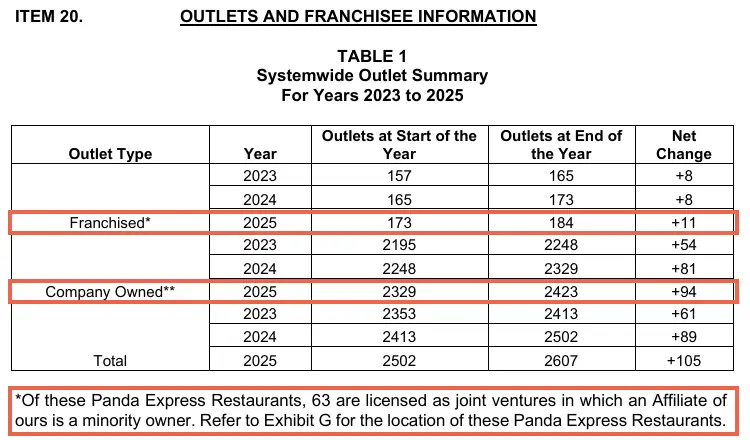
Table 1 prints a net change of +54 for affiliate-owned outlets in 2023, although 2,248 minus 2,195 is 53, and a total change of +61 where the difference is 60; we quote the table as printed. Table 5 projects 10 new licensed restaurants and 132 new affiliate-owned restaurants in 2026, with 4 licenses signed but not yet open, all at an airport or Army post in Colorado, Texas and Oklahoma according to Exhibit G.
| Item 20 measure | 2023 | 2024 | 2025 |
|---|---|---|---|
| Licensed outlets at year end | 165 | 173 | 184 |
| Licensed outlets opened | 9 | 11 | 11 |
| Licensed outlets terminated, reacquired or ceased | 1 | 3 | 0 |
| Transfers between licensees (Table 2) | 5 | 3 | 2 |
| Affiliate-owned outlets at year end | 2,248 | 2,329 | 2,423 |
| Affiliate-owned outlets opened | 75 | 87 | 99 |
| Affiliate-owned outlets closed | 21 | 6 | 5 |
California (23), Texas (22), Florida (14), North Carolina (13) and Virginia (12) held the most licensed restaurants at the end of 2025. Source: Citadel Panda Express FDD, April 17, 2026, Item 20, Table 3.
California (23) and Texas (22) held the most licensed restaurants at the end of 2025, followed by Florida (14), North Carolina (13) and Virginia (12), per Item 20, Table 3. The FTC rule behind these tables is 16 CFR 436.5(t), which requires three years of franchised and company-owned counts; our guide to reading an FDD walks through the other 22 Items.
Panda Express license figures in circulation, checked against the 2026 FDD
Several pages that rank for Panda Express franchise terms repeat numbers that the April 17, 2026 FDD does not support. We checked six recurring claims against the filing; the publishers are described, not named.
| Claim found online | What the 2026 FDD says | Source |
|---|---|---|
| Initial fee of $25,000 to $35,000 (third-party profile) | $25,000 for new licensees, including captive venues; fees received in 2025 ranged $12,500 to $25,000 | Item 5 |
| 5% royalty (third-party profile) | 8% per Royalty Period, minimum Royalty currently $4,000 | Item 6 |
| 2% marketing fund (third-party profile) | No marketing fund contribution currently required | Item 11 |
| Total investment of $426,700 to $2,404,000 (2022 FDD recap) | $514,500 to $3,275,500 | Item 7 |
| Not open for franchising (older profile page) | Licenses offered; 184 licensed restaurants at fiscal 2025 year end | Items 1 and 20 |
| About 190 licensed restaurants (consultancy page) | 184, of which 63 are joint ventures | Item 20 |
Which Asian quick-service brands sell franchises through an FDD?
Several Asian-menu systems file a Minnesota FDD with a conventional fee structure, and two use host-facility models closer to Panda’s captive-venue license. The table lists six alphabetically with each brand’s own Item 5, 6, 7 and 20 figures; Manchu Wok and Teriyaki Madness come from their 2026 filings, the other three rows from our coded dataset of the cited filings. It compares terms and is not a ranking.
| Brand (franchisor) | Format | Initial fee | Royalty or revenue share | Item 7 range | Franchised outlets (Item 20) | Source |
|---|---|---|---|---|---|---|
| Aloha Poke Co. (Aloha Poke Franchising LLC) | Fast-casual poke bowl restaurant | $35,000 | 5% of weekly Gross Sales, Brand Fund 1% | $140,900 to $475,930 | 5 (2024) | FDD issued April 25, 2025 |
| FujiSan Asian Bar Kiosks (Fujisan Franchising Corp.) | Sushi kiosk inside a host grocery store or campus | $3,750 plus $6,000 certification fee | Host collects sales; franchisor share typically 5% to 15% | $30,583 to $122,255 | 773 (2025) | FDD issued March 23, 2026 |
| Manchu Wok (MTY Franchising USA, Inc.) | Chinese quick-service, often in mall food courts | $30,000 | 7% traditional, 6% non-traditional; ad fund 2% | $484,050 to $820,500 | 15 (2025) | FDD issued March 27, 2026 |
| Panda Express (Citadel Panda Express, Inc.) | Licensed restaurant, mostly captive venues | $25,000 | 8%, minimum $4,000 per Royalty Period; no marketing fund | $514,500 to $3,275,500 | 184 (2025) | FDD issued April 17, 2026 |
| Teriyaki Madness (M. H. Franchise Company Inc.) | Fast-casual Japanese-style teriyaki restaurant | $45,000 single; $99,000 for 3 under a Development Agreement | 6% of Net Sales; Marketing Fund 4% | $392,967 to $1,122,005 (single) | 197 (2025) | FDD issued March 18, 2026, amended July 30, 2026 |
| Zenshi (Advanced Fresh Concepts Franchise Corp.) | Sushi counter inside a grocery store or host facility | $6,250 | Host keeps typically 25% to 27%; franchisor typically 8% to 11% | $45,004 to $151,404 | 3,572 (FY ending March 31, 2025) | FDD issued July 22, 2025 |
Two of these, FujiSan and Zenshi, resemble Panda’s model in one respect: the host facility, not the franchisee, collects sales and pays out a share. Manchu Wok is the closest menu match, and its Item 5 offers a 20% discount on the $30,000 Initial Franchise Fee to active, reserve or honorably discharged members of the U.S. Armed Forces, a policy our veteran franchise discounts research tracks across brands. For other restaurant formats, see the fast food franchise overview.
Is a Panda Express license a fit for your situation?
The FDD’s own terms sort applicants quickly: venue access, capital above $514,500 and acceptance of no territory are the three gates. The decision table applies those thresholds; it reflects the 2026 FDD only and is not legal or financial advice, so have a franchise attorney and accountant review the License Agreement before you sign.
| If your situation is | Then | FDD basis |
|---|---|---|
| You already run food service under a contract at an airport, base, campus, casino, hospital or travel plaza | You match the applicant Item 1 describes; ask the venue owner whether a Panda Express unit fits your Client contract, then request site authorization | Items 1 and 11 |
| You want a street-side or drive-thru Panda Express | Ask whether the pilot program is open to you and budget up to $1,500,000 above the Item 7 high | Item 7, note 13 |
| Your total budget is under $514,500 | You are below the Item 7 low; host-facility concepts such as Zenshi ($45,004 low) or FujiSan ($30,583 low) start lower | Item 7 of each FDD |
| You need an exclusive or protected territory | Panda grants none; compare Item 12 terms in other systems | Item 12 |
| You want to buy a running restaurant | Ask PEI whether any unit is for sale; price is negotiated and a License Agreement is still required | Item 1, Exhibit F |
| Your venue contract could end before 10 years | Price in the exit cost: minimum Royalty for 90 days plus 24 months of Royalties | Item 12 |
The question of how much a licensee earns belongs to Item 19. The 2026 FDD includes an Item 19 that reports fiscal 2025 gross sales for licensed restaurants in captive venues, grouped by venue type; this site does not republish those figures. Read Item 19 in the filing itself, and see our Item 19 research for what such tables can and cannot show. A franchise consultant can also compare captive-venue concepts with conventional franchises at your budget.
Frequently asked questions
Is Panda Express a franchise?
Partly. Panda affiliates own most restaurants, 2,423 at the end of fiscal 2025, but Citadel Panda Express, Inc. also licenses restaurants to outside operators. Its April 17, 2026 FDD calls the deal “a license (or ‘franchise’ under this Disclosure Document)”, and licensees ran 184 restaurants at year end, mostly in airports, military bases, universities and other captive venues (Items 1 and 20).
How much does a Panda Express franchise cost?
The 2026 FDD estimates $514,500 to $3,275,500 to open one licensed restaurant and run it for 3 months, including the $25,000 Initial License Fee (Item 7). Leasehold improvements alone run $100,000 to $1,500,000. A free-standing drive-thru under Panda’s limited pilot can add up to $1,500,000 more, per note 13 of Item 7.
How much does a Panda Express franchise owner make?
This site does not publish earnings figures. The 2026 FDD has an Item 19 that reports fiscal 2025 gross sales for licensed captive-venue restaurants by venue type; read it in the filing. Income then depends on costs the FDD does list: the 8% royalty with a $4,000 minimum per Royalty Period, the 10% Proprietary Product surcharge, venue rent and payroll.
What are the Panda Express franchise requirements?
The 2026 FDD expects most licensees to operate in a captive venue, often under a Client contract with the venue owner (Item 1). You need Panda’s written authorization for each site, certified managers and cooks trained before opening (Items 11 and 15), insurance including $10,000,000 general liability per occurrence (Item 7, note 8), and capital in the $514,500 to $3,275,500 Item 7 range.
Does Panda Express charge a marketing fund fee?
No marketing fund contribution is currently required. Item 11 of the 2026 FDD says Panda has “no formal advertising program for the franchise system” and that licensees are “not currently required to contribute to any marketing fund.” Licensees instead buy quarterly promotional campaign materials from Panda’s marketing department, estimated at $300 to $1,000 per year in Item 6.
Can you buy an existing Panda Express restaurant?
Sometimes. Item 1 says Panda Express, Inc. “occasionally sells” a restaurant it operates to a prospective licensee under an asset purchase agreement (Exhibit F), with price and lease terms negotiated case by case, and the buyer also signs a License Agreement. Between licensees, Item 20 shows 2 transfers in 2025, and Item 6 sets a $10,000 transfer fee per restaurant.
How we compiled this
We read the full 365-page Citadel Panda Express, Inc. FDD issued April 17, 2026 (Minnesota CARDS file 6955), Panda’s licensing page in a November 2, 2025 archive capture because the live page refused our request, and the FTC Franchise Rule text in 16 CFR Part 436, all in November 2026. We also opened the 2026 Manchu Wok and Teriyaki Madness FDDs; three comparison rows come from our coded dataset of Minnesota FDDs, each linked to its filing. Item 19 figures and licensee names were excluded by site rule.
Sources
- Citadel Panda Express, Inc. Franchise Disclosure Document, issued April 17, 2026, Minnesota Department of Commerce CARDS, accessed November 3, 2026
- Panda Express, Licensing Opportunities, Wayback Machine capture of November 2, 2025, accessed November 3, 2026
- 16 CFR 436.1, Definitions, eCFR, accessed November 3, 2026
- 16 CFR 436.5, Disclosure items, eCFR, accessed November 3, 2026
- Aloha Poke Franchising LLC FDD, issued April 25, 2025, Minnesota CARDS, via our coded dataset, accessed November 3, 2026
- Fujisan Franchising Corp. FDD, issued March 23, 2026, Minnesota CARDS, via our coded dataset, accessed November 3, 2026
- MTY Franchising USA, Inc. (Manchu Wok) FDD, issued March 27, 2026, Minnesota CARDS, accessed November 3, 2026
- M. H. Franchise Company Inc. (Teriyaki Madness) FDD, issued March 18, 2026, as amended July 30, 2026, Minnesota CARDS, accessed November 3, 2026
- Advanced Fresh Concepts Franchise Corp. (Zenshi) FDD, issued July 22, 2025, Minnesota CARDS, via our coded dataset, accessed November 3, 2026