
The Capriotti’s franchise disclosure document (FDD) now on file was issued July 29, 2026: a 305-page filing, Minnesota document 37081-202607-04, pricing a traditional restaurant at $594,700 to $935,000 in Item 7.
A Virtual Kitchen costs $145,000 to $324,000, and the franchisor offers no financing (Item 10). Capriotti’s Sandwich Shop, Inc., a Nevada corporation based at 6056 S. Durango Drive in Las Vegas, must hand you the document at least 14 calendar days before you sign or pay anything.
Key takeaways
- The current filing is the Capriotti’s FDD issued July 29, 2026, received by the Minnesota Department of Commerce on July 30, 2026 under file number 6073.
- Of the $594,700 to $935,000 traditional budget, $80,000 goes to the franchisor: a $40,000 franchise fee, a $10,000 Site Development Services Fee and a $30,000 New Shop Opening Plan (Items 5 and 7).
- After opening, Item 6 lists a 7% royalty for one or two restaurants (6% under a three-restaurant Development Rights Agreement), a 2% Marketing Fund charge and a 2% cooperative contribution, all on Gross Sales.
- Item 20 shows 155 outlets at the end of 2025 (139 franchised, 16 company-owned); franchisees opened 15 restaurants in 2025 while 15 left the franchised count.
- The state-required risk page flags the franchisor’s financial condition; the audited balance sheet in Exhibit G shows a total stockholders’ deficit of $(8,740,514) at December 28, 2025 (Item 21).
Where can you download the current Capriotti’s FDD?
Two routes work as of November 2026. The franchisor sends the FDD once you apply, and the federal FTC Franchise Rule, 16 CFR Part 436, requires delivery at least 14 calendar days before you sign or pay. Minnesota also posts registered filings publicly, so you can read the full July 29, 2026 version before any sales call.
- Open the Minnesota CARDS franchise registration search and enter “Capriotti” as the franchisor name.
- Pick the row for CAPRIOTTI’S SANDWICH SHOP INC, file number 6073, document type Clean FDD, year 2026, received 07/30/2026.
- Download document 37081-202607-04, a 305-page PDF. Earlier versions sit beside it: 34668-202508-02 (received 08/22/2025) and 31929-202406-03 (received 06/18/2024).
- Check the issuance date on the cover reads July 29, 2026, and check the State Effective Dates page for your state before relying on it.
- Ask the franchisor for the copy addressed to you; signing its Item 23 receipt starts the 14-day clock.
Our franchise disclosure database report explains how CARDS filings are coded across 259 brands, and our guide to reading a franchise disclosure document covers the 23 Items in general terms.
Which page holds each of the 23 Items?
The table of contents of the July 29, 2026 filing places Item 1 on printed page 1 and Items 21 to 23 on printed page 63; the PDF page is the printed page plus 7, because the cover, state notices and contents come first. The exhibits, A through L, fill the remaining pages up to 305. The full map is downloadable as capriottis-fdd-2026-item-map.csv.
Items 1 to 11: the company, the money and the support
| Item | Title | Printed page | PDF page | What it covers | Key figure or fact |
|---|---|---|---|---|---|
| Item 1 | The franchisor and any parents, predecessors and affiliates | 1 | 8 | Nevada corporation organized December 13, 2007; Virtual Kitchen option; affiliates WZ Franchise, LLC and WZ International, LLC franchise WING ZONE | 15 WING ZONE Businesses in the US and 20 abroad as of December 31, 2025 |
| Item 2 | Business experience | 3 | 10 | Officers and directors with dates in role | CEO in role since January 2008 |
| Item 3 | Litigation | 5 | 12 | One pending case | AAA arbitration filed February 20, 2026; rescission of approximately $125,000 sought |
| Item 4 | Bankruptcy | 5 | 12 | None disclosed | None |
| Item 5 | Initial fees | 5 | 12 | Franchise fee, Site Development Services Fee, New Shop Opening Plan, DRA fees | $40,000 fee; $10,000 site fee; $30,000 opening plan; $30,000 per unit under a DRA |
| Item 6 | Other fees | 6 | 13 | Recurring and event fees table | Royalty 6% to 7%; Marketing Fund 2% (up to 4%); Cooperative 2%; transfer fee $10,000 to $20,000 |
| Item 7 | Estimated initial investment | 12 | 19 | Two tables: traditional and Virtual Kitchen | $594,700 to $935,000 traditional; $145,000 to $324,000 Virtual Kitchen |
| Item 8 | Restrictions on sources of products and services | 19 | 26 | Approved suppliers and rebates | Approximately $1,850,630 in supplier rebates in 2025; close to 100% of purchases restricted |
| Item 9 | Franchisee’s obligations | 22 | 29 | Cross-reference table to agreement sections | Table only |
| Item 10 | Financing | 25 | 32 | No financing offered | None offered |
| Item 11 | Franchisor’s assistance, advertising, computer systems and training | 25 | 32 | Site acceptance, training, time to open, POS | Open within 14 months; typical 12 to 14 months; up to 4 weeks training in Las Vegas |
Items 12 to 23: the rules, the track record and the contracts
| Item | Title | Printed page | PDF page | What it covers | Key figure or fact |
|---|---|---|---|---|---|
| Item 12 | Territory | 34 | 41 | No exclusive territory for single units; DRA territory rules | Relocation fee $5,000; WING ZONE units may serve customers near you |
| Item 13 | Trademarks | 36 | 43 | USPTO registrations | Capriotti’s registered November 15, 2005 (No. 3,015,434) |
| Item 14 | Patents, copyrights and proprietary information | 38 | 45 | No patents; unregistered copyrights in the Manual and designs | No patents held |
| Item 15 | Obligation to participate in the actual operation | 39 | 46 | Managing Owner and personal guarantees | Managing Owner holds at least 20%; 2 people complete training |
| Item 16 | Restrictions on what the franchisee may sell | 40 | 47 | Approved menu only; pricing policies | Virtual Kitchen may require Non-Core Products |
| Item 17 | Renewal, termination, transfer and dispute resolution | 41 | 48 | Contract terms table | 10-year term; 10-year renewal; arbitration within 10 miles of the franchisor’s address (Las Vegas); Nevada law |
| Item 18 | Public figures | 50 | 57 | None used | None |
| Item 19 | Financial performance representations | 50 | 57 | Historical 2025 Gross Sales groupings and partial operating statements for 11 affiliate-owned restaurants | Figures not reproduced here by site policy |
| Item 20 | Outlets and franchisee information | 57 | 64 | Five tables of outlet counts 2023 to 2025 | 155 outlets at end of 2025 (139 franchised, 16 company-owned); 21 signed but not open |
| Item 21 | Financial statements | 63 | 70 | Audited consolidated statements (BDO USA, P.C.) | Total stockholders’ deficit $(8,740,514) at December 28, 2025 |
| Item 22 | Contracts | 63 | 70 | 8 contracts listed | Franchise Agreement, DRA, Virtual Kitchen amendment and others |
| Item 23 | Receipts | 63 | 70 | Two receipt pages | Sign and return one copy |
Source: Capriotti’s FDD issued July 29, 2026, table of contents and Items 1 to 23, opened November 10, 2026. Item 19 is described but its figures are excluded by our site policy.
The reading order in the diagram is ours, not the franchisor’s. It groups the six stops as: what you pay (Items 5, 6, 7), what you must buy (Items 8, 10, 11), what you control (Items 12, 15, 17), system health (Items 3 and 20), franchisor finances (Item 21 and Exhibit G) and sales data (Item 19), then the contracts in Exhibits B, C, L and J.
What does the cover page commit you to before Item 1?
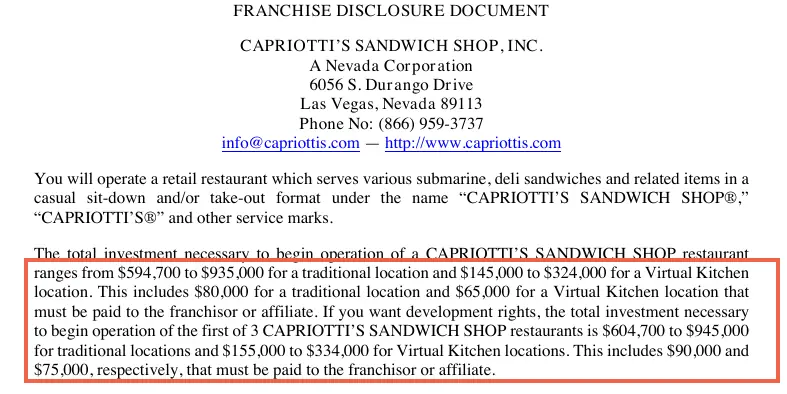
The cover states the whole investment in one paragraph: $594,700 to $935,000 for a traditional restaurant and $145,000 to $324,000 for a Virtual Kitchen, of which $80,000 and $65,000 are paid to the franchisor or an affiliate. With development rights for 3 restaurants, the cover prints $604,700 to $945,000 for the first one, including $90,000 paid to the franchisor.
Three pages later, a “Special Risks to Consider” page lists four risks that certain states require the franchisor to highlight. Each one maps to a later Item:
| Risk named on the cover pages | What the FDD says | Where to verify |
|---|---|---|
| Out-of-state dispute resolution | Arbitration or litigation only in the franchisor’s home state, currently Nevada | Item 17, rows u to w (printed page 47) |
| Spousal liability | Your spouse must sign a guarantee covering all financial obligations | Item 15 (printed page 39) |
| Financial condition | The franchisor’s financial statements call into question its ability to support you | Item 21 and Exhibit G |
| Supplier control | All or nearly all inventory comes from the franchisor, affiliates or designated suppliers | Item 8 (printed page 19) |
Our franchise personal guarantee report compares guarantee language across filings; at Capriotti’s, Item 15 also requires a Managing Owner holding at least 20% of the franchisee entity.
How far apart are the traditional and Virtual Kitchen budgets in Item 7?
Item 7 prints two tables. A traditional restaurant of about 1,400 to 1,600 square feet totals $594,700 to $935,000, while a Virtual Kitchen of about 180 to 400 square feet inside a shared facility totals $145,000 to $324,000. Leasehold improvements explain most of the gap: $250,000 to $350,000 traditional against $1,000 to $50,000 for a Virtual Kitchen (Item 7, printed pages 12 to 17).
| Item 7 line | Traditional | Virtual Kitchen | Paid to |
|---|---|---|---|
| Franchise fee | $40,000 | $40,000 | Franchisor |
| Site or Development Services Fee | $10,000 | $10,000 | Franchisor |
| Architect, engineering, kitchen plans | $15,000 to $35,000 | $5,000 to $20,000 | Vendors |
| Professional services and permits | $5,000 to $50,000 | $500 to $10,000 | Advisers, municipalities |
| Rent and security deposits | $8,500 to $28,000 | $7,000 to $23,000 | Landlord or host |
| Leasehold improvements | $250,000 to $350,000 | $1,000 to $50,000 | General contractor |
| Furniture, fixtures, equipment, smallwares | $150,000 to $210,000 | $30,000 to $75,000 | Approved suppliers |
| Decor, signage, menu boards | $13,000 to $41,000 | Not listed | Vendors |
| POS system | $6,200 to $20,000 | $3,500 to $12,000 | Vendor |
| Training expenses | $15,000 to $20,000 | $15,000 | Travel, wages |
| Opening inventory | $7,000 to $15,000 | $5,000 to $10,000 | Vendor |
| New Shop Opening Plan | $30,000 | $15,000 | Franchisor |
| Mock operations and 3 months of insurance | $5,000 to $11,000 | $3,000 to $9,000 | Various |
| Additional funds, 3 months | $40,000 to $75,000 | $10,000 to $35,000 | Various |
| Total, single unit | $594,700 to $935,000 | $145,000 to $324,000 | |
| Total, first of 3 under a Development Rights Agreement | $604,700 to $945,000 | $155,000 to $334,000 |
Source: Item 7 tables and notes, Capriotti’s FDD issued July 29, 2026. Rows combine adjacent Item 7 lines; we checked that both columns add to the printed totals.
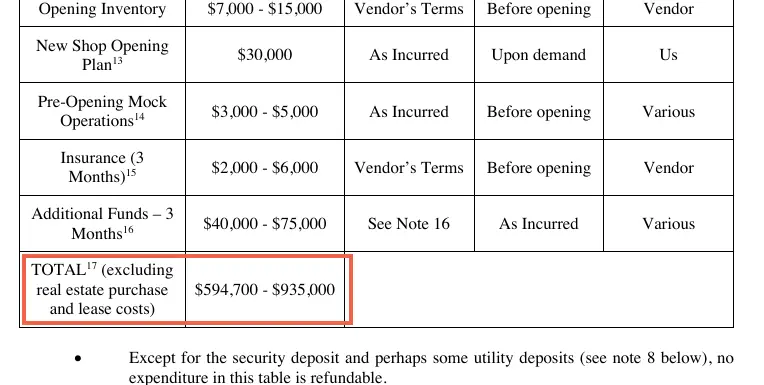
Item 7 totals: $594,700 to $935,000 traditional and $145,000 to $324,000 Virtual Kitchen; development rights add $10,000. Capriotti’s FDD issued July 29, 2026.
Two notes change the reading of these totals. Note 9 says 7 of the 15 traditional franchises opened in 2025 received tenant improvement allowances averaging $50,780, which the landlord then folds into rent. Note 7 says franchisees typically pay no rent before opening, and Note 17 confirms no franchisor financing for any part of the budget.
Which published figures differ from the 2026 filing?
| Claim in a top-ranking page | What the July 29, 2026 FDD prints | Item |
|---|---|---|
| A listing based on the 2024 FDD: $422K to $818K total | $594,700 to $935,000 traditional; $145,000 to $324,000 Virtual Kitchen | Item 7 |
| A broker listing with no FDD year: $105,000 to $653,000, fee $30,000 to $40,000 | $40,000 fee for a single restaurant; $30,000 per restaurant only under a 3-unit agreement | Item 5 |
| The same listing: veteran discount of 10% in one place, 15% in another | 15% off the initial franchise fee through VetFran, with a DD214 | Item 5 |
| A review updated June 2026: 138 franchised outlets at the end of 2024 | 139 franchised outlets at the end of 2024 | Item 20, Table 1 |
Which Item 6 fees come out of Gross Sales after opening?
Item 6 lists 21 fee rows. Four are percentages of Gross Sales: a royalty of 7% for one or two restaurants or 6% under a Development Rights Agreement, a Marketing Fund currently at 2% (cap 4%), a cooperative contribution currently at the full 2% (members can vote it up to 4%), and a 0.65% Technology Fee not charged today. Note 2 says delivery-app commissions do not reduce Gross Sales.
| Fee | Amount in the 2026 FDD | When due |
|---|---|---|
| Royalty Fee | 7% of monthly Gross Sales (1 to 2 restaurants); 6% with a Development Rights Agreement for 3 or more | 5th day after month end |
| Marketing Fund | Up to 4%; currently 2%; point-of-purchase materials up to $2,500 a year | With royalty |
| Cooperative advertising | Up to 2%, currently 2%; vote can raise it to 4% | As the cooperative sets |
| Local marketing (Note 5) | At least 1.5%; up to 4% recommended | Spent directly |
| Technology Fee | 0.65% of Gross Sales; currently 0% | With royalty, on 30 days’ notice |
| Service Management Group fee | Currently $25 monthly | With royalty |
| Extra training | $1,000 per person per 5 days in Las Vegas; $2,000 at your location | At start of training |
| Extensive on-site retraining | $10,000 | On demand |
| Transfer fee | Greater of $10,000 or 5% of the sale price, capped at $20,000; $5,000 for a non-controlling interest | At transfer |
| Renewal fee | $10,000 | At signing of the successor agreement |
| Relocation fee | $5,000 | As incurred |
| Late payment | $250 per late payment; interest at the lesser of 1.5% per month or the legal maximum | When billed |
Item 8 adds the supply side: purchases from approved or designated suppliers make up close to 100% of what a restaurant buys, and the franchisor reports receiving approximately $1,850,630 in supplier rebates in 2025, about 6% of its own 2025 revenue. Our supplier rebate report sets that disclosure against other franchisors.
What does a three-restaurant development deal change in the fees?
A Development Rights Agreement (Exhibit C) commits you to at least 3 restaurants in a defined territory. It lowers the per-restaurant franchise fee from $40,000 to $30,000 and the royalty from 7% to 6%, but the development fee is paid upfront and is not refundable even if the schedule fails (Item 5). Defaulting before 3 openings lets the franchisor raise royalties back to 7%.
| Step | Single Franchise Agreement | Development Rights Agreement, 3 restaurants |
|---|---|---|
| Franchise fee, first restaurant | $40,000 | $30,000 |
| Site Development Services Fee, first restaurant | $10,000 | $10,000 |
| Deposits for restaurants 2 and 3 | None | 2 x $10,000 = $20,000 |
| Paid at signing | $50,000 | $60,000 |
| Still due at each later Franchise Agreement | Not applicable | $20,000 fee ($30,000 minus the $10,000 deposit) plus that restaurant’s $10,000 site fee |
| Franchise fees for all 3 restaurants | 3 x $40,000 = $120,000 if signed one by one | 3 x $30,000 = $90,000 |
| Royalty rate | 7% | 6%, or 7% after a development default |
Arithmetic from Item 5 and Item 6 Note 3 of the July 29, 2026 FDD. The 15% VetFran discount applies to the initial franchise fee; our veteran franchise discount report compares that structure with other brands. Neither single units nor development territories are exclusive under Item 12; our territory rights report explains how that compares.
For a sandwich brand that requires an area development commitment from every buyer, see our Jersey Mike’s franchise cost breakdown.
What do Items 3, 20 and 21 reveal about the system and the franchisor?
These three Items carry the facts the listing sites leave out. Item 3 discloses one pending arbitration filed February 20, 2026. Item 20 shows the franchised count flat at 139 in 2024 and 2025. Item 21 attaches statements audited by BDO USA, P.C., and the balance sheet in Exhibit G shows a stockholders’ deficit, which is why the state-required risk page names financial condition.
Item 3: one arbitration
An existing franchisee filed with the American Arbitration Association (Case No. 01-26-0000-6963) on February 20, 2026, alleging misrepresentation about franchisee financing and opening timing and claims under California’s Franchise Investment Law. The claim seeks rescission and restitution of approximately $125,000. The franchisor states it intends to defend the claims; Item 4 discloses no bankruptcy.
Item 20: openings and exits, 2023 to 2025
| Year | Franchised at start | Opened | Terminated or not renewed | Reacquired by franchisor | Ceased, other reasons | Franchised at end | Company-owned at end |
|---|---|---|---|---|---|---|---|
| 2023 | 126 | 25 | 0 | 0 | 8 | 143 | 10 |
| 2024 | 143 | 14 | 0 | 3 | 15 | 139 | 15 |
| 2025 | 139 | 15 | 2 | 1 | 12 | 139 | 16 |
Source: Item 20 Tables 1, 3 and 4, July 29, 2026 FDD; data file capriottis-item20-franchised-2023-2025.csv. Table 3 excludes 1 licensed ghost kitchen.
Franchised openings fell from 25 in 2023 to 15 in 2025, while exits were 8, 18 and 15. Item 20 Table 3, Capriotti’s FDD issued July 29, 2026.
By state, Delaware went from 17 franchised restaurants to 14 in 2025, Indiana from 4 to 1, and Nevada held 32 franchised plus 14 company-owned at the end of 2025. Table 5 lists 21 franchise agreements signed but not open and 20 projected franchised openings in 2026. Item 20 also states that no franchisee signed a confidentiality clause in the last 3 years and that no trademark-specific franchisee association exists.
Item 21: the franchisor’s balance sheet
Exhibit G shows total assets of $17,248,263 and a total stockholders’ deficit of $(8,740,514) at December 28, 2025, compared with $(9,305,442) a year earlier. Long-term debt, less current maturities, stood at $10,985,386. Our franchisor financial health report shows how deficits and audit opinions read across other filings.
Item 1 and Item 12: the Wing Zone link
Since December 22, 2020, the franchisor has controlled WZ Franchise, LLC and WZ International, LLC, which franchise WING ZONE restaurants: 15 in the United States and 20 abroad as of December 31, 2025. Item 12 says WING ZONE units may take orders from customers near a Capriotti’s restaurant in the same market, and that separate training facilities are kept for each brand.
How long from FDD receipt to opening day?
Item 11 sets a hard deadline: a traditional restaurant must open within 14 months after the Franchise Agreement is signed, and the franchisor estimates a typical 12 to 14 months. Payments are staged: $50,000 at signing, then two $15,000 New Shop Opening Plan payments due at least 8 weeks and at least 4 weeks before the scheduled opening (Item 5).
- Day 0: receive the FDD and sign the Item 23 receipt.
- Day 14 at the earliest: sign the Franchise Agreement and pay the $40,000 franchise fee plus the $10,000 site fee.
- Site review: the franchisor has 30 days after receiving your site package to accept or reject it (Item 11).
- Training: up to 4 weeks in Las Vegas for the Managing Owner and at least 1 other person, at your travel cost of $15,000 to $20,000 (Item 7).
- 8 weeks before opening: pay $15,000 toward the New Shop Opening Plan.
- 4 weeks before opening: pay the second $15,000.
- Opening: up to 12 days of on-site assistance; deadline 14 months after signing.
Our time-to-open report compares the 12 to 14 month estimate with other restaurant filings.
Which Items should you read first for your plan?
The right starting Item depends on the format and scale you are weighing. The table below routes five common buyer situations to the pages of the July 29, 2026 filing that decide them, with the threshold from the FDD that matters most. It is a reading guide, not advice; take the questions it raises to a franchise attorney before signing.
| If you are | Read first | Threshold from the FDD |
|---|---|---|
| Comparing a storefront with a delivery-only kitchen | Item 7, both tables; Exhibit L | $594,700 to $935,000 versus $145,000 to $324,000; Virtual Kitchen space terms are likely shorter than the 10-year franchise term (Item 17) |
| Planning 3 or more restaurants | Items 5, 6 Note 3 and 12; Exhibit C | Development fee non-refundable; royalty 6%, reverting to 7% on default |
| A veteran with a DD214 | Item 5 | 15% off the initial franchise fee |
| Buying an existing restaurant | Items 5, 6 and 17; Item 20 Table 2 | $7,500 Transfer Marketing Plan; transfer fee $10,000 to $20,000; 2 transfers a year from 2023 to 2025 |
| Weighing franchisor stability | Item 21 and Exhibit G; Item 20 Table 3 | Stockholders’ deficit of $(8,740,514); 15 exits from the franchised count in 2025 |
| Trying to estimate sales | Item 19, then Items 6 and 7 | Item 19 covers 119 franchised and 12 affiliate-owned traditional restaurants open all of 2025 |
Item 19 also includes partial operating statements for 11 affiliate-owned restaurants; we do not reproduce its figures. Our Item 19 research report explains how to read those groupings, and the FTC’s Consumer’s Guide to Buying a Franchise lists questions to ask current owners named in Exhibit F. This page is general information, not legal, financial or investment advice.
How we compiled this
We read the Capriotti’s Sandwich Shop, Inc. FDD issued July 29, 2026 (305 pages), downloaded from Minnesota CARDS, and mapped every Item to its printed and PDF page. We checked that both Item 7 columns sum to the printed totals and compared five top-ranking pages against the filing in November 2026. We excluded all Item 19 figures and did not name any franchisee from Item 3, Item 20 or Exhibit F.
Frequently asked questions
How much does a Capriotti's franchise cost?
The FDD issued July 29, 2026 puts a traditional Capriotti’s restaurant at $594,700 to $935,000 and a Virtual Kitchen at $145,000 to $324,000 (Item 7), excluding real estate purchase. Of that, $80,000 and $65,000 respectively go to the franchisor: the franchise fee, the $10,000 site fee and the New Shop Opening Plan. The first of 3 restaurants under development rights costs $604,700 to $945,000.
Where can I get the Capriotti's franchise disclosure document?
The franchisor sends it after you apply, at least 14 calendar days before you sign or pay. The full July 29, 2026 version is also public on the Minnesota CARDS database as document 37081-202607-04 under file number 6073; search the franchisor name “Capriotti” and pick the Clean FDD row received 07/30/2026.
What are the requirements to own a Capriotti's franchise?
Item 15 requires a Managing Owner holding at least 20% of the franchisee entity, personal guarantees from all owners, and at the franchisor’s request a spouse’s signature. At least 2 people must complete initial training of up to 4 weeks in Las Vegas (Item 11). The FDD itself sets no net worth or liquidity minimum; ask the franchisor for its current financial qualification criteria in writing.
Does the Capriotti's FDD include an Item 19?
Yes. Item 19 of the July 29, 2026 FDD reports historical 2025 Gross Sales for 119 franchised and 12 affiliate-owned traditional restaurants open all year, with subgroups for mature markets and older units, plus partial operating statements for 11 affiliate-owned restaurants. By site policy we do not reproduce those figures; read Item 19 on printed pages 50 to 57.
Does Capriotti's offer a veteran discount?
Item 5 states that Capriotti’s participates in the VetFran program, giving military veterans who provide a copy of their DD214 a 15% discount on the initial franchise fee. On the $40,000 single-unit fee, that is $6,000. Item 5 also notes that 2 franchisees received a 15% discount on their initial franchise fees in 2025.
Is Capriotti's related to Wing Zone?
Yes. Item 1 says Capriotti’s Sandwich Shop, Inc. acquired WZ Franchise, LLC and WZ International, LLC on December 22, 2020; they franchise WING ZONE restaurants, 15 in the United States and 20 abroad as of December 31, 2025. Item 12 notes WING ZONE units in your market may serve customers near your Capriotti’s restaurant.
Sources
- Capriotti’s Sandwich Shop, Inc. Franchise Disclosure Document, issued July 29, 2026, Minnesota CARDS document 37081-202607-04, file number 6073, cover, Items 1 to 23 and Exhibit G. Accessed November 10, 2026.
- Minnesota Department of Commerce CARDS franchise registrations search. Accessed November 10, 2026.
- 16 CFR Part 436, Disclosure Requirements and Prohibitions Concerning Franchising, eCFR. Accessed November 10, 2026.
- A Consumer’s Guide to Buying a Franchise, Federal Trade Commission. Accessed November 10, 2026.