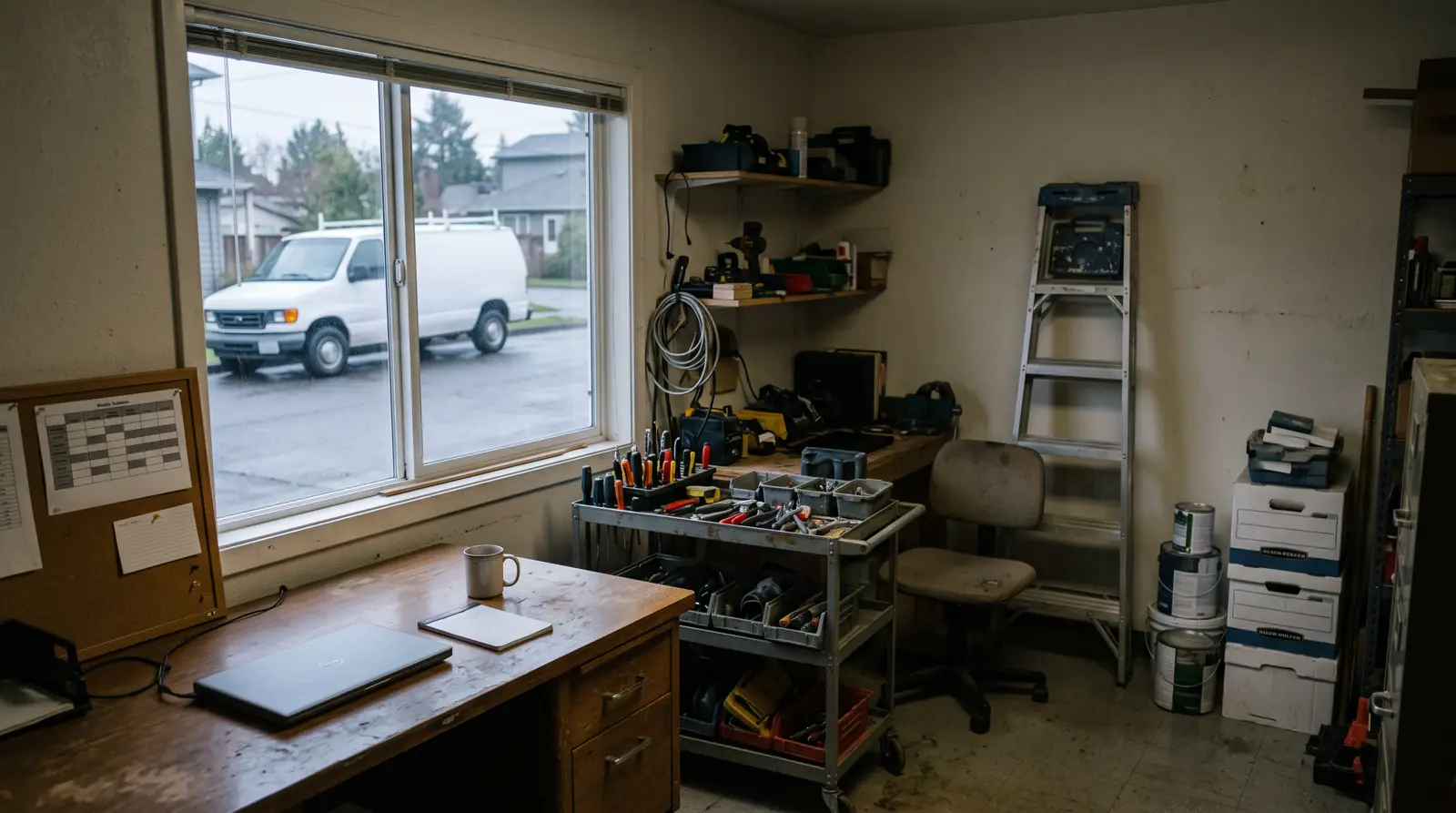
A Handyman Connection franchise costs $115,837 to $238,736 to open under the FDD issued March 13, 2026, and its owner manages a network of craftsmen who do the repairs; $77,000 of that total goes to the franchisor.
Key takeaways
- Item 7 of the Handyman Connection Franchise Disclosure Document issued March 13, 2026 totals $115,837 to $238,736; the $71,000 franchise fee and the $6,000 software license are the $77,000 paid to the franchisor at the low end.
- All services are performed by independent contractors or employees the franchisee recruits, and each customer is charged a flat fee per job, part of which goes to the service provider (FDD, Item 1).
- Four charges scale with Gross Sales: a 6% royalty, a 2% Brand Development Fund, a 1% technology fee and local advertising of at least 10% in the first year, or 19% combined before $175 per user per month (FDD, Items 6 and 11).
- The territory is not exclusive; from the third calendar year it carries a sales floor of $225,000 per 50,000-household group, rising to $350,000 in years 6 to 10, backed by a Minimum Royalty of $13,500 and then $21,000 per group (FDD, Items 6 and 12).
- The system ended 2025 with 65 franchised outlets, 49 in the U.S. and 16 in Canada; 20 outlets were terminated or ceased operations from 2023 to 2025 (FDD, Items 1 and 20).
Who does the repairs in a Handyman Connection franchise?
Craftsmen in the franchisee’s network do the repairs, not the owner. Item 1 of the 2026 Handyman Connection FDD says all services are performed by independent contractors or employees recruited by you, each customer is charged a flat fee per job, and a portion of that fee is paid to the service provider. The owner’s job under Item 15 is full-time management of that network.
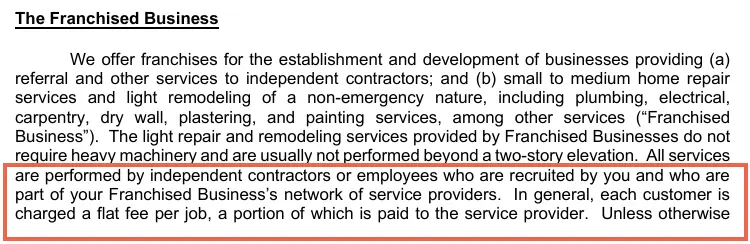
Item 1 describes the business as two lines of activity: referral and other services to independent contractors, and small to medium home repair and light remodeling of a non-emergency nature for homeowners. The work needs no heavy machinery and is usually not performed above a two-story elevation. Item 8 names craftsman recruiting as one of six categories with a designated supplier, beside software, clothing, vehicle wraps, phone systems and marketing literature.
The operations manual makes the craftsman side its own discipline. Exhibit H lists 12 manuals totaling about 796 pages, and Module 5, Craftsman Success, runs 71 pages with chapters on independent contractors versus employees, recruiting, onboarding, scheduling and retention (FDD, Item 11 and Exhibit H).
| Task | Who handles it under the 2026 FDD | Source |
|---|---|---|
| Day-to-day management | A trained manager working at least 40 hours a week; the signer works full time unless the franchisor consents in writing | Item 15 |
| Phones and scheduling | A customer service representative (CSR) in your office; virtual assistants allowed if approved; no call center required at present | Item 7, note 8 |
| Pricing a job | A flat fee per job quoted to the homeowner | Item 1 |
| The repair work | Independent contractors or employees recruited into your network | Item 1 |
| Software access | Owner, service advisors, CSRs and craftsmen all use the platform at $175 per user per month | Items 6 and 7 |
| Complaints | Reply to any customer or craftsman inquiry within one business day; best efforts to resolve within 7 days | Item 15 |
| Premises | A leased office of up to 500 square feet recommended; you may not operate out of your home | Item 7, note 3 |
Classification is the legal pressure point of this model. Item 1 warns that federal and state rules on employees versus independent contractors vary by state, and Item 8 says some states may require you to pay workers’ compensation premiums for the independent contractors you recruit. Each subcontractor should carry its own insurance naming your business as additional insured at limits equal to yours (Item 8). Section 16.1 of the franchise agreement states that the franchisor is not a joint employer of your employees or subcontractors.
The six steps of a job, as the FDD lays them out:
- A homeowner request arrives through the brand’s lead website or central phone number (Item 12).
- Your office CSR books the estimate (Item 7, note 8).
- The estimate is done virtually or in person, and the customer is quoted a flat fee per job (Item 1; Exhibit H).
- A craftsman in your network, independent contractor or employee, does the work (Item 1).
- The customer pays, and a portion of the fee goes to the craftsman (Item 1).
- The whole ticket counts as Gross Sales, including materials customers pay contractors directly, and the percentage fees apply to it (Item 6, note 2).
What sits inside the $115,837 to $238,736 Item 7 estimate?
Item 7 of the March 2026 filing has 11 lines. The $71,000 fee does not move; the gap of $122,899 between the low and high totals comes mostly from two lines: grand opening marketing, which swings $44,015, and three months of additional funds, which swings $39,100. Together they explain $83,115 of the spread.
| Item 7 line | Low | High | Paid to | What the note adds (Source) |
|---|---|---|---|---|
| Initial franchise fee | $71,000 | $71,000 | Handyman Connection | About 100,000 households; $1 per extra household (note 1) |
| Travel and living while training | $2,825 | $5,800 | Airline, hotels, restaurants, auto rental | One person only (note 2) |
| Real estate (leased) | $2,400 | $5,400 | Lessor | First three months’ rent plus a one-month deposit; 500 square feet maximum recommended (note 3) |
| Office equipment | $1,100 | $6,800 | Various vendors | Phone system from the required supplier, workstations, copier (note 4) |
| Lease and utility deposits | $850 | $2,100 | Landlord, utility company | Usually a factor of rent (note 5) |
| Insurance | $2,537 | $7,664 | Insurer or agency | Assumes monthly pro-rata premiums; dishonesty bond paid up front (note 6) |
| Licenses and permits | $215 | $7,500 | Government agencies | Set by state and city law (note 7) |
| Grand opening marketing, advertising and promotion | $25,685 | $69,700 | Various vendors | One vehicle wrap, online presence, pay-per-click, SEO, digital door knocking, signs, mailings (note 8) |
| Computer hardware and software | $1,495 | $9,942 | Various vendors | 1 to 3 users at $175 a month; AI Virtual Estimating $70 to $717 a month (note 9) |
| Proprietary software license | $6,000 | $12,000 | Handyman Connection | $6,000 per franchise agreement signed (note 10) |
| Additional funds, 3 months | $1,730 | $40,830 | Vendors, including Handyman Connection | Business costs only; minimal employee wages (note 11) |
| Total | $115,837 | $238,736 | Handyman Connection FDD, Item 7 |
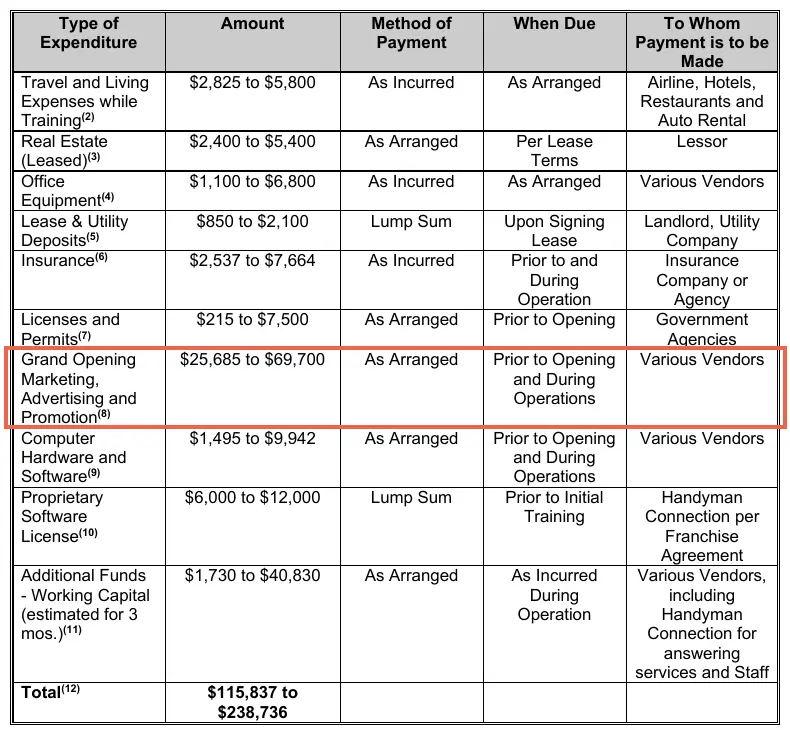
Grouping the lines shows where the money goes. Payments to the franchisor are fixed at $77,000 to $83,000, so the low and high totals differ mainly in how much a buyer spends on launch marketing and how much cash it holds for the first three months.
| Component of Item 7 | Low | High | Source |
|---|---|---|---|
| Paid to Handyman Connection (fee plus software license) | $77,000 | $83,000 | Item 7, notes 1 and 10 |
| Grand opening marketing | $25,685 | $69,700 | Item 7, note 8 |
| Additional funds, 3 months | $1,730 | $40,830 | Item 7, note 11 |
| Other seven lines (travel, rent, equipment, deposits, insurance, licenses, computers) | $11,422 | $45,206 | Item 7; our sum |
| Total | $115,837 | $238,736 | Item 7 |
Payments to the franchisor stay at $77,000 to $83,000 while marketing and working funds drive the spread. Handyman Connection FDD issued March 13, 2026, Item 7.
Which costs does the Item 7 estimate leave out?
Note 11 says the additional funds line covers business costs only, reflects minimal employee wages and excludes royalties, Brand Development Fund contributions, Technology Fee payments, debt service and personal living expenses. A wrapped vehicle and lead-safe certification also sit outside or only partly inside the 11 lines.
| Cost | How Item 7 treats it | Source |
|---|---|---|
| A work vehicle | The franchise agreement requires at least one wrapped vehicle; Item 7 prices only the wrap, inside grand opening marketing, and has no vehicle purchase line | Item 7, note 8; Franchise Agreement 9.9.2 |
| EPA lead-safe certification | Required for work that disturbs lead paint in homes built before 1978, at your own cost; the franchisor does not provide the training | Item 1 |
| Royalty, fund and technology fee in months 1 to 3 | Excluded from additional funds | Item 7, note 11 |
| Office payroll beyond minimal wages | Excluded; a CSR in the office is required | Item 7, notes 8 and 11 |
| A future technology platform | Two current systems are not fully integrated; a different platform is anticipated and may add cost | Item 7, note 9 |
| Users above 25 | About $20 a month per user over 25 | Item 7, note 9 |
| Cyber liability and EPLI cover | Recommended, not yet required | Item 8 |
| Annual Conference | $500 to $1,000 per person, plus travel; $2,500 if you skip it | Item 6 |
The EPA Renovation, Repair and Painting program page for contractors says firms paid to disturb paint in pre-1978 houses, apartments and child-occupied facilities must be certified, including sole proprietorships. Item 1 notes that the rule took effect on April 22, 2010. This is general information, not legal, financial or investment advice; ask a contractor-licensing lawyer in your state which job types need a license and at what job value before you sign.
Percentage fees, fixed charges and penalties in the Item 6 schedule
Item 6 of the Handyman Connection FDD stacks four percentage charges on Gross Sales and a set of fixed and penalty fees. The definition matters: note 2 counts all amounts, including the cost of materials, that customers pay directly to your independent contractors, so the percentages apply to the full ticket, not only to the share your business keeps.
| Fee | Amount | When due | Source |
|---|---|---|---|
| Royalty | 6% of Gross Sales | Monthly, on the 10th | Item 6 |
| Minimum Royalty | $13,500 per HH Group in calendar years 3 to 5; $21,000 per HH Group in years 6 to 10 | January 10 of the following year | Item 6 |
| Brand Development Fund | 2% of Gross Sales up to $3,000,000; 1.5% from $3,000,000 to $5,000,000; 1% above $5,000,000 | Monthly, on the 10th | Item 6 |
| Technology Fee | $175 per user per month plus 1% of Gross Sales; increases capped at 25% a year | Monthly after opening | Item 6 |
| Software license | $200 to $300 per licensed user | Annually | Item 6 |
| Texting platform | $55 per phone line per month for 5,000 texts; $.015 per extra text | As incurred | Item 6 |
| Call center | Not assessed now; estimated $100 to $500 a month if created | Monthly | Item 6 |
| Local advertising | At least 10% of Gross Sales in the first year; then 8% under $1,000,000, 7% from $1,000,000 to $3,000,000, 5% above $3,000,000 | As incurred | Items 6 and 11 |
| Annual Conference | $500 to $1,000 per person; $2,500 if you do not attend | On registration | Item 6 |
| Late payments and reports | Interest up to 1.5% a month plus $100 each; late tax returns $100 a day | When late | Item 6 |
| Missed financial reports | $500 per monthly profit and loss statement; $1,000 per annual report | When incurred | Item 6 |
| Additional training or meetings | Has ranged from $850 to $1,250 | As incurred | Item 6 |
| Transfer | $12,500; waived for the first transfer to your own entity | On transfer | Item 6 |
| Renewal | Greater of 15% of the then-current fee or $10,000; $25,000 floor if you missed the in-person conference in any of the last 3 years | On renewal | Items 6 and 17 |
The rate stack changes with annual Gross Sales bands printed in Items 6 and 11. The table adds the percentages only; it is not a sales forecast, and the $175 per user per month comes on top.
| Charge | First year | Later years, under $1,000,000 | $1,000,000 to $3,000,000 | $3,000,000 to $5,000,000 | Over $5,000,000 |
|---|---|---|---|---|---|
| Royalty | 6% | 6% | 6% | 6% | 6% |
| Brand Development Fund | 2% | 2% | 2% | 1.5% | 1% |
| Technology Fee (percentage part) | 1% | 1% | 1% | 1% | 1% |
| Local advertising minimum | 10% | 8% | 7% | 5% | 5% |
| Combined share of Gross Sales | 19% | 17% | 16% | 13.5% | 13% |
The split between royalty and fund changed recently. Item 12 says that starting in 2025 the royalty moved to 6% from 5% and the Brand Development Fund to 2% from 3%, so the two still add to 8%, and some existing franchisees pay different rates. For fiscal 2025 the fund spent 22% on production, 39% on media and 39% on administration and other expenses (Item 11). Our study of franchise technology fees shows how per-user charges like the $175 line compare across filings.
The franchisor also earns from suppliers. Item 8 discloses a paint supplier rebate of 2% of paint and sundry purchases and $1 per background check, and says required franchisee purchases produced $54,859 in fiscal 2025, or 1.44% of total revenue of $3,793,553. Our franchise supplier rebates report explains how Item 8 rebate disclosures work.
What does a Handyman Connection territory actually give you?
A Handyman Connection territory is a list of zip codes sized by USPS housing counts, generally 75,000 to 100,000 households and typically 100,000 to 105,000, and it is not exclusive. What you hold is the right to receive and service new residential leads that arrive through the brand’s lead website or central 1-800 number for those zip codes (Item 12).
| Territory rule | What the 2026 FDD says | Source |
|---|---|---|
| Size and price | $71,000 for about 100,000 households; extra zip codes at $1 per household; no fee reduction for a smaller territory | Items 5 and 12 |
| What is protected | New residential leads from the central platform in your zip codes are not assigned to another franchisee while you comply | Item 12 |
| What is not | Other franchisees or company outlets may serve residential or commercial customers in your zip codes who contact them directly | Items 1 and 12 |
| Work outside your zip codes | Allowed unless that area belongs to a franchisee with exclusivity; rights end when the area is sold | Item 12 |
| Reserved to the franchisor | National Accounts, other brands and internet or retail channels inside your territory | Item 12 |
| Scope of work | Residential Services for one, two or three owner-occupied dwellings; no lawn care, roofing, cleaning, power washing or HVAC without written consent | Item 12 |
| Job size, years 1 and 2 | $15,000 per project, $30,000 in the aggregate, unless approved | Items 1 and 16 |
| Commercial work | Only with written permission and never exclusive | Item 1 |
The lead right can shrink. If you miss the sales floor, Item 12 lets the franchisor remove zip codes, rescind your right to residential leads, put you into a resale program or terminate. Our research on franchise territory rights shows how often Item 12 grants no exclusivity across filings.
How do the sales floor and minimum royalty step up over 10 years?
From the third calendar year, each 50,000-household group in your territory carries a sales floor of $225,000, rising to $350,000 in years 6 to 10. If royalties come in below 6% of that floor, you pay the gap as the Minimum Royalty: $13,500 and then $21,000 per group. Groups round down, so a 99,000-household territory counts as one.
| Territory households | HH Groups | Fee at signing | Floor, years 3 to 5 | Minimum Royalty, years 3 to 5 | Floor, years 6 to 10 | Minimum Royalty, years 6 to 10 |
|---|---|---|---|---|---|---|
| 75,000 | 1 | $71,000 | $225,000 | $13,500 | $350,000 | $21,000 |
| 100,000 | 2 | $71,000 | $450,000 | $27,000 | $700,000 | $42,000 |
| 150,000 | 3 | $121,000 | $675,000 | $40,500 | $1,050,000 | $63,000 |
Inputs are from Items 5, 6 and 12: $71,000 for about 100,000 households, $1 for each extra household, $225,000 and $350,000 per HH Group, and HH Groups of 50,000 rounded down. The 150,000-household row assumes the franchisor agrees to sell 50,000 extra households at $1 each.
Three timing rules change these numbers. A franchise agreement signed in January or February starts the floor in the second calendar year and steps it up in the fifth. Extra territories bought at the same signing carry no floor until the fourth calendar year. A buyer of an existing territory generally takes the seller’s highest criteria, $350,000 per group, from the start (Items 6 and 12).
What does leaving early cost?
Item 6 sets the Payment Upon Early Termination at the current calendar year’s Minimum Royalty plus the next two years’ in full. For a 100,000-household territory that ends in calendar year 7 before May 1, with every conference attended, that is 3 x $42,000, or $126,000. Three add-ons apply:
- A termination before the end of the Third Calendar Year owes the Minimum Royalty for the Fourth and Fifth Calendar Years, $54,000 for two groups (2 x $27,000).
- A termination after May 1 adds 25% of the following year’s Minimum Royalty.
- Missing in-person conferences in the 3 prior years adds 50% of the Sixth Calendar Year’s Minimum Royalty.
Item 17 adds a warranty charge on exit, the greater of 2% of the prior 24 months’ Gross Sales or $15,000, and a 3-year non-compete within 25 miles of your territory. Because a spouse must sign the personal guaranty, these sums can reach marital assets, a risk the FDD lists on its special-risks page; our report on franchise personal guarantees covers how spousal guaranties work.
What must be in place before the first job?
Item 11 puts signing to opening at 2 to 4 months, with a contract deadline of 120 days, and expects you to open 1 to 6 weeks after training ends. Before then you need the training certificate, an approved office lease, insurance certificates, state licenses and a wrapped vehicle. The franchisor must hand you the FDD at least 14 calendar days before you sign or pay under 16 CFR 436.2(a).
| Requirement | Detail | Source |
|---|---|---|
| Initial training | Up to 5 weeks for you and up to one manager; 112 classroom hours and 54 on-the-job hours; no tuition | Item 11 |
| Contractor licenses | Special licenses in AZ, CA, CO, CT, FL, ID, IL, MD, MI, MN, NE, NJ, NM, NV, NY, OR, PA, SC, TN, VA, WA, WV and WI; AZ, CA, FL, NM, NV and SC also require experience | Item 1 |
| General liability | $1,000,000 per occurrence; $2,000,000 general aggregate; $2,000,000 products and completed operations | Item 8 |
| Auto liability | $1,000,000 combined single limit, owned, hired and non-owned vehicles | Item 8 |
| Employer’s liability | $1,000,000 per accident and per employee; workers’ compensation at the state or SOP level | Item 8 |
| Umbrella and bond | $1,000,000 umbrella; $5,000 employee dishonesty cover; carriers rated A or better by AM Best | Item 8 |
| Personal guaranty | Owners above 10% and their spouses sign | Item 15 |
| Brand marking | At least one vehicle with the approved wrap; failing to install it is a curable default | Items 11 and 17 |
The order of steps from first meeting to opening, as the filing sets it:
- Receive the current FDD at least 14 calendar days before signing or paying anything (16 CFR 436.2).
- Sign the franchise agreement and pay the $71,000 fee, or $61,000 as a qualified veteran or first responder (Item 5).
- Pay the $6,000 software license before initial training (Item 5).
- Complete initial training; it runs every two to three months as needed (Item 11).
- Get the lease approved, place insurance and file certificates before operations start (Item 8).
- Open 1 to 6 weeks after training and no later than 120 days after signing (Item 11).
The veteran and first-responder price of $61,000 is $10,000 below the standard fee; first responders must have served at least 2 full years full time as police, EMS or firefighters (Item 5). Our veteran franchise discount study lists how other filings price that discount.
How many Handyman Connection outlets opened and closed from 2023 to 2025?
Handyman Connection had 65 franchised outlets and no company-owned ones at the end of 2025, unchanged from the start of the year. Openings of 7, 10 and 10 from 2023 to 2025 were offset by 5 terminations and 15 outlets that ceased operations, and the FDD’s special-risks page flags turnover above 22% over three years.
| Year | Start | Opened | Terminated | Ceased for other reasons | End | Transfers | Source |
|---|---|---|---|---|---|---|---|
| 2023 | 58 | 7 | 2 | 1 | 62 | 4 | Item 20, Tables 1 to 3 |
| 2024 | 62 | 10 | 1 | 6 | 65 | 4 | Item 20, Tables 1 to 3 |
| 2025 | 65 | 10 | 2 | 8 | 65 | 7 | Item 20, Tables 1 to 3 |
In 2025, 10 openings matched 10 outlets lost, leaving the system at 65. Handyman Connection FDD issued March 13, 2026, Item 20, Table 3.
The counts mix two countries. Item 1 places 16 of the 65 outlets in Canada, run through master franchisee Newbridge Management Group, Inc. under an agreement from November 1995; Canada lost 2 outlets in 2025. Table 5 projects 4 new U.S. outlets in the next fiscal year, 1 each in Michigan and Nebraska and 2 in Texas, with no agreements signed but unopened. The franchisor reports no litigation under Item 3 and no bankruptcy under Item 4 of the 2026 filing.
Item 20 adds two points for anyone calling owners. Some current and former franchisees have signed provisions restricting their ability to speak openly, and an independent group, HFA, Inc., asked to be listed alongside the franchisor-recognized advisory council elected at the annual convention. Our franchisee associations report shows how often filings list independent groups.
Financing comes from outside lenders. Item 10 says the franchisor offers no financing and will sign the SBA’s universal addendum. The SBA Franchise Directory file effective September 29, 2026 lists Handyman Connection under code S0784 since 10/01/2017, and our SBA franchise directory tabulation counts 21 SBA 7(a) loans to the brand from fiscal 2020 to June 30, 2026.
What does Item 19 report?
Item 19 of the 2026 filing has three parts: annual Gross Sales for 27 of 28 U.S. franchisees that operated all of 2025, a ranking of the 10 service categories quoted most often, and gross margin on service revenue from 25 franchisees’ unaudited profit and loss statements. We do not republish those figures; read them in Item 19 of the current FDD, and see our Item 19 research on how such disclosures work.
Figures in circulation that the 2026 filing replaces
Several widely read pages still carry Handyman Connection numbers from the 2025 FDD or from directory listings with no item reference. The March 13, 2026 filing raised the fee to $71,000 and the Item 7 range to $115,837 to $238,736, and it prints charges that summaries often omit, such as the 1% technology fee.
| What a published source says | What the 2026 FDD says | Source |
|---|---|---|
| A cost review updated October 2025: $110,722 to $231,114 total and a $70,000 fee | $115,837 to $238,736 and $71,000 | Items 5 and 7 |
| The same review: grand opening marketing $21,485 to $64,700 | $25,685 to $69,700 | Item 7 |
| The same review lists royalty, brand fund and local marketing as the ongoing fees | Also a Technology Fee of 1% plus $175 per user per month | Item 6 |
| A consultant directory: $60,000 franchise fee | $60,000 is the price of each extra territory bought at signing; the standard fee is $71,000 | Item 5 |
| The same directory: $30,000 liquid capital and $250,000 net worth | Items 5, 7 and 10 state no liquid capital or net worth minimum; ask the franchisor where such criteria come from | Items 5, 7, 10 |
| Listings showing a 5% royalty and 3% ad fund | 6% royalty and 2% fund since 2025 | Item 12 |
| Founded in 1992 | The predecessor franchised from January 1993; the current franchisor since January 31, 2014 | Item 1 |
Is the Handyman Connection model a match for your situation?
The FDD sorts buyers on five questions: whether you want to manage craftsmen rather than do the work, whether you can work full time, whether your state licenses handyman work, whether your reserves can cover the floor from year 3, and whether you buy new or resale. Each row cites the item that decides it.
| If this describes you | What the FDD means for you | Item |
|---|---|---|
| You want to do the repairs yourself | The model is built on a recruited network and full-time management; ask in writing whether owners may also work jobs | Items 1 and 15 |
| You cannot commit full time | You need written consent and an approved manager working at least 40 hours a week | Item 15 |
| You planned a home office | Not allowed; budget $2,400 to $5,400 for three months of rent and a deposit | Item 7, note 3 |
| Your state is on the 23-state list | Confirm the license, and any experience requirement in AZ, CA, FL, NM, NV or SC, before signing | Item 1 |
| Your reserve after opening is under $13,500 per HH Group | That is the year-3 Minimum Royalty owed even if sales fall short | Items 6 and 12 |
| You are a veteran or a first responder with 2 full years of service | The fee is $61,000 instead of $71,000 | Item 5 |
| You want two or more territories at once | $60,000 for each extra territory; their floors start in the fourth calendar year | Items 5 and 6 |
| You prefer an existing outlet | No initial fee; $12,500 transfer fee; floor generally at $350,000 per group from the start; 7 transfers in 2025 | Items 6, 7, 12, 20 |
For the wider category and how other handyman franchisors price territories and fees, read our handyman business franchise comparison.
Questions worth putting to the franchisor in writing, each tied to a clause in the 2026 FDD:
- Which technology platform will replace the two current systems, when, and at what per-user price (Item 7, note 9)?
- What vehicle do new owners typically buy, given that only the wrap is in Item 7 (Item 7, note 8)?
- How many households does my proposed zip-code list hold, and how many HH Groups does that make after rounding down (Items 6 and 12)?
- How are craftsmen classified in my state, and who pays workers’ compensation on contractor labor (Items 1 and 8)?
- Which of the 20 outlets that left from 2023 to 2025 operated in my state, per Exhibit B (Item 20)?
How we compiled this
We read the Handyman Connection FDD issued March 13, 2026, as filed with the Minnesota Department of Commerce (CARDS document 35507-202603-01), including Items 1 to 23 and Exhibit H, and quoted each figure with its item number. We also opened 16 CFR 436.2 (Legal Information Institute copy, because eCFR returned a bot check), the EPA RRP contractor page and the SBA Franchise Directory file of September 29, 2026; the loan count comes from our SBA tabulation. Every Item 19 figure was excluded under our editorial rule. Sources were accessed in November 2026.
Frequently asked questions
How much does a Handyman Connection franchise cost?
Item 7 of the Handyman Connection FDD issued March 13, 2026 puts the initial investment at $115,837 to $238,736. That includes the $71,000 franchise fee, a $6,000 to $12,000 software license, $25,685 to $69,700 of grand opening marketing and $1,730 to $40,830 of three-month working funds. It has no line for buying the wrapped vehicle the franchise agreement requires.
Do Handyman Connection franchise owners do the repairs themselves?
The FDD does not build the business around the owner doing repairs. Item 1 says all services are performed by independent contractors or employees the franchisee recruits, with customers paying a flat fee per job and part of it going to the service provider. Item 15 requires full-time management by a trained person working at least 40 hours a week.
What is the Handyman Connection royalty fee?
The royalty is 6% of Gross Sales, paid monthly on the 10th, under Item 6 of the 2026 FDD. On top come a 2% Brand Development Fund contribution, a Technology Fee of 1% plus $175 per user per month, and local advertising of at least 10% of Gross Sales in the first year. Item 12 says the royalty moved to 6% from 5% starting in 2025.
Is a Handyman Connection territory exclusive?
No. Item 12 says you will not receive an exclusive territory. You get the right to receive and service new residential leads that come through the brand’s lead website or central 1-800 number for your zip codes, typically 100,000 to 105,000 households. Other franchisees may serve customers in your area who contact them directly.
How many Handyman Connection locations are there?
Item 20 of the 2026 FDD counts 65 franchised outlets at the end of 2025 and no company-owned outlets. Item 1 places 49 in the United States and 16 in Canada, where Newbridge Management Group, Inc. is the master franchisee. Table 5 projects 4 more U.S. openings in the next fiscal year.
How much do Handyman Connection franchise owners make?
This site does not publish earnings figures. Item 19 of the 2026 FDD reports 2025 Gross Sales and gross margin data for reporting U.S. franchisees, and you can read it there. Owner income depends on the craftsman share of each flat fee, office payroll and the Item 6 charges, which take 19% of Gross Sales in the first year before per-user technology fees.
Does Handyman Connection offer financing?
No. Item 10 of the 2026 FDD says the franchisor offers no direct or indirect financing but will sign the SBA’s universal addendum for buyers using SBA loans. The SBA Franchise Directory lists the brand under code S0784, and our tabulation of SBA data counts 21 SBA 7(a) loans to Handyman Connection franchisees from fiscal 2020 to June 30, 2026.
Sources
- Trident Investment Partners, Inc. d/b/a Handyman Connection, Franchise Disclosure Document, issued March 13, 2026 (Minnesota Department of Commerce CARDS, document 35507-202603-01; accessed November 3, 2026)
- 16 CFR 436.2, Obligation to furnish documents (Legal Information Institute copy of the Code of Federal Regulations; accessed November 3, 2026)
- Lead Renovation, Repair and Painting Program for Contractors (U.S. Environmental Protection Agency; accessed November 3, 2026)
- SBA Franchise Directory, file effective September 29, 2026 (U.S. Small Business Administration; accessed November 3, 2026)
- SBA 7(a) and 504 FOIA loan data (U.S. Small Business Administration; loan count via our SBA franchise directory tabulation)