
How to buy a franchise with no money of your own: cover the 10% SBA start-up injection with a gift, partner cash or a ROBS rollover, because the lowest Item 7 estimate in 259 FDDs still starts at $3,620.
Key takeaways
- Under SBA SOP 50 10 8.1, effective October 1, 2026, standard 7(a) and 7(a) Small loans to a business open 1 year or less need an equity injection of at least 10% of total project cost.
- SBA Express loans, capped at $500,000, leave the injection to the lender’s business judgment, so the SOP itself sets no floor on that product.
- The 10% does not have to be your savings: the SOP accepts a gift, a partner’s equity investment, a personal loan repaid from outside the business, or debt on full standby.
- In 185 of 259 franchise disclosure documents (71.4%), Item 10 says the franchisor offers no financing; 24 (9.3%) finance part of the initial fee, per our read of filings on Minnesota CARDS.
- The IRS calls ROBS arrangements “questionable” though not abusive: the plan buys C corporation stock and must file Form 5500 every year.
- In an SBA-financed resale, seller debt on full standby can supply no more than half of the 10%, so the buyer still brings at least 5% of project cost.
What is the least cash each route accepts?
No route in the federal lending rules or in 259 current disclosure documents accepts literally zero. The floor is set by whoever supplies the money: SBA asks a start-up for 10% of project cost, SBA Express hands the decision to the bank, and a franchisor that lends at all most often covers a slice of the fee. The table gives each floor per $100,000 of project cost.
| Route | Governing rule | Floor per $100,000 of project cost | Whose money can fill it | Source |
|---|---|---|---|---|
| Standard 7(a) or 7(a) Small loan, start-up | Equity injection of at least 10% of total project cost | $10,000 | Your cash, a gift, partner equity, a personal loan repaid from outside the business, standby debt | SOP 50 10 8.1 |
| SBA Express, loans up to $500,000 | Whether to require an injection is the lender’s business judgment | Set by the lender | The same sources, if the lender asks | SOP 50 10 8.1 |
| ROBS paired with a 7(a) loan | IRS ROBS rules; SBA requires the plan sponsor’s guaranty | $10,000 out of a 401(k) or IRA | Your retirement balance | IRS ROBS page |
| Franchisor financing | Terms must appear in FDD Item 10, 16 CFR 436.5(j) | Item 7 minus the amount financed | The franchisor, for part of the fee in most cases | 16 CFR 436.5 |
| Veteran incentive | Disclosed in FDD Item 5 | Lowers project cost by a median $6,000 | A fee discount, not a loan | Our veteran discount data |
| Resale with SBA loan and seller note | Initial Acquisition: 10%, cannot be reduced; standby seller debt no more than half | $5,000 cash plus a $5,000 standby seller note | Buyer and seller | SOP 50 10 8.1, Appendix 15 |
| Partner’s cash | Equity investment counts; each owner of 20% or more gives an unlimited guaranty | $0 of yours if the partner funds the $10,000 | Partner | SOP 50 10 8.1, Section A, Ch. 5 |
The cheapest entry ticket in our sample belongs to Poop 911: its May 21, 2025 FDD puts the total investment at $3,620 to $25,970 and states that initial fees paid to the franchisor are $0. That is the exception. The median Item 7 low across all 259 filings is $265,372, which makes the 10% SBA injection $26,537, and only 54 filings (20.8%) start below $100,000, according to our franchise initial investment data.
Set that against household balance sheets. The Federal Reserve’s 2022 Survey of Consumer Finances puts median family liquid assets at $10,000 in 2022, a little over a third of the injection on a median-priced unit. Item 7 also leaves out your rent at home: The UPS Store’s 2026 FDD says its additional funds line covers payroll but “not any draw, salary, or living expenses for you,” so budget months of personal costs on top of the 10%.
Which route fits your cash? A decision tree
Work down the questions in order and stop at the first yes. Start from the Item 7 total of the brand you want, because SBA treats all costs to become operational as the project cost, and read Item 5 (veteran discount) and Item 10 (franchisor financing) before you price anything else. Each answer below names the rule that sets your minimum.
| If this is true | Route to test first | Threshold that decides it | Rule |
|---|---|---|---|
| Cash or a gift worth 10% of the project cost? | Standard 7(a) or 7(a) Small loan: 10% injection (SOP 50 10 8.1) | 10% of Item 7 total; the lender may ask for more | SOP 50 10 8.1, Ch. 1 and 2 |
| Retirement funds worth 10% of the project cost? | ROBS: plan buys C corporation stock, Form 5500 every year | Rollover balance at least equal to the injection, plus formation costs paid outside the SBA loan | IRS ROBS project; SOP 50 10 8.1 |
| Buying an existing unit (a resale)? | Seller note on full standby covers at most half of the 10% | Buyer cash at least 5% of project cost | SOP 50 10 8.1, Appendix 15 |
| A partner who brings cash? | Partner equity counts; every 20%+ owner signs an unlimited guaranty | Partner cash equal to the 10%; no repayment before the SBA guaranty is released | SOP 50 10 8.1 |
| Project cost $500,000 or less? | SBA Express: the lender decides whether to require any injection | Loan at or under $500,000; 50% SBA guaranty | SOP 50 10 8.1; SBA Express terms |
| No route fits yet | Build the 10% first, or compare Item 7 lows under $100,000 (54 of 259 FDDs) | Item 7 low under $100,000 | 16 CFR 436.5(g), Item 7 |
Does an SBA loan really need only 10% down for a new franchise?
For a start-up, 10% of total project cost is the SBA minimum on standard 7(a) and 7(a) Small loans under SOP 50 10 8.1, and it applies to every such loan to a business that has generated revenue for 1 year or less. It is a floor: the SOP tells the lender to judge whether equity is adequate for the industry and management experience, so a bank can ask for more.
Project cost means all costs required to become operational, regardless of who pays them, except lines of credit and 504 loans. Two loans approved more than 90 days apart count as separate projects, so splitting a build-out means each phase needs its own 10%.
What counts as your 10%?
SOP 50 10 8.1 lists the sources a lender may accept as a start-up’s injection, and only some of them have to be your own savings. That list is the honest answer to how a buyer with little cash gets in, provided every dollar can be traced through bank records:
- Cash that is not borrowed, including a gift; a gift letter alone is not enough without corroborating bank evidence.
- A personal loan whose repayment comes from a source other than the business’s cash flow (the salary the business pays you does not qualify).
- Debt on full standby: no payments of principal or interest for the term of the 7(a) loan, documented on SBA Form 155 or the lender’s equivalent.
- An equity investment with no agreement to repay it before the SBA guaranty is released.
- Grants with no repayment or clawback during the loan, non-cash assets with an independent valuation, and verified prepaid expenses.
Borrowed injection, such as a home equity line, is allowed only on those terms, and the lender must address its repayment and any standby or subordination in the credit file (SOP 50 10 8.1, Ch. 6).
When is SBA Express the low-cash option?
SBA Express is the one 7(a) product where the SOP leaves the injection to the lender. It is capped at $500,000 with a 50% SBA guaranty, and banks that verify equity on similar unguaranteed loans must verify it here too. SBA’s FOIA file shows 17.7% of start-up franchise 7(a) loans from FY2020 to June 2026 went through Express, against 8.5% of resale loans, per our franchise resale loan analysis.
Fees move the cash figure too. The FY2027 SBA fee notice sets the upfront guaranty fee at 3% of the guaranteed portion for loans of $150,001 to $700,000, and at $0 for SBA Express loans to businesses owned and controlled by a veteran or a veteran’s spouse. A non-veteran borrowing the full $500,000 through Express would owe $7,500 (50% guaranteed, times 3%).
Can retirement savings stand in for cash through ROBS?
Yes, if you have a 401(k) or IRA balance at least as large as the injection. A rollover as business start-up is not a loan: according to the IRS ROBS Compliance Project page, your rolled-over funds sit in a new plan that buys stock in your new C corporation. The IRS says ROBS plans are not abusive tax avoidance but are “questionable because they may solely benefit one individual.”
- Form a C corporation.
- The corporation adopts a 401(k) plan.
- Roll your IRA or 401(k) into the new plan.
- The plan buys C corporation stock.
- The corporation pays franchise costs, including the 10% injection if you pair ROBS with an SBA loan.
Once the plan owns the company, the obligations below apply. The IRS started its ROBS project in 2009 and found that most ROBS businesses “either failed or were on the road to failure,” with high rates of bankruptcy, liens and corporate dissolutions; it published no counts.
- File Form 5500 every year: the 5500-EZ exception does not apply, because the plan, not you, owns the business (the one-participant exception covers plans under $250,000).
- Issue Form 1099-R on the rollover.
- Do not amend the plan to block other employees from buying stock; the IRS flags this as a coverage and discrimination problem.
- SBA lender: the plan sponsor signs a full unconditional guaranty, whatever their ownership share.
- SBA loan proceeds cannot pay plan formation costs, so promoter and setup fees come out of your own pocket or the rollover.
The lender must also collect the plan’s IRS favorable determination letter, the C corporation formation documents and the stock purchase documents with the loan application (SOP 50 10 8.1, 401(k) and ROBS plans). Ask a CPA who will file Form 5500 and administer the plan every year it exists, since the IRS lists promoter fees and asset valuation among recurring problems.
How often will the franchisor lend you the money?
Seldom for a first unit, and almost never for the whole investment. 16 CFR 436.5(j) requires Item 10 of every FDD to disclose each direct or indirect financing arrangement the franchisor or its affiliates offer. We read Item 10 in all 259 FDDs of our sample: 185 (71.4%) say there is none, and 24 (9.3%) finance part of the initial fee.
185 of 259 FDDs (71.4%) state the franchisor offers no direct or indirect financing in Item 10. Source: our read of Minnesota CARDS filings, October 2026.
The split by sector is sharp. Hotel brands disclose development incentives in 14 of 18 lodging FDDs, usually forgivable notes or key money for building or converting a property. None of the 18 children’s education FDDs offers any financing. Subleases, lender referrals and occasional lease guaranties were not counted as financing in our coding.
Where a franchisor does lend, the terms show how far it goes. The last column subtracts the most the franchisor will finance from the low end of its own Item 7 estimate:
| Brand (FDD issued) | What Item 10 finances | Down, term, rate | Item 7 total | Cash still needed at the Item 7 low |
|---|---|---|---|---|
| The Tailored Closet (March 20, 2026) | $44,000 of the initial and territory fee | $0 down, 60 months, 10% | $177,130 to $270,650 | $133,130 |
| Lightspeed Restoration (April 1, 2026) | $32,000 of the territory fee | $0 down, 60 months, 10% | $157,180 to $268,950 | $125,180 |
| System 4 (March 26, 2026) | Up to 20% of the initial fee | At least 80% down, 1 to 3 years, 12% | $128,000 to $377,000 | $108,800 (20% of a $96,000 fee) |
| Homewatch CareGivers (April 30, 2026) | Up to 75% of the $50,000 fee | Up to 36 installments, 12% | $142,890 to $194,080 | $105,390 |
| ComForCare Home Care (March 18, 2026) | Up to 50% of the $59,000 fee | 60 months, 10% | $102,475 to $163,925 | $72,975 |
| Bark Busters (March 16, 2026) | Up to $30,000 of the $49,500 fee | 36 monthly payments, prime + 3% (9.75% as of January 2026) | $77,900 to $117,000 | $47,900 |
| Toro Taxes (April 20, 2026) | $35,000 of the initial fee | $5,000 down, 120 months, 12.9% APR | $17,835 to $79,150 | $44,150 at the Item 7 high, where the $40,000 fee applies |
| Christmas Decor (March 18, 2026) | Lesser of 50% of the territory fee or $7,500 | Up to 18 months, 10% APR | $29,550 to $116,250 | $22,050 |
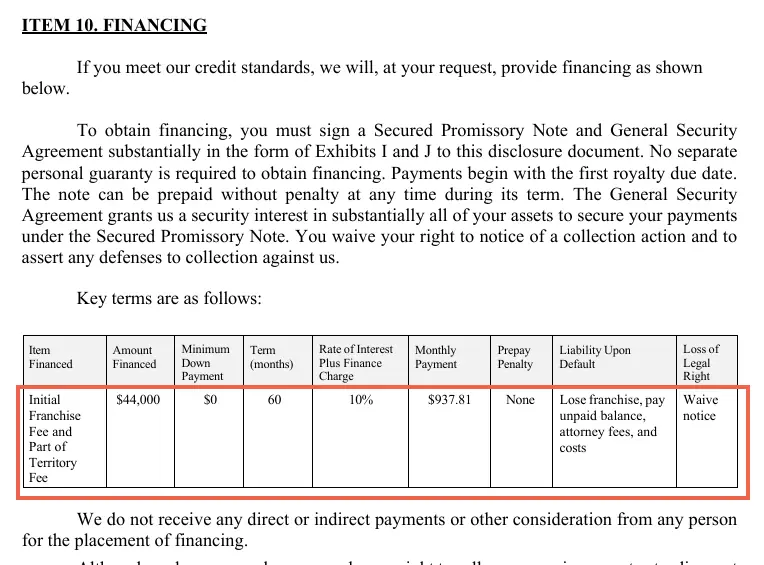
Read the default terms as closely as the rate. The Tailored Closet’s note waives notice of a collection action, and on default you “lose franchise, pay unpaid balance, attorney fees, and costs” (Item 10, page 20). Homewatch CareGivers excludes deals involving brokers or referral sources from its 75% fee financing. Our guide to reading the franchise disclosure document explains where Items 5, 7 and 10 sit and when you must receive them.
Do veteran discounts make a real dent?
They trim the fee, not the build-out. Of 259 FDDs, 130 (50.2%) disclose some veteran incentive and 117 (45.2%) cut the initial franchise fee. The median cut is $6,000, which equals 3.08% of the low end of the brand’s own Item 7 range, so a veteran still needs most of the 10% injection from another source.
- Largest cut found: a $35,000 fee waived in full.
- 52 of the 130 programs apply to the first unit only.
- The UPS Store’s 2026 FDD cuts the first-center fee from $39,950 to $19,950 under VetFran and waives it entirely for the first 10 qualifying veterans who apply by December 31, 2026 (Item 5).
- SBA Express loans to veteran-owned businesses carry a $0 upfront fee in FY2027.
Each program sets its own proof: 100 of the 130 FDDs require an honorable discharge or a DD-214. Program details, sector by sector, are in our veteran franchise discount research.
Can a seller note replace the down payment on a resale?
Only half of it, if a bank loan is involved. SOP 50 10 8.1, Appendix 15, sets a 10% injection for an Initial Acquisition that “cannot be reduced or eliminated,” and seller debt counts toward it only when it is subordinated and on full standby, with no principal or interest paid for the life of the 7(a) loan. Such limited sources may provide no more than half of the required injection.
| Per $100,000 of resale project cost | Amount | Rule |
|---|---|---|
| Required equity injection, Initial Acquisition | $10,000 | SOP 50 10 8.1, Appendix 15 |
| Most a standby seller note can supply | $5,000 | Limited sources: no more than half |
| Least the buyer brings from unlimited sources | $5,000 | Cash, gift, outside-repaid loan |
| Seller note payments during the 7(a) loan | $0 | Full standby |
| When the seller note may be refinanced | After 36 months in place and current | Appendix 15 |
Resales also cost more to finance. Changes of ownership are 14.9% of franchise-coded 7(a) loans, and the median resale loan was $806,000 against $302,000 for a start-up, so the 10% is larger in dollars. A seller can finance more than half the injection, or the whole price, only outside an SBA loan. The UPS Store is a frequent resale brand: 323 of its 1,044 franchise 7(a) loans (30.9%) were changes of ownership, and its Item 6 lists a $6,000 transfer fee.
What does a partner’s money cost you?
Control and a personal guaranty. A partner’s equity investment counts as injection under the SOP if it is not repaid before the SBA guaranty is released, but any individual owning 20% or more must sign an unlimited full guaranty of the loan, and the lender can require guaranties from smaller owners who are critical to the business. Franchisors add their own layer:
| Who signs | SBA 7(a) loan | Franchise agreement (259 FDDs) |
|---|---|---|
| Owners of 20% or more | Unlimited full guaranty, required | All owners sign in 168 of 252 FDDs with a guaranty (66.7%) |
| Owners under 20% | Lender may require a guaranty from key people | 66 FDDs use an ownership threshold: 5% (26), 10% (30), 20% (9) |
| Spouses | Ownership of spouses and minor children is combined | 92 of 259 FDDs (35.5%) require spouses to sign a guaranty |
| Any owner | Equity cannot be repaid before the guaranty is released | 239 of 259 FDDs (92.3%) require owners to sign a personal guaranty |
So a partner who funds the 10% for a 20% stake and a no-money operator holding 80% both end up personally liable to the bank, and in most systems to the franchisor too. The clause-level detail is in our franchise personal guarantee research.
Worked example: what does The UPS Store take on each route?
The UPS Store suits the exercise because its FDD issued April 23, 2026 offers no financing in Item 10 and runs several fee programs in Item 5. A New or Relocation Traditional center under the Laser Lite design costs $222,368 to $606,081, of which $43,523 to $75,643 goes to the franchisor or an affiliate.
| Route (New or Relocation Traditional center) | At the Item 7 low | At the Item 7 high | Source |
|---|---|---|---|
| Item 7 total, all cash | $222,368 | $606,081 | 2026 FDD, Item 7 |
| Standard 7(a): 10% injection | $22,237 | $60,608 | SOP 50 10 8.1; our arithmetic |
| Loan amount at 90% | $200,131 | $545,473 | Our arithmetic |
| FY2027 upfront fee, 3% of the 75% guaranteed portion | $4,503 | $12,273 | SBA fee notice; our arithmetic |
| VetFran fee of $19,950: 10% injection | $20,237 | $58,608 | 2026 FDD, Item 5 |
| 2026 veteran fee waiver (first 10 veterans): 10% injection | $18,242 | $56,613 | 2026 FDD, Item 5 |
| SBA Express, injection at lender judgment | Possible: total under $500,000 | Not alone: total above $500,000 | SBA Express terms |
| ROBS balance needed to fund the injection | $22,237 | $60,608 | IRS; SOP 50 10 8.1 |
| Franchisor financing | None offered | None offered | 2026 FDD, Item 10 |
| Additional funds inside Item 7 (no owner draw) | $40,000 | $70,000 | 2026 FDD, Item 7, note 10 |
A 10% SBA injection on The UPS Store’s $222,368 to $606,081 Item 7 range is $22,237 to $60,608. Source: 2026 FDD, Items 5 and 7; SBA SOP 50 10 8.1, October 2026.
Read the gap between rows one and two as the whole point: an SBA loan cuts the cash requirement at the low end from $222,368 to $22,237, and no Item 5 program or Item 10 note takes it to zero. The fee, line-by-line Item 7 and the other formats are covered in our UPS Store franchise cost breakdown.
How the SBA loan compares with the Item 7 total across 68 brands with 10 or more start-up loans is measured in our analysis of what franchise buyers borrow; the median brand’s loan equals 84.2% of its Item 7 midpoint, an estimate based on SBA FOIA data.
Which no-money claims fail against the SBA and IRS text?
The two top-ranking guides we opened date from 2018 and 2023, before SOP 50 10 8.1 took effect on October 1, 2026, and neither cites the SOP, the IRS ROBS page or any Item 10. Four of their claims fail a check:
| What several guides say | What the primary source says | Source |
|---|---|---|
| A franchisor blog (2018): SBA loans need about 20% to 30% of the loan amount as a down payment | Start-up 7(a) and 7(a) Small loans need at least 10% of total project cost; SBA Express leaves it to the lender | SOP 50 10 8.1 |
| A franchisor blog (2018): ROBS is a way to borrow from yourself | The plan buys stock in your C corporation; it is an equity purchase with yearly Form 5500 filings | IRS ROBS page |
| A franchise broker guide (2023): franchisor financing is the first of seven ways to start with no money | 185 of 259 Item 10 sections (71.4%) state no financing; 24 (9.3%) finance part of the fee | Our Item 10 read, Minnesota CARDS |
| A franchise broker guide (2023): initial fees range from $10,000 to $100,000 | Poop 911’s fee is $0 (May 2025 FDD); System 4’s runs from $96,000 to $300,000 (2026 FDD) | FDD Item 5 and cover pages |
If you are still sizing what you can afford, our guide to franchises under $100,000 explains how fee, Item 7 total and liquid capital requirements differ.
How we compiled this
We read the Item 10 section of 259 franchise disclosure documents filed with the Minnesota Department of Commerce (issued January 24, 2025 to August 18, 2026), coded each by hand where a script could not decide, and rechecked a random 15 of the rest. Lending rules come from SBA SOP 50 10 8.1 and the FY2027 fee notice, ROBS rules from the IRS, and loan statistics from our earlier analyses of SBA FOIA data, all accessed in October 2026. We excluded earnings claims and forum advice. This is general information, not legal, financial or investment advice.
Frequently asked questions
Can you get an SBA loan for a franchise with no money down?
Not on a standard 7(a) or 7(a) Small loan to a start-up: SOP 50 10 8.1 requires an equity injection of at least 10% of total project cost. SBA Express, capped at $500,000, leaves the injection to the lender’s judgment. The 10% can come from a gift, a partner’s equity or debt on full standby rather than your savings.
Can I use a gift from family as my franchise down payment?
Yes. SOP 50 10 8.1 counts cash that is not borrowed, including a gift, as equity injection. The lender must verify it with bank evidence: the SOP says a gift letter, promissory note or financial statement alone is not sufficient. If the money is really a loan, it counts only when repaid from a source other than the business.
Is ROBS a loan from my 401(k)?
No. In a rollover as business start-up, your retirement money moves into a new plan that buys stock in your C corporation, as the IRS ROBS Compliance Project page describes. Nothing is repaid. The plan must file Form 5500 every year, and if an SBA loan is involved, the plan sponsor signs a full unconditional guaranty.
Do franchisors finance the franchise fee?
A minority do. In our read of 259 FDDs, 24 (9.3%) finance part of the initial fee and 185 (71.4%) state no financing at all in Item 10. Terms we found run from 20% of the fee at 12% (System 4) to $44,000 with nothing down over 60 months at 10% (The Tailored Closet).
What is the cheapest franchise to start?
In our 259-FDD sample, the lowest Item 7 estimate is Poop 911’s $3,620 to $25,970, with $0 in initial fees to the franchisor (FDD issued May 21, 2025). Only 54 of the 259 filings (20.8%) start below $100,000, and the median Item 7 low is $265,372. Check the brand’s current FDD before relying on any figure.
Can a seller finance 100% of a franchise resale?
Not alongside an SBA 7(a) loan. Appendix 15 of SOP 50 10 8.1 requires a 10% injection for an Initial Acquisition that cannot be reduced, and seller debt on full standby may supply no more than half of it. Full seller financing is a private deal between buyer and seller, subject to the franchisor’s transfer approval.
Sources
- U.S. Small Business Administration, SOP 50 10 8.1 with Technical Policy Updates, effective October 1, 2026, accessed October 27, 2026.
- U.S. Small Business Administration, SOP 50 10: Lender and Development Company Loan Programs (document page), accessed October 27, 2026.
- U.S. Small Business Administration, Information Notice 5000-881797: 7(a) Fees for FY2027, accessed October 27, 2026.
- U.S. Small Business Administration, 7(a) loan program: terms, conditions and eligibility, accessed October 27, 2026.
- U.S. Small Business Administration, 7(a) and 504 FOIA loan data, as of June 30, 2026, accessed October 27, 2026.
- Internal Revenue Service, Rollovers as Business Start-Ups Compliance Project, accessed October 27, 2026.
- U.S. Government Publishing Office, 16 CFR 436.5, Disclosure items (2026 edition), accessed October 27, 2026.
- Board of Governors of the Federal Reserve System, Survey of Consumer Finances 2022, summary extract, accessed October 27, 2026.
- Minnesota Department of Commerce, Franchise registrations search (CARDS), accessed October 27, 2026.
- The UPS Store, Inc. (Minnesota CARDS), The UPS Store (Traditional) Franchise Disclosure Document, issued April 23, 2026, accessed October 27, 2026.
- Poop 911 (Minnesota CARDS), Poop 911 Franchise Disclosure Document, issued May 21, 2025, accessed October 27, 2026.
- Minnesota CARDS, The Tailored Closet Franchise Disclosure Document, issued March 20, 2026, Item 10, accessed October 27, 2026.
- Minnesota CARDS, Lightspeed Restoration Franchise Disclosure Document, issued April 1, 2026, Item 10, accessed October 27, 2026.
- Minnesota CARDS, System 4 Franchise Disclosure Document, issued March 26, 2026, Item 10, accessed October 27, 2026.
- Minnesota CARDS, Homewatch CareGivers Franchise Disclosure Document, issued April 30, 2026, Item 10, accessed October 27, 2026.
- Minnesota CARDS, ComForCare Home Care Franchise Disclosure Document, issued March 18, 2026, Item 10, accessed October 27, 2026.
- Minnesota CARDS, Bark Busters Franchise Disclosure Document, issued March 16, 2026, Item 10, accessed October 27, 2026.
- Minnesota CARDS, Toro Taxes Franchise Disclosure Document, issued April 20, 2026, Item 10, accessed October 27, 2026.
- Minnesota CARDS, Christmas Decor Franchise Disclosure Document, issued March 18, 2026, Item 10, accessed October 27, 2026.