The Little Caesars franchise cost is $376,500 to $1,769,200 for one new restaurant, including the $20,000 initial fee, according to Item 7 of the Little Caesars disclosure document issued March 27, 2026.
Key takeaways
- Item 7 totals $376,500 to $1,769,200, down from $446,500 to $1,817,200 in the FDD issued March 31, 2025 (2026 FDD, Item 7; 2025 FDD, Item 7).
- $277,000 to $504,000 of the total is paid to Little Caesar Enterprises or its affiliate Blue Line Foodservice Distribution (2026 FDD, cover page).
- The royalty is the greater of 6% of weekly Gross Sales or $300 a week; advertising is up to 7% of Gross Sales as Little Caesars determines (2026 FDD, Item 6).
- The franchising site asks for a $400,000 net worth with $200,000 liquid, and Item 10 says Little Caesars offers no financing (Little Caesars franchising page).
- In 2025, 22 franchised Little Caesars restaurants ceased operating and 239 changed hands, against 3,701 open at the start of the year (2026 FDD, Item 20).
What does the 2026 Item 7 add up to for one Little Caesars restaurant?
Item 7 of the March 27, 2026 Little Caesars FDD lists 12 lines that total $376,500 to $1,769,200 for a traditional restaurant of 1,200 to 1,600 square feet, counting one month of rent and three months of additional funds. Leasehold improvements swing the most, from $50,000 to $1,000,000. Adding the printed lines reproduces both printed totals exactly.
The figures come from the Little Caesar Enterprises, Inc. Franchise Disclosure Document, issued March 27, 2026, as filed with Minnesota’s CARDS registry. The 2025 column is from the FDD issued March 31, 2025, filed the same way.
| Item 7 line (2026 wording) | 2026 FDD | 2025 FDD | Paid to (2026) | Source |
|---|---|---|---|---|
| Initial franchise fee | $20,000 | $20,000 | Little Caesar Enterprises | Item 7, Item 5 |
| Rent, one month | $1,500 to $8,500 | $1,500 to $7,000 | Lessor | Item 7, note 2 |
| Leasehold improvements | $50,000 to $1,000,000 | $50,000 to $1,000,000 | Suppliers | Item 7, note 3 |
| Equipment and technology from Blue Line | $235,000 to $460,000 | $250,500 to $369,500 | Blue Line | Item 7, note 4 |
| Other fixtures, equipment and signage | $15,000 to $158,000 | $15,000 to $158,000 | Suppliers | Item 7 |
| Grand opening advertising | $15,000 | $15,000 | Little Caesar Enterprises | Item 7, note 5 |
| Training expenses | $12,000 to $16,500 | $12,000 to $16,500 | Hotels, airlines, licensing | Item 7, note 6 |
| Opening food, paper goods, chemicals and supplies | $7,000 to $9,000 | $63,000 to $154,000 | Blue Line | Item 7, note 7 |
| Insurance | $500 to $1,200 | $500 to $1,200 | Insurers | Item 7, note 8 |
| Utility expenses | $1,000 to $9,000 | $1,000 to $9,000 | Utilities | Item 7, note 9 |
| Licenses and permits | $2,500 to $25,000 | $1,000 to $20,000 | Governments | Item 7, note 10 |
| Additional funds, 3 months | $17,000 to $47,000 | $17,000 to $47,000 | Various | Item 7, note 11 |
| Total | $376,500 to $1,769,200 | $446,500 to $1,817,200 | Item 7, note 12 |
The arithmetic check: $20,000 + $1,500 + $50,000 + $235,000 + $15,000 + $15,000 + $12,000 + $7,000 + $500 + $1,000 + $2,500 + $17,000 equals the printed $376,500, and the high column adds to the printed $1,769,200. The 2025 columns also add to their printed $446,500 and $1,817,200.
Three Little Caesars costs sit outside the total. Note 2 excludes buying real estate and any lease deposit; note 4 excludes the optional M.I.K.E. automated production system, which Little Caesars says it may make mandatory; note 3 adds a refurbishment duty of up to $150,000, which cannot be required sooner than 5 years after construction or the last full refurbishment.
One printed figure reads oddly: note 5 says the upper end of the grand opening range reflects a “strong” plan, yet both columns print $15,000, the minimum spend. For how Little Caesars’ Item 7 sits among other brands, see the Item 7 section of our franchise cost guide.
Why did the low end drop $70,000 from the 2025 Little Caesars FDD?
The Little Caesars low end fell $70,000 and the high end $48,000 because two Blue Line lines were rewritten. The 2025 FDD carried a $63,000 to $154,000 start-up inventory line; the 2026 FDD replaces it with a $7,000 to $9,000 opening order, while the Blue Line package moved from $250,500 to $369,500 to $235,000 to $460,000.
At the high end, the inventory line fell from $154,000 to $9,000 while the Blue Line package rose from $369,500 to $460,000. Source: Little Caesars FDDs issued March 31, 2025 and March 27, 2026, Item 7.
| Changed Item 7 line | Change at low end | Change at high end | Source |
|---|---|---|---|
| Start-up inventory (2025) to opening order (2026) | minus $56,000 | minus $145,000 | 2025 and 2026 FDD, Item 7 |
| Blue Line supplies and equipment (2025) to equipment and technology (2026) | minus $15,500 | plus $90,500 | 2025 and 2026 FDD, Item 7 |
| Rent, one month | $0 | plus $1,500 | 2025 and 2026 FDD, Item 7 |
| Licenses and permits | plus $1,500 | plus $5,000 | 2025 and 2026 FDD, Item 7 |
| Net change in total | minus $70,000 | minus $48,000 | Our arithmetic |
The 2025 Item 5 broke its $250,500 to $369,500 Blue Line package into food, packaging, supplies, pizza pans at $18,000 to $23,000, equipment at $200,000 to $300,000, smallwares and $15,000 of graphics. The 2026 Item 5 instead prices equipment and technology for a freestanding restaurant from the most recent freestanding openings, including the Pizza Portal pickup equipment, the Caesar Vision system and a walk-in cooler.
If a Little Caesars quote, lender model or broker sheet in your hands still shows $446,500 at the low end, it is built on the 2025 edition; ask which edition’s Item 7 it uses before comparing it with the $376,500 now printed.
Which Little Caesars formats does the Item 7 table cover?
One Item 7 table covers every traditional Little Caesars restaurant, freestanding or inline, and its rent line assumes 1,200 to 1,600 square feet. The franchising site lists four footprints from 400 to 1,800 square feet, but Express and other Non-Traditional outlets run under a separate LC Express License that the FDD does not offer, and food trucks are open only to existing franchisees.
| Format | Size (franchising site) | How it is sold | Cost figure in the FDD | Source |
|---|---|---|---|---|
| Freestanding traditional | 1,400 to 1,800 sq ft | Franchise Agreement | Item 7 total; Blue Line package priced on freestanding openings | Items 5 and 7; franchising page |
| Inline or end cap traditional | 1,200 to 1,400 sq ft | Franchise Agreement | Same Item 7 table | Item 7; franchising page |
| Non-Traditional (campuses, airports, concessions) | 900 to 1,000 sq ft | LC Express License Agreement | Not disclosed | Item 1; franchising page |
| Express in gas and convenience stores | 400 to 600 sq ft | LC Express License Agreement | Not disclosed | Item 1; franchising page |
| Food Truck | Not stated | Food Truck Addendum, existing franchisees only | $7,500 fee; 5-year term; $2,500 renewal fee | Items 5, 6 and 17 |
| Territory Reservation Agreement | 1 to 10 restaurants | Reserves an area for development | $41,000 to $45,000 for 4 restaurants, plus each restaurant’s Item 7 | Item 7, second table |
Item 1 says many LC Express outlets are licensed to experienced foodservice operators in deals exempt from franchise registration, so their costs never appear in the Little Caesars FDD. A buyer pricing a gas-station Express unit from the $376,500 low end is using the wrong document.
How much of the cost is paid to Little Caesar Enterprises and Blue Line?
The cover page of the 2026 Little Caesars FDD says $277,000 to $504,000 of the investment must be paid to the franchisor or its affiliate. That is the $20,000 fee, the $15,000 grand opening payment, the $235,000 to $460,000 Blue Line package and the $7,000 to $9,000 opening order: about 74% of the low total and 28% of the high total.
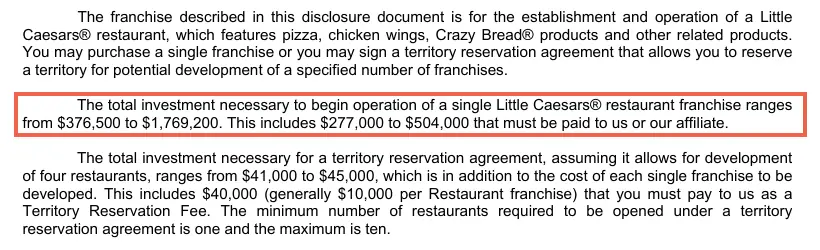
The franchisor and Blue Line receive $277,000 of the $376,500 low estimate and $504,000 of the $1,769,200 high estimate. Source: Little Caesars FDD issued March 27, 2026, Item 7.
| Who receives the money | Low end | High end | Item 7 lines included |
|---|---|---|---|
| Little Caesar Enterprises | $35,000 | $35,000 | Initial fee, grand opening |
| Blue Line Foodservice Distribution | $242,000 | $469,000 | Equipment and technology, opening order |
| Contractors and suppliers | $65,000 | $1,158,000 | Leasehold improvements, other fixtures and signage |
| Landlord | $1,500 | $8,500 | One month of rent |
| Others | $33,000 | $98,700 | Training travel, insurance, utilities, permits, additional funds |
| Total | $376,500 | $1,769,200 | Source: 2026 FDD, Item 7 “To whom” column |
The 2025 cover put the same figure at $270,500 to $404,500. Its low end equals the $20,000 fee plus the $250,500 Blue Line line without the $15,000 grand opening payment, while its high end includes it; the 2026 cover adds all four franchisor-group lines at both ends.
After opening, the share stays high. Item 8 estimates that purchases from Blue Line, Pepsi-Cola and other designated suppliers will be 90 to 100 percent of what you buy to operate, excluding real estate. Blue Line reported $2,139,409,252 of sales to Little Caesars franchisees in the fiscal year ended December 29, 2025, up from $2,050,694,969 a year earlier; Little Caesar Enterprises itself reported none.
Blue Line buys some items from Champion Foods, LLC, a Little Caesars food-manufacturing affiliate in New Boston, Michigan. Pepsi-Cola is the exclusive supplier of certain beverages through December 31, 2026, and Item 8 says no purchasing cooperative operates in the Little Caesars system.
Which programs reduce the $20,000 Little Caesars fee?
The standard Little Caesars fee is $20,000, but Item 5 cuts it to $15,000 for honorably discharged veterans and qualified first responders and waives it for combat-disabled veterans and Gold Star families. Because of these programs, Little Caesars collected fees of $0 to $20,000 in its last fiscal year, and Blue Line adds equipment and food-order discounts.
| Program | Initial fee | Blue Line equipment discount | First food order discount | Other benefits | Source |
|---|---|---|---|---|---|
| Standard | $20,000 | None | None | None | Item 5 |
| Honorably discharged veterans | $15,000 | $5,000 | $5,000 | $10,000 of corporate communications support | Item 5 |
| First responders (police, fire, EMT, nurse) | $15,000 | $5,000 | $5,000 | Most veterans program benefits | Item 5 |
| Combat-disabled veterans and Gold Star families | $0 | $10,000 | $7,000 | $10,000 of support; $10,000 donation to a veterans charity | Item 5 |
| Food Truck (existing franchisees) | $7,500 | Not stated | Not stated | Attached to an open restaurant | Item 5 |
| Territory Reservation Agreement, on-time opening | $2,500 credit per restaurant | Not stated | Not stated | Credit from the $10,000 reservation fee | Item 5 |
The disability wording differs across documents: Item 5 says combat-disabled veterans, Item 7 note 1 says service-disabled veterans, and the franchising site’s footnote reads “10% VA Disability.” Ask Little Caesars in writing which definition applies to you. Item 5 also says discounts generally cannot be combined. Our veteran franchise discount study found a median veteran discount of $6,000 across 259 FDDs.
What does Little Caesars collect each week after opening?
Item 6 sets the Little Caesars royalty at the greater of 6% of Gross Sales or $300 for each one-week period, drafted electronically, plus advertising of up to 7% of Gross Sales that Little Caesars splits among Caesar Fund, a local cooperative and local spending. The franchising site’s FAQ states marketing fees of 5%; the FDD makes 7% the ceiling.
| Fee | 2026 FDD | 2025 FDD | Paid to | Source |
|---|---|---|---|---|
| Royalty | Greater of 6% of weekly Gross Sales or $300 a week | Greater of 6% (same formula) | Little Caesar Enterprises | Item 6 |
| Advertising | Up to 7% of Gross Sales, as determined by Little Caesars | Up to 7% | Caesar Fund, cooperative, local media | Items 6 and 11 |
| Caesar Vision support | $3,120 a year (cap $3,750) | $2,990 a year (cap $3,500) | Blue Line | Item 6, note 4 |
| Digital transaction fee | $0.36 per order (cap $0.40), plus up to $0.10 aggregator fee | $0.35 per order | Blue Line | Item 6, note 5 |
| Security and technology fee | $0.06 per card transaction (cap $0.09) | $0.06 | Collected by FIS/Worldpay | Item 6 |
| Learning Management System | $260 a year | $260 a year | Little Caesar Enterprises | Item 6, note 7 |
| Restaurant Dashboard | $25 a month if installed or required | $25 a month | Blue Line | Item 6 |
| App and website delivery via DoorDash | $3.99 delivery, 12% service (max $4.00), $2.00 small order, $0.50 per late order | Not compared | Customer pays most; restaurant remits to Blue Line | Item 6, note 6 |
| Third-party delivery apps | Service fee up to 25%, currently 18% to 22% | Not compared | Delivery provider | Item 6, note 6 |
| Conference Fee Deposit | $2,500 in each of the first 3 years, refunded if the owner attends | $2,500 | Little Caesar Enterprises | Item 6 |
| Transfer | $5,000 if control changes; $1,000 otherwise | Not compared | Little Caesar Enterprises | Item 6, note 9 |
| Renewal | $5,000 for one 10-year renewal | Not compared | Little Caesar Enterprises | Items 6 and 17 |
The fixed Little Caesars technology charges printed in Item 6 come to $3,680 a year once the Restaurant Dashboard is used, before per-order charges:
- Caesar Vision support: $3,120
- Learning Management System: $260
- Restaurant Dashboard: $300 (twelve months at $25)
Our franchise technology requirements study put the median system at $3,236 to $4,800 a year.
The $300 royalty floor equals $15,600 over 52 weeks and is owed even in weeks when 6% of Gross Sales comes to less, which is why the FDD’s state-required risk page lists “Mandatory Minimum Payments.” The 6% rate matches the 6% median in our royalty rate study of 239 Minnesota-filed FDDs, while the 7% advertising ceiling compares with a 2% median brand fund.
Item 11 reports how Caesar Fund spent its 2025 money: 79.9% on media, 18.1% on production, 1.8% on research, 0.6% on the loyalty program and 0.3% on administration. On termination for default, Item 6 note 14 charges average monthly royalty, advertising and other fees multiplied by the lesser of 60 months or the months left in the term.
How much cash do Little Caesars and lenders expect?
The Little Caesars franchising site asks for a $400,000 net worth, $200,000 of it liquid, while Item 10 says Little Caesars offers no direct or indirect financing and guarantees no note or lease. The FDD prints no net worth figure itself; the Rider to Contract for Sale in Exhibit R only refers to minimum net worth and liquidity requirements for buyers of existing restaurants.
| Worked example | Low end | High end | Source |
|---|---|---|---|
| Item 7 total | $376,500 | $1,769,200 | 2026 FDD, Item 7 |
| Paid to Little Caesar Enterprises or Blue Line | $277,000 | $504,000 | 2026 FDD, cover page |
| Published liquid minimum | $200,000 | $200,000 | Franchising page |
| Item 7 total above the liquid minimum | $176,500 | $1,569,200 | Our arithmetic |
| Liquid minimum as a share of Item 7 | 53.1% | 11.3% | Our arithmetic |
| Royalty floor for the 13 weeks that “additional funds” cover ($300 x 13) | $3,900 | $3,900 | Item 6; Item 7, note 11 excludes royalty and advertising |
The $200,000 liquid minimum does not cover the $277,000 that the franchisor group alone collects at the low end, so even the cheapest Little Caesars build needs other assets or a loan. Note 11 of Item 7 excludes royalty and advertising from the $17,000 to $47,000 of additional funds, so the $3,900 royalty floor for those 13 weeks sits on top.
Lenders have filled that gap: SBA records show 149 7(a) loans to Little Caesars franchisees under brand code S1009 from fiscal 2020 to June 30, 2026, totaling $109.1 million with a median loan of $500,000, per the SBA 7(a) and 504 FOIA files compiled in our restaurant franchise statistics. Using the Federal Reserve’s 2022 Survey of Consumer Finances, our franchise affordability study estimates that 13.1% of US families meet both Little Caesars minimums.
None of this is financial, legal or investment advice. Before signing, ask a lender whether it will count the $235,000 to $460,000 Blue Line package as collateral and ask a franchise attorney how the Item 15 spousal guarantee applies to your household.
How long from signing to opening, and what does the one-mile territory protect?
Item 11 estimates 60 to 270 days from signing the Little Caesars franchise agreement to opening, and the contract sets two hard deadlines: start construction within 6 months and open within 9 months, or Little Caesars may terminate. The protected territory is usually a one-mile radius, half a mile or less or none in dense cities, and none in New York City’s five boroughs.
- Before signing: Discovery Day and interview, 6 hours; real estate and equipment training, 12 hours; a store visit with a zone manager, 8 hours minimum and up to two days.
- Day 0, sign: pay the $20,000 fee on approval. With no site yet, you have 60 days to get one approved, and Little Caesars generally decides within 30 business days of receiving your materials.
- Before opening, training: 250 hours in store (50 hours x 5 weeks) plus 64 classroom hours, including a business week in Detroit; ServSafe costs about $125.
- Month 6: construction must begin.
- Month 9: the restaurant must be open to the public. Without a site at signing, both deadlines run from site approval.
Little Caesars’ 60 to 270 day estimate compares with a median franchisor estimate of 5.9 to 9 months across 259 FDDs in our time-to-open study.
Item 12 says the one-mile territory is not exclusive: Little Caesars keeps the right to place Non-Traditional Restaurants, such as stadium, airport or convenience-store outlets, inside it, and it sets delivery boundaries separately. A relocation must stay within one mile, reopen within 6 months and costs $2,500. Item 15 requires you or an approved individual to manage the restaurant full time on site, and owners’ spouses sign the guarantee.
How often do Little Caesars franchises close or change hands?
Item 20 of the 2026 FDD shows franchised Little Caesars restaurants rising from 3,701 to 3,788 in 2025, with 109 openings, 22 restaurants ceasing operations and no terminations or non-renewals. Against the start-of-year count, 0.6% left the system, and 7.1% left or changed hands once the 239 transfers are added.
| Year | Start | Opened | Terminated | Not renewed | Ceased operations | End | Transfers |
|---|---|---|---|---|---|---|---|
| 2023 | 3,599 | 83 | 0 | 20 | 21 | 3,641 | 253 |
| 2024 | 3,641 | 101 | 0 | 0 | 41 | 3,701 | 316 |
| 2025 | 3,701 | 109 | 0 | 0 | 22 | 3,788 | 239 |
Franchised openings rose from 83 to 109 while departures fell from 41 to 22 between 2023 and 2025. Source: Little Caesars FDD issued March 27, 2026, Item 20, Table 3.
Source: 2026 FDD, Item 20, Tables 2 and 3; no outlets were reacquired by Little Caesars in these years. Company-owned restaurants went from 580 to 586 in 2025, for 4,374 in total. Our franchise closure rate study, using the same start-of-year base across 220 systems, found a median of 4.7% leaving and 9.8% leaving or changing hands.
The 2026 FDD restates 2024. The 2025 FDD reported 108 openings, 44 closures and 3,705 franchised Little Caesars restaurants at the end of 2024; the 2026 FDD shows 101, 41 and 3,701. The 2025 FDD’s 2023 row also failed its own arithmetic: 3,599 plus 83 minus 19 minus 21 is 3,642, not the printed 3,641. The 2026 edition prints 20 non-renewals, which balances.
Table 5 lists 43 signed Little Caesars agreements not yet open and 108 projected franchised openings in 2026, 30 of them in Texas; the 2025 FDD had projected 100 for 2025, and 109 opened. Item 20 also lists the Independent Organization of Little Caesars Franchisees and warns that franchisees signed confidentiality clauses in the last 3 fiscal years.
Why does Item 21 show LC Trademarks’ statements, and is there an Item 19?
Little Caesars makes no Item 19 financial performance representation, so its FDD gives no sales, cost or profit figures for any restaurant. Item 21 does not include Little Caesar Enterprises’ own statements; it attaches those of LC Trademarks, Inc., a subsidiary that guarantees the franchisor’s obligations and reported $5,010,900 of assets and no activity for 2023 to 2025.
The FTC Franchise Rule, 16 CFR 436.5(u)(1)(iii), lets a franchisor file an affiliate’s statements if the affiliate absolutely and unconditionally guarantees the franchisor’s duties. LC Trademarks’ only asset in each year is $5,010,900 due from its parent, matched by $5,010,900 of contributed capital; its statements of operations and cash flows, audited by Deloitte & Touche LLP, read “No activity.”
That is why the FDD’s state-required risk page says the affiliate guarantor’s financial condition “calls into question the franchisor’s financial ability to provide services and support to you.” Our franchisor financial health study sets this beside the 259 FDDs it reviewed. Under 16 CFR 436.5(s), Item 19 still allows Little Caesars to hand a buyer the actual records of an existing restaurant being sold, the one route to unit-level numbers.
Which Little Caesars cost figures in other guides are out of date?
Several top-ranking Little Caesars cost guides still quote 2023 or 2024 editions of the FDD or round the figures. The table sets each claim beside the March 27, 2026 FDD or the Little Caesars franchising page, both opened in October 2026, so you can check a figure you have already seen elsewhere.
| What a guide says | What the primary source says | Source |
|---|---|---|
| A franchise listing site, citing the 2024 FDD: $403,000 to $1,728,700 | $376,500 to $1,769,200 | 2026 FDD, Item 7 |
| A cost guide dated December 2023: royalty of 6% or $100 per week, whichever is greater | 6% or $300 per week, whichever is greater | 2026 FDD, Item 6 |
| A lender guide updated May 2026: $350K to $1.6M total and a $250,000 net worth | $376,500 to $1,769,200; $400,000 net worth with $200,000 liquid | 2026 FDD, Item 7; franchising page |
| The same lender guide cites Item 19 for a break-even timeline | No Item 19 representation is made | 2026 FDD, Item 19 |
| The same lender guide: a carryout model with no delivery costs | DoorDash is exclusive for app orders until February 2029; Item 6 lists delivery and service fees | 2026 FDD, Items 6 and 8 |
| A 2026 franchise data site: a 13% fee load from a 6% royalty and 7% ad fund | 6% royalty with a $300 weekly floor, plus advertising “up to 7%”; the franchising FAQ says 5% | 2026 FDD, Item 6; franchising page |
New build, reservation, resale or temporary operation: which Little Caesars path fits?
The Little Caesars FDD offers four ways in: a new restaurant, a Territory Reservation Agreement for 1 to 10 restaurants, buying an existing restaurant from a franchisee or through Little Caesars’ Offer Letter, and a Temporary Operating Agreement. The table matches common situations to the clause that governs each, using thresholds printed in the 2026 FDD.
| If | Then | Source |
|---|---|---|
| Your liquid assets are under $200,000 | You are below the franchising page minimum; a partner’s assets or an SBA loan would have to close the gap before applying | Franchising page |
| You are an honorably discharged veteran or a first responder | The fee drops to $15,000, with $5,000 off equipment and $5,000 off the first food order | Item 5 |
| You plan 2 to 10 restaurants in one area | Reservation fee of $10,000 per restaurant, with $2,500 credited to each fee if you open on schedule | Item 5 |
| You want an existing restaurant | $5,000 transfer fee if control changes; you get only the seller’s remaining term (Exhibit O or P); ask for that location’s actual records | Items 6, 17 and 19 |
| Your site is in one of New York City’s five boroughs | No protected territory | Item 12 |
| You cannot work on site full time | Little Caesars must approve a full-time on-site operator and may require an equity stake if you live outside the market | Item 15 |
| Your restaurant has been open 5 years or more | Little Caesars can require a refurbishment of up to $150,000 within 6 months of notice | Item 7, note 3 |
A consultant can set Little Caesars’ $300 royalty floor and 90 to 100 percent Blue Line purchasing beside other pizza FDDs; see what a franchise consultant does.
How we compiled this
We read 4 primary documents in October 2026: the Little Caesars FDD issued March 27, 2026, the prior FDD issued March 31, 2025 (both from Minnesota CARDS), the Little Caesars franchising page and 16 CFR 436.5. We added every Item 7 line by hand to check printed totals, and took SBA loan counts and household shares from our research reports, which cite SBA FOIA files and the Federal Reserve. We excluded Item 19 figures because none exist and used no franchisee names from Exhibits F and G.
Frequently asked questions
How much is a Little Caesars franchise?
Item 7 of the Little Caesars FDD issued March 27, 2026 puts one new restaurant at $376,500 to $1,769,200, including the $20,000 fee, one month of rent and three months of additional funds. Leasehold improvements of $50,000 to $1,000,000 drive most of the spread. The total excludes buying land, lease deposits and the optional M.I.K.E. system.
What is the Little Caesars franchise fee?
The standard initial fee is $20,000, paid in full when Little Caesars approves you and non-refundable once you sign. Honorably discharged veterans and qualified first responders pay $15,000, combat-disabled veterans and Gold Star families pay $0, and a Food Truck added by an existing franchisee costs $7,500, per Item 5 of the 2026 FDD.
Is there a Little Caesars franchise for sale?
Existing restaurants change hands often: Item 20 of the 2026 FDD counts 239 transfers in 2025 and 316 in 2024. You can buy from a franchisee with Little Caesars’ approval under its Rider to Contract for Sale, or take over Little Caesars’ purchase right through an Offer Letter for a negotiated fee. A change of control carries a $5,000 transfer fee.
What is the Little Caesars franchise failure rate?
The FDD gives no failure rate, but Item 20 shows that 22 franchised restaurants ceased operations in 2025 out of 3,701 open at the start of the year, about 0.6%, with no terminations or non-renewals. Adding 239 transfers, 7.1% left or changed hands. Our closure study found medians of 4.7% and 9.8% across 220 systems.
How much do Little Caesars franchise owners make?
The Little Caesars FDD makes no Item 19 financial performance representation, so it publishes no sales or profit figures, and we do not estimate them. What a restaurant keeps turns on Gross Sales against the 6% royalty with its $300 weekly floor, up to 7% advertising, Blue Line purchase prices and rent. Ask for an existing restaurant’s actual records if you buy one.
Does Little Caesars help finance a franchise?
No. Item 10 of the 2026 FDD says Little Caesars offers no direct or indirect financing and guarantees no note, lease or obligation. Little Caesars franchisees have used SBA 7(a) loans instead: SBA FOIA files list 149 such loans under brand code S1009 from fiscal 2020 to June 30, 2026, with a median loan of $500,000.
Do you have to run a Little Caesars restaurant yourself?
Item 15 requires the franchisee, an owner or an approved individual to devote full time to on-site management. If you live outside the market, Little Caesars must approve your operator and may require that person to hold equity. Every owner signs a personal guarantee, and Item 15 also requires each guarantor’s spouse to sign it.
Sources
- Little Caesar Enterprises, Inc. Franchise Disclosure Document, issued March 27, 2026, Minnesota Department of Commerce CARDS, accessed October 20, 2026.
- Little Caesar Enterprises, Inc. Franchise Disclosure Document, issued March 31, 2025, Minnesota Department of Commerce CARDS, accessed October 26, 2026.
- Little Caesars Franchise, franchising page and FAQ, Little Caesar Enterprises, accessed October 20, 2026.
- 16 CFR 436.5, Disclosure items (FTC Franchise Rule), eCFR, accessed October 20, 2026.
- SBA 7(a) and 504 FOIA loan data, as of June 30, 2026, U.S. Small Business Administration, accessed October 7, 2026.
- Survey of Consumer Finances 2022, summary extract, Board of Governors of the Federal Reserve System, accessed October 3, 2026.