The Culver’s franchise cost is $3,406,350 to $10,294,100 in the March 30, 2026 FDD, but Culver’s first requires a full-time on-site Operator who owns at least 50% and completes 16 weeks of training.
Key takeaways
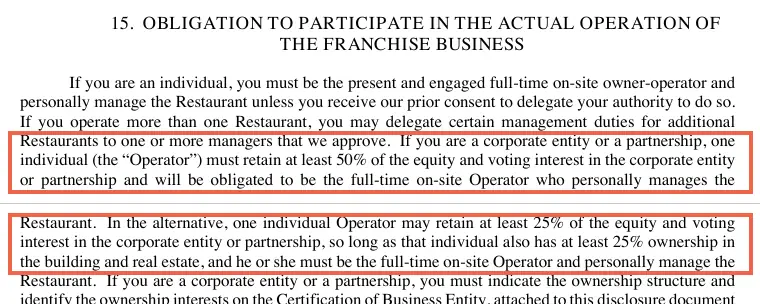
- The buyer must run the restaurant. Item 15 of the Culver’s Franchise Disclosure Document, issued March 30, 2026 requires one individual Operator with at least 50% of the equity and votes, or 25% plus 25% ownership of the building and real estate, working full time on site.
- Selection comes before signing. Exhibit F of the FDD sets a $5,000 refundable Application Fee and an unpaid five-day Discovery Week, Monday to Friday, inside a company-owned restaurant.
- Training is 670 hours for the Operator. The Item 11 table lists 120 classroom and 550 on-the-job hours in the 16-week Franchisee Development Program, against a median of 76 hours across 252 FDDs in our franchise training programs study.
- Real estate is most of the bill. Land, site work and building account for $2,628,000 of the $3,406,350 low total (77.2%) and $8,984,000 of the $10,294,100 high total (87.3%), per Item 7.
- Cash must cover 20% of the plan. Item 7 Note 13 says “We require that you have 20% of your total projected initial investment in cash or liquid assets”, which is $681,270 to $2,058,820 at the printed totals.
- The system is still growing. Item 20 shows franchised restaurants rising from 990 to 1,034 in 2025, with 45 openings, 0 terminations and 58 signed agreements not yet open.
Who is allowed to own and run a Culver’s restaurant?
Culver’s sells the right to operate one restaurant to a person who will run it in person. Item 15 of the March 30, 2026 FDD says an individual franchisee “must be the present and engaged full-time on-site owner-operator”, and an entity must name one Operator who holds at least 50% of the equity and voting interest, or at least 25% plus 25% of the building and real estate.
That second route is the detail most summaries skip. An Operator can hold as little as 25% of the operating company only if that same person also owns at least 25% of the land and building, which ties the Operator rule directly to the real estate model in Item 7. The FTC Franchise Rule at 16 CFR 436.5(o) requires franchisors to disclose whether the franchisee must “participate personally in the direct operation” of the business; Culver’s answers yes, and allows delegation only with its prior consent.
| Owner type | What Culver’s requires | Source |
|---|---|---|
| Individual franchisee | Present and engaged full-time on-site owner-operator who personally manages the restaurant, unless Culver’s consents in advance to delegation | FDD Item 15; Franchise Agreement Section 10(A) |
| Company or partnership, standard route | One Operator with at least 50% of equity and voting interest, full time on site | FDD Item 15 |
| Company or partnership, real estate route | One Operator with at least 25% of equity and votes plus at least 25% ownership of the building and real estate, full time on site | FDD Item 15 |
| Owners of 10% or more | Each one, with his or her spouse, signs a personal Guaranty of the franchise agreement | FDD Item 15 |
| Multi-unit developer | Development Operator with 50% of the entity, or 25% of the entity plus 25% of each restaurant’s real estate | FDD Item 15; Exhibit C |
| Second restaurant | Restaurant Operator Workshop (or equivalent) completed first; duties at additional units may go to managers Culver’s approves | FDD Item 15 |
The spouse signature matters for planning. Across 259 FDDs in our franchise personal guarantee study, spouses must sign in 92 (35.5%); Culver’s is in that group, so a married Operator’s household carries the guaranty, not only the company. Culver’s also falls in the minority of systems that bar a manager-run first unit: 60 of 259 FDDs (23.2%) require a full-time owner in our semi-absentee franchise index.
What does Culver’s check before it will sign a franchise agreement?
Culver’s screens the Operator through a Preliminary Agreement (Exhibit F) before any franchise agreement exists. The applicant files an Application for Franchise Consideration with a financial summary, pays a $5,000 Application Fee, and works a Discovery Week in a company-owned restaurant. Written approval then gives the applicant 24 months to sign the franchise agreement and pay the rest of the $65,000 fee.
- Receive the FDD and wait. The cover page says you must receive it at least 14 calendar days before signing or paying anything; the FTC’s Consumer’s Guide to Buying a Franchise states the same 14-day rule.
- Sign the Preliminary Agreement and pay $5,000. The fee is credited to the franchise fee if you are approved and refunded if you are not (Item 5, Exhibit F Section 7).
- Work Discovery Week. Five days, Monday to Friday, with hours between 6:00 a.m. and 8:00 p.m., in front-line and back-line jobs; the applicant is not an employee, is not paid, and covers meals, lodging, travel and uniform (Exhibit F Section 3).
- Get written approval. Item 5 then allows 24 months to sign the franchise agreement; Exhibit F gives a full Application Fee refund on withdrawal only up to the end of an 18-month approval period.
- Secure a site within 12 months of signing. You must own it or hold a binding lease with no open contingencies; Culver’s answers a site request within 30 days of receiving complete information (Item 11).
- Train. The Operator completes the 16-week Franchisee Development Program and at least 7 managers complete the 7-week manager program (Items 11 and 15).
- Open 4 to 24 months after signing. If the restaurant is not open by month 24, Culver’s may terminate before opening (Item 11).
Two clauses in Exhibit F shape the due diligence. Applicants agree not to ask employees of the 7 company-owned restaurants about financial performance and to direct those questions to existing franchisees. Item 20 also warns that some current and former franchisees signed confidentiality provisions, so not every owner listed in Exhibit D may be free to talk. Culver’s Mentoring Program applicants skip Discovery Week and take a video Leadership Assessment instead.
How many hours of Culver’s training come before opening?
The Operator’s Franchisee Development Program totals 670 hours: 120 in the classroom and 550 on the job, per the Item 11 training table in the 2026 FDD. Culver’s runs it in three 16-week sessions a year with capped seats, at Prairie du Sac, Wisconsin, or a designated company-owned restaurant, and charges no fee, though the franchisee pays travel and living costs.
The program is long by any comparison we can document. The median initial program across 252 disclosure documents in our training study is 76 hours, so the Culver’s Operator program is roughly 8.8 times that median. Item 5 adds a financial lever to the schedule: a franchisee who quits before the fifth week of the program can terminate and receive 75% of the initial franchise fee back.
| Franchisee Development Program subject | Classroom hours | On-the-job hours |
|---|---|---|
| Orientation | 8 | 2 |
| Guest Relations | 4 | Ongoing during other sessions |
| Product Orientation | 6 | 20 |
| Safety/Procedure Sanitation | 3 | 14 |
| Back of House/Cooking Skills | 0 | 180 |
| Front of House | 0 | 160 |
| Supervision/Administration | 67 | 170 |
| Advertising/Marketing/Media | 11 | 4 |
| Architectural Design | 1 | 0 |
| E-Learning and ServU Courses | 20 | 0 |
| Total, Operator (16 weeks) | 120 | 550 |
| New Manager Training, each manager (7 weeks) | 14 | 268 |
Source: Culver’s Franchise Disclosure Document, issued March 30, 2026, Item 11 training tables. The format follows 16 CFR 436.5(k)(7), which requires subject, classroom hours, on-the-job hours and location columns.
The Culver’s Operator program totals 670 hours (120 classroom, 550 on the job) and each manager’s program 282 hours, against a 76-hour median across 252 FDDs. Sources: Culver’s FDD, March 30, 2026, Item 11; our training study, 2026.
The staffing load sits on top of the Operator’s hours. Item 11 says the management team will “typically include 7 to 9 individuals”, at least 7 managers must hold a state sanitation certificate or the ServSafe equivalent, and one certified manager must work every shift. Item 7 Note 6 prices the high case on training the franchisee for 16 weeks, 7 managers for 7 weeks each, 4 key employees for 40 hours and 75 crew members for 17 hours.
What is the Culver’s franchise cost in the 2026 FDD?
The Culver’s franchise cost in Item 7 of the March 30, 2026 FDD is $3,406,350 to $10,294,100, covering pre-opening spending and the first 3 months of operation. The estimate assumes you buy land and build a new freestanding restaurant, and Note 13 says no 2025 project had every lowest or every highest cost.
| Item 7 line | Low | High | What the FDD note says |
|---|---|---|---|
| Initial franchise fee | $35,000 | $65,000 | Generally $65,000; reduced routes in Item 5 |
| Land | $225,000 | $2,400,000 | 45,000 to 70,000 sq ft; lower if leased |
| Site work | $356,000 | $2,193,000 | Assumes new construction on acquired land |
| Building | $2,047,000 | $4,391,000 | New finished building incl. architecture and engineering fees |
| Travel, living and expenses during training | $20,000 | $80,000 | Franchisee pays for all trainees |
| Initial inventory | $50,000 | $65,000 | Food, paper, cleaning supplies |
| Furniture, fixtures, equipment and supplies | $458,000 | $584,000 | Based on the Metro L prototype; custard machines included |
| Sign package | $88,000 | $300,000 | Interior and exterior signs, digital menu boards |
| POS system | $42,350 | $56,100 | Point of sale hardware, before sales tax |
| Miscellaneous expenses | $20,000 | $40,000 | Legal, accounting, licenses, deposits, Open House |
| Additional funds, 3 months | $65,000 | $120,000 | Excludes hourly labor, food costs and rent |
| Total | $3,406,350 | $10,294,100 | Our sum of the lines matches the printed totals |
Building ($2,047,000 to $4,391,000), land ($225,000 to $2,400,000) and site work ($356,000 to $2,193,000) dominate the $3,406,350 to $10,294,100 Item 7 total. Source: Culver’s FDD, March 30, 2026, Item 7.
Two lines deserve a second read. The $65,000 to $120,000 working capital line leaves out hourly labor, food and rent, and Note 12 says “You should not plan to draw income from Restaurant operations during the start-up” period. The $35,000 fee low sits $10,000 under the cheapest fee Item 5 lists ($45,000 under the Mentoring Program), while the cover page prints $45,000 to $65,000; the FDD does not show which combination produces $35,000. For how Item 7 compares across brands, our franchise costs guide explains each FDD cost item.
Which discounts and refund windows change the $65,000 fee?
Item 5 prices the initial franchise fee by route: $65,000 for a new franchisee, $55,000 for an existing franchisee adding a restaurant with the same Operator, and $45,000 under the Mentoring Program for a Key Manager with 12 months as a general manager. A $10,000 Veterans’ Discount applies to a first restaurant run full time by an honorably discharged veteran with a DD 214.
| Route or payment | Amount | Condition or refund rule | Source |
|---|---|---|---|
| New franchisee fee | $65,000 | $5,000 Application Fee credited; 75% refund if you terminate before week 5 of training | Item 5; FA Section 6(A) |
| Additional restaurant fee | $55,000 | Same Operator, full compliance, Application Fee waived | Item 5; FA Section 6(B) |
| Mentoring Program fee | $45,000 | Key Manager worked 12 months as general manager in the mentor’s group; Leadership Assessment | Item 5; Exhibit I |
| Veterans’ Discount | $10,000 off | DD 214, first restaurant, full-time on-site owner-operator | Item 5 |
| Territory Reservation Fee | $40,000 | Existing Operator of a unit open 90 days; full credit if you sign within 12 months, $20,000 credit at 12 to 24 months | Items 5, 12 |
| Development Agreement Territory Fee | $50,000 per restaurant | Refunded in full if each scheduled opening date is met | Item 5 |
Our veteran franchise discounts study compares fee reductions like the $10,000 Culver’s offer across other systems.
Why is a Culver’s mostly a real estate project?
Item 7 assumes the franchisee acquires 45,000 to 70,000 square feet of land and builds a new freestanding restaurant, so land, site work and building make up 77.2% to 87.3% of the totals. The franchise agreement lets you lease or buy the land and lease or build the building, and Culver’s offers no financing (Item 10).
Leasing changes the shape of the cost rather than removing it. Item 7 Note 3 estimates land leases at $100,000 to $500,000 a year, and any lease must carry the Addendum to Lease attached to the franchise agreement, which lets Culver’s receive default notices and step into the lease. The Certification of Business Entity (Exhibit J) asks who owns the land and building and the purchase price or first-year rent.
| Real estate variable | What the 2026 FDD states | Source |
|---|---|---|
| Land size | 45,000 to 70,000 sq ft | Item 7 Note 3 |
| Land lease instead of purchase | $100,000 to $500,000 a year | Item 7 Note 3 |
| Prototype buildings | Metro M 2025 at 4,060 sq ft and Metro L 2025 at 4,310 sq ft; each may be mirrored (+18 sq ft) | Item 7 Note 5 |
| Converting an existing building | Allowed; Building Conversion Fee up to $10,000 | Item 7 Notes 4 and 5; Item 6 |
| Changing the prototype plans | Custom Design Fee up to $5,000 | Item 6 |
| Building without sealed professional plans | Extraordinary Building Assistance Fee up to $50,000 | Item 6 |
| Site designs | Two free; $1,000 per site from the third | Item 6 |
| Territory | Typically a 3-mile radius; may be smaller for non-freestanding or no drive-thru sites | Item 12 |
| Remodel cycle | Full remodel no more than once every 5 years | FA Section 10 |
SBA loan data points the same way. Under SBA franchise code S0449, Culver’s borrowers took 156 SBA 504 loans and 113 SBA 7(a) loans from FY2020 to June 30, 2026, per SBA’s 7(a) and 504 FOIA files as compiled in our SBA franchise directory report. The SBA 504 program funds “the purchase, construction or renovation of existing buildings or land” but not working capital or inventory, which is why it fits a land-and-building franchise.
How much of the investment must be cash or liquid assets?
Item 7 Note 13 of the 2026 FDD sets the rule in one sentence: “We require that you have 20% of your total projected initial investment in cash or liquid assets.” Applied to the printed totals, that is $681,270 at the $3,406,350 low and $2,058,820 at the $10,294,100 high, before any lender adds its own equity test.

| Scenario | Projected investment | 20% cash or liquid assets | Basis |
|---|---|---|---|
| Item 7 low total | $3,406,350 | $681,270 | Note 13 rule x printed low |
| Item 7 high total | $10,294,100 | $2,058,820 | Note 13 rule x printed high |
| Item 7 lines other than land, site work and building, low | $778,350 | $155,670 | Illustration only: the share outside real estate |
| Item 7 lines other than land, site work and building, high | $1,310,100 | $262,020 | Illustration only: the share outside real estate |
Culver’s franchise FAQ states flat figures instead: $500,000 in liquid assets for a leased site and $750,000 if you own the real estate, building and equipment, with no net worth figure, as recorded in our franchise affordability study when we checked the FAQ page on October 3, 2026. The 20% rule in the FDD scales with your own projection, so a high-cost site can push the requirement past the FAQ figure. Ask the franchise development representative which test applies to your projected budget and whether a land lease counts toward it. This is general information, not legal, financial or investment advice.
Which percentages and monthly bills follow the restaurant after opening?
A Culver’s pays a 4% Service Fee and a 2.5% Advertising Fee on Gross Sales each month, both drafted by EFT by the 10th, and must spend at least 1% of Gross Sales on local advertising, per Items 6 and 11 of the 2026 FDD. Software subscriptions add about $3,200 a month and required security services about $110 to $130 a month.
| Ongoing cost | Amount | When | Source |
|---|---|---|---|
| Service Fee (royalty) | 4% of Gross Sales | Monthly, by the 10th | Item 6; FA Section 7(A) |
| Advertising Fee | 2.5% of Gross Sales (2% for agreements signed before March 31, 2012) | Monthly, by the 10th | Items 6, 11 |
| Local advertising | At least 1% of Gross Sales | Ongoing | Item 11 |
| Cooperative advertising | Up to 4% of Gross Sales if a co-op is formed (none formed) | Set by co-op | Items 6, 11 |
| Software subscriptions incl. CrunchTime! | About $3,200 a month | Monthly, to suppliers | Item 11 |
| Managed security services | About $110 to $130 a month | Monthly, to approved MSSP | Item 11 |
| Technology Fee | Estimated $600 to $1,000 a month; not charged as of the FDD date | Reserved right | Item 6 |
| Gift card fee | $.22 per redeemed transaction, may rise to $.35 | Per redemption | Item 6 |
| Renewal fee | $40,000 for one 10-year renewal after the 15-year term | At renewal | Items 6, 17 |
| Transfer fee | $10,000 plus attorneys’ fees ($5,000 if the buyer is an existing franchisee) | Before transfer closes | Item 6 |
Purchasing rules carry their own cost. Item 8 estimates that 90% to 95% of both startup and operating purchases are subject to sourcing restrictions, compared with a median of 70% startup and 50% ongoing in our franchise supplier rebates study. Culver’s reported $35,558,759 of rebate revenue in 2025, 10.5% of its $337,705,581 total revenue, and requires Coca-Cola and Dr Pepper soft drink syrup plus Culver’s Root Beer.
Is the Culver’s system still adding restaurants?
Yes. Item 20 of the 2026 FDD shows franchised Culver’s restaurants rising from 886 at the start of 2023 to 1,034 at the end of 2025, with 0 terminations in all three years and 1 restaurant ceasing operations in 2025 (Utah). The 7 company-owned restaurants, all in Wisconsin, did not change in 2024 or 2025.
| Year | Franchised at start | Opened | Terminated | Not renewed | Ceased, other reasons | Franchised at end | Transfers to new owners |
|---|---|---|---|---|---|---|---|
| 2023 | 886 | 52 | 0 | 1 | 0 | 937 | 16 |
| 2024 | 937 | 53 | 0 | 0 | 0 | 990 | 23 |
| 2025 | 990 | 45 | 0 | 0 | 1 | 1,034 | 20 |
Source: Culver’s Franchise Disclosure Document, issued March 30, 2026, Item 20 Tables 1 to 3. At the end of 2025 there were 58 signed franchise agreements not yet open and 59 projected franchised openings, with Florida holding the largest backlog at 13 signed agreements. Franchised restaurants operated in 26 states, led by Wisconsin (148), Illinois (140), Florida (126) and Michigan (107).
Item 19 is present. It discloses sales for the 988 franchised and 7 company-owned restaurants open all of 2025 and selected cost percentages for the 7 company-owned units, with tables by state, interstate proximity, population, household income, employee count and nearby eating places. We do not republish those figures; read them in Item 19 of the FDD and test them with franchisees listed in Exhibit D, using the questions in our FDD guide.
Which Culver’s figures in other write-ups are out of date?
Most ranking Culver’s cost pages read in October 2026 quote the 2024 or 2025 FDD, so their totals, fees and training figures trail the March 30, 2026 filing. The table pairs each published claim, described without naming the site, with what the current FDD prints and the item where it appears.
| What a published guide says | What the March 30, 2026 FDD says | Where |
|---|---|---|
| A guide updated January 2026 gives $2,642,500 to $8,573,000 (2025 FDD) | $3,406,350 to $10,294,100 | Item 7 |
| A guide from September 2024 gives $2,811,500 to $6,867,000 and a $20,000 to $55,000 fee (2024 FDD) | $3,406,350 to $10,294,100; fee generally $65,000 | Items 5, 7 |
| Several pages list a $55,000 franchise fee | $65,000 for new franchisees; $55,000 applies to an existing franchisee’s additional restaurant | Item 5 |
| Mentoring Program fee of $30,000 | $45,000 | Item 5 |
| A food news site says owners may hold “no more than four locations” | No numeric cap stated; a second unit needs the Restaurant Operator Workshop, and extra units may use approved managers | Item 15 |
| A franchise directory page updated October 2026 says training takes about 722 hours, 172 of them in the classroom | 120 classroom plus 550 on-the-job hours (670) for the Operator | Item 11 |
| The same directory page labels $2,642,500 to $8,573,000 as 2026 FDD figures | $3,406,350 to $10,294,100; the lower range matches what the January 2026 guide attributes to the 2025 FDD | Item 7 |
| A food news site says Discovery Week means five full days at the original Culver’s | Five days at one of the company-owned restaurants, Monday to Friday, hours between 6:00 a.m. and 8:00 p.m. | Exhibit F |
The FDD also disagrees with itself in three places. Note 5 says “1 building style that comes in 4 plan options” but names two plans, each of which may be mirrored. Item 6 charges $1,000 per site design after two sites, while franchise agreement Section 5(B) mentions $500 from a fifth site. Exhibit F describes a 5-day Leadership Assessment, while the Mentoring Program Addendum (Exhibit I) calls it a 4-day assessment. Ask Culver’s which version governs before you sign.
When does the Culver’s owner-operator model fit, and when does it not?
The 2026 FDD makes three tests decisive: whether you will work full time inside the restaurant, whether you can hold 50% of the operating company (or 25% plus 25% of the real estate), and whether your cash or liquid assets reach 20% of your projected Item 7 budget. Training time and site financing follow from those answers.
| If your situation is | Then the FDD points to | Basis |
|---|---|---|
| You want a manager to run the first unit while you keep another job | Not permitted without Culver’s prior consent; look at systems that allow manager-run units | Item 15 |
| Your partners will own more than 50% of the company | Only the 25% equity plus 25% real estate route keeps you eligible as Operator | Item 15 |
| Cash and liquid assets below 20% of your projected total ($681,270 at the printed low) | Below the Note 13 requirement; the FAQ floor of $500,000 for a leased site also applies | Item 7 Note 13; Culver’s FAQ |
| You cannot spend 16 weeks at a company-owned restaurant (all 7 in Wisconsin) | Timing conflict; sessions run three times a year with capped seats | Items 1, 11 |
| You have worked 12 months or more as a Culver’s general manager in a mentor’s group | Mentoring Program: $45,000 fee and a video Leadership Assessment instead of Discovery Week | Item 5; Exhibit F |
| Honorably discharged veteran opening a first restaurant | $10,000 off the initial fee with a DD 214 | Item 5 |
| You would rather not buy 45,000 to 70,000 sq ft of land | Lease the land at an estimated $100,000 to $500,000 a year, with the Lease Addendum | Item 7 Note 3; FA Section 2(A) |
| You plan to open more units later | $55,000 fee per added unit, Restaurant Operator Workshop, optional $40,000 Territory Reservation | Items 5, 12, 15 |
Timing compares poorly with lighter systems: Culver’s allows 4 to 24 months from signing to opening, while the median typical estimate across 223 brands in our time-to-open study is 5.9 to 9 months. A buyer who fails the first three tests can still use the 2026 FDD as a benchmark for what a fully owner-operated, real-estate-heavy restaurant system demands.
How we compiled this
We read the full 216-page Culver’s FDD issued March 30, 2026 (Minnesota CARDS document 35692-202603-08), including the franchise agreement and Exhibits F, I and J, and quoted every figure as printed with its item number; we summed the Item 7 lines ourselves. We added 16 CFR 436.5, the FTC buyer’s guide, SBA’s 504 page and SBA FOIA loan counts, and read five competing pages only to check their figures. Culver’s franchise web pages refused our automated requests in October 2026, so the FAQ liquidity figures come from our October 3, 2026 check. Item 19 figures are excluded under our site rules.
Frequently asked questions
Is Culver's a franchise?
Yes. Culver Franchising System, LLC has franchised since 1990, and Item 20 of its March 30, 2026 FDD lists 1,034 franchised restaurants and 7 company-owned restaurants at the end of 2025. The company-owned units are all in Wisconsin, where the first Culver’s opened in Sauk City on July 18, 1984.
How much does it cost to open a Culver's franchise?
Item 7 of the 2026 FDD estimates $3,406,350 to $10,294,100, including a franchise fee that is generally $65,000, land at $225,000 to $2,400,000 and a building at $2,047,000 to $4,391,000. Culver’s also requires cash or liquid assets equal to 20% of your projected total investment.
How much do Culver's owners make?
The FDD does not promise any owner income. Item 19 of the 2026 FDD reports sales for 988 franchised restaurants and cost percentages for 7 company-owned ones; read it there. Owner income then depends on the 4% Service Fee, the 2.5% Advertising Fee, rent or debt on the real estate, and labor, which Item 7 working capital excludes.
Can you own more than one Culver's?
Yes. Item 5 sets a $55,000 fee for an additional restaurant run by the same Operator, and Item 15 requires the Restaurant Operator Workshop before a second franchise agreement. Owners of several units may delegate duties at the added units to managers Culver’s approves. The 2026 FDD states no numeric cap on units.
Does Culver's offer financing?
No. Item 10 of the 2026 FDD says Culver’s does not offer direct or indirect financing or guarantee any loan or lease. Owners use outside lenders; SBA FOIA data shows 156 SBA 504 loans and 113 SBA 7(a) loans under the Culver’s franchise code from FY2020 to June 30, 2026.
How long does it take to open a Culver's?
Item 11 estimates as little as 4 months and no more than 24 months from signing the franchise agreement to opening. Inside that window you must secure a site within 12 months, and the Operator must finish a 16-week training program that runs only three times a year with limited seats.
Sources
- Culver’s Franchise Disclosure Document, issued March 30, 2026, Items 1 to 23 and Exhibits B, C, F, I, J; Minnesota Department of Commerce CARDS, accessed October 27, 2026.
- 16 CFR 436.5, Disclosure items, Legal Information Institute, accessed October 27, 2026.
- A Consumer’s Guide to Buying a Franchise, Federal Trade Commission, accessed October 27, 2026.
- 504 loans, U.S. Small Business Administration, accessed October 27, 2026.
- 7(a) and 504 FOIA data, through June 30, 2026, U.S. Small Business Administration, accessed October 27, 2026.
- Culver’s franchise FAQ, Culver Franchising System, LLC, as checked October 3, 2026.