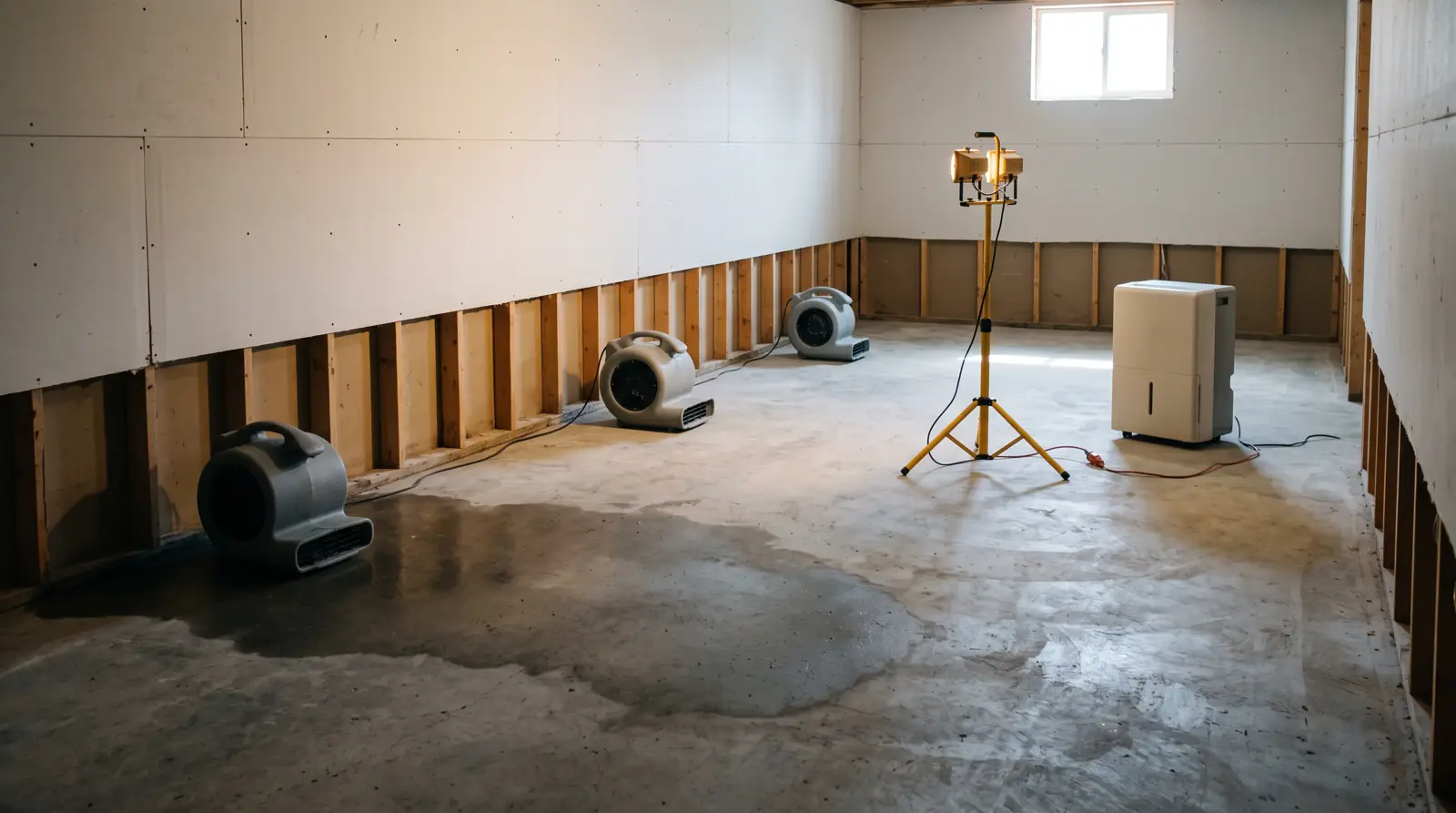
A restoration franchise sells emergency water, fire and mold work, and five 2026 FDDs set three gates for it: IICRC certificates on staff, state mold licenses where required, and insurance-program clauses deciding who controls carrier work.
Key takeaways
- Item 7 totals in five 2026 restoration filings run from $108,503 at PuroClean with the van and drying package financed to $804,900 at the high end of the Paul Davis Restoration FDD issued March 23, 2026.
- Paul Davis tells buyers in Item 7, note 11, to hold minimum working capital of $500,000 per territory, because insurance-related jobs may be too small for a draw schedule or paid by insurers that give no draws (Paul Davis FDD, Item 7).
- Rainbow Restoration lets a franchisee sign third party administrator agreements and binds it to the TPA price list (Rainbow FDD issued April 1, 2026, Item 8); Paul Davis gives the franchisor sole authority over insurer and TPA contracts (Franchise Agreement section 1.4).
- Mold licensing starts at different sizes: 25 contiguous square feet in Texas (16 TAC 78.30), more than 10 square feet in Florida (s. 468.8411) and New York (Labor Law s. 930).
- The EPA lead RRP rule reaches paid work that disturbs paint in housing built before 1978; PuroClean requires both individual and firm RRP certification before its initial training (PuroClean FDD issued April 20, 2026, Item 7 note 9).
Which IICRC certificates do restoration franchisors require, and by when?
The Institute of Inspection, Cleaning and Restoration Certification (IICRC) writes the consensus standards crews work to: the ANSI/IICRC S500 Standard for Professional Water Damage Restoration (Fifth Edition, 2021) and the ANSI/IICRC S520 Standard for Professional Mold Remediation (Fourth Edition, 2024). Franchisors turn those standards into dated obligations: Rainbow wants WRT and ASD before opening, PuroClean wants AMRT within 90 days of training.
The letters are course names the FDDs spell out. WRT is the water restoration (or water damage) technician course, ASD is Applied Structural Drying, AMRT is Applied Microbial Remediation Technician, FSRT is Fire and Smoke Restoration Technician and OCT is Odor Control Technician. The S500 page says a new consensus body has begun revising the 2021 edition, so a franchise signed in 2026 may train to a newer water standard before its first renewal.
| Brand (FDD issued) | Before or during initial training | Later deadline | Fees printed | FDD item |
|---|---|---|---|---|
| PuroClean (April 20, 2026) | IICRC WRT and ASD exams; individual and firm EPA RRP; subrogation training | AMRT within 90 days of initial training | $80 per IICRC exam; AMRT course $799 plus $150 exam; third parties about $1,000 | Item 6 notes 10 and 11; Item 7 note 9 |
| Rainbow Restoration (April 1, 2026) | WRT and ASD before opening | EPA Lead Safe within 6 months of Phase II training; OCT, AMRT and FSRT within the first year open | $80 per exam ($150 AMRT); $224 firm certification; EPA fee $300; AMRT school $900 to $1,200 | Item 11; Item 7 note 6 |
| Paul Davis Restoration (March 23, 2026) | Owner training: WRT/ASD 40 hours, AMRT 32, FSRT 16, Lead 8; 248 classroom and 106 on-the-job hours in all | Re-certification training at the then-current fee | Additional trainee $8,000; re-certification $8,000 | Items 6 and 11 |
| 911 Restoration (June 11, 2026, amended August 25, 2026) | Staff must include holders of AMRT, ASD, WRT, OCT and FSRT certificates | Follow IICRC guidelines for the whole term or retake the course | Initial Training Fee $2,500 to $3,500 | Item 1; Item 5; Item 7 note 14 |
| Servpro (April 15, 2026) | IICRC or equivalent listed as a state requirement in Illinois and Virginia | Not separately dated in our notes | Lead RRP course about $250, certification about $300 | Items 1 and 7 |
The deadlines matter for staffing more than for fees. A Rainbow owner who opens in month one still has to put a technician through three more IICRC courses by month 12, and a 911 Restoration owner has to show five different certificate holders on the payroll, which a two-person start-up may not cover without the owner holding several cards personally. The detailed Servpro training and license lists sit on our Servpro franchise cost breakdown.
When does the EPA lead rule reach a water or fire job?
The EPA Renovation, Repair and Painting rule applies when paid work disturbs paint in housing or child-occupied facilities built before 1978, and the page updated June 17, 2026 says every firm must be certified, sole proprietorships included. Water and fire tear-out qualifies once it passes the minor-repair line in 40 CFR 745.83: 6 square feet of painted surface per room inside, 20 square feet outside.
| RRP point | What the source says | Source |
|---|---|---|
| Buildings covered | Housing and child-occupied facilities built before 1978, including child care facilities and preschools | EPA RRP program page |
| Who certifies | All firms paid to disturb paint, even sole proprietorships; workers trained as or by a certified renovator | EPA RRP program page |
| Minor repair, interior | 6 square feet or less of painted surface per room | 40 CFR 745.83 |
| Minor repair, exterior | 20 square feet or less of painted surface | 40 CFR 745.83 |
| Never minor | Window replacement or demolition of painted surface areas, at any size | 40 CFR 745.83 |
| PuroClean deadline | Individual and firm RRP before the initial training program | PuroClean FDD, Item 7 note 9 |
| Rainbow deadline and cost | Lead Safe within 6 months of Phase II; EPA certification fee $300; Item 7 line $650 to $3,100 | Rainbow FDD, Items 7 and 11 |
The demolition clause is the one restoration buyers tend to miss. A flood cut that removes painted drywall is demolition of a painted surface, so the 6-square-foot allowance may not apply at all in a 1960s house. If your target ZIP codes are dominated by pre-1978 housing stock, ask the franchisor in discovery whether its Item 11 training already includes the 8-hour lead class Paul Davis lists, or whether you buy it separately.
How do Texas, Florida and New York license mold remediation?
All three states license mold remediation, but the size trigger and the separation rules differ. Texas exempts some persons below 25 contiguous square feet (16 TAC 78.30), while Florida and New York define regulated work as growth over 10 square feet. Florida and New York also keep testing and cleanup apart, so one licensee cannot assess and then remediate the same property.
| Rule | Texas | Florida | New York |
|---|---|---|---|
| Law | Occupations Code ch. 1958; rules 16 TAC ch. 78 (TDLR fact sheet, Dec. 2025) | Florida Statutes ch. 468, Part XVI (s. 468.8411 and following) | Labor Law Article 32 (NYS DOL Mold Program) |
| Size trigger | Exempt person who finds 25 contiguous sq ft or more must stop work (16 TAC 78.30(d)); no TDLR notice below 25 | Mold assessment and remediation defined for growth greater than 10 sq ft (s. 468.8411(3), (5)) | A project means areas greater than ten square feet (s. 930(6)) |
| Licenses a remediation business holds | Mold Remediation Contractor $450; Mold Remediation Company $850; Worker registration $50 | Mold remediator license after an exam and documented training in water, mold and respiratory protection (s. 468.8414(2)) | Mold Remediation Contractor; Mold Abatement Worker; Mold Assessor (individual, 2 years) |
| Assessment vs remediation | Assessment consultant writes the protocol at least 1 day before work; contractor writes the work plan | No remediation on a structure the same company assessed within 12 months, and the reverse (s. 468.8419) | No licensee may perform both on the same property (s. 936(2)) |
| Notice or insurance | Notify TDLR at least 5 days before a project | Remediator general liability of at least $1,000,000 with mold coverage (s. 468.8421(2)) | Independent assessment sets the remediation scope (NYS DOL) |
The Servpro filing lists mold remediation licenses in Louisiana, Texas, the District of Columbia, New York, Tennessee and Florida, which matches what the statutes show for the three states checked here. Paul Davis warns in Item 7, note 8, that insurance requirements under California and New York law can push its $20,500 to $63,500 insurance estimate higher. Our home services franchise trade comparison covers license rules for seven other trades.
What do Texas licenses add to an Item 7 permit line?
The Texas fee schedule lets you test whether an Item 7 permit line covers the state. The example below assumes one licensed contractor, one company license and three registered workers, using TDLR fees from December 2025; change the worker count to match your crew plan.
| Texas item (TDLR fee schedule, Dec. 2025) | Count | Fee | Subtotal |
|---|---|---|---|
| Mold Remediation Contractor license | 1 | $450 | $450 |
| Mold Remediation Company license | 1 | $850 | $850 |
| Mold Remediation Worker registration | 3 | $50 | $150 |
| Total state license fees | $1,450 | ||
| Compare: 911 Restoration Item 7 permits and licenses | $0 to $2,000 | ||
| Compare: PuroClean Item 7 business licenses | $0 to $550 |
At PuroClean the $550 top of the business license line sits $900 below the $1,450 Texas example before training costs for the license exams, so a Texas buyer would budget the difference out of the $20,000 to $35,000 additional funds line.
How do third party administrators and national accounts route claims to a franchisee?
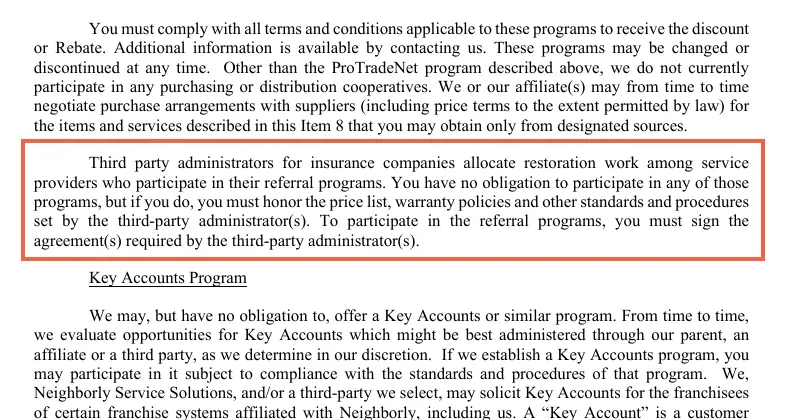
Insurance-program work arrives under a contract that the franchisee may or may not hold. Rainbow Restoration Item 8 lets the franchisee sign third party administrator (TPA) agreements and binds it to each TPA price list; Paul Davis reserves every insurer, TPA and national account contract to the franchisor; 911 Restoration bills its national accounts itself and keeps 5%.
| Brand | Who holds carrier, TPA or national account contracts | If you decline or do not qualify | FDD item |
|---|---|---|---|
| Rainbow Restoration | Franchisee signs the TPA agreement; must honor the TPA price list, warranty policies and procedures; Neighborly Service Solutions may solicit Key Accounts | Participation is optional; no penalty stated | Item 8, page 40 |
| Paul Davis Restoration | PDRI has sole authority over Program Accounts with insurers, TPAs, commercial clients and property managers; signing one without consent is a material breach | PDRI may assign the program work in your territory to other franchisees; no exclusive territory | Item 12, page 35; Franchise Agreement 1.4 |
| 911 Restoration | Franchisor runs the National Accounts Program and bills and collects | Declining any job, or 3 or more within 2 consecutive months, can mean suspension and reassignment; royalty below 9% requires accepting all assigned jobs | Items 6 and 12 |
| PuroClean | Optional Certified Priority Response (CPR) Vendor Programs through the franchisor; 50% of 2024 Marketing Fees went to national account development | Multi-unit program allows no more than 35% of revenue from PuroClean national accounts | Item 6 note 12; Item 11; multi-unit amendment |
| Servpro | Referred leads and third-party electronic assignments billed by the franchisor | See the Servpro page | Item 6 |
- The policyholder files a claim with the insurer.
- The carrier, or a TPA working for it, assigns the job to a provider in its referral program and sets the price list.
- The program holder receives it: the franchisee under Rainbow’s TPA agreements, or the franchisor under Paul Davis Program Accounts and 911 Restoration National Accounts.
- The franchisee mitigates and writes the estimate in Xactimate, which PuroClean, Paul Davis, 911 Restoration and Rainbow all name; Paul Davis and 911 also name Symbility.
- The invoice is priced to the program list and, at Paul Davis, paid centrally, with PDRI disbursing program funds within 30 business days of collection.
- Program fees and royalty come off: at 911 Restoration the 5% is deducted before the balance reaches you.
What comes off an insurance-program invoice before the franchisee is paid?
Program fees stack on top of royalty. The 2026 filings show 911 Restoration deducting a 5% National Account Program Fee, Paul Davis charging program account management at cost plus a 20% administrative charge (expected at 2% of the job for 2025) and 5% on its Commercial Program, and PuroClean charging $79 for each CPR job lead.
| Fee | Brand | Amount as printed | Royalty on it? | FDD item |
|---|---|---|---|---|
| National Account Program Fee | 911 Restoration | 5% of gross revenue from National Account customers, excluding construction and jobs under $500 | Fee not subject to royalty | Item 6 |
| Job File Audit Fee | 911 Restoration | Up to $50 when a National Accounts client requires an audit | Not stated | Item 6 |
| Program Account Management Fee | Paul Davis | Actual cost per assignment plus 20% administrative charge; expected 2% of the job for 2025 | Royalty charged on the net invoice, not on admin fees | Item 6 |
| Commercial Program; FAST Remote Estimating | Paul Davis | 5% of the job; 1.5% of estimate subtotal | Same rule | Item 6 |
| Indemnity Fund Fee | Paul Davis | 0.10% of Gross Sales on the first $2,000,000, stepping to 0.04%; funds a policy indemnifying program carriers | Separate fee | Item 6 |
| Xactimate and Xactanalysis | Paul Davis | Basic up to $108.68, Pro $154.32 per license monthly; up to $9.00 per assignment | Separate fee | Item 6 |
| CPR Vendor Program | PuroClean | $79 per job lead plus added insurance and background checks | Separate fee | Item 6 note 12 |
| Xactware | Rainbow Restoration | $250 setup; $155 per month; $5.30 to $31.45 per claim | Separate fee | Items 5, 6 and 11 |
| Referred lead | Servpro | Up to $75 per referred lead | Separate fee | Item 6 |
None of these fees shows up in an advertised royalty rate. Read the Item 6 table line by line, then ask for the program guidelines the FDD references; 911 Restoration and Paul Davis both say program terms, training and fees can be added later through optional programs. Our royalty data covers 2026 filings across sectors in the franchise royalty rates report.
What do PuroClean, Paul Davis, 911 Restoration and Rainbow charge at signing and every month?
Up front, the four filings charge a flat $39,000 to $60,000 or, at Paul Davis, $0.26 per resident of the territory, printed as $65,000 to $208,000. Monthly structures differ more: Paul Davis takes a flat 4% of Gross Sales, 911 Restoration 9% on restoration work, Rainbow 3% to 8%, and PuroClean 10% falling to 3% on mitigation receipts as the calendar year builds.
| Brand | Item 5 initial fee | Territory | Item 6 royalty | Item 6 marketing | Minimum royalty |
|---|---|---|---|---|---|
| PuroClean | $59,000; VetFran 25% off | Up to 100,000 people | Mitigation 10% on the first $249,999.99 of calendar-year receipts, down 1 point per $250,000 band to 3% at $1,750,000; reconstruction 3% | Marketing Fee 2% (2026 cap $23,500) plus 2% local spend | $400 a month in year 1, $1,000 in year 2, $1,500 in year 3, $2,500 in years 4 and 5 |
| Paul Davis Restoration | $0.26 per person: $65,000 to $208,000; half may be financed over 4 years at 7% APR; VetFran 25% off | Generally up to 800,000; Item 7 assumes 500,000 | 4% of Gross Sales, including items the insurer pays directly | Strategic Marketing Plan $500 a month plus 0.75% of Invoiced Sales | Population x minimum sales rate ($1.00 in the first full year, rising to $6.00 from the ninth) x 4% |
| 911 Restoration | $55,000 Traditional or Conversion; $39,000 Micro-Market; plus $2,500 to $3,500 training and $10,000 Business Launch Fee | 250,000 to 350,000 (Micro-Market 100,000 to 249,999) | 9% restoration services; 3% non-restoration services | National Advertising Fund 1%; local advertising $3,500 a month | From month 7: $750 a month, rising to $3,500 from month 49 (Traditional) |
| Rainbow Restoration | $60,000 for up to 200,000 people plus $400 per 1,000; VetFran 20% off | 200,000 to 500,000 | License Fee 3% to 8% of Gross Sales | MAP Fee 2%; local groups up to 3%; $30,000 initial marketing spend in year 1 | Minimum license and MAP fees per the Fees Chart |
| Servpro | $100,000 fee plus $112,000 equipment package | 50,000 to 80,000 | 3% to 10% plus a fixed fee | Brand Fund currently 2.5% | $100 a month |
Owners of an existing restoration company get the widest spread of terms. PuroClean discounts its fee by up to 50% ($29,500) for converters, 911 Restoration offers a conversion franchise at the same $55,000 fee with a 4% mitigation royalty for qualifying converters, Rainbow’s Roll-In Discount reaches 50%, and Paul Davis says in Item 7, note 2, that it has no formal conversion program. Conversion offers in other sectors are compared in our conversion franchising research. VetFran percentages across systems sit in the veteran franchise discounts report.
Which Rainbow fee figure is current?
One printed figure does not reconcile. The Rainbow cover page says the $185,336 to $351,900 total includes $40,250 paid to the franchisor and its affiliate, while Items 5 and 7 set a $60,000 Minimum Initial Franchise Fee that alone exceeds that amount. Ask Rainbow in writing which figure is current before relying on either.
Why does working capital swing the Item 7 totals from $108,503 to $804,900?
Vans and drying gear cost similar amounts across the five filings; the spread comes from working capital and insurance. Paul Davis budgets $150,000 to $200,000 for the first three months and asks for $500,000 of working capital per territory, while PuroClean budgets $20,000 to $35,000 and lets the van and the $75,000 drying package be leased.
Paul Davis Restoration prints the widest range, $298,800 to $804,900; PuroClean is lowest at $108,503 with the van and package financed. Source: Item 7 of each 2026 FDD, Minnesota CARDS.
| Brand | Vehicle | Equipment package | Insurance | Additional funds (period) | Item 7 total |
|---|---|---|---|---|---|
| PuroClean | $7,000 to $14,000 leased 3 months, or $70,000 bought | $5,000 to $6,500 financed, or $75,000 bought | $2,500 to $5,000 | $20,000 to $35,000 (3 months) | $108,503 to $152,618 financed; $233,503 to $277,118 bought |
| Paul Davis Restoration | $10,000 to $121,000 | $5,000 to $54,000 plus $13,000 to $30,000 computer and copier | $20,500 to $63,500 | $150,000 to $200,000 (first 3 months) | $298,800 to $804,900 |
| 911 Restoration (Traditional) | $1,500 to $60,000 | $35,000 to $60,000 | $1,500 to $2,700 (3 months) | $50,000 to $100,000 (3 to 6 months) | $167,700 to $334,000 |
| Rainbow Restoration | $10,000 to $55,000 | $41,461 to $66,000 | $12,000 to $18,000 (annual) | $40,000 to $100,000 (6 to 9 months) | $185,336 to $351,900 |
| Servpro | $5,000 to $69,900 | $112,000 | $5,010 to $25,300 | $32,250 to $50,000 (3 months) | $263,305 to $385,570 |
Paul Davis budgets $150,000 to $200,000 for the first three months, against $20,000 to $35,000 at PuroClean. Source: Item 7 of each 2026 FDD, Minnesota CARDS.
Paul Davis explains the number in note 11: cash must cover material, labor and commissions on insurance-related jobs that are too small for a draw schedule or come from insurers that do not give draws. After year one it expects working capital, including unused credit lines, equal to the greater of $500,000 or 10% of the prior year’s sales, and it budgets $2,500 to $5,000 a month for a job cost accountant. The 911 Restoration Micro-Market version lowers the additional funds line to $35,000 to $75,000 and the total to $135,200 to $296,000.
Does the PuroClean purchase column add up?
Not exactly. Swapping the two lease figures in the financed low column for the $70,000 van and $75,000 package purchase prices gives $241,503, which is $8,000 more than the $233,503 PuroClean prints as the low purchase total in Item 7; the high column reconciles to the printed $277,118.
| Step | Amount |
|---|---|
| Printed total with vehicle and package financed (low) | $108,503 |
| Replace vehicle lease low $7,000 with $70,000 purchase | +$63,000 |
| Replace package lease low $5,000 with $75,000 purchase | +$70,000 |
| Our sum for the purchase column (low) | $241,503 |
| Printed purchase total (low) | $233,503 |
| Gap | $8,000 |
| High column: $152,618 + $56,000 + $68,500 | $277,118, matches print |
Note 2 also gives the leased package as $4,000 to $6,500 where the table prints $5,000 to $6,500. Neither gap changes the decision, but both are worth a written question. How Item 7 lines are built is covered in our franchise disclosure document guide.
What pollution and mold coverage must a restoration franchisee carry?
Every filing requires contractor pollution liability that reaches mold, with a $1,000,000 floor in the four new FDDs and $3,000,000 per occurrence at Servpro. Florida adds a state rule: a licensed mold remediator must carry general liability of at least $1,000,000 with specific mold coverage under s. 468.8421(2).
| Brand | Pollution liability minimum | Other cover named in Item 8 | Item 7 insurance line |
|---|---|---|---|
| PuroClean | $1,000,000 per event and $1,000,000 aggregate, covering mold and bacteria | CGL $1,000,000 / $2,000,000; auto $1,000,000 | $2,500 to $5,000 (workers’ comp excluded) |
| Paul Davis Restoration | Not less than $1 million per occurrence and in aggregate | Umbrella $4 million; employer’s liability $500,000; bailee | $20,500 to $63,500 |
| 911 Restoration | $1,000,000 per occurrence / $2,000,000 aggregate, occurrence form at renewal | Professional liability $1,000,000 | $1,500 to $2,700 for 3 months |
| Rainbow Restoration | $1,000,000 per loss and aggregate, covering mold, bacteria and fungi remediation | Bailee $250,000; auto $1,000,000 to $2,000,000 | $12,000 to $18,000 annual |
| Servpro | $3,000,000 per occurrence / $5,000,000 aggregate | Captive RRRG for Limited Service and Repair | $5,010 to $25,300 |
The low insurance lines are three-month or down-payment figures, not annual premiums, so compare them with care: 911 Restoration’s $2,700 covers 3 months, Rainbow’s $18,000 is annual. Cross-sector minimums are in our franchise insurance requirements research.
Filed numbers set against two common claims
Two claims repeat across restoration franchise pages, and one figure inside a filing conflicts with itself. The table sets each against the primary document; competitor pages are described, not linked, and the FDD figures are quoted with their item numbers.
| Claim | Where it appears | What the primary source says |
|---|---|---|
| Royalty fees typically range from 4% to 10% of gross sales | A restoration franchisor’s franchise-sales blog, undated | Paul Davis 4% flat; 911 Restoration 9% and 3%; PuroClean 10% to 3% on mitigation and 3% on reconstruction; Rainbow 3% to 8%; Servpro 3% to 10% plus a fixed fee (Item 6 of each) |
| Licensing is a start-up cost alongside insurance and bonding | A consultancy guide updated January 2026 | Texas licenses at $450, $850 and $50 under ch. 1958; Florida requires an exam (s. 468.8414); New York bars assessing and remediating the same property (s. 936); EPA requires firm RRP certification |
| $40,250 paid to franchisor and affiliate | Rainbow FDD cover page | Items 5 and 7 of the same FDD set a $60,000 Minimum Initial Franchise Fee |
Matching a restoration franchise to your state, your crew and your cash
The decision turns on three facts you can check before discovery day: the state rules where you will work, how many certificate holders you can field in year one, and whether you can show the working capital insurance jobs need. The table pairs each situation with the clause or statute that settles it.
| If | Then | Source |
|---|---|---|
| You will remediate 25 contiguous sq ft or more of mold in Texas | Budget the contractor ($450) and company ($850) licenses, worker registrations and 5-day TDLR notices | TDLR fact sheet; 16 TAC 78.30 |
| You want to sell mold testing and cleanup in Florida | One company cannot remediate a structure it assessed within 12 months | s. 468.8419 |
| You will work in New York | Refer assessments to an independent licensee; one licensee cannot do both on the same property | Labor Law s. 936(2) |
| Much of your territory was built before 1978 | Hold firm RRP certification before tear-out; PuroClean requires it before training | EPA RRP; PuroClean Item 7 note 9 |
| You want to sign your own carrier or TPA agreements | Rainbow’s Item 8 allows it; at Paul Davis it is a material breach without consent | Rainbow Item 8; Paul Davis FA 1.4 |
| You cannot show $500,000 in working capital or unused credit | Paul Davis’s note 11 standard is out of reach; 911 ($50,000 to $100,000) and PuroClean ($20,000 to $35,000) budget less | Item 7 of each FDD |
| You already own a restoration company | Compare PuroClean’s 50% fee discount, 911’s conversion program and Rainbow’s Roll-In Discount; Paul Davis has no formal program | Items 5 and 7 |
| You are an honorably discharged veteran | PuroClean and Paul Davis take 25% off, 911 Restoration may, Rainbow takes 20% | Item 5 of each FDD |
Bring the program questions to a consultant or the franchisor in writing: which TPAs and carriers the system holds today, what share of jobs came through them, and which program fees apply on top of the Item 6 royalty. What a consultant can and cannot answer is set out in what a franchise consultant does. This page summarizes public filings and statutes as of November 2026 and is not legal, financial or investment advice.
Owner income is the question these filings answer only in Item 19. PuroClean, Paul Davis, 911 Restoration and Rainbow each include an Item 19 with historical gross sales data in their 2026 FDDs, and Servpro’s April 15, 2026 FDD makes no financial performance representation; read our Item 19 research for what those disclosures can and cannot show. Sector counts are in our home service franchise statistics.
How we compiled this
On November 3, 2026 we downloaded four restoration FDDs from Minnesota CARDS (PuroClean, Paul Davis Restoration, 911 Restoration and Rainbow Restoration) and read Items 1, 5 to 8, 11, 12, 19 and 20, plus section 1.4 of the Paul Davis franchise agreement; Servpro figures come from its April 15, 2026 FDD as recorded for our Servpro page. We opened 13 regulatory pages from the IICRC, EPA, Cornell LII, TDLR, the Florida Legislature, the NYS Department of Labor and the New York Senate. We added the Item 7 columns ourselves, excluded every Item 19 figure, and left out the revenue thresholds tied to conversion and multi-unit discounts.
Frequently asked questions
How much does a restoration franchise cost?
Item 7 totals in five 2026 restoration FDDs run from $108,503 (PuroClean, van and drying package financed) to $804,900 (Paul Davis Restoration, high case). 911 Restoration prints $167,700 to $334,000 for a Traditional franchise, Rainbow Restoration $185,336 to $351,900 and Servpro $263,305 to $385,570. Working capital and insurance lines drive most of the spread.
Do you need a license to run a restoration franchise?
Often, yes. Texas licenses mold remediation contractors ($450) and companies ($850) under Occupations Code chapter 1958, Florida requires a mold remediator license after an exam, and New York licenses remediation contractors under Labor Law Article 32. Firms disturbing paint in pre-1978 homes also need EPA RRP certification. Item 7 of each FDD carries a permit line.
Which IICRC certifications does a restoration franchise need?
The four 2026 filings name WRT, ASD, AMRT, FSRT and OCT. Rainbow Restoration requires WRT and ASD before opening and the other three within the first year; PuroClean requires AMRT within 90 days of initial training; 911 Restoration requires a holder of each of the five on staff. IICRC exams were $80 each in the filings, $150 for AMRT.
What is a TPA in restoration work?
A third party administrator manages claims for an insurer and allocates restoration jobs among providers in its referral program. Rainbow Restoration’s 2026 FDD, Item 8, says a participating franchisee must sign the TPA agreement and honor its price list, warranty policies and procedures. Paul Davis reserves TPA contracts to the franchisor under Franchise Agreement section 1.4.
Can a restoration franchisee sign its own insurance company programs?
It depends on the contract. Rainbow Restoration lets franchisees sign TPA referral agreements. Paul Davis Restoration treats a franchisee signing a regional or national account without written consent as a material breach. 911 Restoration runs national accounts centrally and deducts a 5% program fee before paying the balance. Read Items 6, 8 and 12 together.
How much does a restoration franchise owner make?
The filings answer that only in Item 19, and this site does not quote those figures. PuroClean, Paul Davis, 911 Restoration and Rainbow each include historical gross sales in Item 19 of their 2026 FDDs; Servpro makes no financial performance representation. What you keep depends on the Item 6 royalty, program fees and the working capital Item 7 asks for.
Sources
- PuroClean Franchise Disclosure Document, issued April 20, 2026, PuroSystems, LLC (Minnesota CARDS), accessed November 3, 2026
- Paul Davis Restoration Franchise Disclosure Document, issued March 23, 2026, Paul Davis Restoration, Inc. (Minnesota CARDS), accessed November 3, 2026
- 911 Restoration Franchise Disclosure Document, issued June 11, 2026, amended August 25, 2026, 911 Restoration Franchise Inc. (Minnesota CARDS), accessed November 3, 2026
- Rainbow Restoration Franchise Disclosure Document, issued April 1, 2026, Rainbow International SPV LLC (Minnesota CARDS), accessed November 3, 2026
- SERVPRO Franchise Disclosure Document, issued April 15, 2026, SERVPRO Franchisor, LLC (Minnesota CARDS), accessed November 3, 2026
- ANSI/IICRC S500 Standard for Professional Water Damage Restoration, IICRC, accessed November 3, 2026
- ANSI/IICRC S520 Standard for Professional Mold Remediation, IICRC, accessed November 3, 2026
- Lead Renovation, Repair and Painting Program, U.S. Environmental Protection Agency, accessed November 3, 2026
- 40 CFR 745.83 Definitions, Legal Information Institute, Cornell Law School, accessed November 3, 2026
- Mold Assessors and Remediators At A Glance (Dec. 2025), Texas Department of Licensing and Regulation, accessed November 3, 2026
- 16 Tex. Admin. Code 78.30 Exceptions and Exemptions, Legal Information Institute, Cornell Law School, accessed November 3, 2026
- Florida Statutes s. 468.8411 Definitions, The Florida Legislature, accessed November 3, 2026
- Florida Statutes s. 468.8414 Licensure, The Florida Legislature, accessed November 3, 2026
- Florida Statutes s. 468.8419 Prohibitions, The Florida Legislature, accessed November 3, 2026
- Florida Statutes s. 468.8421 Insurance, The Florida Legislature, accessed November 3, 2026
- Mold Program, New York State Department of Labor, accessed November 3, 2026
- New York Labor Law s. 930 Definitions, New York State Senate, accessed November 3, 2026
- New York Labor Law s. 936 Licensee duties; prohibited activities, New York State Senate, accessed November 3, 2026