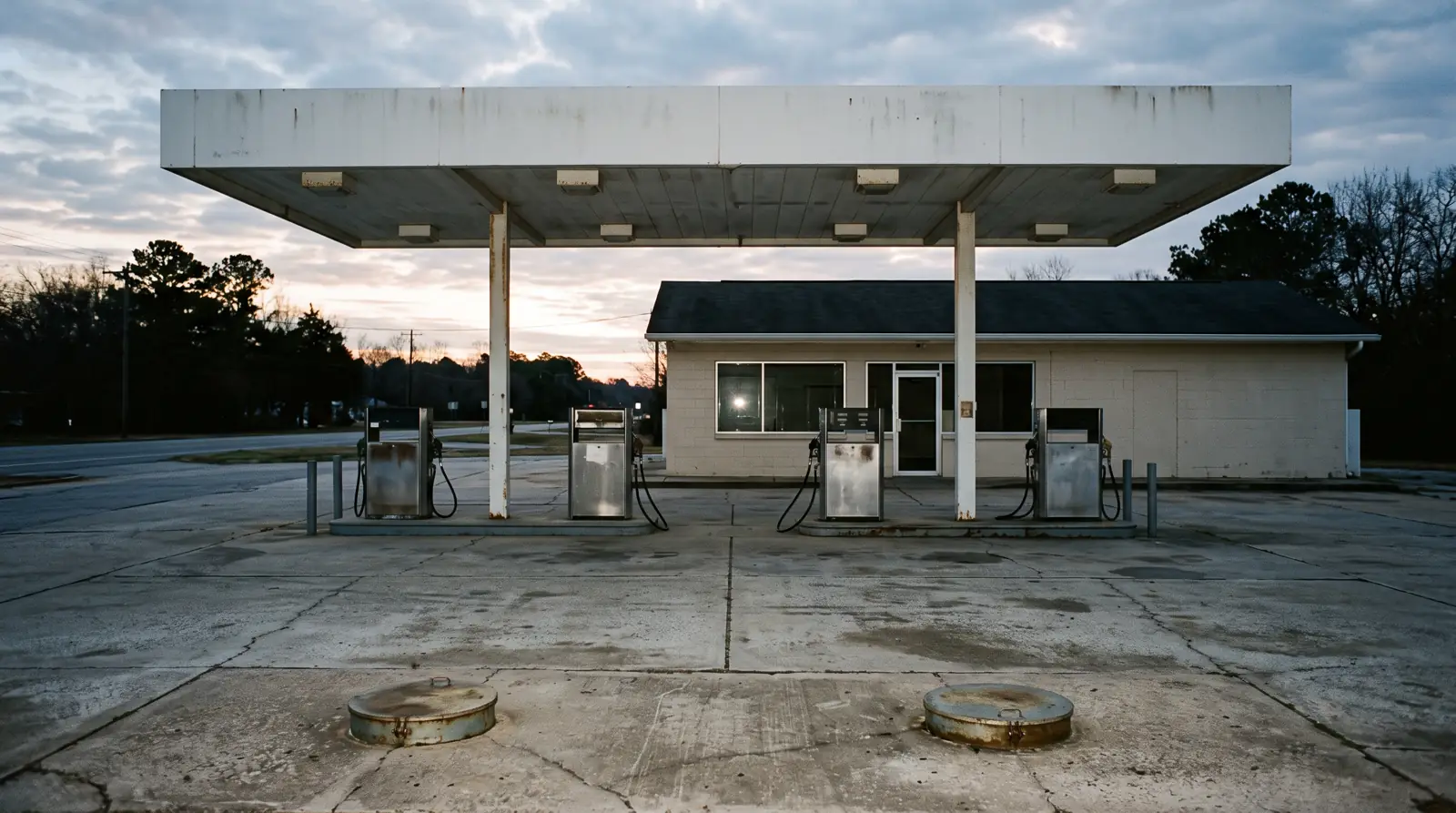
A gas station franchise can be two separate contracts: a fuel supply or branding deal that the Petroleum Marketing Practices Act can govern, and a convenience store franchise sold under the FTC Rule, both resting on EPA-regulated tanks.
Key takeaways
- The Petroleum Marketing Practices Act (15 U.S.C. 2801) calls a contract to sell motor fuel under a trademark owned or controlled by a refiner a franchise, and the FTC Franchise Rule does not apply to those relationships (16 CFR 436.8(a)(4)), so a fuel-only dealer deal can arrive with no disclosure document.
- Under the Act a fuel supplier may end or refuse to renew only on grounds listed in 15 U.S.C. 2802(b), with written notice at least 90 days ahead under 2804(a), and the dealer has 1 year to sue under 2805(a).
- Two current filings disagree about the Act: the Circle K Motor Fuel Supply Agreement (FDD issued July 10, 2026, Exhibit H, section 36) says the PMPA does not apply, while the APLUS Premises Lease in the Sunoco Retail FDD issued April 24, 2025 calls the operator a PMPA franchisee and retailer.
- Owners of petroleum tanks at a fuel retail site must carry $1 million per occurrence in financial responsibility for leaks and $1 million in annual aggregate for 1 to 100 tanks (40 CFR 280.93).
- EPA counted 534,189 active underground storage tanks at about 190,224 facilities as of March 2026, and a 60.9% technical compliance rate from April 2025 to March 2026 (EPA UST performance measures).
| Key number | What it is | Source |
|---|---|---|
| $25,000 | Circle K Initial Franchise Fee, single store | Circle K FDD (July 10, 2026), Item 5 and Item 7 Note 1 |
| $30,000 to $125,000 | Circle K Security Deposit paid with the Motor Fuel Agreement | Circle K FDD (July 10, 2026), Item 5 and Item 7 Note 13 |
| $0.0075 per gallon | Motor fuel leg of the Circle K royalty test | Circle K FDD (July 10, 2026), Item 6 |
| $15,000 | APLUS initial franchise fee | APLUS FDD (April 24, 2025), Item 5 |
| Up to 6% of Gross Sales | APLUS royalty, non-captive stores | APLUS FDD (April 24, 2025), Item 6 |
| 90 days | Minimum PMPA notice before termination or nonrenewal | 15 U.S.C. 2804(a)(2) |
| $1 million | Tank financial responsibility per occurrence at a fuel retail site | 40 CFR 280.93(a)(1) |
| 30 days | Deadline to notify the agency after buying a tank system | 40 CFR 280.22(b) |
Is a gas station franchise one contract or two?
It is one or two, depending on whose name is on the canopy and on the store. A dealer selling a refiner’s brand of fuel signs a supply or branding agreement with the refiner or a distributor, which 15 U.S.C. 2801(1) defines as a franchise. A store brand such as Circle K or APLUS adds a business-format franchise with its own disclosure document. One operator can hold both at the same address.
The two sides answer to different federal law. The FTC Franchise Rule does not apply where the PMPA covers the relationship (16 CFR 436.8(a)(4)), which is why a branded fuel dealer agreement can come with no FDD at all. Circle K’s FDD issued July 10, 2026 bundles both: a Franchise Agreement (Exhibit F) and a Motor Fuel Supply Agreement (Exhibit H), under which the franchisee must buy its motor fuel from TMC Franchise Corporation or an affiliate (Circle K FDD, Item 1).
- Fuel side: Refiner (owns or controls the fuel trademark), then Distributor (jobber, buys fuel for resale to stations), then the station operator. A PMPA franchise under 15 U.S.C. 2801(1): end only on 2802 grounds, 90-day written notice (2804), sue within 1 year (2805). No FTC disclosure document: 16 CFR 436.8(a)(4).
- Store side: Store franchisor, Circle K (TMC) or APLUS (Sunoco Retail), delivers an FDD at least 14 days before signing. FTC Franchise Rule, 16 CFR 436: Item 5 and 6 fees, Item 7 build cost; termination per the contract and state relationship laws. Circle K fuel agreement s.36: PMPA does not apply.
- Under both: EPA tank rules, 40 CFR Part 280, bind the tank owner and operator.
| Question | Fuel supply or branding agreement | Convenience store franchise | Source |
|---|---|---|---|
| Federal law | Petroleum Marketing Practices Act, 15 U.S.C. 2801 to 2807 | FTC Franchise Rule, 16 CFR Part 436 | Statute; 16 CFR 436.8(a)(4) |
| Disclosure before signing | No FDD where the PMPA covers the relationship | FDD at least 14 calendar days before signing or paying | 16 CFR 436.8(a)(4); cover pages of the Circle K and APLUS FDDs |
| Who grants it | A refiner or distributor (2801(3)) | TMC Franchise Corporation (Circle K); Sunoco Retail LLC (APLUS) | 15 U.S.C. 2801(3); FDD Item 1 |
| How it can end | Only on 2802(b) grounds, after notice under 2804 | Contract terms, subject to state relationship laws | 15 U.S.C. 2802, 2804 |
| State termination laws | Preempted unless the same as the Act (2806(a)(1)) | Apply where a state has enacted one | 15 U.S.C. 2806 |
| Fuel purchase | Branded fuel from the franchisor | Circle K: fuel from TMC or an affiliate. APLUS: fuel optional; other fuel brands eligible | Circle K Item 1; APLUS Item 1 |
State rules that govern how a store franchisor may end the store agreement are compared in our franchise relationship laws tracker. Sector counts, SBA lending to fuel retailers and the cover-page investment ranges of 11 filings sit in our convenience store franchise statistics report, so this page does not repeat them.
What does the Petroleum Marketing Practices Act protect, and when does it apply?
The Act protects the dealer’s right to keep the brand and, at a leased station, the premises. A franchisor may terminate or refuse to renew only for reasons in 15 U.S.C. 2802(b) and only after notice under 2804. Coverage turns on the trademark: 2801(1) reaches a mark owned or controlled by a refiner, or by a refiner that supplies the distributor granting the brand.
| Rule | What the statute says | Section |
|---|---|---|
| Grounds to end or not renew | Failure to comply with a provision that is reasonable and of material significance; failure to exert good faith efforts after written notice; a relevant event; a written mutual agreement; a good-faith withdrawal from the market area | 15 U.S.C. 2802(b)(2) |
| Relevant events listed | Fraud or criminal misconduct, bankruptcy, severe disability of at least 3 months, loss of the franchisor’s underlying lease, and others | 2802(c) |
| Knowledge window | The franchisor must have learned of the failure or event no more than 120 days before notice (60 days when less than 90 days’ notice is given) | 2802(b)(2)(A) and (C) |
| Notice | In writing, by certified mail or personal delivery, at least 90 days before the effective date, with reasons and the federal summary statement | 2804(a), 2804(c) |
| Mutual termination | Signed no more than 180 days ahead; the dealer may repudiate within 7 days by certified mail | 2802(b)(2)(D) |
| Trial franchise | First-time franchisee, written, initial term of 1 year or less; nonrenewal protections do not apply | 2803(b)(1) |
| Interim franchise | Combined term of 3 years or less after a market-withdrawal nonrenewal | 2803(b)(3) |
| Deadline to sue | 1 year after the later of the termination or the franchisor’s failure to comply | 2805(a) |
| Waivers and choice of law | A franchisor may not require a waiver of the Act as a condition of signing or renewing; a clause choosing another state’s law is not enforceable | 2805(f) |
| Renewable fuel | Agreements signed or renewed on or after December 19, 2007 may not bar an E85 or 20% biodiesel pump (tanks on franchisor-leased premises excepted) | 2807(b) |
| State law | State termination and notice rules are preempted unless identical; no state-mandated goodwill payment | 2806(a) |
Two current contracts, two answers on the Act
The two FDDs we opened take opposite positions. Section 36 of the Circle K Motor Fuel Supply Agreement (Exhibit H, page H-9) picks Arizona law and states that the PMPA does not apply to the agreement or the relationship; the same agreement sells fuel under the CIRCLE K trademarks (Circle K FDD issued July 10, 2026).

Section 1.11(C) of the APLUS Premises Lease (Attachment 6 to the Franchise Agreement, page 8) says the operator is a franchisee and a retailer as defined by the PMPA, and section 1.11(B) says Sunoco loans the motor fuel equipment for the lease term (APLUS FDD issued April 24, 2025). The same lease lets Sunoco end it when a fuel supply default gives PMPA grounds.

This is not legal, financial or investment advice. Which statement holds for a given site is a question for a petroleum marketing attorney, and three questions frame it: is the fuel trademark owned or controlled by a refiner under 2801(1); does 2805(f)(2) reach a clause choosing another state’s law; and what notice applies if the store agreement ends first? Our guide to hiring a franchise attorney covers what that review costs and which clauses to send.
What do the Circle K and APLUS filings charge for the fuel side?
Circle K prices fuel into its royalty and a deposit; APLUS leaves fuel optional and charges on store sales. Circle K’s royalty test includes $0.0075 per gallon of Motor Fuel Sales, and a $30,000 to $125,000 Security Deposit secures the Motor Fuel Agreement. APLUS charges up to 6% of Gross Sales, with a minimum monthly royalty difference of up to $2,000 (Item 6).
| Term | Circle K (Standard), FDD issued July 10, 2026 | APLUS, FDD issued April 24, 2025 | Source |
|---|---|---|---|
| Fuel required | Yes: motor fuel from TMC or an affiliate | No: Sunoco or another fuel brand, or no fuel | Item 1 |
| Initial franchise fee | $25,000; $15,000 to $5,000 per store under a Multiple Site Operator schedule; 25% off under the Conversion Program | $15,000; Captive Market supplemental fee $15,000 to $300,000 | Item 5 |
| Royalty | The greater of (a) (i) 3.5% of Gross Sales and (ii) $0.0075 per gallon of Motor Fuel Sales, or (b) $1,500 per Accounting Period | Up to 6% of Gross Sales; up to 15% at Captive Market locations | Item 6 |
| Minimum royalty | $1,500 per Accounting Period (currently 28 or 35 days) | Difference between royalty paid and up to $2,000 a month | Item 6 |
| Fuel-linked charges | Motor Fuel Pass-Through Fee or Delivery Fees: $35 to $50 per delivery | Kerosene fee $250 per month, where kerosene is allowed | Item 6 |
| Deposit | Security Deposit $30,000 to $125,000, non-interest-bearing, secures the Motor Fuel Agreement | Collateral Security Deposit $10,000 to $21,000, set by credit rating | Item 5 |
| Term | 10 years for the Franchise Agreement and the Motor Fuel Agreement | 5 years leased store; 10 years non-leased; one renewal of equal length | Item 17 |
Under the Circle K fuel agreement, TMC is the exclusive supplier of the station’s motor fuel (section 2), the franchisee buys all of its fuel requirements from TMC (section 4) and pays for each delivery within 3 days (section 5). Conversion Program stores that convert within 9 months pay only the $0.0075 per gallon royalty for the first 25 Accounting Periods (Item 6).
APLUS adds a 1% of Gross Sales Alcoholic Beverages Assessment if the store does not sell alcohol, a marketing fee of up to $1,500 or 2% of Gross Sales (currently $750), and rent of $5,000 to $34,000 a month at a leased store (Item 6). Its Item 11 training plan includes 4 classroom hours and 3 on-the-job hours of Underground Storage Tank Review within 75 classroom and 116 on-the-job hours.
Item 7 with a forecourt: which lines move the budget?
Construction and equipment move it most. Circle K’s new-build table lists $1,800,000 to $6,000,000 for construction and $500,000 to $1,200,000 for furniture, fixtures and equipment, where fuel equipment cost turns on the canopy and the number of multi-product dispensers (Item 7, Note 5). An APLUS leased store has no construction line because Sunoco supplies the premises and loans the equipment.
| Item 7 line | Circle K new build | Circle K conversion | APLUS leased store | Source |
|---|---|---|---|---|
| Initial franchise fee | $25,000 | $25,000 | $15,000 | Item 7 |
| Construction, remodeling, leasehold improvements | $1,800,000 to $6,000,000 | $100,000 to $650,000 | N/A | Item 7 |
| Other site development or permitting | $135,000 to $250,000 | $20,000 to $80,000 | N/A | Item 7 |
| Furniture, fixtures and equipment (Circle K includes fuel equipment) | $500,000 to $1,200,000 | $300,000 to $1,100,000 | $83,000 to $275,000 (store fixtures) | Item 7, Circle K Note 5 |
| Signs | $50,000 to $150,000 | $20,000 to $120,000 | N/A (graphics) | Item 7 |
| Inventory | $100,000 to $220,000 (merchandise and fuel) | $100,000 to $220,000 | $42,000 to $125,000 (store) | Item 7, Circle K Note 9 |
| Fuel or collateral deposit | $30,000 to $125,000 | $30,000 to $125,000 | $10,000 to $21,000 | Item 7 |
| Optional car wash, building plus equipment (two lines added) | $365,000 to $1,300,000 | $265,000 to $1,200,000 | Not listed | Item 7 |
| Additional funds, 3 months | $10,000 to $20,000 | $10,000 to $20,000 | $56,000 to $115,000 | Item 7 |
| Real estate | Excluded (Note 3) | Excluded (Note 3) | Rent for 3 months: $16,000 to $124,000 | Item 7 |
Circle K’s fuel security deposit ($30,000 to $125,000) alone exceeds the whole APLUS collateral deposit range ($10,000 to $21,000). Sources: Circle K FDD (July 10, 2026) and APLUS FDD (April 24, 2025), Item 7, accessed November 3, 2026.
The notes carry costs that sit outside the totals. Circle K stores average about 5,200 square feet on at least 50,000 square feet of land, and land is not in the estimate (Note 3). Liquor licenses can reach $1,000,000 where licenses are scarce (Note 7), and forecourt inventory depends on tank size and the price per gallon on delivery day (Note 9). APLUS warns that engineering permits can add $20,000 or more to a conversion (Note 3) and that licenses sell for over $250,000 in a few areas (Note 10).
Do the Circle K Item 7 totals match their own lines?
Not exactly. Adding the 18 priced lines in each Circle K table gives figures that differ from the printed totals by $10,000 at the low end and $75,000 at the high end, in both the new-build and the conversion tables. The cover page and the Multiple Site Operator table also put the new-build top figure $1,000,000 below the printed Item 7 total.
| Check | New build | Conversion | Source |
|---|---|---|---|
| Sum of the 18 priced lines (our arithmetic) | $3,108,500 to $9,505,500 | $963,500 to $3,755,500 | Circle K FDD, Item 7, pages 21 to 23 |
| TOTAL printed in Item 7 | $3,098,500 to $9,430,500 | $953,500 to $3,680,500 | Item 7, Notes 15 and 16 |
| Gap (sum minus printed total) | $10,000 to $75,000 | $10,000 to $75,000 | Our arithmetic |
We report the arithmetic only. Before sizing a loan on these figures, ask TMC Franchise Corporation in writing which total it stands behind and whether a line was changed after the totals were set. Item 7 ranges across other sectors are compared in our franchise initial investment report.
Which EPA tank rules start on the day you own the tanks?
Part 280 binds the owner and the operator of the tanks, whatever the brand. A buyer files an ownership notice within 30 days (40 CFR 280.22(b)), carries $1 million per occurrence of financial responsibility (280.93(a)(1)), trains Class A and B operators within 30 days (280.243), runs 30-day walkthroughs (280.36) and reports suspected releases within 24 hours (280.50).
| Duty | Interval or amount | 40 CFR section |
|---|---|---|
| Notify the agency of a new tank system | Within 30 days of bringing it into use | 280.22(a) |
| Notify the agency of an ownership change | Within 30 days of acquisition | 280.22(b) |
| Secondary containment with interstitial monitoring | Tanks and piping installed or replaced after April 11, 2016 | 280.20 |
| Walkthrough: spill buckets and release detection | Every 30 days | 280.36(a)(1)(i) |
| Walkthrough: containment sumps and hand-held gauges | Annually | 280.36(a)(1)(ii) |
| Release detection equipment test | At least annually | 280.40(a)(3) |
| Release monitoring, tanks installed after April 11, 2016 | At least every 30 days | 280.41(a)(2) |
| Spill bucket and containment sump test | At least once every three years (unless double-walled and monitored) | 280.35(a)(1) |
| Overfill prevention inspection | At least once every three years | 280.35(a)(2) |
| Cathodic protection test | Within 6 months of installation, then at least every 3 years | 280.31(b) |
| Report a suspected release | Within 24 hours | 280.50 |
| Report a petroleum spill or overfill | Within 24 hours if over 25 gallons or causing a sheen | 280.53(a) |
| Start the initial response to a confirmed release | Within 24 hours: report, stop further release, mitigate fire and vapor hazards | 280.61 |
| Financial responsibility per occurrence | $1 million at fuel retail sites or over 10,000 gallons a month; $500,000 otherwise | 280.93(a) |
| Financial responsibility, annual aggregate | $1 million for 1 to 100 tanks; $2 million for 101 or more | 280.93(b) |
| Class A and B operator training | Within 30 days of assuming duties; Class C before duties | 280.243 |
| Notice before closing a tank | At least 30 days before permanent closure | 280.71(a) |
Franchise contracts layer their own terms on top. Circle K’s Item 1 requires inspections of release detection, automatic tank gauging and vapor recovery equipment, and its insurance rules call for environmental pollution coverage of at least $1,000,000 that runs at least two years past the end of the Motor Fuel Agreement, with tank financial assurance through a state UST fund or commercial UST insurance (Item 8). A self-insurer must show tangible net worth of at least ten times the required aggregate (280.95(b)(1)). Brand-by-brand insurance minimums are indexed in our franchise insurance requirements report.
How often do tank sites fall short of these rules?
EPA’s national figures show the walkthrough and technical rules are where sites slip most. From April 2025 to March 2026 the technical compliance rate was 60.9%, and 83.2% of facilities met walkthrough requirements, against 89.7% for operator training and 90.4% for financial responsibility (EPA UST performance measures).
Technical compliance at federally regulated tank facilities was 60.9% from April 2025 to March 2026, the lowest of the four EPA measures. Source: EPA UST Performance Measures, accessed November 3, 2026.
| EPA measure | Value | Period |
|---|---|---|
| Technical compliance rate | 60.9% | April 2025 to March 2026 |
| Facilities meeting walkthrough requirements | 83.2% | April 2025 to March 2026 |
| Facilities meeting Class A and B operator training requirements | 89.7% | April 2025 to March 2026 |
| Facilities meeting financial responsibility requirements | 90.4% | April 2025 to March 2026 |
| On-site inspections | 38,326 | October 2025 to March 2026 |
| Confirmed releases | 1,997 | October 2025 to March 2026 |
| Releases remaining to be cleaned up | 52,859 | As of March 2026 |
Can the brand pay for the build, and what does leaving early cost?
Both franchisors offer build money tied to staying. Circle K’s Funding runs $100,000 to $1,000,000, needs no payments while the store is in compliance, and is written down 30% at the third anniversary of opening, then by 1/120th a month (Item 10). Leave early and the unamortized balance comes due, on top of liquidated damages under the fuel agreement.
- Circle K Additional Funding: up to $100,000 more for a new build signed by January 31, 2027 and opened within 15 months; it cannot be combined with the Conversion Program royalty discount (Item 10, Note 1).
- Circle K security: a security interest in the store’s assets and personal guaranties from all owners (Item 10, Note 4).
- Circle K volume default: TMC may end the fuel agreement after a 30-day cure period if the store buys less than 75% of its minimum volume (Exhibit H, section 22(b)).
- Circle K liquidated damages: the greater of $0.04 per gallon times the minimum Accounting Period volume, or $0.04 times the average volume of the prior 13 periods, multiplied by the lesser of 52 Accounting Periods or the periods left (section 22(c)).
- APLUS funding: Item 10 states that Sunoco Retail does not offer direct or indirect financing, while Item 1 describes optional Equipment and Construction Funding for Non-Leased stores, amortized monthly over the franchise term and generally set at 8.33% of the prior 12 months’ gross sales for a conversion.
Neither figure says what a station will earn. The Circle K Standard FDD includes an Item 19 built on company-operated Circle K stores, and the APLUS FDD states it makes no financial performance representation; what each kind of Item 19 can and cannot show is explained in our franchise Item 19 report.
Buying an existing branded station: what carries over?
The tanks, their records and any compliance gaps carry over to the buyer; the brand contracts may not. Under 40 CFR 280.22(b) the buyer notifies the implementing agency within 30 days of acquisition, and Circle K requires upgrades within nine months when a franchisee buys a company-operated store (Item 7 notes).
- Get the tank file the seller must keep under 40 CFR 280.34(b): release detection records, 30-day walkthrough logs, 3-year spill and overfill results, cathodic protection tests and the operator training list (280.245).
- Ask when each tank and piping run was installed or replaced; after April 11, 2016 they must be secondarily contained (280.20).
- Confirm the financial responsibility mechanism (state fund under 280.101, insurance, or self-insurance) and that it covers $1 million per occurrence (280.93).
- Read the fuel agreement’s transfer clause; the PMPA leaves transfers to the franchise terms and applicable state law (15 U.S.C. 2806(b)), and a transferred term does not count as a trial franchise (2803(b)(2)).
- If converting to Circle K, check the Conversion Program: 25% off the Initial Franchise Fee for agreements signed before the Program Expiration Date (Item 5), and the per-gallon royalty for 25 Accounting Periods if the store converts within 9 months (Item 6).
- Within 30 days of closing, file the ownership notice (280.22(b)) and have Class A and B operators trained (280.243).
Resale loans and FDD transfer fees across franchise systems are covered in our franchise resale report.
Fuel-only deal, store franchise or both: a decision table
Match the contract to what you already control: land, tanks, a store and capital. The thresholds below come from the two FDDs, the PMPA and 40 CFR Part 280. They are screening rules, not legal, financial or investment advice, and a franchise attorney and a lender should read the fuel agreement, the franchise agreement and the tank file together.
| If | Then | Why (source) |
|---|---|---|
| You own a station with tanks and want a fuel brand only | Compare refiner and distributor supply offers; expect no FDD; ask for the federal summary statement | 16 CFR 436.8(a)(4); 15 U.S.C. 2804(c) |
| You want a store brand and already sell another fuel brand | APLUS accepts operators selling other fuel brands; Circle K requires its own fuel | APLUS Item 1; Circle K Item 1 |
| You have no land | Circle K needs at least 50,000 square feet and excludes real estate; an APLUS leased store rents from Sunoco | Circle K Item 7 Note 3; APLUS Item 7 |
| Your fuel volume is uncertain | Price the 75% minimum volume trigger and the $0.04 per gallon liquidated damages before signing | Circle K Exhibit H, section 22 |
| The brand offers build funding | Model repayment if you leave before the write-down ends (30% at year 3, then 1/120th a month) | Circle K Item 10 |
| Tanks or piping were replaced after April 11, 2016 | Confirm secondary containment and interstitial monitoring are in place | 40 CFR 280.20 |
| You will sell alcohol in a capped-license state | Budget the license outside the Item 7 range: up to $1,000,000 (Circle K) or over $250,000 (APLUS) | Circle K Note 7; APLUS Note 10 |
| A supplier sends a termination notice | Check the grounds against 2802(b), the 90-day notice and the 1-year suit deadline | 15 U.S.C. 2802, 2804, 2805 |
Every store franchisor must deliver its FDD at least 14 days before you sign; our franchise disclosure document guide walks through all 23 Items. How SBA lenders check an agreement is explained in our SBA Franchise Directory report, and the federal rules on disclosure timing are in our FTC Franchise Rule explainer.
How we compiled this
On November 3, 2026 we opened two current FDDs from Minnesota’s CARDS registry (Circle K Standard, issued July 10, 2026, and APLUS, issued April 24, 2025) and read Items 1, 5, 6, 7, 8, 10, 11, 17 and 19, the Circle K Motor Fuel Supply Agreement and the APLUS Premises Lease. We read 15 U.S.C. 2801 to 2807 on GovInfo, 40 CFR Part 280 and 16 CFR 436.8 on eCFR, and EPA’s UST performance measures. A third CARDS search returned an unrelated brand and was discarded; we excluded Item 19 figures, fuel margins and brand cost claims that cite no filing.
Frequently asked questions
How much does it cost to open a gas station franchise?
It turns on whether you build, convert or lease. In the Circle K FDD issued July 10, 2026, the 18 priced Item 7 lines for a new build add to $3,108,500 to $9,505,500 before land, against $963,500 to $3,755,500 for a conversion. An APLUS leased store has no construction line: its fee is $15,000 and store fixtures run $83,000 to $275,000.
Is a gas station a franchise if it only sells a brand of fuel?
It can be, under federal law. The Petroleum Marketing Practices Act, 15 U.S.C. 2801(1), treats a contract to sell motor fuel under a trademark owned or controlled by a refiner as a franchise. Those relationships are exempt from the FTC Franchise Rule under 16 CFR 436.8(a)(4), so the dealer may receive a supply agreement but no Franchise Disclosure Document.
How can a fuel supplier end a gas station franchise?
Where the PMPA applies, only on the grounds in 15 U.S.C. 2802(b), such as failure to comply with a material, reasonable provision, a relevant event like bankruptcy, or a market withdrawal. Notice must be written, sent by certified mail or delivered in person at least 90 days ahead under 2804, and the dealer has 1 year to sue under 2805(a).
How much is a 7-Eleven or Chevron gas station franchise?
We did not open a 7-Eleven or Chevron filing for this page, so we quote no figure. Check Items 5, 6 and 7 of the current FDD for a store brand, and for branded fuel ask the refiner or distributor for the supply agreement; under 16 CFR 436.8(a)(4) a PMPA fuel deal comes with no FDD.
Is owning a gas station franchise profitable?
This page publishes no earnings figures. Owner results depend on the Item 6 fees, such as Circle K’s $0.0075 per gallon royalty leg, the Item 7 build cost and fuel deal terms. The Circle K Standard FDD includes an Item 19 on company-operated stores; the APLUS FDD issued April 24, 2025 includes none.
Who pays if the tanks at a franchised gas station leak?
The tank owner and operator. Under 40 CFR 280.93 they must show $1 million per occurrence in financial responsibility at a fuel retail site, through a state fund, insurance or self-insurance. Circle K also requires at least $1,000,000 of pollution coverage lasting two years past the end of its Motor Fuel Agreement (Item 8).
Sources
- Circle K (Standard) Franchise Disclosure Document, issued July 10, 2026, TMC Franchise Corporation, Minnesota CARDS (Items 1, 5, 6, 7, 8, 10, 17, 19; Exhibit H Motor Fuel Supply Agreement). Accessed 2026-11-03.
- APLUS Franchise Disclosure Document, issued April 24, 2025, Sunoco Retail LLC, Minnesota CARDS (Items 1, 5, 6, 7, 10, 11, 17, 19; Attachment 6 Premises Lease). Accessed 2026-11-03.
- 15 U.S.C. chapter 55, subchapter I, Petroleum Marketing Practices Act, sections 2801 to 2807, U.S. Code 2024 edition, GovInfo. Accessed 2026-11-03.
- 40 CFR Part 280, Technical Standards and Corrective Action Requirements for Owners and Operators of Underground Storage Tanks, eCFR. Accessed 2026-11-03.
- 16 CFR 436.8, Exemptions, FTC Franchise Rule, eCFR. Accessed 2026-11-03.
- UST Performance Measures, U.S. Environmental Protection Agency. Accessed 2026-11-03.
- Franchise Registrations search, Minnesota Department of Commerce CARDS. Accessed 2026-11-03.