An urgent care franchise licenses the business side of a walk-in clinic, not the medicine: in most structures a physician-owned entity employs the clinicians, and American Family Care’s April 2026 FDD estimates $948,250 to $1,514,000 to open.
State law, not the franchisor, decides who may own the medical side. The rule text for 4 states, the federal CLIA lab certificate and Items 5 to 7 of 2 urgent care disclosure documents filed in Minnesota follow. This page is general information, not legal advice.
Key takeaways
- California Business and Professions Code section 2400 says corporations “shall have no professional rights, privileges, or powers” (Cal. Bus. & Prof. Code s. 2400), so lay franchisees there sit on the management side of the clinic.
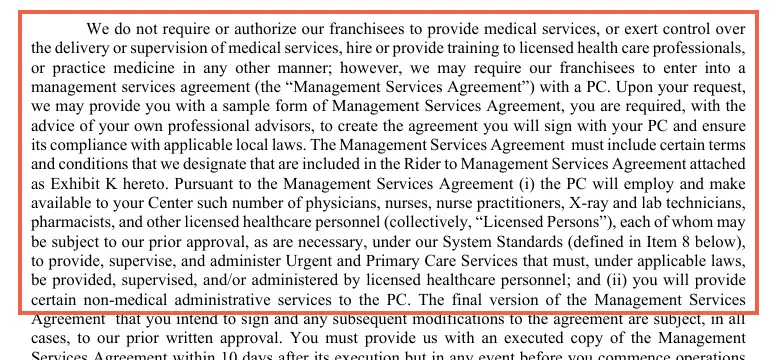
- American Family Care may require each franchisee to sign a management services agreement with a physician-owned professional entity and to deliver a written legal opinion on the structure before opening (AFC FDD issued April 29, 2026, Item 1).
- A center that tests patient specimens needs a CLIA certificate; CMS lists $248 per two-year cycle for a Certificate of Waiver and $297 for provider-performed microscopy (CMS CLIA fee schedule, updated 2024).
- Item 7 totals: American Family Care $948,250 to $1,514,000; BreezeMed Urgent Care prints $534,500 to $869,000 in its table and $511,000 to $885,000 on its cover (BreezeMed FDD issued March 11, 2025).
- American Family Care ended 2025 with 327 franchised and 80 affiliate-owned centers (Item 20); BreezeMed reported 0 franchised outlets from 2022 through 2024.
Who is allowed to own the medical side of an urgent care franchise?
State law decides. California and Texas reserve the practice of medicine to licensed people, New York lets only licensed professionals form a professional service corporation, and Florida allows lay ownership but licenses each clinic through its Agency for Health Care Administration unless licensed practitioners wholly own it. Both FDDs reviewed here send the question to the buyer’s own health care attorney.
| State | Rule text | Section | What it means for a non-physician franchisee | Source |
|---|---|---|---|---|
| California | “Corporations and other artificial legal entities shall have no professional rights, privileges, or powers.” | Bus. & Prof. Code s. 2400 | A lay-owned company cannot itself practice; patient care sits in a physician-owned entity that contracts with the business. | Internet Archive copy of leginfo, May 19, 2023 (section dates from 1980) |
| Florida | “A license issued by the agency is required in order to operate a clinic in this state. Each clinic location shall be licensed separately” | Fla. Stat. s. 400.991(1)(a); s. 400.9905(4)(g) | Lay ownership is possible, but each location needs its own clinic license, and owners of 5 percent or more face level 2 background screening. A clinic wholly owned by licensed practitioners is exempt. | Fla. Stat. s. 400.991 |
| New York | A professional service corporation may be organized by “one or more individuals duly authorized by law to render the same professional service within the state” | Bus. Corp. Law s. 1503(a) | Only licensed physicians can own the medical corporation; the franchisee’s company provides management services to it. | NY Senate, BSC s. 1503 |
| Texas | “A person may not practice medicine in this state unless the person holds a license issued under this subtitle.” | Occ. Code s. 155.001; s. 162.001 | Physicians practice as licensees or through a nonprofit health organization certified by the Texas Medical Board and organized solely by its licensees. | Internet Archive copy, Dec. 9, 2023; s. 162.001 copy |
BreezeMed Urgent Care states the point in Item 1 of its March 11, 2025 FDD: “Your center will need to be owned by a person who is permitted to do so under your state laws, such as a Physician, Physician’s Assistant, or Nurse Practitioner.” The same Item requires buyers to hire a local health care attorney before signing and says the franchisor does not help determine which license laws apply.
Four states are examples, not a national map. American Family Care’s Item 1 lists corporate practice of medicine, fee-splitting limits, the federal Anti-Kickback Statute, the Stark Law and HIPAA among the rules a franchisee must follow, and each one can change how the management fee between the clinic and the physician entity may be set.
How do the clinic, the physician entity and the franchisor split the work?
In the American Family Care model, the franchisee owns the Center and supplies non-medical administrative services, while a professional entity, called the PC, employs the physicians, nurse practitioners, X-ray and lab technicians who treat patients. A management services agreement ties the two, and the franchisor must approve its final version (AFC FDD, Item 1).
The chain below runs from the franchisor to the patient, as the April 29, 2026 FDD describes it:
- Franchisor: AFC Franchising, LLC. Licenses the brand and system, which it says do not “govern or directly or indirectly exert control over the practice of medicine” (Item 1).
- Franchise Agreement: 6% royalty on Net Payments, paid weekly by electronic debit (Item 6).
- Franchisee: owns the Center. Provides non-medical administrative services, lease, staff and billing to the PC.
- Management Services Agreement. Must contain the Exhibit K rider terms; an executed copy is due within 10 days of signing and before opening, with a written legal opinion that the structure complies.
- Professional entity (PC): physician-owned. Holds the clinical side under state law.
- Licensed Persons: physicians, NPs, X-ray and lab techs, each of whom may be subject to franchisor approval under System Standards.
- Patients: urgent and primary care services, including lab tests, X-rays, certain vaccines and, where permitted by law, dispensing of common medicines.
Net Payments, the base for that 6% royalty, includes “all amounts due from the PC pursuant to the Management Services Agreement.” If the PC does not pay the Center, the royalty is still owed as if collected, though the franchisor may defer it; payer claw backs are credited only if claimed within a 24-month Lookback Period (Item 6, note 2).
Where state law lets the franchisee own the Center, employ licensed staff and pay the fees directly, American Family Care may waive the management services agreement on request (Item 1). A physician buyer in a state without a corporate practice bar therefore signs fewer documents than a lay buyer in California.
Which licenses and accreditations does the center itself need?
Ownership rules are only the first layer. Florida requires a separate Agency for Health Care Administration clinic license for each location, American Family Care requires Urgent Care Association accreditation within 24 months of opening, and both FDDs price licenses, insurance and credentialing as separate Item 7 lines, set out below.
| Requirement | Set by | Trigger or deadline | Item 7 line | Source |
|---|---|---|---|---|
| Health care clinic license (Florida) | Agency for Health Care Administration | Each location; owners of 5 percent or more screened | Not itemized | Fla. Stat. s. 400.991 |
| Medical director (Florida) | Fla. Stat. s. 400.9905(5) | Physician with a “full and unencumbered” license | Not itemized | Fla. Stat. s. 400.9905 |
| Business licenses and permits | Local and state agencies | Before opening | AFC $500 to $2,500; BreezeMed $7,000 to $15,000 | FDD Item 7, both |
| Payer credentialing | Insurers and government payers | Some states bar starting it before opening | AFC $4,500 to $7,000 | AFC FDD Item 7, note 13 |
| Urgent Care Association accreditation | American Family Care | Within 24 months of opening | Not itemized | AFC FDD Item 1 |
| Insurance, including malpractice | Franchisor specifications | Before opening | AFC $14,500 to $21,000; BreezeMed $2,500 to $5,000 for 3 months | FDD Item 7, both |
One exclusion matters for budgeting. American Family Care’s Item 7, note 10, says the estimates “do not include the costs that the PC may incur to obtain the necessary licenses and certifications,” so the physician entity’s own licensing sits outside the $948,250 to $1,514,000 range.
What lab certificate covers in-clinic tests, and what does CMS charge?
Any site that tests human specimens to diagnose or treat disease needs a CLIA certificate before testing, applied for on Form CMS-116 through the state agency. Every certificate type lasts two years. A center running only waived tests holds a Certificate of Waiver, priced at $248 per cycle on the CMS fee schedule updated in 2024.
American Family Care’s Item 1 describes each Center as equipped with “an on-site laboratory” and X-ray equipment, so the lab rules apply to the franchise model as filed. CMS states that “all laboratories must be properly certified to receive Medicare or Medicaid payments,” and that CLIA covers about 320,000 laboratory entities.
| Certificate | Lab director rule | Biennial certificate fee | Average survey fee | Source |
|---|---|---|---|---|
| Certificate of Waiver (waived tests only) | Director required; no federal education or experience minimum | $248 | None | CMS apply page; fee schedule |
| Provider-Performed Microscopy (a non-waived category) | Must meet CLIA education, training and experience rules | $297 | None | CMS fee schedule |
| Compliance, Low Volume A (2,000 or fewer tests a year) | Must meet CLIA rules | $223 | $446 | CMS fee schedule |
| Compliance, Schedule A (3 or fewer specialties, 2,001 to 10,000 tests) | Must meet CLIA rules | $223 | $1,477 | CMS fee schedule |
| Compliance, Schedule C (3 or fewer specialties, 10,001 to 25,000 tests) | Must meet CLIA rules | $639 | $2,463 | CMS fee schedule |
A waived-tests-only urgent care lab pays $248 per two-year CLIA cycle; compliance labs add survey fees from $446. CMS fee schedule updated 2024, accessed November 8, 2026.
CMS tells labs to apply for the certificate matching “the highest complexity of tests” they perform. Follow-up and complaint surveys are billed at the state agency hourly rate, $111.81 in fiscal year 2024, and a replacement certificate costs $75 (CMS fee schedule).
What do American Family Care and BreezeMed charge before opening?
American Family Care’s FDD issued April 29, 2026 estimates $948,250 to $1,514,000 for a new Center, including a $60,000 franchise fee. BreezeMed Urgent Care’s FDD issued March 11, 2025 charges a $50,000 fee and prints an Item 7 total of $534,500 to $869,000. Construction and three months of operating funds are the largest lines in both.
| Item 5 or 7 line | American Family Care | BreezeMed Urgent Care | Source |
|---|---|---|---|
| Initial franchise fee | $60,000 | $50,000 | Item 5, both |
| Multi-unit fees | Area development fee $47,500 for 2 more units; later unit fees $50,000, then $45,000 | $25,000 per business; $100,000 to $150,000 for 3 to 5 outlets | Item 5, both |
| Construction or leasehold improvements | $419,750 to $472,500 (1,750 to 2,000 sq ft, 4 to 5 exam rooms, about $210 per sq ft) | $200,000 to $300,000 | Item 7, both |
| Medical equipment | $80,000 to $145,000 from affiliates plus $30,000 from third parties ($110,000 to $175,000 combined) | $120,000 to $200,000 | Item 7, both |
| Construction management services fee | $50,000 if the franchisor requires it | Not listed | AFC Item 5 |
| Grand opening | $35,000 to $50,000, paid to the franchisor | $1,000 to $3,000 | Items 5 and 7 |
| Rent, deposits | $6,000 to $10,000 deposits | $9,000 to $18,000 for 3 months | Item 7, both |
| Legal and professional fees | $15,000 to $25,000 | $3,000 to $6,000 | Item 7, both |
| Recruitment | $3,000 to $50,000 | Not listed | AFC Item 7 |
| Additional funds, first 3 months | $200,000 to $500,000 | $90,000 to $180,000 | Item 7, both |
| Item 7 total as printed | $948,250 to $1,514,000 | $534,500 to $869,000 | Item 7, both |
At the high end, American Family Care budgets $472,500 for construction and $500,000 for 3 months of funds; BreezeMed budgets $300,000 and $180,000. Item 7 of each FDD.
Several cost guides in circulation give other American Family Care ranges: a ranked list updated in April 2026 shows $1,008,000 to $1,441,500, and a lender guide updated in July 2026 shows $1.2 million to $2.5 million. Neither cites an FDD date. The range printed in the April 29, 2026 filing is $948,250 to $1,514,000. How to read the fee lines is covered in our guide to the franchise fee and what it buys.
Does each urgent care FDD add its own Item 7 rows correctly?
For American Family Care they do. For BreezeMed, the 15 rows add to a different figure than either total the document prints, as the arithmetic below shows. Rows and totals are quoted as printed; the sums are ours.
| Brand | Sum of rows, low | Sum of rows, high | Item 7 table total | Cover page total |
|---|---|---|---|---|
| American Family Care (18 rows) | $948,250 | $1,514,000 | $948,250 to $1,514,000 | $948,250 to $1,514,000 |
| BreezeMed Urgent Care (15 rows) | $516,500 | $843,000 | $534,500 to $869,000 | $511,000 to $885,000 |
BreezeMed’s Item 7B note adds a fourth figure, describing the Table A range as $186,000 to $321,200. Ask the franchisor in writing which total is current, and check whether a later amendment in Minnesota or another registration state corrects it. Our guide to reading a franchise disclosure document lists the 23 Items and where totals like these sit.
Which payments continue after opening, and what are they charged on?
American Family Care charges a 6% royalty and a 2% marketing fee on Net Payments, which include amounts the PC owes the Center, plus a technology fee of $767 a month. BreezeMed charges a 5.5% royalty on Gross Revenues, 1.5% to a national fund once implemented, and about $2,500 a month for POS and software.
| Item 6 fee | American Family Care | BreezeMed Urgent Care |
|---|---|---|
| Royalty | 6% of Net Payments, weekly; if royalties for a four-week period are under $1,250, you pay the difference | 5.5% of Gross Revenues, monthly by the 10th |
| Brand or marketing fund | Currently 2% of Net Payments | 1.5% of Gross Revenue once implemented on 30 days’ notice |
| Local advertising | At least $2,000 a month, starting 3 months after grand opening | Greater of 2% of Gross Revenues or $1,500 a month |
| Marketing cap | Marketing fee plus local advertising capped at 5% of Net Payments | None stated |
| Technology | Currently $767 a month; increases capped at 1% of Net Payments | POS and software about $2,500 a month plus transaction costs |
| Conference | $1,000 per person, 2 required attendees | $500 convention fee |
| Transfer | Higher of $10,000 or 10% of the then-current fee; higher of $25,000 or 10% if the franchisor brokers the sale | $10,000 |
| Renewal | $5,000 or 10% of the then-current fee, whichever is higher | $10,000 |
| Early exit | Lost Revenue Damages: present value of royalty and marketing fee for up to 36 months | Not listed in Item 6 |
The fee base is the line to read twice. A royalty on Net Payments that includes PC receivables, owed whether or not the PC pays, is a different exposure from 5.5% of revenue actually received by the franchisee. Royalty bases across 2026 filings are compared in our franchise royalty rates report.
How long from signing to the first patient?
American Family Care puts the typical gap from signing to opening at 6 to 12 months, with a site due within 270 days and opening required within 365 days of signing. BreezeMed estimates 120 to 210 days and requires opening within 300 days. Payer credentialing can lag further, because some states bar starting it before the clinic opens (AFC Item 7, note 13).
| Clock | American Family Care | BreezeMed Urgent Care | Source |
|---|---|---|---|
| Site secured | Within 270 days of signing | No separate deadline quoted in Item 11 | Item 11 |
| Opening deadline | Earlier of 90 days after securing premises or 365 days after signing | Within 300 days of signing | Item 11 |
| Typical time to open | 6 to 12 months | 120 to 210 days | Item 11 |
| Local advertising minimum begins | Month 3 after grand opening, $2,000 a month | Monthly from opening | Item 6 |
| Accreditation | Urgent Care Association, within 24 months of opening | Not required in Item 1 | Item 1 |
| Owner involvement | Operating Principal manages full time, plus a full-time Center Administrator | Owner or Designated Manager at least 40 hours a week | Item 15 |
| Agreement term | 10 years from opening | 10 years | Item 17 |
| CLIA certificate | Renew every 2 years | Renew every 2 years | CMS |
Opening clocks across other categories appear in our report on how long it takes to open a franchise, which uses Item 11 of 2026 filings.
How many centers are open, and where is the performance data?
American Family Care’s Item 20 shows 327 franchised and 80 affiliate-owned centers at the end of 2025, up from 306 and 82 a year earlier. BreezeMed’s Item 20 shows no franchised outlets from 2022 through 2024, and its franchisor was formed on June 11, 2024. Both FDDs include an Item 19, which this page does not reproduce.
| Year | AFC franchised, start to end | AFC affiliate-owned, start to end | AFC total at year end |
|---|---|---|---|
| 2023 | 217 to 275 | 79 to 82 | 357 |
| 2024 | 276 to 306 | 82 to 82 | 387 |
| 2025 | 306 to 327 | 82 to 80 | 407 |
American Family Care’s Item 19 covers 79 affiliate-owned and 291 franchisee-owned Centers that operated for all of 2025, grouped into octiles for cash revenue, gross profit, a four-wall profit measure, annual visits and patients per day. BreezeMed’s Item 19 covers 1 affiliate-owned outlet in Naples, Florida, for 2024. What to ask about any Item 19 is set out in our Item 19 research report.
Which ownership route fits your license, state and capital?
Start with your license and the clinic’s state, then the lab menu, then the cash. A physician in a state that allows direct ownership has the simplest path; a lay buyer in California, New York or Texas needs a physician-owned entity and a management services agreement in place before the Center opens, with costs that show up in Item 7.
| If | Then | Where to check |
|---|---|---|
| You hold a medical license in the clinic’s state and state law lets you own the clinic and employ staff | Ask American Family Care whether it will waive the management services agreement | AFC FDD Item 1 |
| You are not a physician and the clinic is in California, New York or Texas | Plan a physician-owned PC (in Texas, possibly a nonprofit health organization under s. 162.001) and a management services agreement; AFC budgets $15,000 to $25,000 for legal and professional fees | Statutes above; AFC Item 7 |
| The clinic is in Florida and not wholly owned by licensed practitioners | Apply for a clinic license for each location and name a physician medical director | Fla. Stat. ss. 400.991, 400.9905 |
| The lab runs waived tests only | Certificate of Waiver, $248 every 2 years | CMS fee schedule |
| The lab adds microscopy or moderate complexity tests | PPM certificate ($297) or a compliance certificate plus survey fees, with a qualified lab director | CMS apply page |
| Your reserves cannot cover the first 3 months | Compare AFC’s $200,000 to $500,000 additional funds line with BreezeMed’s $90,000 to $180,000 before choosing | Item 7, both |
| You will not run the clinic day to day | AFC requires a full-time Operating Principal; BreezeMed allows a Designated Manager working at least 40 hours a week | Item 15, both |
| You want an existing clinic, not a build | Review AFC’s Conversion Addendum (royalty credit of up to $30,000) or a resale; AFC recorded 6 Colorado transfers in 2025 | AFC Items 1, 5, 20 |
Questions for a health care attorney in the clinic’s state: whether a royalty on PC payments counts as fee splitting there, how the management fee in the Exhibit K rider may be calculated, and which entity holds the CLIA certificate. Our franchise attorney guide covers fees and scope for the franchise side of that review, and loan routes for a build that starts at $948,250 in AFC’s Item 7 are in our franchise financing guide.
Buying an operating center changes the Item 7 math, as our guide to buying a franchise for sale explains for transfer approvals and fees. Non-medical home care, which runs on agency licenses rather than physician ownership rules, is covered in our senior care franchise licensing guide.
How we compiled this
We read 2 urgent care Franchise Disclosure Documents filed with the Minnesota Department of Commerce (American Family Care, issued April 29, 2026; BreezeMed Urgent Care, issued March 11, 2025), 6 statute sections from 4 states and 3 CMS pages on CLIA, all in November 2026. Two other urgent care brands searched in Minnesota’s CARDS database had no Clean FDD on file. California and Texas statutes were read in Internet Archive copies because the live state sites blocked automated access. Item 19 figures, payer reimbursement rates and revenue claims were excluded.
Frequently asked questions
How much does an urgent care franchise cost?
In the 2 Minnesota-filed FDDs reviewed in November 2026, American Family Care estimates $948,250 to $1,514,000 for a new Center (issued April 29, 2026, Item 7) and BreezeMed Urgent Care prints $534,500 to $869,000 (issued March 11, 2025, Item 7). Franchise fees are $60,000 and $50,000. Build-out, medical equipment and three months of operating funds make up most of each total.
Can you own an urgent care franchise if you are not a doctor?
Often yes for the business, not always for the medical practice. California, New York and Texas reserve medicine to licensed people, so a lay franchisee usually owns the management company and contracts with a physician-owned entity. Florida allows lay ownership with a clinic license for each location. BreezeMed’s FDD says the center must be owned by someone your state permits, such as a physician, physician assistant or nurse practitioner.
How much do urgent care franchise owners make?
This site does not publish earnings figures. Owner income turns on the royalty base (6% of Net Payments at American Family Care, 5.5% of Gross Revenues at BreezeMed), the Item 7 build cost, payer contracts and the physician entity’s costs. Both FDDs include an Item 19; read it in the current document and ask which centers and which years the figures cover.
Do urgent care franchises need a CLIA certificate?
Yes, if the center tests patient specimens, which an American Family Care Center does through its on-site laboratory (FDD Item 1). CMS requires a CLIA certificate before testing, applied for on Form CMS-116 through the state agency and renewed every two years. A lab running waived tests only pays $248 per cycle under the CMS fee schedule updated in 2024.
How long does it take to open an urgent care franchise?
American Family Care’s April 2026 FDD puts the typical time from signing to opening at 6 to 12 months and requires opening within 365 days of signing. BreezeMed estimates 120 to 210 days and requires opening within 300 days. Insurance credentialing can extend the wait, since some states do not let it start until the clinic is open.
Can I buy an existing urgent care franchise instead of building one?
Yes. American Family Care’s Item 20 lists transfers of franchised Centers to new owners, including 6 in Colorado in 2025, and its transfer fee is the higher of $10,000 or 10% of the then-current franchise fee when it does not broker the sale. Owners of independent clinics can also convert under AFC’s Conversion Addendum, with a royalty credit of up to $30,000.
How many American Family Care centers are there?
Item 20 of the April 29, 2026 FDD counts 327 franchised Centers and 80 Centers owned by affiliates at the end of 2025, for 407 in total, up from 387 a year earlier. AFC Franchising, LLC owns none itself. It began offering franchises in May 2013, after its affiliate acquired the Doctors Express system.
Sources
- American Family Care Franchise Disclosure Document, issued April 29, 2026, AFC Franchising, LLC, Minnesota CARDS, Items 1, 5, 6, 7, 11, 15, 17, 19, 20. Accessed November 8, 2026.
- BreezeMed Urgent Care Franchise Disclosure Document, issued March 11, 2025, BreezeMed Urgent Care Franchising LLC, Minnesota CARDS, Items 1, 5, 6, 7, 11, 15, 17, 19, 20. Accessed November 8, 2026.
- California Business and Professions Code s. 2400, Internet Archive capture of leginfo.legislature.ca.gov, May 19, 2023. Accessed November 8, 2026.
- Florida Statutes s. 400.991 and s. 400.9905, Online Sunshine, Florida Legislature. Accessed November 8, 2026.
- New York Business Corporation Law s. 1503, New York State Senate. Accessed November 8, 2026.
- Texas Occupations Code s. 155.001 and s. 162.001, Internet Archive captures of statutes.capitol.texas.gov, December 9, 2023 and December 11, 2025. Accessed November 8, 2026.
- Clinical Laboratory Improvement Amendments (CLIA) and Apply for a CLIA Certificate, Centers for Medicare & Medicaid Services. Accessed November 8, 2026.
- CLIA Certificate Fee Schedule (Updated 2024), Centers for Medicare & Medicaid Services. Accessed November 8, 2026.