
Franchise financing mostly runs through an SBA 7(a) loan, an SBA 504 loan for property, or debt a franchisor discloses in FDD Item 10, and each carries its own rate cap, upfront fee and exit cost.
Key takeaways
- With the prime rate at 7.00% on October 27, 2026 (FRED, series DPRIME), 13 CFR 120.214 caps a variable SBA 7(a) rate at 10.00% for loans over $350,000 and 13.50% for loans of $50,000 or less.
- SBA’s FY2027 upfront fee is 3% of the guaranteed portion on loans of $150,001 to $700,000 (SBA Information Notice 5000-881797); on the $539,329 low end of the 2026 Anytime Fitness Item 7, that works out to $10,921.
- An SBA 504 borrower puts in at least 10%, 15% for a business 2 years old or less, and 20% when a new business buys special purpose property such as a car wash or hotel (SBA SOP 50 10 8.1).
- The Fleet Clean FDD issued April 30, 2026 lets the franchisor demand a Balloon Payment after 24 months on a note priced at 10% to 16% and compounded weekly (Item 10).
- A ROBS is equity, not a loan: under 29 CFR 2550.408e the plan may buy your company’s stock only for adequate consideration, and the IRS says a ROBS plan still files Form 5500 every year.
Which franchise financing routes exist, and what does each one cost you?
Seven routes recur across SBA rules and 2026 FDD Item 10 sections: SBA 7(a), SBA Express, SBA 504, a conventional bank loan, franchisor financing disclosed in Item 10, an equipment lease and a ROBS plan, with home equity often pledged as added collateral. The table sets the binding terms from SBA SOP 50 10 8.1, 13 CFR 120.214 and three 2026 FDDs beside what SBA loan data shows.
| Route | What it pays for | Size and term | Price rule | Your cash and collateral | What the data shows | Source |
|---|---|---|---|---|---|---|
| SBA 7(a) | Franchise fee, build-out, equipment, working capital, real estate | Up to $5,000,000; 10 years for working capital and leasehold improvements, 25 for real estate | Variable cap of prime + 3.0 points over $350,000; upfront fee 2% to 3.75% of the guaranteed portion | 10% injection for a start-up; lien on available fixed assets; 75% guaranty over $150,000 | Median franchise-coded loan $394,000 in FY2026; median rate 9.00% in April to June 2026 | SOP 50 10 8.1; 13 CFR 120.214; SBA FOIA files |
| SBA Express | Same uses, approved by the lender without prior SBA review | $500,000 or less | Same caps; $0 upfront fee for veteran-owned borrowers in FY2027 | 50% guaranty; injection left to the lender’s judgment; no collateral required at $50,000 or less | 17.7% of franchise-coded start-up 7(a) loans, FY2020 to June 30, 2026 | SOP 50 10 8.1; Notice 5000-881797; SBA FOIA files |
| SBA 504 | Land, buildings and equipment with a useful life of at least 10 years | Debenture up to $5,000,000 per business ($5,500,000 for small manufacturers); 10, 20 or 25 years | CDC debenture plus a bank loan of at least 7 or 10 years | 10%, 15% or 20% contribution by project type | 4,461 franchise-coded 504 loans, FY2020 to June 30, 2026 | SOP 50 10 8.1; SBA FOIA files |
SBA programs carry most of the measurable volume. Lenders coded 46,582 SBA 7(a) loans and 4,461 SBA 504 loans as franchise loans from FY2020 to June 30, 2026, according to SBA’s 7(a) and 504 FOIA files, a count broken out in our study of how much franchise buyers borrow against Item 7.
Lender choice is wide but lopsided: 823 lenders made 18,722 franchise-coded 7(a) loans from October 2023 to June 30, 2026, and the 10 largest held 47.3% of them, per the same files. The lender-by-lender counts sit in our SBA franchise lender league table.
Which routes sit outside SBA’s rules?
Four routes carry no SBA guaranty, so no federal rate cap or upfront fee applies: a conventional bank loan, a franchisor note or lease disclosed in Item 10, a third-party equipment lease and a ROBS plan. Their terms come from the bank’s policy, the FDD and federal retirement-plan rules, and home equity can back any of them as collateral.
| Route | What it pays for | Size and term | Price rule | Your cash and collateral | What the data shows | Source |
|---|---|---|---|---|---|---|
| Conventional bank loan | Whatever the bank’s policy allows | Bank policy | No SBA cap | Bank policy | If you meet the bank’s conventional standards, the project is not eligible for SBA | SOP 50 10 8.1, credit elsewhere test |
| Franchisor financing (Item 10) | Only what Item 10 lists | Fleet Clean: up to 100% of fee and equipment, 24 to 120 months | Fleet Clean 10% to 16%; Papa John’s equipment lease carries no interest | Fleet Clean takes a security interest in all assets; all owners sign | 74 of 259 FDDs we coded disclose any financing | 2026 FDDs, Item 10 |
| Equipment lease | Equipment only; the Anytime Fitness lender excludes the fee and working capital | Up to $200,000 per new Anytime Fitness location; 12 to 60 months | 7% to 13% per annum | Advance payment up to 20% plus a 1 month deposit; owners and spouses guarantee | The franchisor receives a 1.5% referral fee | Anytime Fitness FDD, Item 10 |
| ROBS | Equity: a 401(k) buys stock in your C corporation | Limited by your rollover balance | Setup fee $4,995 plus $149 a month in the program the Anytime Fitness FDD describes | Annual Form 5500; stock bought at adequate consideration | IRS: most ROBS businesses it studied failed or were headed that way | IRS; 29 CFR 2550.408e; Item 10 |
| Home equity pledged to SBA | Secures a 7(a) loan; it is collateral, not a separate loan | Not applicable | Not applicable | No lien required when equity is under 25% of market value; lien may be capped at 150% of equity | No public loan-level data | SOP 50 10 8.1, Appendix 19 |
The minimum-cash side of each route, including what counts toward the 10% injection and how seller notes on standby work, is covered in our guide to buying a franchise with little or no cash.
What will an SBA 7(a) franchise loan cost at today’s prime rate?
With prime at 7.00% since September 17, 2026 (Federal Reserve H.15 data via FRED), 13 CFR 120.214 caps a variable 7(a) rate at 10.00% for loans over $350,000 and 13.50% for loans of $50,000 or less. On top sits SBA’s FY2027 upfront fee of 2% to 3.75% of the guaranteed portion and, on loans of 15 years or longer, a prepayment fee in years 1 to 3.
| Loan amount | Maximum spread over prime | Maximum variable rate at 7.00% prime | FY2027 upfront fee | Maximum SBA guaranty |
|---|---|---|---|---|
| $50,000 or less | 6.5 points | 13.50% | 2% of guaranteed portion | 85% |
| $50,001 to $150,000 | 6.0 points | 13.00% | 2% | 85% |
| $150,001 to $250,000 | 6.0 points | 13.00% | 3% | 75% |
| $250,001 to $350,000 | 4.5 points | 11.50% | 3% | 75% |
| $350,001 to $700,000 | 3.0 points | 10.00% | 3% | 75% |
| $700,001 to $5,000,000 | 3.0 points | 10.00% | 3.5% on the first $1,000,000 guaranteed, 3.75% above | 75%, up to $3,750,000 |
At 7.00% prime, SBA caps variable 7(a) rates at 10.00% to 13.50% depending on loan size. Source: 13 CFR 120.214 and FRED DPRIME, accessed November 3, 2026.
Lenders priced franchise loans below those ceilings. The median franchise-coded 7(a) loan approved April 1 to June 30, 2026 carried 9.00%, prime plus 2.25 points when prime stood at 6.75%, and 90.7% of those loans were variable, per SBA’s FOIA file. The quarter-by-quarter spreads are in our franchise loan interest rate monitor.
Two smaller costs belong in the comparison. Notice 5000-881797 sets the lender’s annual service fee at 0.55% of the guaranteed balance and bars passing it to the borrower, and it charges 0% upfront on loans of $700,000 or less to manufacturers and rural-area businesses. A franchise outside those groups pays the standard schedule in the table.
Does the brand have to be on the SBA Franchise Directory?
Yes, when the brand meets the FTC definition of a franchise. SOP 50 10 8.1 says such a brand “must be on the Directory in order to obtain SBA financing,” and a lender cannot approve under delegated authority or submit the file to SBA until the brand is listed. SBA adds that a listing “is not an endorsement or a guaranty of the success of the brand.”
The same SOP counts “a commitment by a franchisor or licensor to provide financial assistance to the franchisee” among the non-SBA sources a lender must weigh before certifying that credit is unavailable elsewhere. Codes and listing dates for each brand are in our SBA Franchise Directory tracker.
Worked example: what would SBA charge on an Anytime Fitness build-out?
The Anytime Fitness FDD issued March 31, 2026 and amended September 14, 2026 puts the total initial investment at $539,329 to $905,482 in Item 7. If that full range were the project cost of a start-up 7(a) loan, the rows below apply SOP 50 10 8.1’s 10% injection, its 75% guaranty and the FY2027 upfront fee schedule, with amounts rounded to whole dollars.
| Step | Item 7 low | Item 7 high | Rule applied |
|---|---|---|---|
| Total initial investment | $539,329 | $905,482 | Anytime Fitness FDD, Item 7 |
| Minimum injection (10%) | $53,933 | $90,548 | SOP 50 10 8.1, start-up injection |
| Maximum 7(a) loan | $485,396 | $814,934 | Total minus injection |
| SBA guaranteed portion (75%) | $364,047 | $611,201 | SOP Appendix 16 |
| FY2027 upfront fee | $10,921 (3%) | $21,392 (3.5%) | Notice 5000-881797 |
| Rate ceiling at 7.00% prime | 10.00% | 10.00% | 13 CFR 120.214(d)(4) |
| Prepayment fee | None if term is under 15 years | None if term is under 15 years | SOP, subsidy recoupment fee |
Item 7 already includes $139,873 to $157,936 of fitness equipment. If part of it goes on the Geneva Capital lease that the same FDD’s Item 10 describes (up to $200,000 for a new location), the SBA project shrinks. Ask the lender how it treats the lease under SBA’s piggyback rule, which bars an SBA loan from holding a junior or no lien on collateral that secures a non-SBA loan made within 90 days for the same purpose.
When does an SBA 504 loan fit a franchise project better than 7(a)?
SBA 504 fits when most of the money buys land, a building or equipment with a useful life of at least 10 years. SOP 50 10 8.1 sets 504 terms of 10, 20 or 25 years and splits the project between a bank lending 50% or more, a Certified Development Company lending up to 40% through an SBA-guaranteed debenture, and a borrower putting in at least 10%.
| Project type (SOP 50 10 8.1) | Bank loan, at least | CDC debenture, at most | Borrower contribution, at least | Franchise example |
|---|---|---|---|---|
| Standard project | 50% | 40% | 10% | An operating franchisee buying its building |
| New business (2 years or less) | 50% | 35% | 15% | A first unit built on purchased land |
| Limited or special purpose property | 50% | 35% | 15% | An existing car wash, hotel or lube center with pits and in-ground lifts |
| New business and special purpose property | 50% | 30% | 20% | A new car wash or hotel franchisee |
A new franchisee buying special purpose property such as a car wash puts in at least 20% under SBA 504. Source: SBA SOP 50 10 8.1, effective October 1, 2026.
The franchise fee and opening cash are not fixed assets, so a 504 buyer needs another source for them, such as cash or a 7(a) loan; when both are used, the SOP says the 7(a) loan should be approved first. The gross debenture is limited to $5,000,000 per small business, or $5,500,000 per project for small manufacturers and eligible energy projects.
Hotels lead franchise 504 use. Lenders coded 1,390 of 17,214 SBA 504 loans (8.1%) as franchise loans from FY2024 to June 30, 2026, and Accommodation (NAICS 721) made up 36.1% of them, ahead of food services at 17.5%, per SBA’s FOIA file; the yearly series is in our SBA franchise loan data report.
What loan terms do franchisors write into Item 10?
Item 10 of a Franchise Disclosure Document is where the franchisor states any direct or indirect financing, and three 2026 filings show how far the terms spread: a secured note at 10% to 16% with a possible 24-month balloon, a third-party equipment lease at 7% to 13%, and an interest-free 48-month equipment lease tied to a development schedule.
| Term | Fleet Clean FDD, April 30, 2026 | Anytime Fitness FDD, amended September 14, 2026 | Papa John’s FDD, March 30, 2026 |
|---|---|---|---|
| Lender | Franchisor (Secured Promissory Note) | Geneva Capital, LLC, a third party | Affiliate PJUSA, only for Development Agreement signers |
| What it covers | Up to 100% of fee, wash box, chassis beds, other equipment and purchased accounts | Equipment up to $200,000 for a new location; excludes fee and working capital | Equipment worth $30,000 to $125,000 |
| Rate | 10% to 16%, compounded weekly | 7% to 13% per annum | No interest or finance charges |
| Term | 24 to 120 months; Balloon Payment may be required at month 24 | 12 to 60 months | 48 months; single $50 payment at the end |
| Upfront cash | Not stated | Advance payment up to 20% plus 1 month deposit | You buy the equipment, then are reimbursed within 60 days |
| Security and guaranty | Security interest in all assets; all owners personally liable | Each owner and spouse guarantees | Filed security interest; owners guarantee under the Owner Agreement |
| Early payoff | Without penalty | Negotiated case by case | Not available |
| Default terms | Cross-default with the franchise agreement; rate rises to the legal maximum | Late charge of 15% or $25; 18% default interest | Repossession, or payment of the unamortized amount if the restaurant closes |
| Rights waived and other limits | Arbitration in Passaic County, New Jersey; jury and class waivers | Jury waiver; noncancelable net lease | You indemnify PJUSA; franchisor policy is not to approve a pledge of franchise rights or a subordination sought by SBA or bank lenders |
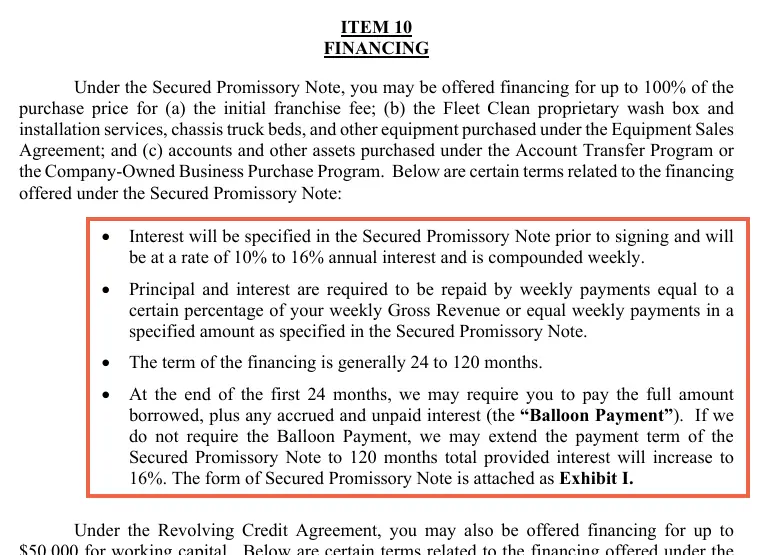
“At the end of the first 24 months, we may require you to pay the full amount borrowed, plus any accrued and unpaid interest (the “Balloon Payment”).” Fleet Clean FDD, Item 10.
“There are no interest or finance charges under the Equipment Lease.” Papa John’s FDD, Item 10.
Offers like these are the exception. In our coding of 259 Minnesota-filed FDDs issued from January 2025 to August 2026, 74 (28.6%) disclosed any direct or indirect financing and 185 (71.4%) stated none. The SBA rule for variable 7(a) loans, 13 CFR 120.214(e), says SBA does not allow balloon payments, which is one clause to compare line by line against a franchisor note.
Who gets paid when a franchisor refers you to a lender?
Item 10 can disclose referral money, and the Anytime Fitness FDD does. Geneva Capital pays the franchisor 1.5% of each lease amount as a referral fee and adds another 1.5% to a guaranty pool, so a $200,000 lease sends $3,000 to the franchisor. The franchisor is also paid $1,000 for each client who enters Guidant Financial’s retirement rollover program.
Papa John’s Item 10 states the opposite: neither it nor its affiliates “receives any consideration for placing financing with any lender.” A referral fee does not make a quote unfair, but it is a reason to price the same equipment with an outside lessor or an SBA lender before signing; the Anytime Fitness fees above appear on pages 27 to 28 of its FDD.
What does pledging your home add to an SBA franchise loan?
SOP 50 10 8.1 requires a 7(a) loan to be “fully secured” by available business fixed assets where possible, and when they fall short the lender looks to personal real estate. Appendix 19 lets the lender skip a lien when equity is under 25% of the home’s market value and cap any lien at the collateral shortfall or 150% of the equity.
| Asset | Value SBA lets the lender count | Source |
|---|---|---|
| New machinery and equipment | No more than 75% of price, minus prior liens | SOP 50 10 8.1, Appendix 19 |
| Used machinery and equipment | 50% of net book value, or 80% with an orderly liquidation appraisal | SOP 50 10 8.1, Appendix 19 |
| Improved real estate | No more than 85% of market value | SOP 50 10 8.1, Appendix 19 |
| Unimproved real estate | 50% of market value | SOP 50 10 8.1, Appendix 19 |
| Accounts receivable and inventory | No more than 10% of current book value | SOP 50 10 8.1, Appendix 19 |
| Loans of $50,000 or less (7(a) Small and Express) | Collateral not required | SOP 50 10 8.1, Appendix 19 |
Applied to the Anytime Fitness example, the $139,873 to $157,936 of new fitness equipment counts for at most $104,905 to $118,452 at 75% of price, far short of a $485,396 to $814,934 loan in leased space. That shortfall is where personal real estate enters the lender’s analysis under Appendix 19, although SOP 50 10 8.1 also says a request “must not be declined solely because collateral is inadequate.”
Owners of 20% or more must sign an unlimited full guaranty under SOP 50 10 8.1, and a non-owner spouse signs the collateral documents for jointly held property. Our franchise personal guarantee study found 239 of 259 FDDs also require owners to guarantee the franchise agreement itself.
What do the IRS and Labor Department require before a ROBS buys your franchise?
A ROBS is equity, not a loan: rollover funds move into a new 401(k) plan that buys stock in your C corporation. The IRS calls ROBS questionable but “not considered an abusive tax avoidance transaction,” and the Labor Department rule at 29 CFR 2550.408e lets a plan buy employer stock only for adequate consideration and with no commission charged to the plan.
| Requirement | What the rule says | Source |
|---|---|---|
| Structure | The plan “uses the rollover assets to purchase the stock of the new C Corporation business” | IRS ROBS Compliance Project page |
| Price paid by the plan | Adequate consideration: for stock with no market, fair market value set in good faith by the trustee or named fiduciary (ERISA section 3(18)) | 29 CFR 2550.408e(d) |
| Commissions | No commission charged to the plan; an appraisal fee is not a commission | 29 CFR 2550.408e(a)(2) and (e) |
| If the price fails | The stock exchange is a prohibited transaction unless ERISA 408(e) is met; correction can mean redeeming the stock at fair market value plus lost earnings | IRS memorandum, October 1, 2008 |
| Annual return | The Form 5500-EZ exception for plans under $250,000 does not apply; Form 5500 is still required | IRS ROBS Compliance Project page |
| Adding an SBA loan | Full unconditional guaranty from the plan sponsor; IRS favorable determination letter; “SBA loan proceeds may not be used for any 401(k) plan formation costs”; the 401(k) cannot guaranty the loan | SOP 50 10 8.1 |
| Setup cost in one disclosed program | $4,995 setup plus $149 a month for plan administration (Guidant Financial) | Anytime Fitness FDD, Item 10 |
The IRS reports that most ROBS businesses in its compliance project “either failed or were on the road to failure with high rates of bankruptcy,” without giving counts. Its 2008 memorandum notes that “franchises are often the business form of choice” for these plans, so the valuation and filing rules land squarely on franchise buyers.
How long does each kind of franchise debt last, and what does early payoff cost?
Franchise debt runs from 24 months on a franchisor note to 25 years on SBA-financed real estate, and the costs cluster at the start: SBA’s upfront fee is due at approval, and loans of 15 years or longer owe SBA 5%, 3% or 1% of any prepayment over 25% of the balance in years 1 to 3 under SOP 50 10 8.1.
- Day 0: SBA upfront fee of 2%, 3% or 3.5% of the guaranteed portion (FY2027, Notice 5000-881797).
- Month 1: first variable-rate change allowed, then no more often than monthly (13 CFR 120.214(a)).
- Years 1 to 3: SBA prepayment fee on loans of 15 years or longer, 5%, then 3%, then 1% of the amount prepaid (SOP 50 10 8.1).
- Month 24: Fleet Clean may require the Balloon Payment on its Secured Promissory Note (Item 10).
- Month 36: Fleet Clean’s revolving credit of up to $50,000 at 10% must be fully repaid (Item 10).
- Month 48: Papa John’s equipment lease ends with a single $50 payment (Item 10).
- Month 60: the longest Geneva equipment lease term in the Anytime Fitness FDD (Item 10).
- Year 10: the 7(a) limit for working capital and leasehold improvements, and Fleet Clean’s 120-month maximum.
- Year 25: the longest term for real estate under 7(a) and 504 (SOP 50 10 8.1).
Where do common franchise loan claims differ from SBA rules?
Four claims in current top-ranking franchise financing guides do not match the primary text. The table states each claim neutrally, names the type of page and its date, and sets it against SOP 50 10 8.1, 13 CFR 120.214 or SBA’s own loan data, so a reader can check the rule before a lender meeting.
| Claim in circulation | What the primary source says | Source |
|---|---|---|
| A franchise marketplace guide (updated April 2025): SBA guarantees up to 85% of the loan | 85% applies only to 7(a) loans of $150,000 or less; 75% above that; 50% on SBA Express | SOP 50 10 8.1, Appendix 16 |
| A loan comparison page (updated June 2026): SBA 7(a) minimum interest rate of 10% | SBA sets maximum spreads, not minimums; the median franchise-coded 7(a) rate was 9.00% in April to June 2026 | 13 CFR 120.214; SBA FOIA files |
| A bank article (February 2026): SBA down payment of up to 20% of project costs | A start-up 7(a) needs 10%; 504 needs 10%, 15% or 20% depending on business age and property type | SOP 50 10 8.1 |
| Several guides: SBA requires a credit score of 650, 680 or 690 | The SOP sets no consumer score minimum, and a lender may not cite its credit score policy as the sole reason credit is unavailable elsewhere | SOP 50 10 8.1, credit elsewhere test |
Which financing route matches your project?
Match the route to the asset and the dollar amount first, then compare quotes. The thresholds below come from SOP 50 10 8.1, 13 CFR 120.214 at a 7.00% prime rate and Item 10 of three 2026 FDDs. This page is general information, not legal, financial or investment advice; ask each lender for a written term sheet and have a franchise attorney read any Item 10 note.
| If your situation is | Consider | Threshold to check |
|---|---|---|
| Most of the cost is land or a building you will occupy | SBA 504, or a 7(a) with a real estate term | 10% to 20% contribution; terms up to 25 years |
| A new business buying a car wash, hotel or other special purpose property | SBA 504 | 20% contribution; debenture no more than 30% |
| Fee, build-out and working capital in leased space | SBA 7(a) | 10% start-up injection; 10-year maximum for working capital and leasehold improvements |
| Total need of $500,000 or less and a lender with Express authority | SBA Express | 50% guaranty; $0 upfront fee for veteran-owned borrowers in FY2027 |
| Your Item 10 offers a franchisor note | Compare it against an SBA quote | Fleet Clean’s 10% to 16% versus SBA caps of 10.00% to 13.50% at 7.00% prime |
| You meet a bank’s conventional credit standards | Conventional bank loan | SBA treats such a project as ineligible |
| Retirement savings are your main equity | ROBS, with a valuation and an annual Form 5500 | Adequate consideration under 29 CFR 2550.408e |
| Home equity is under 25% of market value | Expect no SBA lien on the home | SOP 50 10 8.1, Appendix 19 |
Total project cost is the starting number for every row. Our Item 7 initial investment dataset gives the low and high estimate for 259 brands to plug into the 10%, 15% or 20% rules above.
How we compiled this
We read SBA SOP 50 10 8.1 (effective October 1, 2026), SBA Information Notice 5000-881797, 13 CFR 120.214, 29 CFR 2550.408e, the IRS ROBS compliance page and its October 1, 2008 memorandum, FRED prime-rate data, and Items 7 and 10 of three Franchise Disclosure Documents filed with Minnesota CARDS in 2026, all accessed in November 2026. Loan counts, sizes and rates come from our analysis of SBA’s 7(a) and 504 FOIA files as of June 30, 2026. We left out lender advertising, credit-score claims absent from SBA rules, all Item 19 data and every borrower and franchisee name.
Frequently asked questions
Can you finance a franchise fee?
Often, yes. SBA 7(a) proceeds can pay the initial franchise fee as part of total project cost, and some franchisors lend it directly: the Fleet Clean FDD issued April 30, 2026 offers a note for up to 100% of the fee at 10% to 16%. Most franchisors do not, though; 185 of 259 FDDs we coded state no financing in Item 10.
What credit score do you need for a franchise loan?
SBA SOP 50 10 8.1 sets no minimum consumer credit score, and it bars a lender from citing its score policy as the only reason credit is unavailable elsewhere. Individual programs do set floors: the Anytime Fitness FDD amended September 14, 2026 lists 680 for one unsecured program and 700 for equipment leasing to a new business. Ask each lender for its written minimum.
Does the SBA lend to every franchise brand?
No. Under SOP 50 10 8.1, a brand that meets the FTC definition of a franchise must appear on the SBA Franchise Directory before a lender can approve or submit the loan. SBA says the listing is not an endorsement. If your brand is missing, the lender can explain how the franchisor applies to be added, which delays the loan until SBA lists it.
Do you have to personally guarantee a franchise loan?
For SBA loans, yes if you own 20% or more: SOP 50 10 8.1 requires an unlimited full guaranty from each such owner. Franchisor and lessor programs add their own: Fleet Clean makes all owners personally liable on its note, and the Geneva equipment lease in the Anytime Fitness FDD requires each owner and spouse to guarantee it.
Can I use my 401(k) to buy a franchise?
Through a ROBS plan, yes, but the money becomes stock in your C corporation rather than a loan. The plan must pay adequate consideration under 29 CFR 2550.408e, the IRS says Form 5500 is required every year, and an SBA lender will want the plan sponsor’s full guaranty plus an IRS favorable determination letter. The IRS found most ROBS businesses it studied failed.
How large can an SBA franchise loan be?
A standard 7(a) loan can reach $5,000,000 with SBA guaranteeing up to $3,750,000, SBA Express stops at $500,000, and a 504 debenture is limited to $5,000,000 per business, or $5,500,000 for small manufacturers. Actual loans run smaller: the median franchise-coded 7(a) loan was $394,000 in FY2026 through June 30, 2026, per SBA’s FOIA files.
Sources
- SOP 50 10 8.1, Lender and Development Company Loan Programs, effective October 1, 2026, U.S. Small Business Administration (version page), accessed November 3, 2026.
- Information Notice 5000-881797, 7(a) Fees Effective October 1, 2026 for Fiscal Year 2027, U.S. Small Business Administration, accessed November 3, 2026.
- 13 CFR 120.214, What conditions apply for variable interest rates?, eCFR, accessed November 3, 2026.
- 29 CFR 2550.408e, Statutory exemption for acquisition or sale of qualifying employer securities, eCFR (U.S. Department of Labor rule), accessed November 3, 2026.
- Bank Prime Loan Rate (DPRIME), Board of Governors of the Federal Reserve System via FRED, accessed November 3, 2026.
- Rollovers as Business Start-Ups Compliance Project, Internal Revenue Service, page reviewed November 16, 2025, accessed November 3, 2026.
- Guidelines regarding rollovers as business start-ups, memorandum of October 1, 2008, Internal Revenue Service, accessed November 3, 2026.
- 7(a) and 504 FOIA loan files, as of June 30, 2026, U.S. Small Business Administration, accessed through our research reports, October 2026.
- Fleet Clean Franchise Disclosure Document, issued April 30, 2026, FW Fleet Clean, LLC, Minnesota CARDS document 36661-202605-04, Item 7 and Item 10, accessed November 3, 2026.
- Anytime Fitness Franchise Disclosure Document, issued March 31, 2026, as amended September 14, 2026, Anytime Fitness Franchisor LLC, Minnesota CARDS document 37264-202609-04, Item 7 and Item 10, accessed November 3, 2026.
- Papa John’s Franchise Disclosure Document, issued March 30, 2026, Papa John’s Franchising, LLC, Minnesota CARDS document 35810-202604-11, Item 10, accessed November 3, 2026.