A Jamba Juice franchise, sold as Jamba since June 2019, costs $480,850 to $941,300 for a traditional store without a drive-thru, including the $35,500 franchise fee, under the FDD issued March 27, 2026.
The same Item 7 prints $517,000 to $960,700 with a drive-thru, $249,025 to $825,200 for a non-traditional site and $472,375 to $1,811,400 for an Auntie Anne’s co-branded store. The seller is Jamba Juice Franchisor SPV LLC, an indirect subsidiary of GoTo Foods LLC, formerly Focus Brands LLC, according to Item 1 of the Jamba Franchise Disclosure Document, issued March 27, 2026.
Key takeaways
- Four Item 7 tables: the cheapest low end is $249,025 (non-traditional) and the highest high end is $1,811,400 (Auntie Anne’s co-branded), per the March 27, 2026 FDD, Item 7.
- Fees: $35,500 initial fee ($20,000 under VetFran), 6% royalty and a 3% Advertising Contribution on Net Sales, plus at least 1% local marketing each quarter (Items 5 and 6).
- Owner: GoTo Foods, the former Focus Brands, bought Jamba, Inc. for $13.00 per share, a deal valued at about $200 million, and closed on September 13, 2018 (SEC Form 8-K).
- System size: US franchised stores fell from 735 at the start of 2023 to 709 at the end of 2025; California alone went from 372 to 356 in 2025 (Item 20, Tables 1 and 3).
- Pipeline: 199 franchise agreements were signed but not opened at December 31, 2025, with 37 openings projected for 2026 (Item 20, Table 5).
Jamba Juice or Jamba: who signs your franchise agreement in 2026?
Your counterparty is Jamba Juice Franchisor SPV LLC, a Delaware company organized on September 14, 2018, with its office at 5620 Glenridge Drive NE, Atlanta. It offered franchises under the Jamba Juice mark from October 2018 to June 2019 and under the Jamba mark since. Item 1 says new franchises will not use the Jamba Juice mark and that existing stores are expected to convert gradually.
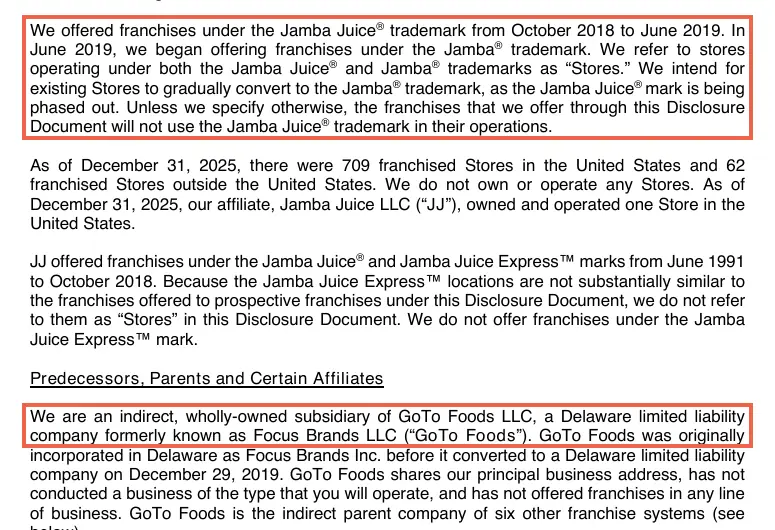
The franchisor owns no stores. Its affiliate Jamba Juice LLC, the 1991 company first incorporated as “Juice Club, Inc.”, owned and operated one US store at December 31, 2025, against 709 franchised US stores and 62 franchised stores abroad. Jamba Juice Express units are excluded from every count because Item 1 treats them as a different concept that is no longer offered.
| Entity named in the FDD | Role for a franchisee | Where stated |
|---|---|---|
| Jamba Juice Franchisor SPV LLC | Signs the Franchise Agreement and collects fees | Item 1, p.1 |
| Jamba Juice Funding LLC | Direct parent of the franchisor | Item 1, p.2 |
| GoTo Foods LLC (formerly Focus Brands LLC) | Indirect parent; provides support under a management agreement; franchise sales agent | Items 1 and 21 |
| GoTo Foods Systems LLC | Guarantees the franchisor’s obligations; audited statements in Exhibit A | Items 1 and 21 |
| FSC LLC (“GoTo Supply”) | Runs procurement, distribution and quality assurance | Items 1 and 8 |
| Jamba Juice LLC | Predecessor; runs the gift card program for 3% of gross gift card sales | Item 1, p.2 |
| Roark Capital Management, LLC funds | Control link to Inspire Brands and other Affiliated Programs | Item 1, p.4 |
The ownership chain changed in two steps. On August 2, 2018, Focus Brands Inc. announced a merger agreement to buy Jamba, Inc. for $13.00 per share in cash, about $200 million, and described itself as majority owned by affiliates of Roark (Exhibit 99.2 to Jamba’s 8-K). The merger closed on September 13, 2018. Focus Brands later took the GoTo Foods name, a change Restaurant Dive reported on February 20, 2024.
GoTo Foods is the indirect parent of seven franchisors in the 2026 FDD: Jamba, Auntie Anne’s, Carvel, Cinnabon, Schlotzsky’s, Moe’s and McAlister’s. For a buyer, the practical result is that a sister brand, Auntie Anne’s, is the only co-brand with its own Item 7 table in the Jamba document. Fund ownership patterns across franchisors are tracked in our private equity franchise ownership report.
Four formats, four Item 7 totals: which table is yours?
The table depends on the site, not on preference. A Traditional Store sits in an urban in-line space or a freestanding building and comes with or without a drive-thru; a Non-Traditional Store sits in a captive venue such as an airport, campus, gym or a retail center above 350,000 square feet; a co-branded store adds a second franchise from Auntie Anne’s. Item 7 puts the typical traditional or non-traditional store at 1,200 square feet.
| Format (Item 1 term) | Typical site | Item 7 total | Paid to franchisor or affiliates | Area of Protection (Item 12) | Source |
|---|---|---|---|---|---|
| Traditional, no drive-thru | Urban in-line or freestanding, about 1,200 sq ft | $480,850 to $941,300 | $35,727 to $62,702 | Up to a one-block radius urban, one-mile radius non-urban | Cover; Item 7 p.34 |
| Traditional, drive-thru | Freestanding with lane | $517,000 to $960,700 | $35,727 to $62,702 | Same as above | Cover; Item 7 p.35 |
| Non-Traditional | Airport, stadium, campus, hospital, health club, big box | $249,025 to $825,200 | $35,727 to $62,702 | None | Cover; Item 7 p.37 |
| Auntie Anne’s Co-Branded | About 1,270 sq ft, Streetside or Other Location | $472,375 to $1,811,400 | $71,227 to $125,102 | Streetside only, against other co-branded Streetside units | Cover; Item 7 p.38 |
| Multi-Unit Addendum, 3 to 10 Traditional | Fees only, before any build-out | $106,500 to $355,000 | $106,500 to $355,000 | Per store | Cover; Item 7 p.43 |
Item 7 totals range from $249,025 (non-traditional low) to $1,811,400 (co-branded high). Jamba FDD issued March 27, 2026.
The widest table is the co-branded one: its build-out line alone runs $210,000 to $1,083,400. The cover page says “There are five types of Stores” but names three; Item 1 resolves this as Traditional (two formats), Non-Traditional and Co-Branded. All 23 line items for the four single-store tables are in jamba-item7-by-format-2026.csv, and our sums reconcile to every printed total.
| Item 7 line | Traditional, no drive-thru | Traditional, drive-thru | Non-Traditional | Co-Branded |
|---|---|---|---|---|
| Initial Franchise Fee | $35,500 | $35,500 | $35,500 | $71,000 |
| Construction and Build Out | $212,000 to $418,500 | $212,000 to $396,000 | $98,600 to $405,000 | $210,000 to $1,083,400 |
| Equipment Package | $142,000 to $176,000 | $146,300 to $180,250 | $29,000 to $100,000 | $60,000 to $207,000 |
| Exterior Signage | $6,500 to $16,000 | $25,500 to $62,000 | $6,000 to $25,500 | $5,000 to $65,000 |
| Architect/Engineer | $6,200 to $15,300 | $13,900 to $35,000 | $4,000 to $22,350 | $7,000 to $50,000 |
| Computer System | $8,800 to $24,000 | $13,400 to $31,300 | $13,400 to $31,300 | $10,500 to $32,000 |
| Opening Inventory | $5,000 to $50,000 | $5,000 to $10,000 | $5,000 to $25,000 | $11,000 to $15,000 |
| Additional Funds, 3 months | $15,000 to $43,000 | $15,000 to $43,000 | $10,000 to $28,000 | $15,000 to $54,000 |
| Total | $480,850 to $941,300 | $517,000 to $960,700 | $249,025 to $825,200 | $472,375 to $1,811,400 |
Where does the drive-thru add money, and where does it cost less?
The drive-thru table starts $36,150 higher than the no-drive-thru table ($517,000 against $480,850) but ends only $19,400 higher ($960,700 against $941,300). Signage, design and permits push the drive-thru up; lower high-end estimates for build-out, millwork and opening inventory pull it back. The line-by-line differences below come from Item 7, pages 34 to 36.
| Item 7 line | Low-end change | High-end change | Reading |
|---|---|---|---|
| Exterior Signage | +$19,000 | +$46,000 | Lane and pylon signage on a freestanding site |
| Architect/Engineer | +$7,700 | +$19,700 | Site and lane design |
| Permitting | +$600 | +$17,500 | High end reaches $21,000 |
| Computer System | +$4,600 | +$7,300 | Extra order points |
| Equipment Package | +$4,300 | +$4,250 | |
| Menu Board, Graphics, Interior Signage | $0 | +$10,700 | |
| Construction and Build Out | $0 | -$22,500 | $396,000 high, against $418,500 |
| Millwork | $0 | -$17,500 | |
| Furniture | $0 | -$5,950 | |
| Opening Inventory | $0 | -$40,000 | $10,000 high, against $50,000 |
| Smallwares and Insurance | -$50 | -$100 | |
| Net difference | +$36,150 | +$19,400 | Matches the printed totals |
The $40,000 gap in the opening inventory high end is the largest single offset, and the FDD does not explain it in the notes we read. If a lender or landlord uses the no-drive-thru table for a drive-thru site, the low-end budget is $36,150 short before any site work. Ask the franchise development team which table its 2025 openings were built under, since Item 7 Note 13 prices rent as one month only, between $4,000 and $15,000.
What does Jamba bill before opening, then every week and month?
Before opening, the main payment is the $35,500 Initial Franchise Fee, non-refundable, with $20,000 for qualifying veterans under the VetFran program. Item 5 also says franchisees actually paid between $0 and $17,750 in fees during 2025, which shows discounts are granted case by case. After opening, 10% of Net Sales goes to royalty, the Ad Fund and a local marketing floor.
| Fee | Amount in the 2026 FDD | When due | Item |
|---|---|---|---|
| Initial Franchise Fee | $35,500; $71,000 co-branded; $20,000 VetFran | At signing | 5 |
| Plan review (third and later plan sets) | $2,500 per set | On review | 5 |
| Management Training, third store onward | $3,000 ($4,000 co-branded) | Before training | 5 |
| Grand opening spend | At least $10,000 ($6,000 to $25,000 co-branded) | 90 days before to 90 days after opening | 5 |
| Royalty Fee | 6% of Net Sales | Weekly | 6 |
| Advertising Contribution | Currently 3% of Net Sales | Weekly | 6 |
| Local Marketing Obligation | At least 1% of Net Sales per quarter; Ad Fund plus local capped at 5% | Quarterly | 6 |
| Late Reporting Fee | $50 per week | On invoice | 6 |
| Interest | Lesser of 1.5% per month or legal maximum | On invoice | 6 |
| Remodel Site Survey and Design | $1,200 to $6,000; remodel every ten years | As incurred | 6 |
Fixed technology charges sit on top of the percentage fees. Using only the monthly amounts Item 6 prints, a store that buys its POS hardware (CapEx Program) pays $447 to $824 a month, and a store that leases it (HaaS Program) pays $591 to $1,172. Online ordering also carries a 0.04% per-transaction charge that this arithmetic leaves out.
| Monthly line (Item 6) | CapEx low | CapEx high | HaaS low | HaaS high |
|---|---|---|---|---|
| POS license and lease | $227 | $454 | $371 | $802 |
| POS System Support Fee | $100 | $250 | $100 | $250 |
| Loyalty App Fee | $54 | $54 | $54 | $54 |
| Online Ordering Fee (fixed part) | $66 | $66 | $66 | $66 |
| Monthly total | $447 | $824 | $591 | $1,172 |
| Per year, plus $170 Learning Management System | $5,534 | $10,058 | $7,262 | $14,234 |
How these charges compare with other systems is covered in our franchise technology requirements report, which reads the same Item 6 and Item 11 rows across filed FDDs.
What does GoTo Foods ownership mean on the supply and support side?
Most of what you buy runs through GoTo Foods affiliates. Item 8 estimates that purchases under Jamba’s Standards are about 90% of start-up spending and about 95% of operating purchases. In fiscal 2025 the franchisor received $5,687,202 from Approved Suppliers, 16% of its total revenue of $35,431,597, figures the FDD labels unaudited.
| Ownership effect | What the FDD says | Item |
|---|---|---|
| Supplier payments to the franchisor | $5,687,202 in fiscal 2025, 16% of franchisor revenue | 8 |
| Distribution case fees, all GoTo brands | About $13,803,727 collected by GoTo Foods Systems and FSC in fiscal 2025 | 8 |
| Help desk and network fees to Jamba Juice LLC | $788,700 from franchisees in fiscal 2025 | 8 |
| Who guarantees the franchisor | GoTo Foods Systems LLC; GoTo Foods statements are disclosure only | 21 |
| Referral fee | $5,000 to a franchisee or broker who introduces an approved new buyer | 1 |
| Financing | None offered directly or indirectly; brand is in the SBA Franchise Directory | 10 |
The SBA Franchise Directory dated October 28, 2026 lists Jamba under code S0897 with no addendum note. How rebate income like the $5,687,202 figure compares across systems is in our franchise supplier rebates report.
Is the 709-store system growing or contracting, and where?
It is contracting. Franchised US stores went from 735 to 733 in 2023, to 726 in 2024 and to 709 in 2025. In each year exits outnumbered openings: 34 against 32, 50 against 43 and 46 against 29. Exits here are terminations plus non-renewals plus other closures from Item 20, Table 3; no store was reacquired by the franchisor in the three years.
Exits exceeded openings each year: 34 vs 32 (2023), 50 vs 43 (2024), 46 vs 29 (2025). Jamba FDD, Item 20, Table No. 3, issued March 27, 2026.
| Year | Start | Opened | Terminations | Non-renewals | Ceased, other | End | Transfers (Table 2) |
|---|---|---|---|---|---|---|---|
| 2023 | 735 | 32 | 28 | 6 | 0 | 733 | 55 |
| 2024 | 733 | 43 | 46 | 3 | 1 | 726 | 28 |
| 2025 | 726 | 29 | 42 | 4 | 0 | 709 | 43 |
California explains most of the 2025 decline. It held 356 of 709 franchised stores at year-end, 50.2%, and lost a net 16 stores while the system lost a net 17. Texas added a net 3, and 36 jurisdictions (35 states plus the District of Columbia) had at least one store. The full state table is in jamba-item20-franchised-stores-by-state-2025.csv.
| State | End of 2024 | Opened 2025 | Exits 2025 | End of 2025 | Signed, not opened (Table 5) |
|---|---|---|---|---|---|
| California | 372 | 9 | 25 | 356 | 71 |
| Texas | 41 | 6 | 3 | 44 | 21 |
| Arizona | 36 | 1 | 2 | 35 | 2 |
| Oregon | 28 | 2 | 1 | 29 | 9 |
| Hawaii | 27 | 1 | 0 | 28 | 0 |
| Washington | 24 | 0 | 3 | 21 | 3 |
| Virginia | 4 | 0 | 1 | 3 | 10 |
The forward view is thinner than the backlog. Table 5 shows 199 signed agreements not yet open but projects only 37 new franchised stores in 2026, because multi-unit deals are built over several years. Item 20 also says former franchisees signed confidentiality clauses in the past three years. How such backlogs convert across brands is in our franchise development backlog report.
Buying a Jamba Juice franchise for sale: what does a resale add?
Resales are common: Item 20 counts 55 transfers in 2023, 28 in 2024 and 43 in 2025, and California accounted for 41 of the 2025 transfers. A buyer pays the seller’s price plus Jamba’s transfer charges, then inherits the remodel cycle and the conversion from Jamba Juice to Jamba signage if the store still carries the old mark.
| Charge or rule | FDD wording | At today’s $35,500 fee | Item |
|---|---|---|---|
| Control Transfer fee | 50% of then-current Initial Franchise Fee | $17,750 | 6 |
| Related-party or non-control transfer | 10% of then-current fee | $3,550 | 6 |
| POS System Administration at transfer | $1,500 to $2,000 | $1,500 to $2,000 | 6 |
| Renewal fee | 20% of then-current fee, one 20-year renewal | $7,100 | 6, 17 |
| Relocation fee | 10% of then-current fee | $3,550 | 6 |
| Control Transfer trigger | More than 20% of ownership, the store, or control | Not a dollar figure | 6 |
| Post-term non-compete | 24 months, within 3 miles of your site or any Store | Not a dollar figure | 17 |
The listing price of a resale is not in the FDD; Item 20 only counts the transfers. Before an offer, ask the seller for the remaining years on the 20-year term in Item 17 and the date of the last ten-year remodel. Typical resale terms across systems are in our franchise transfer fees report and our guide to a franchise for sale.
How do Jamba’s terms line up against Smoothie King and Tropical Smoothie Cafe?
All three charge a 6% royalty on sales. Jamba has the longest term, 20 years, and the smallest US franchised count of the three at the end of 2025. Its traditional Item 7 low end, $480,850, is above both rivals’ in-line low ends, and its 3% brand fund matches Smoothie King’s and sits below Tropical Smoothie Cafe’s 5%. Each row cites the brand’s own 2026 FDD.
| Term | Jamba | Smoothie King | Tropical Smoothie Cafe | Source |
|---|---|---|---|---|
| Initial fee | $35,500 | $30,000 traditional | $35,000 | Jamba Item 5; SK Item 5; TSC Item 5 |
| Royalty | 6% of Net Sales | 6% of Gross Sales (Operating Fee) | 6% of Gross Sales | Item 6 of each FDD |
| Brand fund | 3% of Net Sales | 3% National Marketing | 5% National Marketing | Item 6 of each FDD |
| In-line or no-drive-thru Item 7 | $480,850 to $941,300 | $329,850 to $683,715 | $275,500 to $770,500 | Item 7 of each FDD |
| Initial term | 20 years | 10 years | 15 years | Item 17 of each FDD |
| US franchised units, end of 2025 | 709 | 1,200 | 1,650 | Item 20, Table 1 |
The Smoothie King and Tropical Smoothie Cafe rows come from our readings of those filings, issued April 8, 2026 and April 17, 2026 as amended June 10, 2026. The cost breakdown by format for the first is on our Smoothie King franchise cost page, and the food-kitchen side of the second is on our Tropical Smoothie Cafe franchise page.
Which Jamba format fits your cash, site and growth plan?
Start from the site you can get, then check the cash. GoTo Foods’ Jamba development page asks for at least $120,000 in liquid capital and $300,000 in net worth, which is below the low end of every single-store Item 7 total, so most buyers finance the rest. Item 10 offers no in-house financing.
| If your situation is | Then the FDD points to | Check first |
|---|---|---|
| A lease offer inside an airport, campus, gym or big box store | Non-Traditional Store, $249,025 to $825,200 | No Area of Protection under Item 12; venue landlord terms |
| A freestanding pad with a lane | Traditional with drive-thru, $517,000 to $960,700 | Permitting high end of $21,000 and exterior signage up to $62,000 |
| An in-line space of about 1,200 sq ft | Traditional without drive-thru, $480,850 to $941,300 | Area of Protection capped at one block urban or one mile non-urban |
| You want two menus in one unit | Auntie Anne’s Co-Branded, $472,375 to $1,811,400 | Two franchise agreements and Auntie Anne’s own FDD |
| You plan 3 to 10 stores | Multi-Unit Addendum, $106,500 to $355,000 in fees at signing | All fees prepaid and non-refundable if a deadline is missed |
| You are a qualifying veteran | VetFran fee of $20,000 per Traditional or Non-Traditional store | Proof of service; our veteran franchise discounts report |
Item 11 estimates three to 12 months from signing to opening, and Item 1 requires two full-time managers who finish the Management Training Program. A buyer comparing these formats with other franchise budgets can use our franchise costs guide. This page is information, not legal, financial or investment advice.
What older Jamba Juice franchise numbers are still in circulation?
Several ranking pages still print figures from earlier filings or announcements. The March 27, 2026 FDD replaces each one below; the differences matter most for the no-drive-thru total, where the high end moved by more than $135,000 against the most widely repeated range.
| What a ranking page says | What the primary source says | Primary source |
|---|---|---|
| A 2018 franchise announcement: $35,000 fee, $236,100 to $501,800 investment | $35,500 fee; $480,850 to $941,300 without drive-thru | Items 5 and 7, March 27, 2026 FDD |
| A cost guide labelled 2026: $468,850 to $806,250 | $480,850 to $941,300 without drive-thru | Item 7, p.34 |
| A 2025 review: 726 franchised US stores | 709 at December 31, 2025 | Item 20, Table 1 |
| A lender page: $125,000 liquid capital and $400,000 net worth | $120,000 and $300,000 on the franchisor’s own page | GoTo Foods development page, accessed November 10, 2026 |
| “Jamba Juice is owned by Focus Brands” | GoTo Foods LLC, formerly known as Focus Brands LLC | Item 1, p.1 |
How we compiled this
We read the 381-page Jamba Franchise Disclosure Document, issued March 27, 2026, retrieved from the Minnesota CARDS registry, and two Jamba, Inc. filings on SEC EDGAR from August and September 2018, all in November 2026. Item 7 totals were re-added from every line item; Item 20 state rows were summed against the printed totals. Comparison rows come from the Smoothie King and Tropical Smoothie Cafe FDDs. Item 19 numbers were excluded by site policy.
Frequently asked questions
How much does it cost to open a Jamba Juice franchise?
Under the Jamba FDD issued March 27, 2026, Item 7 totals are $480,850 to $941,300 for a traditional store without a drive-thru, $517,000 to $960,700 with one, $249,025 to $825,200 for a non-traditional site and $472,375 to $1,811,400 for an Auntie Anne’s co-branded store. Each total includes the initial fee and three months of additional funds.
How much is the Jamba Juice franchise fee?
Item 5 sets the Initial Franchise Fee at $35,500 for a traditional or non-traditional store and $71,000 for an Auntie Anne’s co-branded store, of which $35,500 goes to Auntie Anne’s. Qualifying veterans pay $20,000 under VetFran. The fee is non-refundable, and franchisees actually paid between $0 and $17,750 during 2025.
How much does a Jamba Juice franchise owner make?
This site does not publish earnings figures. Item 19 of the March 2026 FDD covers fiscal 2025 for traditional franchised stores that reported sales in all 52 weeks and excludes non-traditional and co-branded stores. Owner income then depends on the 6% royalty, 3% Ad Fund and 1% local floor in Item 6, rent, labor and debt on the Item 7 investment.
Who owns Jamba Juice now?
Item 1 of the 2026 FDD names Jamba Juice Franchisor SPV LLC as franchisor, an indirect wholly-owned subsidiary of GoTo Foods LLC, formerly Focus Brands LLC. Focus Brands bought Jamba, Inc. for $13.00 per share, about $200 million, closing September 13, 2018, per SEC filings. Item 1 also links the brand to funds managed by Roark Capital Management.
Why did Jamba Juice change its name to Jamba?
Item 1 records the switch but gives no reason: the franchisor offered franchises under the Jamba Juice mark from October 2018 to June 2019 and under the Jamba mark from June 2019. New franchises do not use the Jamba Juice mark, and existing stores are expected to convert gradually as that mark is phased out.
Can you buy a Jamba Juice franchise for sale instead of building one?
Yes. Item 20 lists 43 transfers of franchised stores in 2025, 41 of them in California. A Control Transfer costs 50% of the then-current Initial Franchise Fee, $17,750 at today’s $35,500 fee, plus a $1,500 to $2,000 POS administration fee. Asking prices come from sellers, not from the FDD.
What liquid capital and net worth does Jamba require?
The GoTo Foods Jamba development page, accessed November 10, 2026, lists a minimum of $120,000 in liquid capital and $300,000 in net worth. The FDD itself does not set these thresholds, and Item 10 says the franchisor offers no direct or indirect financing, though Jamba appears in the SBA Franchise Directory as code S0897.
Sources
- Jamba Franchise Disclosure Document, issued March 27, 2026, Items 1, 5 to 8, 10 to 12, 17, 19 to 21. Minnesota CARDS doc 35789-202604-08. Accessed November 10, 2026.
- Jamba, Inc. Form 8-K, Exhibit 99.2, press release dated August 2, 2018, SEC EDGAR. Accessed November 10, 2026.
- Jamba, Inc. Form 8-K, date of report September 13, 2018, SEC EDGAR. Accessed November 10, 2026.
- GoTo Foods, Jamba franchise development page. Accessed November 10, 2026.
- Restaurant Dive, Focus Brands renames itself GoTo Foods, February 20, 2024. Accessed November 10, 2026.
- U.S. Small Business Administration, SBA Franchise Directory, file dated October 28, 2026. Accessed November 10, 2026.
- Smoothie King Franchise Disclosure Document, issued April 8, 2026, Minnesota CARDS. Accessed November 2, 2026.
- Tropical Smoothie Cafe Franchise Disclosure Document, April 17, 2026, as amended June 10, 2026, Minnesota CARDS. Accessed November 3, 2026.
- Federal Trade Commission, A Consumer’s Guide to Buying a Franchise. Accessed November 10, 2026.