
Franchisee vs franchisor: the franchisor owns the brand and operating system and grants the franchise, while the franchisee pays for that right, runs the local business as a separate company and follows the franchisor’s contract and manual.
The FTC Franchise Rule, 16 CFR 436.1 defines each role in one line. A franchisee is “any person who is granted a franchise,” and a franchisor is “any person who grants a franchise and participates in the franchise relationship,” subfranchisors included. Everything else each side does, pays or may demand is written into one of the 23 numbered Items of the Franchise Disclosure Document (FDD).
Key takeaways
- Under 16 CFR 436.1(i) and (k), the franchisee is the party granted the franchise and the franchisor is the party that grants it and stays in the relationship; a subfranchisor counts as a franchisor.
- The franchisee’s duties sit in FDD Item 9, a 25-row table (rows a to y), and the franchisor’s in Item 11, which must open “Except as listed below, [the franchisor] is not required to provide you with any assistance” (16 CFR 436.5(i) and (k)).
- Money mostly flows to the franchisor: in 239 FDDs with a percentage royalty the median royalty was 6% of sales, and 206 of 259 FDDs added a brand fund, median 2% (Minnesota CARDS filings, issued 2025 to 2026).
- 97.3% of 259 FDDs require or provide for a personal guarantee from the franchisee’s owners, while only 4.2% let the franchisor end the agreement without cause (Minnesota CARDS filings, 2025 to 2026).
- 81.1% of 259 FDDs promise the franchisee a protected area, yet 85.3% print the federal sentence “You will not receive an exclusive territory” (Minnesota CARDS filings, 2025 to 2026).
- The franchisor must deliver the FDD at least 14 calendar days before the franchisee signs or pays anything (16 CFR 436.2(a)).
| Key number | What it measures | Source |
|---|---|---|
| 14 calendar days | Minimum time between receiving the FDD and signing or paying | 16 CFR 436.2(a) |
| 25 rows | Franchisee obligations in the Item 9 table, rows a to y | 16 CFR 436.5(i) |
| 6% | Median royalty, 239 FDDs with a percentage royalty | Minnesota CARDS, Item 6 |
| $49,500 | Median initial franchise fee, 259 FDDs | Minnesota CARDS, Item 5 |
| 97.3% | FDDs requiring or providing for an owner’s personal guarantee | Minnesota CARDS, Items 15, 17 and 22 |
| 4.2% | FDDs letting the franchisor terminate without cause | Minnesota CARDS, Item 17(e) |
| 18 states and Puerto Rico | Jurisdictions with a franchise relationship law | Our relationship laws report, statutes read October 8, 2026 |
What is the difference between a franchisee and a franchisor?
The franchisor owns the trademark, writes the system and the contract, and sells franchises; the franchisee buys one franchise, puts its own money into the unit, employs the staff and pays fees back. The FTC Rule treats the franchisor as the seller that must disclose, across 23 FDD Items, and the franchisee as the buyer that receives them at least 14 calendar days before signing.
| Question | Franchisor | Franchisee | Where it is written |
|---|---|---|---|
| Legal definition | Grants a franchise and participates in the relationship | Is granted a franchise | 16 CFR 436.1(k) and (i) |
| Owns | The trademark, the system and the operations manual | Its own business entity, equipment and usually the lease | Items 13 and 14; franchise agreement |
| Drafts | The FDD and the franchise agreement | Its entity documents, lease and payroll | 16 CFR 436.2; Item 22 |
| Money | Collects the initial fee, royalty, brand fund and other fees | Pays them, plus its own build-out and payroll | Items 5, 6 and 7 |
| Staff | Employs its own corporate staff | Employs the unit’s staff | 29 CFR 103.40 |
| Sells franchises | Yes, as a franchise seller | Only its own outlet, which does not make it a franchise seller | 16 CFR 436.1(j) |
Whether a deal counts as a franchise at all is a separate question, answered by the three elements of 16 CFR 436.1(h) in our franchise definition guide. Named systems in each structure, from business format to product distribution, are sorted in our franchise examples by type.
Who does what in a franchise, Item by Item?
Each side’s duties are fixed in the FDD, not in the sales pitch. Item 9 lists the franchisee’s principal obligations in a 25-row table, and Item 11 lists what the franchisor must do before and after opening; a service missing from Item 11 is not owed. The table pairs each duty with its Item, the 16 CFR 436.5 paragraph behind it and how often 259 recent FDDs impose it.
| Duty or right | Franchisor | Franchisee | FDD Item | 16 CFR | Measured in 259 FDDs, 2025 to 2026 | Source |
|---|---|---|---|---|---|---|
| Pre-sale disclosure | Delivers the FDD and a receipt page | Reads it; cannot be asked to sign or pay for 14 days | Item 23 | 436.2(a); 436.5(w) | Applies to every covered sale | Rule text |
| Initial fee | Sets it and states any refund terms | Pays it, usually at signing | Item 5 | 436.5(e) | Median $49,500 (259 FDDs) | Minnesota CARDS |
| Ongoing fees | Sets royalty, brand fund and other fees, with any increase formula | Pays them weekly or monthly | Item 6 | 436.5(f) | Median royalty 6% of sales (239 FDDs); 87.3% list a technology charge | Minnesota CARDS |
| Supplies | Approves suppliers; may sell to franchisees and take rebates | Buys from approved sources or to spec | Item 8 | 436.5(h) | 99.2% restrict purchases; 47.9% report rebates received | Minnesota CARDS |
| Operating standards | Writes the manual and standards | Follows the manual, insurance, records, inspections and remodeling rules | Item 9 | 436.5(i) | 25 obligation rows, a to y | Rule text |
| Training and support | Provides only what Item 11 lists | Attends and usually pays trainees’ travel | Item 11 | 436.5(k) | Median 76 hours of initial training (252 FDDs); franchisee pays travel in 89.1% | Minnesota CARDS |
| Advertising | Runs the brand fund and picks the media | Contributes and may run local ads | Item 11 | 436.5(k)(4) | 79.5% require a fund contribution; 8.2% of 207 active funds are audited | Minnesota CARDS |
- Franchisor gives: FDD 14 calendar days before signing (436.2(a))
- Franchisor gives: Trademark license (Item 13)
- Franchisor gives: Training and support listed in Item 11
- Franchisor gives: Territory as defined in Item 12
- Franchisee pays: Initial fee (Item 5): median $49,500
- Franchisee pays: Royalty (Item 6): median 6% of sales
- Franchisee pays: Brand fund (Item 6): median 2% of sales
- Franchisee pays: Required purchases (Item 8), with franchisor or affiliate revenue from them in 77.2% of FDDs
Rows 8 to 16 cover the territory, the people running the unit and the end of the contract, where most disputes start.
| Duty or right | Franchisor | Franchisee | FDD Item | 16 CFR | Measured in 259 FDDs, 2025 to 2026 | Source |
|---|---|---|---|---|---|---|
| Territory | Defines it and keeps reserved channels | Gets only what Item 12 grants | Item 12 | 436.5(l) | 81.1% promise a protected area; 92.9% of those keep online sales rights | Minnesota CARDS |
| Trademarks | Owns, registers and defends the marks | Uses them only as licensed | Item 13 | 436.5(m) | No share measured | Rule text |
| Running the unit | Approves managers where the contract says so | Works in the business or hires an approved manager | Item 15 | 436.5(o) | 78.0% allow a hired manager; 23.2% require an owner full time | Minnesota CARDS |
| Term and termination | Sets the term and the grounds to end it | Renews only on the stated conditions | Item 17 | 436.5(q) | 65.6% use a 10-year term; 4.2% allow termination without cause | Minnesota CARDS |
| Personal guarantee | Requires it from owners | Owners sign, usually with no cap | Items 15, 17 and 22 | 436.5(o), (q) and (v) | 97.3% require or provide for one; 96.1% set no dollar cap | Minnesota CARDS |
| Non-compete | Imposes it | Cannot run a competing business during or after the term | Item 17, rows q and r | 436.5(q) | 88.4% have a post-term non-compete; 86.0% of those last 2 years | Minnesota CARDS |
| Speaking about the system | Discloses confidentiality clauses franchisees signed | May be bound by one | Item 20 | 436.5(t)(7) | 53.3% disclose such clauses | Minnesota CARDS |
| Franchisee groups | Lists franchisor-created and independent associations | May join one | Item 20 | 436.5(t)(8) | 5.8% list an independent association | Minnesota CARDS |
| Financial strength | Attaches audited financial statements | Reads them before signing | Item 21 | 436.5(u) | 259 of 259 attached audited statements | Minnesota CARDS |
Shares in the last column come from FDDs filed with the Minnesota Department of Commerce and issued January 24, 2025 to August 18, 2026, one per brand. The fee medians are broken out by sector in our franchise royalty rates report.
Who pays whom, and how much?
The franchisee pays and the franchisor collects. In 259 FDDs filed in Minnesota and issued in 2025 or 2026, the median initial fee was $49,500, the median royalty 6% of sales and the median brand fund 2%, and all percentage fees together reached a median 8%. Money rarely flows back: of 124 FDDs reporting supplier rebates, 16 pass some to franchisees.
| Fee | Median rate or amount | Arithmetic | Paid to the franchisor | Source |
|---|---|---|---|---|
| Royalty | 6% of sales | $100,000 x 6% | $6,000 | Item 6, 239 FDDs |
| Brand fund | 2% of sales | $100,000 x 2% | $2,000 | Item 6, 187 FDDs with a percentage fund |
| All percentage fees combined | 8% of sales | $100,000 x 8% | $8,000 | Item 6, 239 FDDs |
| Fixed recurring fees beyond royalty and fund | $5,500 a year | Flat amount | $5,500 a year | Item 6, 247 FDDs |
| Initial fee | $49,500 | Once, at signing | $49,500 | Item 5, 259 FDDs |
| Transfer fee if the franchisee sells | $10,000 | Once, per sale | $10,000 | Item 6, 245 FDDs |
| Renewal fee | $8,750 | Once, per renewal | $8,750 | Item 6, FDDs offering renewal |
The $100,000 base is a scaling unit, not a sales estimate for any brand: multiply each percentage by a unit’s actual gross sales. Any sales or earnings data a franchisor chooses to give appears only in Item 19 of its current FDD.
Royalties are not always the franchisor’s biggest line. McDonald’s reported $10,442 million in rent, $6,018 million in royalties and $88 million in initial fees from franchised restaurants in 2025 (McDonald’s Form 10-K, fiscal 2025), because its conventional franchisees pay rent on sites the company owns or leases. Across 26 US-listed franchisors the royalty line was a median 23.5% of total revenue, per our analysis of how franchisors make money.
McDonald’s collected more rent ($10,442 million) than royalties ($6,018 million) from franchised restaurants in fiscal 2025 (Form 10-K, SEC EDGAR, accessed October 2026).
What legal duties does each side owe?
The franchisor’s main legal duty before the sale is disclosure: a current FDD at least 14 calendar days before signing or payment, with audited financial statements in Item 21. After the sale, both sides owe what the franchise agreement says. The franchisee also carries the employer’s duties for its staff, and its owners usually guarantee the contract personally, with no cap in 96.1% of 259 FDDs.
| Duty | Owed by | Rule or document | Deadline or threshold |
|---|---|---|---|
| Deliver the current FDD | Franchisor | 16 CFR 436.2(a) | 14 calendar days before signing or any payment |
| Deliver agreement changes it imposed | Franchisor | 16 CFR 436.2(b) | 7 calendar days before signing the revised agreement; changes the buyer asked for are exempt |
| Attach audited financial statements | Franchisor | 16 CFR 436.5(u), Item 21 | Audited by an independent CPA; 259 of 259 sample FDDs complied |
| Leave reports to regulators unrestricted | Franchisor | FTC policy statement, July 2024; FTC Act Section 5 | Clauses barring reports to government are “unfair and unenforceable” |
| Follow the system | Franchisee | Item 9 and the franchise agreement | 25 listed obligation areas |
| Cure a default | Franchisee | Item 17(g) | Median 30 days for ordinary defaults |
| Guarantee the contract | Franchisee’s owners | Guaranty exhibit, Item 22 | No dollar cap in 96.1% of FDDs |
| Employ and pay the staff | Franchisee | 29 CFR 103.40 | Franchisor is a joint employer only if it shares or codetermines essential terms |
Unit staff work for the franchisee. Under the National Labor Relations Board rule at 29 CFR 103.40, a franchisor is a joint employer only through “substantial direct and immediate control” over essential terms of employment. The Board’s broader 2023 rule was vacated by a federal court in Texas on March 8, 2024, and withdrawn in a final rule set for Federal Register publication on February 27, 2026.
Guarantees are close to universal and rarely limited: only 3 of 247 guaranty forms cap the owner’s liability, and spouses must sign a guarantee in 35.5% of FDDs, per our franchise personal guarantee report.
This page explains disclosure rules and typical contract terms; it is not legal or financial advice. Before signing, ask a franchise attorney to read your Item 17 table against your state addendum and to say whether a state statute overrides the termination, venue or non-compete clauses.
What rights does a franchisee have, and where are they written?
A franchisee’s rights come from three places: the contract terms summarized in Items 12 and 17, relationship laws in 18 states and Puerto Rico, and federal limits such as the FTC’s July 2024 position that a contract cannot stop a franchisee reporting possible violations to regulators. The contract often grants less than buyers assume: 85.3% of 259 FDDs disclaim an exclusive territory.
| Right | Where it is written | What 259 FDDs usually say | Legal floor |
|---|---|---|---|
| Territory protection | Item 12, 436.5(l) | 81.1% protect an area; 92.9% of those keep online sales rights | No federal floor; the FDD must say whether the territory is exclusive |
| Renewal | Item 17(b) and (c) | 99.6% of 245 renewable agreements renew on the then-current agreement | Minnesota: 180 days notice of nonrenewal (Minn. Stat. 80C.14 subd. 4) |
| Protection from termination | Item 17(e) to (h) | 4.2% allow termination without cause; median cure 30 days | Minnesota: 90 days notice and 60 days to cure (subd. 3); 16 of 19 jurisdictions require cause |
| Selling the unit | Item 17(k) to (m) | 97.7% charge a transfer fee, median $10,000 | 8 jurisdictions limit a franchisor’s refusal of a transfer |
| Speaking to regulators | Item 20, 436.5(t)(7) | 53.3% disclose confidentiality clauses | FTC, July 2024: clauses barring reports to government are unenforceable |
| Joining an association | Item 20, 436.5(t)(8) | 5.8% list an independent association | Maryland added a right to join one from October 1, 2026 |
| Seeing brand fund accounts | Item 11, 436.5(k)(4) | 84.5% of 207 active funds make statements available | Disclosure only; 8.2% of active funds are audited |
97.3% of 259 FDDs require or provide for an owner’s personal guarantee, while 4.2% let the franchisor terminate without cause (Minnesota CARDS, 2025 to 2026, accessed October 2026).
Contract terms by sector, including the 10-year term in 65.6% of FDDs and binding arbitration in 71.4%, are in our franchise agreement terms report. Territory carve-outs across 14 sectors are in our franchise territory rights report, and notice and cure periods for all 19 jurisdictions are in our franchise relationship laws report.
What does one real FDD say about both roles?
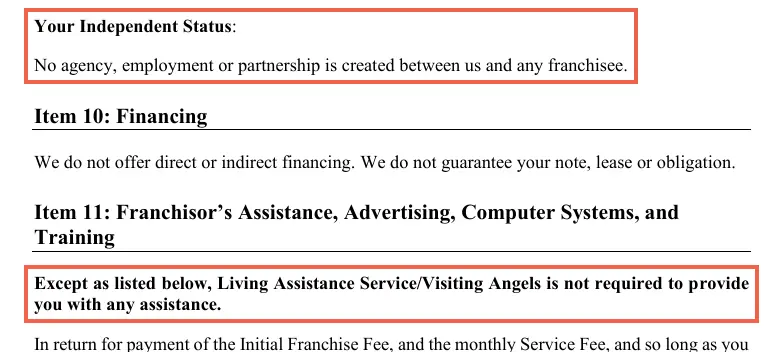
Reading one FDD from both sides shows how the rules land in practice. The Visiting Angels FDD issued April 20, 2026, for non-medical in-home care, states the franchisor’s promises in Item 11 and the franchisee’s duties in Items 5, 6, 9, 15 and 17. It is used here because its Items are short and plainly worded, not as a recommendation of the brand.
| Item | Franchisor side | Franchisee side | FDD page |
|---|---|---|---|
| Item 5 | Sets the initial fee by territory population | Pays $51,950 to $89,950; $64,950 for a 200,000-population territory | 12 |
| Item 6 | Collects a Gross Service Fee | Pays 3.5% of gross revenues, with lower percentage tiers at higher monthly volume; minimum $495 a month from the 2nd month after training | 13 |
| Item 11 | Provides 26.5 hours of initial training over 5 days in Newtown Square, PA, for 2 trainees | Pays its own travel and living costs | 39 |
| Item 12 | Grants a Protected Territory described by zip codes | Receives no exclusive territory, per the prescribed sentence | 48 |
| Item 15 | Requires an owner in the business | An owner with at least 25% must manage full time for the first 4 years | 59 |
| Item 17 | Has no right to terminate without cause | 10-year term; renewal on materially different terms plus a renewal fee; 30 days to cure listed defaults | 60 to 61 |
| Item 20 | Reports 541 franchised and 0 company-owned outlets at the end of 2025 | None of the franchisees who left signed confidentiality clauses in the last 3 fiscal years | 65 and 76 |
Which clauses should a buyer check first? A decision table
Start where the gap between the two roles is widest: termination, territory, guarantees, gag clauses and the 14-day clock. The benchmarks come from medians and shares across 259 FDDs, so a clause outside them is worth a direct question to the franchisor and to the former franchisees listed in Item 20.
| If the FDD or process shows | Then | Benchmark |
|---|---|---|
| You received the FDD fewer than 14 calendar days ago | Do not sign or pay yet | 16 CFR 436.2(a) |
| Item 17(e) allows termination without cause | Ask for it to be removed or limited in writing | 4.2% of FDDs |
| A cure period under 30 days for ordinary defaults | Ask for 30 days and check your state’s floor | Median 30 days; Minnesota 60 days |
| Item 12 protects an area but says “You will not receive an exclusive territory” | Ask which channels the franchisor keeps inside it: online, national accounts, venues | 92.9% keep online sales rights |
| An uncapped guarantee that spouses must sign | Ask for a cap or a burn-off date | 3 of 247 forms cap liability |
| Item 20 discloses confidentiality clauses | Call former franchisees from the Item 20 list and ask what they can discuss | 53.3% of FDDs |
| Item 15 requires an owner full time and you plan to keep a job | Get the manager route in writing or drop the brand | 23.2% require an owner full time |
| The brand fund is not audited | Ask for the last annual fund statement | 8.2% of 207 active funds audited |
- FDD received 14+ calendar days ago? If no: Do not sign or pay yet (16 CFR 436.2(a)).
- Item 17(e) allows termination without cause? If yes: Ask for it to be removed or limited (4.2% of FDDs).
- Uncapped guarantee that spouses must sign? If yes: Ask for a cap or a burn-off date (3 of 247 forms cap liability).
- Item 20 discloses confidentiality clauses? If yes: Call former franchisees (Item 20); 53.3% of FDDs disclose such clauses.
- Item 15 requires an owner full time? If yes: Get the manager route in writing (23.2% of FDDs).
- Then: Attorney review of Item 17 and your state addendum.
Every Item named in this table is explained one by one in our guide to all 23 FDD Items. The order in which to request the FDD, check these clauses and line up financing is laid out in our step-by-step guide to buying a franchise.
How we compiled this
In October 2026 we read the current text of 16 CFR Part 436 on eCFR, Minn. Stat. 80C.14, 29 CFR 103.40 and the NLRB’s 2026 withdrawal notice, the FTC’s July 2024 policy statement, McDonald’s fiscal 2025 Form 10-K and the Visiting Angels FDD issued April 20, 2026. Shares and medians come from our coded set of 259 FDDs filed with the Minnesota Department of Commerce and issued January 24, 2025 to August 18, 2026. We excluded Item 19 earnings data, forum posts and other guides as sources of fact.
Frequently asked questions
What is a franchisee?
A franchisee is the person or company granted a franchise: under 16 CFR 436.1(i), “any person who is granted a franchise.” In practice the franchisee forms its own business entity, signs the franchise agreement, pays the initial fee in Item 5 and the ongoing fees in Item 6, hires the staff and runs the unit under the franchisor’s manual, usually for a 10-year term, the term in 65.6% of 259 recent FDDs.
Is a franchisee an employee of the franchisor?
No. A franchisee is a separate business under contract with the franchisor, and FDDs often say so: the Visiting Angels FDD states “No agency, employment or partnership is created between us and any franchisee.” The franchisee employs the unit’s staff, and under 29 CFR 103.40 the franchisor is a joint employer only if it shares or codetermines their essential terms of employment.
Does the franchisee own the business?
The franchisee owns its business entity, equipment, inventory and usually its lease, but not the brand. The trademark, system and manual stay with the franchisor and are licensed for the term, which is 10 years in 65.6% of 259 FDDs issued 2025 to 2026. Renewal usually means signing the franchisor’s then-current agreement, the rule in 99.6% of renewable agreements.
Can a franchisor terminate a franchisee?
Yes, on the grounds listed in Item 17, rows e to h. Only 4.2% of 259 recent FDDs allow termination without cause; the rest require a default, with a median 30-day cure for ordinary defaults. Eighteen states and Puerto Rico add relationship laws; Minnesota, for example, requires 90 days written notice and 60 days to cure under Minn. Stat. 80C.14.
How does a franchisor make money from franchisees?
Mainly through the initial fee, ongoing royalties, brand fund contributions and, in many systems, sales of required supplies: 77.2% of 259 FDDs report franchisor or affiliate revenue from franchisees’ required purchases. Some franchisors also collect rent. McDonald’s booked $10,442 million in rent against $6,018 million in royalties from franchised restaurants in fiscal 2025, per its Form 10-K.
How do you become a franchisee?
Request the FDD and wait at least 14 calendar days, as 16 CFR 436.2(a) requires. Read Items 5 to 7, 11, 12, 15, 17 and 20, call current and former franchisees from the Item 20 list, and have a franchise attorney review the agreement. Then sign and pay the initial fee, a median $49,500 in 259 recent FDDs.
Sources
- U.S. Government Publishing Office / National Archives, 16 CFR Part 436, Disclosure Requirements and Prohibitions Concerning Franchising (eCFR, current), accessed October 26, 2026.
- Federal Trade Commission, Policy Statement on Franchisors’ Use of Contract Provisions, Including Non-Disparagement, Goodwill, and Confidentiality Clauses (July 2024), accessed October 26, 2026.
- Minnesota Office of the Revisor of Statutes, Minn. Stat. 80C.14, Unfair practices (2025 edition), accessed October 26, 2026.
- National Labor Relations Board via eCFR, 29 CFR 103.40, Joint employers (eCFR, current), accessed October 26, 2026.
- National Labor Relations Board, Federal Register, Withdrawal of 2023 Standard for Determining Joint Employer Status, final rule, doc. 2026-03955, accessed October 26, 2026.
- U.S. Securities and Exchange Commission (EDGAR), McDonald’s Corporation Form 10-K, fiscal year ended December 31, 2025, accessed October 26, 2026.
- Minnesota Department of Commerce, CARDS, Visiting Angels (Living Assistance Services, Inc.) Franchise Disclosure Document, issued April 20, 2026, accessed October 26, 2026.
- Minnesota Department of Commerce, CARDS, Franchise registrations, 259 FDDs issued January 24, 2025 to August 18, 2026, accessed October 26, 2026.