A Tim Hortons franchise in the United States costs $148,000 to $3,312,500 before real estate, plus a $50,000 fee for a Standard Shop, under the 2026 FDD. In most cases the franchisor also controls the site and charges rent.
Key takeaways
- The Tim Hortons USA Inc. Franchise Disclosure Document, issued March 13, 2026, prints five Item 7 totals, from $60,150 for an Operator Agreement shop to $3,312,500 for a new Standard Shop built to the current New Model design.
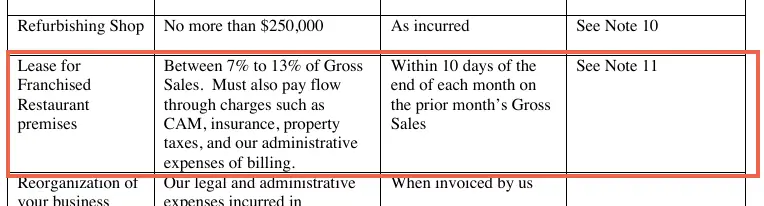
- Rent is a separate percentage: Item 6 lists the lease for franchised premises at “Between 7% to 13% of Gross Sales”, on top of a 4.5% to 6% royalty and a 4% advertising contribution.
- Restaurant Brands International’s Form 10-K for 2025 shows 3,534 of 4,555 franchised Tim Hortons sites in the US and Canada sit on property the company owns or leases, about 77.6%.
- Canada runs through a different affiliate, The TDL Group Corp., with 3,903 shops at December 31, 2025 (FDD Item 1); its own pages set a $500,000 net worth and $100,000 unencumbered funds minimum.
- The US system grew from 663 to 693 outlets in 2025 (Item 20, Table 1), and 589 of the 669 franchised shops are in New York, Michigan and Ohio.
What does a Tim Hortons franchise cost in the US under the 2026 FDD?
The 2026 Tim Hortons FDD gives a separate Item 7 table for each format, so the answer depends on which shop you would open. A Standard Shop inside a gas station starts at $427,500; a ground-up New Model Standard Shop runs $988,000 to $3,312,500. Every total excludes the land or building lease, which Item 7 Note 5 leaves out “because of the numerous variables”.
| Format (Item 7 table) | Low | High | Paid to franchisor or affiliate | Source |
|---|---|---|---|---|
| Standard Shop: New Model | $988,000 | $3,312,500 | $102,500 to $470,000 (all Standard Shops) | 2026 FDD, Item 7 p.28; cover |
| Standard Shop: within petro locations | $427,500 | $1,573,500 | Same Standard Shop range | 2026 FDD, Item 7 p.29 |
| Standard Shop: other | $913,000 | $3,013,500 | Same Standard Shop range | 2026 FDD, Item 7 p.30 to 31 |
| Non-Standard Shop (self-service cart) | $148,000 | $802,700 | $77,500 to $230,000 | 2026 FDD, Item 7 p.31 to 32; cover |
| Operator Agreement shop | $60,150 | $217,500 | $7,500 to $45,000 | 2026 FDD, Item 7 p.35; cover |
Where the New Model money goes
Three construction lines drive the New Model range: site development at $100,000 to $1,200,000, building costs at $385,000 to $1,020,000 and planning and design at $20,000 to $275,000. Item 7 Note 15 says these totals are “based on restaurants built in 2024 and 2025”. We re-added the twelve lines below and both columns match the printed totals.
| New Model line (Item 7, p.28) | Low | High | Paid to |
|---|---|---|---|
| Initial franchise fee | $50,000 | $50,000 | Tim Hortons |
| Real estate taxes, personal property taxes and CAM charges | $35,000 | $100,000 | Tim Hortons, or other lessor or sublessor |
| Equipment | $335,000 | $500,000 | Tim Hortons and other suppliers |
| Planning, development and design | $20,000 | $275,000 | Government agencies and approved providers |
| Site development | $100,000 | $1,200,000 | Contractors |
| Building costs | $385,000 | $1,020,000 | Contractors and Tim Hortons |
| Training | $20,000 | $50,000 | Tim Hortons and travel suppliers |
| Start-up supplies and initial inventory | $7,000 | $14,000 | Suppliers |
| Professional and license fees | $8,500 | $25,000 | Attorneys, accountants, agencies |
| Insurance (first year) | $2,500 | $21,500 | Tim Hortons, insurers or lessor |
| Security deposits | $0 | $15,000 | Utilities, lessor |
| Additional funds (first 3 months) | $25,000 | $42,000 | Various |
| Total | $988,000 | $3,312,500 | Real estate excluded (Note 5) |
Item 10 adds that “Neither we nor any affiliate of ours offers financing”, so the full Item 7 amount comes from your own capital or an outside lender. The FDD prints no net worth or liquidity minimum for US applicants.
Who owns the land under a Tim Hortons restaurant?
Usually the franchisor does, or it holds the lease. RBI’s 2025 Form 10-K, Item 2, counts 765 Tim Hortons sites in the US and Canada that RBI owns and leases to franchisees and 2,769 it leases and subleases, against 1,021 that franchisees own or lease directly. That is about 77.6% franchisor-controlled, compared with 18.4% at Burger King and 2.5% at Popeyes in the same table.
RBI owns or leases 3,534 of 4,555 franchised Tim Hortons sites in the US and Canada (77.6%). Source: RBI Form 10-K for 2025, Item 2, filed February 20, 2026. Data: tim-hortons-site-control.csv.
| RBI brand, US and Canada (Dec 31, 2025) | Owned by RBI, leased to franchisee | Leased by RBI, subleased | Franchisee owns or leases | Franchisor-controlled share | Source |
|---|---|---|---|---|---|
| Tim Hortons | 765 | 2,769 | 1,021 | 77.6% | RBI 10-K FY2025, Item 2 |
| Burger King | 530 | 554 | 4,809 | 18.4% | RBI 10-K FY2025, Item 2 |
| Popeyes | 34 | 52 | 3,397 | 2.5% | RBI 10-K FY2025, Item 2 |
The share column is our arithmetic on the 10-K counts; the raw rows are in the downloadable CSV listed under the chart. In the US filing, the rule sits in Item 8: “If we or our affiliate own or lease the Franchised Restaurant premises, you must lease or sublease the Franchised Restaurant premises from us or an affiliate.” The landlord affiliate is Tim Donut U.S. Limited, Inc., which Item 8 says had $53,749,760 of 2025 revenue from leases and subleases with franchisees.
How the percentages stack on each $100 of Gross Sales
Royalty, advertising and rent are all set as a share of Gross Sales, so a franchisee leasing from Tim Hortons pays $14.50 to $23.00 of every $100 to the franchisor side before food, labor or flow-through charges. Item 6 Note 2 says the royalty “is generally 6%, assuming that you have property control”; other franchisees “may pay reduced royalties”.
| Charge (2026 FDD, Item 6) | Low case | High case | Basis |
|---|---|---|---|
| Royalty | 4.5% | 6% | Weekly, on prior week’s Gross Sales |
| Advertising contribution | 3% (captured-traffic sites) | 4% | Monthly (Note 4) |
| Lease for franchised premises | 7% | 13% | Monthly, plus CAM, insurance, property taxes |
| Combined share of Gross Sales | 14.5% | 23% | Our sum of the three lines |
The 10-K gives the parent’s view of the same rent: across about 4,700 properties leased “primarily to TH and BK franchisees”, rent is “usually 8.5% to 10.0%” of monthly gross sales and/or fixed rent. Our research on how franchisors make money from rent, supply and royalties places this model next to other public franchisors.
What does Tim Hortons USA bill before opening day and every week after?
Before opening, the franchisor collects the $50,000 Standard Shop fee (or $25,000 for a Non-Standard Shop), training at $500 per person per week, and equipment, fixtures and signage of $50,000 to $410,000 for a Standard Shop (Item 5). After opening, the Item 6 franchise table runs to 18 fee lines, from the royalty to a $1,750 Tim Horton Children’s Foundation charge.
| Payment | Amount | When | FDD item |
|---|---|---|---|
| Initial franchise fee | $50,000 Standard; $25,000 Non-Standard; none for Operators | On signing; non-refundable | Item 5 p.18 |
| Equipment, fixtures and signage bought from franchisor | $50,000 to $410,000 Standard; $50,000 to $200,000 Non-Standard | On invoice | Item 5 p.18 |
| Initial training | $500 per person per week; about 5 weeks; up to 4 people | Before opening | Item 5 p.18 |
| Development Agreement prepayment | $25,000 per committed restaurant | First installment at signing | Item 5 p.18 |
| Restaurant Technology charges | $450 to $1,400 per month | As incurred | Item 6 p.21 |
| Refurbishing | No more than $250,000; may be required every 5 years | As incurred | Item 6 p.21, Note 10 |
| Transfer fee | 5% of the full purchase price, up to $25,000 per Shop | Before transfer | Item 6 p.20 |
| Late payment interest | Maximum lawful rate, or 18% per year | As incurred | Item 6 Note 5 |
Supply is the larger revenue stream. Item 8 reports that $211,230,437 of THUSA’s $397,236,809 in 2025 revenue, about 53.2%, came from franchisee and Operator purchases or leases, mostly $204,787,670 of “Selected Goods or Articles” sold through distributors. For comparison, the Popeyes FDD issued March 20, 2026 reports about 1.7% of revenue from required purchases. Our study of Item 8 supplier revenue across franchisors sets out how to read that disclosure.
Franchise, Operator or Development Agreement: three US contracts side by side
Tim Hortons USA signs three kinds of contract, and they differ more than most cost pages show. A Franchise Agreement holder builds or buys the shop; an Operator runs a fully equipped shop the franchisor owns and pays an Operator Fee of 20% to 24% of Gross Sales; a developer commits to several Standard Shops and prepays $25,000 for each (Items 1, 5 and 6).
| Contract | Upfront | Ongoing | Term and exit | Shops at end of 2025 |
|---|---|---|---|---|
| Franchise Agreement | Fee $50,000 or $25,000; Item 7 $148,000 to $3,312,500 | Royalty 4.5% to 6%, advertising 4%, lease 7% to 13% | 20 years less 1 day from opening; Non-Standard 5 to 10 years; renewal “Not applicable” (Item 17 b) | 658 of 669 franchised |
| Operator Agreement | No fee; security deposit $5,000 to $35,000; Item 7 $60,150 to $217,500 | Operator Fee 20% to 24%, advertising 4%, flow-through rent charges | Either side may end it on 30 business days’ written notice (Item 17 d, e) | 11 |
| Development Agreement | $25,000 per committed restaurant, credited to each fee | Each shop signs the then-current Franchise Agreement | Non-exclusive Territory; unmet schedule allows termination (Item 12) | Not reported separately |
No contract grants an exclusive territory: Item 12 says the franchisor may open other outlets “regardless of its geographic proximity to or impact on your Tim Hortons Shop”. Our research on franchise territory rights in Item 12 shows how that compares across filings. Item 11 puts signing-to-opening at “approximately 4 to 6 weeks” when you already control a site and build it yourself, and 1 day to 1 year for an Operator. Item 20 adds that, as of the issuance date, Tim Hortons USA did not expect to open any new US shops under Operator Agreements.
How is a Tim Hortons franchise in Canada set up differently?
Canadian restaurants are franchised by The TDL Group Corp. in Toronto, not by Tim Hortons USA, so the US FDD’s Item 7 tables do not apply there. FDD Item 1 lists 3,903 Canadian shops at December 31, 2025, of which 3,896 were franchised. We found no public Canadian disclosure document with an investment table; the company’s Canadian pages state minimums and a selection process instead.
| Term | United States (Tim Hortons USA Inc.) | Canada (The TDL Group Corp.) | Source |
|---|---|---|---|
| Shops, Dec 31, 2025 | 683, excluding self-serve (24 company-owned) | 3,903 (3,896 franchised) | 2026 FDD, Item 1 |
| Disclosure | FDD filed in Minnesota, issued March 13, 2026 | No public investment table found | Minnesota CARDS; our search |
| Minimum net worth | Not stated in FDD | $500,000 | Tim Hortons Canada “Our Process” page, Wayback capture March 24, 2025 |
| Unencumbered or liquid funds | Not stated in FDD | $100,000 (company page); “$150K CAD” (association listing) | Company page, March 2025; Canadian Franchise Association listing |
| Franchise fee | $50,000 Standard Shop | $50,000, “due before the Restaurant opens” | Item 5; Canadian franchising FAQ, Wayback capture June 15, 2021 |
| Royalty and advertising | 4.5% to 6%; 4% | 6% weekly; 4% monthly | Item 6; Canadian FAQ (2021) |
| Term | 20 years less 1 day; no renewal right | “usually 10 years”, renewable for up to 10 more | Item 17; Canadian FAQ (2021) |
| Training | About 5 weeks at $500 per person per week | “3-5 weeks” after final approval | Item 5; Canadian process page (2025) |
The Canadian process page lists six steps: Candidate Inquiry, Discovery Call and Background Screening, Operations Interviews, Restaurant Experience Days, Senior Leadership Team Interview, and Final Approval and Training. Step 4 is two days in a restaurant with a “registration fee required”. The 2021 FAQ also says the company does “not rank applicants in order in which they apply” and prioritizes candidates “willing to relocate anywhere within Canada”.
- Candidate Inquiry: pre-qualification questionnaire against the $500,000 and $100,000 minimums.
- Discovery Call and Background Screening: credit and criminal checks, an Asset Verification letter and an NDA.
- Operations Interviews: two or more, with a business case presentation.
- Restaurant Experience Days: 2 days in a restaurant, registration fee required.
- Senior Leadership Team Interview: Head of Operations or President of Tim Hortons Canada.
- Final Approval and Training: approved candidates are “considered for future franchising opportunities” and complete 3 to 5 weeks of training.
The Canadian amounts on the company page carry no currency label; the association listing states CAD. Supply also differs: the 10-K says nine distribution centers serve Canadian Tim Hortons restaurants, five owned and operated by RBI, while US shops are supplied “through third-party distributors”.
Where are the 6,232 Tim Hortons shops, and is the US system growing?
FDD Item 1 counts 6,232 Tim Hortons Shops worldwide at December 31, 2025, excluding self-serve locations. Canada holds 3,903 of them, about 62.6%; the United States has 683. Outside North America, shops are franchised by Tim Hortons Restaurants International GmbH in Zug (1,315), Tim Hortons Asia Pacific Pte. Ltd. in Singapore (136) and THUSA itself in Latin America and the Caribbean (195).
Canada holds 3,903 of 6,232 Tim Hortons shops; the US has 683. Source: Tim Hortons USA Inc. FDD issued March 13, 2026, Item 1, counts as of December 31, 2025.
| Market and franchisor (Item 1) | Shops, Dec 31, 2025 | Franchising since |
|---|---|---|
| Canada: The TDL Group Corp. | 3,903 | January 1965 |
| International: Tim Hortons Restaurants International GmbH | 1,315 | December 2016 |
| United States: Tim Hortons USA Inc. | 683 | 1993 (after a mid-1980s start) |
| Latin America and Caribbean: Tim Hortons USA Inc. | 195 | July 2020 |
| Asia Pacific: Tim Hortons Asia Pacific Pte. Ltd. | 136 | July 2020 |
Item 20, Table 1 shows US outlets at 642, 663 and 693 at the end of 2023, 2024 and 2025. Franchised openings rose from 26 to 33 to 42 a year, and the 23 company-owned shops that appeared in 2024 were all reacquired from franchisees in New York (Table 4). Table 5 projects 50 new franchised US shops in 2026, 12 of them in New York.
Franchised openings rose from 26 in 2023 to 42 in 2025; 23 shops were reacquired by the franchisor in 2024. Source: 2026 Tim Hortons FDD, Item 20, Table 3. Exits = non-renewals plus ceased operations.
| Franchised US outlets (Item 20, Table 3) | 2023 | 2024 | 2025 |
|---|---|---|---|
| Start of year | 636 | 642 | 640 |
| Opened | 26 | 33 | 42 |
| Non-renewals | 11 | 7 | 10 |
| Reacquired by franchisor | 0 | 23 | 1 |
| Ceased for other reasons | 9 | 5 | 2 |
| End of year | 642 | 640 | 669 |
| Transfers to new owners (Table 2) | 7 | 29 | 4 |
Concentration matters for a new market: at the end of 2025, New York had 253 franchised shops, Michigan 204 and Ohio 132, which is 589 of 669, or 88.0%. Texas grew from 2 to 13 between the start of 2023 and the end of 2025, and Item 20 notes that some current and former franchisees have signed provisions restricting how openly they can discuss the system.
How much do Tim Hortons franchise owners make, and where is that disclosed?
The FDD answers part of this in Item 19, which this site does not reproduce. Item 19 of the 2026 filing reports monthly Gross Sales, cost of goods sold and labor as shares of sales, and same-shop sales change for franchised Standard Shops, drawn from 585 of the 659 franchised Standard Shops open at December 31, 2025. It gives nothing for Operators.
What sits between those sales figures and what an owner keeps is spelled out in other items: royalty of 4.5% to 6% and advertising of 4% (Item 6), rent of 7% to 13% where the franchisor controls the site (Item 6), technology charges of $450 to $1,400 a month, and whatever you borrowed to cover an Item 7 range of up to $3,312,500. Item 19 itself states that its figures do not account for royalties or other fees. Our guide to reading Item 19 financial performance representations lists the questions to put to existing franchisees, whose names Item 20 points to in Exhibits G and H.
Older Tim Hortons cost figures set against the 2026 filing
Several ranking guides still quote ranges from earlier FDDs or from Canadian web copy of 2008 to 2012. Each line below sets the circulating claim next to the March 13, 2026 FDD or the 2025 10-K; we describe the guides without naming them.
| Claim in circulation | Where it comes from | 2026 primary figure | Source |
|---|---|---|---|
| Total cost $971,000 to $1,717,500 | 2023 FDD, quoted by an FDD summary blog | New Model $988,000 to $3,312,500; Petro $427,500 to $1,573,500 | 2026 FDD, Item 7 |
| Setup $1,044,000 to $1,441,500 (USD) | Canadian finance blog, updated May 2024 | Same 2026 Item 7 tables; real estate excluded | 2026 FDD, Item 7 |
| Royalty 4.5%, rent 8.5% (CDN$430,000 to $480,000 cost) | Canadian blog, first published 2012 | US royalty 4.5% to 6%, lease 7% to 13%; Canada 6% royalty (2021 FAQ) | Item 6; Canadian FAQ |
| One range of $148,000 to $3,312,500 | Franchise directory, 2026 FDD | Correct span, but it joins a self-service cart and a New Model build | 2026 FDD, cover and Item 7 |
| About 5,290 units | Directory and blog estimates | 6,232 shops excluding self-serve | 2026 FDD, Item 1 |
Decision table: matching capital, site and country to a Tim Hortons route
The route follows from three facts: which country you are in, whether you control a site, and how much cash you can commit before Item 7’s working capital line of $25,000 to $42,000 runs out. Burger King’s 2026 FDD, with a 4.5% royalty and 4.5% advertising contribution, is broken down on our Burger King franchise cost page, and the chicken brand’s terms are on our Popeyes franchise cost page.
| If your situation is | Route to ask about | Threshold from the documents |
|---|---|---|
| In Canada, with $500,000 net worth and $100,000 or more unencumbered | TDL Group application (six steps) | Company page, March 2025; association listing says $150K CAD |
| In the US, own or can lease a pad site of one-half to 1.5 acres | Franchise Agreement, New Model Standard Shop | Item 7 $988,000 to $3,312,500 plus land; Note 5 site size |
| In the US, with a gas station or convenience site | Standard Shop within petro location | Item 7 $427,500 to $1,573,500; advertising 3% at captured-traffic sites |
| In the US, with $217,500 or less to commit | Operator Agreement, if an existing shop is offered | Item 7 $60,150 to $217,500; Operator Fee 20% to 24%; Item 20 expects no new Operator shops |
| Want a hospital, campus or office kiosk | Non-Standard Shop | Item 7 $148,000 to $802,700; term 5 to 10 years less 1 day |
| Plan several US shops and already run restaurants | Development Agreement | $25,000 prepaid per shop; Item 5 says these go “typically” to “highly experienced franchisees”; no exclusive Territory |
Other coffee concepts sit at different points: the Dunkin’ FDD issued March 26, 2026 lists $532,400 to $1,832,500 for a freestanding shop, covered on our Dunkin’ franchise cost page, and our coffee franchise cost comparison lines up more brands. This page is general information, not legal, financial or investment advice; take the Item 6 lease terms and the Exhibit E lease form to a franchise lawyer before signing, and use our explainer on how to read a franchise disclosure document for the remaining items.
How we compiled this
We read the 672-page Tim Hortons USA Inc. FDD issued March 13, 2026 (Minnesota CARDS document 35506-202603-08), RBI’s Form 10-K for 2025 from SEC EDGAR, two Wayback captures of Tim Hortons Canada franchising pages (the live page returns an error) and the Canadian Franchise Association listing, all in November 2026. Burger King, Popeyes and Dunkin’ figures come from their 2026 FDDs as recorded for our earlier pages. We excluded Item 19 figures under this site’s rule on earnings claims, and we did not interview franchisees.
Frequently asked questions
How much is a Tim Hortons franchise?
In the US, the 2026 Tim Hortons FDD lists $148,000 to $802,700 for a self-service Non-Standard Shop and $988,000 to $3,312,500 for a new New Model Standard Shop, real estate excluded (Item 7). An Operator Agreement shop needs $60,150 to $217,500. Rent of 7% to 13% of Gross Sales applies where the franchisor controls the site.
What is the Tim Hortons franchise fee?
The initial franchise fee is $50,000 for a Standard Shop and $25,000 for a Non-Standard Shop, payable when you sign and non-refundable (2026 FDD, Item 5). Operators pay no franchise fee but post a $5,000 to $35,000 security deposit. Developers prepay $25,000 for each restaurant they commit to open.
How much does a Tim Hortons franchise cost in Canada?
Tim Hortons Canada publishes minimums rather than an investment table: $500,000 net worth and $100,000 unencumbered funds on its March 2025 process page, while the Canadian Franchise Association listing says $150K CAD. Its 2021 FAQ lists a $50,000 fee, a 6% weekly royalty, a 4% advertising levy and a licence term of usually 10 years.
How much does a Tim Hortons franchise cost in the USA?
Tim Hortons USA Inc.’s FDD issued March 13, 2026 prints five Item 7 totals: New Model $988,000 to $3,312,500, petro location $427,500 to $1,573,500, other Standard Shop $913,000 to $3,013,500, Non-Standard $148,000 to $802,700 and Operator $60,150 to $217,500. None includes land, and the franchisor offers no financing (Item 10).
How much does a Tim Hortons franchise owner make?
This site does not publish earnings figures. Item 19 of the 2026 FDD reports sales, food cost and labor data for 585 franchised Standard Shops; read it there. What the owner keeps then depends on the 4.5% to 6% royalty, 4% advertising, 7% to 13% rent, $450 to $1,400 monthly technology charges and the debt behind your Item 7 cost.
Can you get a Tim Hortons franchise in India or other countries?
The US FDD covers only Tim Hortons USA Inc. and its Latin America and Caribbean franchising (195 shops). Item 1 lists Tim Hortons Restaurants International GmbH (1,315 shops) and Tim Hortons Asia Pacific Pte. Ltd. (136) for other markets, and RBI’s 10-K says those run on master franchise or development agreements with fees that vary by country.
How long does it take to open a Tim Hortons?
Item 11 of the 2026 FDD estimates about 4 to 6 weeks from signing a Franchise Agreement to opening when you already control the site and build it yourself, 3 to 18 months from a Development Agreement to operating, and 1 day to 1 year for an Operator. In Canada, approved candidates first complete 3 to 5 weeks of training.
Sources
- Tim Hortons USA Inc., Franchise Disclosure Document, issued March 13, 2026 (Minnesota CARDS, file 6441), Items 1, 5, 6, 7, 8, 10, 11, 12, 17, 19, 20, accessed November 8, 2026.
- Restaurant Brands International Inc., Form 10-K for fiscal 2025, filed February 20, 2026 (SEC EDGAR), Items 1 and 2, accessed November 8, 2026.
- Tim Hortons Canada, “Our Process” franchising page, Wayback capture March 24, 2025, accessed November 8, 2026.
- Tim Hortons Canada, Franchising FAQ, Wayback capture June 15, 2021, accessed November 8, 2026.
- Canadian Franchise Association, Tim Hortons listing, accessed November 8, 2026.
- Burger King Company LLC, Franchise Disclosure Document, issued March 26, 2026, amended September 2, 2026, accessed October 2026.
- Popeyes Louisiana Kitchen, Inc., Franchise Disclosure Document, issued March 20, 2026, Item 8, accessed October 2026.