The 7-Eleven franchise cost starts with an initial fee that 7-Eleven’s own FAQ puts at $50,000 to $750,000 for a traditional store and $25,000 for a conversion, and the ongoing charge is a share of gross profit, not sales.
7-Eleven’s single-unit page prints a second range, $100,000 to $1,000,000, “based on the store’s gross profit.” The binding fee for a given store sits in Item 5 of the current Franchise Disclosure Document (FDD), which we could not obtain from the state registries we checked in November 2026.
Key takeaways
- As of an August 2026 capture of 7-Eleven’s franchise FAQ, a traditional store’s initial fee runs $50,000 to $750,000, plus an inventory, supplies and license down payment of about $29,000.
- A Business Conversion Program (BCP) store, where the owner keeps the land and building, carries a $25,000 initial fee and a $20,000 to $40,000 inventory down payment, per the same FAQ.
- 7-Eleven takes no royalty on sales; it takes the “7-Eleven Charge,” a percentage of gross profit. The 2004 standard agreement filed with the SEC set it at 50% for a 24-hour store.
- 7-Eleven, Inc. had 7,278 franchised and 5,213 corporate retail stores at June 2026 (58.3% franchised), per the Seven & i Holdings data book of October 8, 2026.
- Qualified U.S. veterans get up to 20% off the initial fee, capped at $50,000 in savings, according to 7-Eleven’s veterans page.
Where does a 7-Eleven sales dollar go under the gross profit split?
Every sale lands in an open account that 7-Eleven keeps. Gross profit, defined in the agreement as net sales less cost of goods sold, is split: 7-Eleven takes the 7-Eleven Charge (50% for a 24-hour store in the 2004 form) plus an advertising fee, and the franchisee’s share pays payroll and other store expenses before any draw. Rent, real property taxes and select utilities stay with 7-Eleven.
The same flow in order, as the 2004 Standard Form of 7-Eleven Individual Store Franchise Agreement (Exhibit 10(ii)(B)(1) to the fiscal 2004 7-Eleven, Inc. Form 10-K) describes it:
- Store receipts. The franchisee deposits receipts within 24 hours after each collection period ends, and 7-Eleven credits them to the open account (Paragraphs 12(b) and 13(a)).
- Gross profit. Net sales less cost of goods sold (Exhibit E definitions). 7-Eleven’s FAQ uses the same idea: “sales receipts less the cost of the merchandise sold.”
- 7-Eleven Charge. A percentage of gross profit set in Exhibit D: 50% for a 24-hour store, plus 0.1% of gross profit for each weekly hour closed with permission.
- Advertising fee. Paid with the charge; the 10-K put it at 0.5% to 1.5% of gross profit.
- Franchisee’s share. What remains of gross profit stays in the open account, where payroll, supplies, repairs, insurance and other operating expenses are debited.
- Draws. A weekly draw, plus a monthly draw or excess investment draw paid within 10 days of a written request (Paragraph 11).
Paid by 7-Eleven in a traditional store, per its Financials page captured April 2026: building rent or acquisition cost, real property taxes, select utilities (electric, gas, water, sewer), certain equipment purchase or rent, and bookkeeping and back-office support.
What moves the charge percentage
The 2004 form raised the percentage for three behaviors. Each adjustment below is quoted from the agreement; whether the current form keeps them is an Item 6 question for 7-Eleven.
| Trigger | Effect on the 7-Eleven Charge (2004 form) | Source |
|---|---|---|
| Store open 24 hours | 50% of gross profit | Exhibit D(i)(1) |
| Fewer hours, with 7-Eleven’s permission | 50% plus 0.1% of gross profit per weekly hour closed | Exhibit D(i)(2) |
| Fewer hours, without permission, 136 or more hours a week | Plus 4% of gross profit for that accounting period | Exhibit D(i)(3) |
| Fewer hours, without permission, under 136 hours a week | Plus 6% of gross profit | Exhibit D(i)(3) |
| Recommended-vendor purchases short for 3 consecutive accounting periods | Plus 2 percentage points | Paragraph 10(b) |
| Advertising fee | 0.5% to 1.5% of gross profit, collected with the charge | Form 10-K, Item 1; Paragraph 22(a) |
History matters here: the same 10-K says the earlier “traditional franchise agreement” gave 7-Eleven “approximately 52% of the merchandise gross profits,” and the 2004 form “generally 50%.” By year end 2004, new agreements covered about 3,200 stores, roughly 95% of the franchised base. For any store you are offered today, read the percentage in Item 6 and Exhibit D of the current documents. Royalty rates across other franchise systems are charged on sales, so the two numbers are not comparable line for line.
How much cash does each 7-Eleven store type ask for up front?
A traditional store asks for the initial fee ($50,000 to $750,000 on the FAQ, $100,000 to $1,000,000 on the single-unit page) plus about $29,000 for inventory, supplies, licenses, permits and bonds, and a cash register fund. A BCP store asks for $25,000, a $20,000 to $40,000 inventory down payment and the owner’s own building work.
| Up-front line | Traditional store | Business Conversion Program | Source |
|---|---|---|---|
| Initial franchise fee | $50,000 to $750,000 (FAQ); $100,000 to $1,000,000 (single-unit page); “depend on the store you select” | $25,000 | 7-Eleven FAQ, Aug 2026; single-unit page, Sept 2026 |
| Inventory down payment | Approx. $20,000 (Financials page); approx. $29,000 including supplies, licenses, permits and bonds (FAQ) | $20,000 to $40,000 | Financials page, Apr 2026; FAQ, Aug 2026 |
| Store supplies | Approx. $1,000 | Not stated | Financials page, Apr 2026 |
| Cash register fund | Approx. $2,500 | “Initial cash register fund,” amount not stated | Financials page; FAQ |
| Business licenses, permits, bonds | Vary by state | Not stated separately | Financials page, Apr 2026 |
| Training expenses, Grand Opening fee, insurance | Listed, amounts not stated | Not stated | Financials page, Apr 2026 |
| Land, building, store equipment | 7-Eleven’s cost; on a new site it “may invest as much as $1 million to $2 million” | Owner’s land and building; “improvements, which vary by site” | FAQ, Aug 2026 |
None of these lines is an Item 7 total. The FTC Franchise Rule at 16 CFR 436.5 puts initial fees in Item 5, the full estimated initial investment in Item 7 and financing terms in Item 10, so ask for all three for the specific store number you are offered.
Discounts, zero-fee stores and the 65% fee financing
Three programs shrink the cash at signing. 7-Eleven says its internal program provides “up to 65% financing on your initial franchise fee.” Veterans can take up to 20% off the fee, capped at $50,000. Its glossary also lists Zero Franchise Fee (ZFF) stores: “selected Corporate-owned stores on the Stores Available List that require no initial Franchise Fee.” Our survey of veteran franchise discounts shows how other systems structure theirs.
Worked arithmetic on the two ends of the FAQ fee range. The inputs are the published percentages only; we assume financing is applied to the fee after the veteran discount, which 7-Eleven’s pages do not state, so confirm the order with its franchise sales representative.
| Step | Fee at $50,000 | Fee at $750,000 | Rule used |
|---|---|---|---|
| Published fee | $50,000 | $750,000 | FAQ range, Aug 2026 |
| Veteran discount, 20% capped at $50,000 | minus $10,000 | minus $50,000 (20% would be $150,000) | Veterans page, Sept 2026 |
| Fee after discount | $40,000 | $700,000 | Subtraction |
| Financed at up to 65% | $26,000 | $455,000 | Financials page, Apr 2026 |
| Fee paid in cash at minimum | $14,000 | $245,000 | Fee after discount less financed share |
Who owns the store, the equipment and the inventory?
In a traditional 7-Eleven, the company “obtains and bears the ongoing cost of the land, building, and store equipment,” and the 2004 agreement leases “the Store and 7-Eleven Equipment to you.” The franchisee holds the business: staff, licenses, insurance and the cash and inventory shortages. BCP owners keep their land and building and pay their own improvements.
| 7-Eleven pays for | Franchisee pays for |
|---|---|
| Real property and building rent or acquisition cost | Payroll, payroll processing and payroll taxes |
| Certain equipment purchase or rent; certain equipment replacement | Workers’ compensation and any employee benefits |
| Real property taxes | Business taxes and licenses; all taxes other than real property taxes |
| Select utilities (electric, gas, water, sewer) | Indemnification and insurance |
| Certain building maintenance | Cash and inventory shortage |
| 7-Eleven advertising | National advertising fee and local store advertising |
| Initial training material on store operations | Store supplies; equipment maintenance and general repairs |
| Bookkeeping and back-office support | Outside property maintenance and landscaping |
| Certain inventory audits | Store telephone line, janitorial, laundry and security |
| Product development, merchandising and business advisory help | Grand Opening, interest expenses, other operating expenses |
Source: “Financial Responsibilities for Traditional Franchises,” 7-Eleven Financials page (April 2026 capture) and single-unit page (September 2026 capture). Fuel sits outside the split. 7-Eleven’s FAQ says its model at gas sites “deals with the in-store sales and gross profits, not fuel sales,” and the 2004 10-K said 7-Eleven owned the gasoline inventory at franchised stores, which sold it on consignment. For how fuel supply contracts work as separate agreements, see our gas station franchise guide.
How does the open account pay for inventory and payroll?
The open account is 7-Eleven’s running ledger for each store and doubles as financing. Under Paragraph 13 of the 2004 form, 7-Eleven debits purchases, operating expenses and draws, credits receipts, and lends any unpaid balance at 2% over Bank of America’s prime rate. The franchisee must keep a minimum net worth of $15,000.
7-Eleven’s April 2026 Financials page describes the same arrangement in current terms: an “open account (or financing) for the inventory purchases and operating expenses of your store,” whose balance “generally fluctuates from month to month.” Here is how the 2004 contract ran it, and which FDD item now holds each term.
| Term | 2004 standard agreement | Where the current term is disclosed |
|---|---|---|
| Agreement length | 15 years from the Effective Date, or the end of 7-Eleven’s master lease if sooner (Paragraph 9) | Item 17 |
| Interest on a debit balance | 2% over Bank of America prime (Exhibit D(c)) | Item 10 |
| Interest on a credit balance | Prime minus 2% (Exhibit D(d)) | Item 10 |
| Minimum net worth | At least $15,000; excess can be moved between a franchisee’s stores (Paragraph 13(d)) | Franchise agreement |
| Inventory audits | At least one each calendar quarter (Paragraph 14) | Franchise agreement |
| Renewal notice | 9 to 12 months before expiry; 7-Eleven decides whether to keep the store open (Paragraph 24) | Item 17 |
| Recommended vendors | A specified share of purchases; current FAQ says 85% for BCP stores | Item 8 |
The open account also explains why 7-Eleven, not the franchisee, keeps the books: bookkeeping, bill paying and payroll services are listed among the traditional store’s services in the August 2026 FAQ. The FAQ also mentions a short-term income support program when gross income “falls below certain levels,” with details left to the FDD. Our franchise financing guide covers outside loans for the fee portion 7-Eleven does not finance.
Traditional store or Business Conversion Program: which contract fits your situation?
The two programs split on real estate. A traditional franchisee runs a store 7-Eleven owns or leases; a BCP franchisee brings a store or site, keeps the land and building, and pays a lower 7-Eleven charge, per 7-Eleven’s glossary. BCP stores were 595 of 7,278 franchised 7-Eleven, Inc. stores at June 2026.
| Point | Traditional (single store or multi-unit) | Business Conversion Program | Source |
|---|---|---|---|
| Land and building | 7-Eleven’s | Owner’s; owner pays improvements | FAQ, Aug 2026 |
| Initial franchise fee | $50,000 to $750,000 (FAQ) | $25,000 | FAQ, Aug 2026 |
| 7-Eleven charge | Gross profit share (50% in 2004 form) | “lower for a Business Conversion store” | Glossary, Sept 2026; SEC Exhibit 10(ii)(B)(1) |
| Site and business tests | Store chosen from the Stores Available List | At least 1 year in operation; licenses in good standing; 10 years left on a lease preferred | FAQ, Aug 2026 |
| Physical tests | Not applicable | 1,800 sq ft of selling space preferred, 1,400 minimum; 600 amp, 3-phase service; 24-hour capable | FAQ, Aug 2026 |
| Time to open | Not stated | “as little as six months to over two years” | FAQ, Aug 2026 |
| Stores at June 2026 | 6,683 (Type C) | 595 (Type A) | Seven & i data book, p.38 |
Multi-unit candidates can start with 2 to 10 stores, and 7-Eleven’s single-unit page says “nearly 56%” of its franchises are owned by multi-unit franchisees. All stores run 24 hours, 7 days a week, “where allowed by law.”
Can you buy a 7-Eleven that is already open?
Yes, two ways. 7-Eleven’s Stores Available List carries corporate, new and under-construction stores, and its glossary defines a “Goodwill store” as one “available to purchase from a current franchise owner.” Buying from a franchisee needs 7-Eleven’s written consent, and the 2004 form gave 7-Eleven 10 business days to match a bona fide offer. Item 17 holds today’s transfer rules.
Supply is shifting toward franchise. Seven & i’s October 8, 2026 results say 7-Eleven, Inc. is “accelerating corporate-to-franchise conversion,” and corporate stores fell from 5,719 in March 2025 to 5,213 in June 2026 while franchised stores rose from 7,190 to 7,278. The glossary codes on the list tell you which kind of store you are looking at:
- Corp: a corporately operated store offered for franchise.
- ZFF: a selected corporate store with no initial franchise fee.
- NSO: a store open less than 12 months.
- UC: under construction, usually a traditional site.
- Goodwill store: a franchised store whose current owner is selling.
A goodwill purchase under the 2004 form, Paragraph 25(b) and (c), involved these steps:
- The seller notifies 7-Eleven in writing of the bona fide offer and supplies the documents 7-Eleven requires.
- 7-Eleven or its designee has 10 business days to elect to buy on the same terms, and must close within 10 business days of electing.
- If 7-Eleven passes, the buyer receives a disclosure form with a waiver and release, plus a list of all 7-Eleven stores available for franchise in that area.
- The seller signs a mutual termination or assignment with a general release and an indemnity covering the buyer.
- The seller pays everything owed to 7-Eleven, and 7-Eleven may require the sale premium to be paid into the open account.
- 7-Eleven approves or rejects the buyer for training within 60 days of receiving the information it requires.
- The approved buyer signs the then-current agreement, or an assumption, at then-current terms including the franchise fee, down payment and 7-Eleven Charge, and completes training.
Under that form, a goodwill buyer paid the seller’s price and also 7-Eleven’s then-current fee. Our guide to buying a franchise for sale covers diligence on resales, and the franchise transfer fee research shows what other systems charge to approve a sale.
How many 7-Eleven stores are franchised in 2026?
At June 30, 2026, 7-Eleven, Inc. had 12,491 retail stores: 7,278 franchised (58.3%) and 5,213 corporate, per the Seven & i data book of October 8, 2026. The count excludes 991 wholesale fuel sites. Seven & i forecasts 205 openings and 645 closures for fiscal 2026, including conversions to wholesale fuel.
7-Eleven, Inc. had 7,278 franchised and 5,213 corporate retail stores at June 2026. Source: Seven & i Holdings data book, October 8, 2026, p.38.
| Quarter end | Retail stores | Franchised | of which BCP | Corporate | Franchised share |
|---|---|---|---|---|---|
| Mar 2025 | 12,909 | 7,190 | 591 | 5,719 | 55.7% |
| Jun 2025 | 12,784 | 7,174 | 592 | 5,610 | 56.1% |
| Sep 2025 | 12,765 | 7,206 | 588 | 5,559 | 56.5% |
| Dec 2025 | 12,712 | 7,280 | 594 | 5,432 | 57.3% |
| Mar 2026 | 12,600 | 7,271 | 594 | 5,329 | 57.7% |
| Jun 2026 | 12,491 | 7,278 | 595 | 5,213 | 58.3% |
Source: Seven & i Holdings, Supplementary Information for the second quarter of fiscal 2026, page 38, “Number of Stores by Type.” These are Seven & i’s operating counts, not FDD Item 20 tables, which would also show transfers, terminations and non-renewals by state.
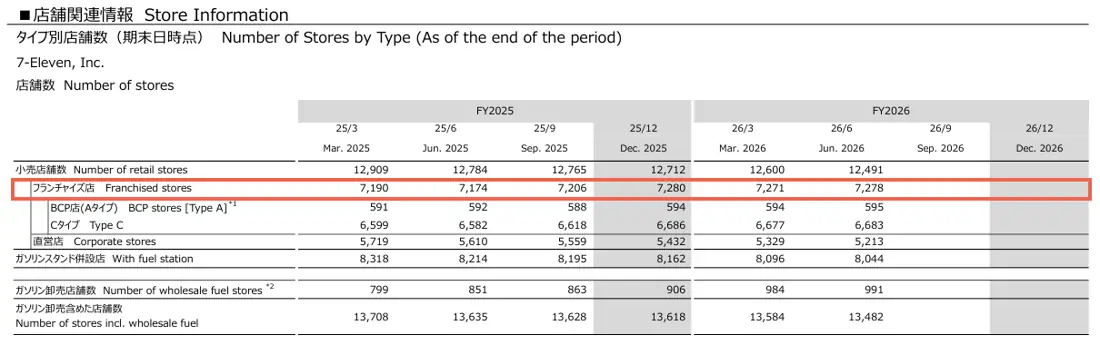
The franchised share rose in each of the five quarters after March 2025, even in the two quarters when the franchised count dipped: 55.7%, 56.1%, 56.5%, 57.3%, 57.7% and 58.3% in June 2026.
The franchised share of 7-Eleven, Inc. retail stores rose from 55.7% in March 2025 to 58.3% in June 2026. Source: Seven & i Holdings data book, October 8, 2026, p.38.
From January to June 2026, Seven & i reported 69 openings and 290 closures for 7-Eleven, Inc., per page 33 of the same data book. For the wider convenience sector, including Census franchise shares and SBA lending, see our convenience store franchise statistics.
What do circulating 7-Eleven numbers get wrong when checked against filings?
Most ranking guides we read cite no year and no document. Some give a fee range found on none of 7-Eleven’s pages, some quote global store totals that mix in licensees abroad, and none states the split percentage. The table sets each claim beside the primary record we opened in October and November 2026.
| Claim in circulation | Primary record | Source |
|---|---|---|
| A 2025 FAQ article: franchise fee $15,000 to $58,500 | $50,000 to $750,000 traditional; $25,000 BCP | 7-Eleven FAQ, Aug 2026 capture |
| A 2026 lender page: conversion franchise fee $0 to $1,000 | BCP initial franchise fee of $25,000; zero fee applies only to listed ZFF corporate stores | 7-Eleven FAQ and glossary |
| A brand directory: 87% of locations franchised | 58.3% of 7-Eleven, Inc. retail stores at June 2026 | Seven & i data book, p.38 |
| A 2021 feature: about 14,000 stores | 12,491 retail stores at June 2026, plus 991 wholesale fuel sites | Seven & i data book, p.38 |
| Several guides: gross profit is shared, percentage not given | 50% of gross profit for a 24-hour store in the 2004 standard form; current percentage in Item 6 | SEC Exhibit 10(ii)(B)(1), Exhibit D |
| Guides quoting one fee range as “the” range | 7-Eleven’s own pages show two ranges at once: $50,000 to $750,000 and $100,000 to $1,000,000 | FAQ, Aug 2026; single-unit page, Sept 2026 |
Item 7 totals also circulate, some citing a 2025 FDD. We did not obtain an FDD, so we neither confirm nor repeat them. The timeline below shows which terms come from the 2004 contract and which from 2026 pages.
| Date | Event | Source |
|---|---|---|
| 2004 | New standard agreement: charge 50% of gross profit for a 24-hour store, 15-year term | Form 10-K for 2004; Exhibit 10(ii)(B)(1) |
| Dec 31, 2004 | 3,422 franchised U.S. stores, more than 64% of the U.S. store base | Form 10-K for 2004 |
| Mar 2025 | 7,190 franchised of 12,909 retail stores (55.7%) | Seven & i data book, p.38 |
| Apr 2026 | Financials page: up to 65% financing of the initial franchise fee | 7-Eleven Financials page capture |
| Jun 2026 | 7,278 franchised of 12,491 retail stores (58.3%) | Seven & i data book, p.38 |
| Oct 8, 2026 | Fiscal 2026 forecast: 205 openings, 645 closures including fuel conversions | Seven & i data book, p.33 |
Which 7-Eleven route matches your cash, site and hours?
Match the route to what you already hold. A store owner with a site that passes the BCP tests faces a $25,000 fee; a veteran without a site starts from the traditional range less up to $50,000; a buyer of an open store must allow for 7-Eleven’s 10-business-day matching right. Use the thresholds below as questions for 7-Eleven’s representative.
| If your situation is | Then look at | Threshold or rule | Source |
|---|---|---|---|
| You own or lease a c-store, gas station, liquor store or deli open 1 year or more | Business Conversion Program | 1,400 sq ft selling space minimum (1,800 preferred); 600 amp 3-phase; $25,000 fee | FAQ, Aug 2026 |
| You lease the site you want to convert | BCP with landlord sign-off | At least 10 years left on the lease preferred, plus an estoppel certificate | FAQ, Aug 2026 |
| You are a qualified U.S. veteran | Traditional store with the veteran discount | Up to 20% off the fee, savings capped at $50,000 | Veterans page, Sept 2026 |
| Your cash covers the down payment but not a large fee | ZFF stores and fee financing | No initial fee on listed ZFF stores; up to 65% of the fee financed | Glossary; Financials page |
| You plan to run several stores from day one | Multi-unit traditional program | 2 to 10 stores at the start | FAQ, Aug 2026 |
| You want to buy a specific franchised store | Goodwill store transfer | Written consent; 10-business-day right of first refusal in the 2004 form | SEC Exhibit 10(ii)(B)(1), Para. 25 |
| You cannot staff 24 hours | Ask for the reduced-hours charge in Item 6 | 2004 form: plus 0.1% of gross profit per weekly hour closed with permission | SEC Exhibit 10(ii)(B)(1), Exhibit D |
| You found a site you neither own nor lease | 7-Eleven’s real estate team, not a franchise | Sites go to real estate development for evaluation | FAQ, Aug 2026 |
Before signing, read Items 5, 6, 7, 10, 17, 19 and 20 together; our franchise agreement guide lists the clauses to compare. This page is general information, not legal, financial or investment advice.
How we compiled this
We could not obtain a 7-Eleven FDD: Minnesota’s CARDS database has no 7-Eleven filing, Wisconsin’s franchise search returned a block page and California’s Docqnet now redirects to a list of regulated entities. We used nine primary documents instead: four 7-Eleven franchise pages read from Wayback Machine captures dated April to September 2026 (the live site refused our request), two Seven & i Holdings reports of October 8, 2026, 7-Eleven, Inc.’s 2004 Form 10-K and its standard franchise agreement on SEC EDGAR, and 16 CFR 436.5. Sales, earnings and Item 19 figures were excluded.
Frequently asked questions
How much does it cost to open a 7-Eleven franchise?
7-Eleven’s franchise FAQ (August 2026 capture) lists a traditional store fee of $50,000 to $750,000, plus about $29,000 for inventory, supplies, licenses, permits and bonds, and a cash register fund. A Business Conversion Program store has a $25,000 fee and a $20,000 to $40,000 inventory down payment. The full estimated investment for a given store is in Item 7 of the current FDD.
What percentage of gross profit does 7-Eleven take?
The 7-Eleven Charge is a percentage of gross profit, meaning net sales less cost of goods sold. The 2004 standard agreement filed with the SEC set it at 50% for a 24-hour store, plus 0.1% for each weekly hour closed with permission, and the 2004 10-K added a 0.5% to 1.5% advertising fee. The current percentage is in Item 6 of the FDD.
How much do 7-Eleven franchise owners make?
We do not publish earnings figures. 7-Eleven says its FDD gives historical financial performance data for existing stores in most states; that is Item 19. What a franchisee keeps depends on the store’s gross profit, the 7-Eleven Charge percentage in Item 6, payroll and other expenses debited to the open account, and the hours the store runs.
Does 7-Eleven finance the franchise fee?
Yes, for qualified applicants. 7-Eleven’s Financials page (April 2026 capture) describes an internal program providing up to 65% financing on the initial franchise fee. The same program runs an open account that finances inventory purchases and operating expenses; under the 2004 agreement a debit balance carried interest at 2% over Bank of America’s prime rate. Current terms are in Item 10.
Can I buy an existing 7-Eleven store from its franchisee?
Yes. 7-Eleven calls these Goodwill stores. Under the 2004 standard agreement, the sale needed 7-Eleven’s written consent, 7-Eleven had 10 business days to match a bona fide offer, and the buyer signed the then-current agreement at then-current fees after approval for training within 60 days. Today’s transfer terms are in Item 17 of the current FDD.
Do 7-Eleven franchisees own the building?
Not in the traditional program. 7-Eleven says it obtains and bears the ongoing cost of the land, building and store equipment, and the 2004 agreement leases the store and equipment to the franchisee. Business Conversion Program franchisees keep their own land and building, pay for improvements, and pay a lower 7-Eleven charge, according to 7-Eleven’s glossary.
Is there a 7-Eleven veterans discount?
Yes. 7-Eleven’s veterans page (September 2026 capture) offers qualified U.S. veterans up to 20% off the initial franchise fee, with savings capped at $50,000, plus special financing options and up to 65% financing through 7-Eleven. On a $750,000 fee, the cap means the discount is $50,000 rather than $150,000.
Sources
- 7-Eleven, Inc., Franchise FAQs (Wayback capture of Aug 23, 2026), accessed November 8, 2026.
- 7-Eleven, Inc., Single-Unit Franchising and Franchising Terms (Wayback capture of Sept 25, 2026), accessed November 8, 2026.
- 7-Eleven, Inc., The Financials (Wayback capture of Apr 11, 2026), accessed November 8, 2026.
- 7-Eleven, Inc., Franchises for Veterans Programs (Wayback capture of Sept 25, 2026), accessed November 8, 2026.
- Seven & i Holdings, Supplementary Information, FY2026 Second Quarter, October 8, 2026, pages 33 and 38, accessed November 8, 2026.
- Seven & i Holdings, Consolidated Financial Results, FY2026 Second Quarter, October 8, 2026, accessed November 8, 2026.
- 7-Eleven, Inc., Form 10-K for fiscal 2004, filed March 16, 2005, SEC EDGAR, accessed November 8, 2026.
- 7-Eleven, Inc., Standard Form of 7-Eleven Individual Store Franchise Agreement, Exhibit 10(ii)(B)(1), SEC EDGAR, accessed November 8, 2026.
- Federal Trade Commission, 16 CFR 436.5, Disclosure items, eCFR, accessed November 8, 2026.