
A Snap-on franchise costs $223,439 to $509,283 in total under the 2026 disclosure document, but a buyer who finances through Snap-on Credit puts in $20,778 to $82,943 of cash.
Key takeaways
- The Snap-on Tools Company LLC Franchise Disclosure Document issued February 13, 2026 puts the Item 7 total at $223,439 to $509,283, and $151,500 to $173,500 of it is paid to Snap-on or an affiliate (cover page, Item 5).
- Pre-selected starting inventory costs the franchisee about $140,000 to $154,000 against a suggested retail value of about $208,000 to $230,000 (Item 5).
- Snap-on Credit’s startup loan ran 8.20% to 10.99% on January 19, 2026, with no scheduled payments for the first 90 days and a term of 10 years less 90 days (Item 10).
- On a Revolving Account the franchisee “bear[s] 100% of the risk of loss”; on an Extended Credit contract assigned to Snap-on Credit the loss share is generally capped at 25% (Item 7 note 7, Item 10).
- Franchised outlets fell from 3,201 to 3,159 in fiscal 2025 while company-owned outlets rose from 143 to 169 (Item 20, Table 1); Snap-on Incorporated’s 2025 Form 10-K counts about 3,400 U.S. routes.
This is not legal, financial or investment advice. Every figure below is quoted from a document we opened on November 10, 2026, with its FDD item number, so you can check it against the copy Snap-on gives you during discovery.
How much cash does a Snap-on route take once Snap-on Credit lends the rest?
With Snap-on Credit’s Franchise Finance Program, Item 7 estimates $20,778 to $82,943 of out-of-pocket cash, because the license fee, the $140,000 to $154,000 inventory and the $3,500 software license are financed. Without that program the full range is $223,439 to $509,283. The van, three months of operating funds and a typical $25,000 down payment make up most of the cash column.
| Item 7 line | Cash with Franchise Finance | Total investment | Source |
|---|---|---|---|
| Initial License Fee | $0 | $8,000 to $16,000 | Item 7 note 2; Item 5 |
| Initial Inventory | $0 | $140,000 to $154,000 | Item 7 note 3 |
| Van | $4,247 to $4,910 | $65,000 to $198,000 | Item 7 note 6 |
| Van Insurance (3 months) | $990 to $5,982 | $990 to $5,982 | Item 7 note 6 |
| Van Delivery Charge | $200 to $4,900 | $200 to $4,900 | Item 7 note 6 |
| License (state) | $200 to $2,400 | $200 to $2,400 | Item 7 note 6 |
| Acquisition / Development of Revolving Accounts | $0 | $0 to $85,000 | Item 7 note 7 |
| Software License Fee | $0 | $3,500 | Item 7 note 9 |
| Signature pad, supplies, other equipment | $150 to $1,040 | $150 to $1,040 | Item 7 notes 4, 5, 8 |
| Documentation Fee (loan) | $100 to $250 | Not applicable | Item 7 note 10 |
| Minimum Down Payment | Typically $25,000 | Not applicable | Item 7 note 11 |
| Additional Funds, 3 months | $14,891 to $38,461 | $5,399 to $38,461 | Item 7 note 12 |
| Total as printed | $20,778 to $82,943 | $223,439 to $509,283 | Item 7 |
The full line list, including the signature pad ($0 to $270), supplies ($0 to $600) and other equipment ($150 to $170) shown combined above, is in snap-on-2026-item-7-lines.csv. The same totals appear on Snap-on’s Investment Information page, which describes the $14,891 to $38,461 as working capital.
Where the $20,778 low end comes from
Adding the low end of every cash line gives $45,778 if the $25,000 down payment is included and $20,778 if it is not. That fits Item 10’s second financing option, which replaces the down payment with a $25,000 bridge loan at 12.99% repaid over 9 months. The reconciliation is our arithmetic; Item 7 does not label which option the low end assumes.
| Cash line (low end) | Amount | Running total |
|---|---|---|
| Van advance payment | $4,247 | $4,247 |
| Van insurance, first quarter | $990 | $5,237 |
| Van delivery plus state license | $400 | $5,637 |
| Other equipment plus loan documentation fee | $250 | $5,887 |
| Additional funds, 3 months | $14,891 | $20,778 |
| Add the typical $25,000 down payment (first option) | $25,000 | $45,778 |
Two lines, three months of operating funds ($38,461) and the $25,000 down payment, make up about 77% of the $82,943 high-end cash need. Source: Snap-on FDD issued February 13, 2026, Item 7.
Item 7 note 12 says the additional funds exclude any draw or salary for you and any employee wages. Note 13 tells buyers to hold separate money for living expenses during the period before cash flow allows a draw, so the cash column is a floor for the business, not for the household.
What are you borrowing, at what rate, and for how long?
Item 10 describes two startup loans from Snap-on Credit LLC, the Libertyville, Illinois lender owned by Snap-on Incorporated. Both finance the license fee, inventory and software license. Rates are a U.S. Treasury yield plus a credit-based margin, fixed at least seven days before signing. On January 19, 2026 the first option priced at 8.20% to 10.99%, and the second option’s main loan at 10.20% to 14.70%.
| Term | First financing option | Second financing option | Source |
|---|---|---|---|
| Rate formula | Treasury Rate plus 4 to 8.5 points; floor 7.60% (new) or 6.90% (additional); cap 10.99% | Treasury Rate plus 6 to 10.5 points; floor 9.60%; cap 14.99% | Item 10 |
| Rate on January 19, 2026 | 8.20% to 10.99% | 10.20% to 14.70%, plus $25,000 bridge loan at 12.99% | Item 10 |
| Illustrated amount | $134,500 ($159,500 of fees less $25,000 down) | $134,500 main loan plus $25,000 bridge | Item 6 note 4 |
| Payment holiday | No scheduled payments for 90 days; interest accrues | Bridge paid from the first Monday of operation; main loan starts in week 40 | Item 10 |
| Estimated payment | $1,702 to $1,923 per month, paid weekly | $2,919 per month for 9 months, then $2,022 to $2,476 per month | Item 6 |
| Who can use it | New, additional and transfer franchises | Initial franchises only; not with veterans, employee or unassociated dealer discounts | Item 10 |
Both loans carry a first security interest in all business assets and a joint personal guarantee from the principal owners (Item 10, Security Interest and Personal Guarantee). Termination of the Franchise Agreement makes every loan due in full, and the default rate is the stated rate plus four percentage points. Prepayment carries no penalty. Our guide to franchise financing options and lender requirements covers bank and SBA routes; Item 7 note 11 adds that a non-Snap-on lender must put Snap-on first in line on Revolving Accounts (SBA loans) or on at least $45,000 of business assets.
What does the Program Van cost per month?
Snap-on Credit requires Franchise Finance borrowers to lease a Program Van, and Item 10 prices a new one at $173,000 to $198,000. On January 19, 2026 the 72-month lease rate was 7.93% (a 3.93% Treasury yield plus 4.0%) to the 10.99% cap. The monthly lease ran $2,839 to $3,572, plus a $325 monthly maintenance fee collected weekly.
| Van and lease | Weekly | Monthly | Source |
|---|---|---|---|
| New van, $173,000 at 7.93%, 72 months | $655 | $2,839 | Item 10 |
| New van, $173,000 at 10.99%, 72 months | $720 | $3,121 | Item 10 |
| New van, $198,000 at 7.93%, 72 months | $750 | $3,249 | Item 10 |
| New van, $198,000 at 10.99%, 72 months | $824 | $3,572 | Item 10 |
| Used van, $65,000 lease amount at 10.99%, 36 months | $489 | $2,118 | Item 10 |
| Used van, $100,000 lease amount at 10.99%, 48 months | $594 | $2,572 | Item 10 |
| Van maintenance program | $75 | $325 | Items 6, 10 |
At the end of a new-van lease the buy-out price is 10% of the original cost, so a $198,000 van carries a $19,800 purchase option (Item 10; the multiplication is ours). A used van older than 4 years needs up to 20% down plus a one-month deposit. Item 6 adds a $350 documentation fee, delivery of $200 to $4,900 within the continental United States, and sales tax on lease payments of up to 12% in some states.
When a mechanic buys on credit, whose money is at risk?
Item 10 gives a Snap-on franchisee three ways to sell on credit, and the loss share differs sharply. Revolving Accounts are the franchisee’s own book, with 100% of the default risk. Extended Credit contracts go to Snap-on Credit with a 0% to 15% reserve and a loss share generally capped at 25%. Open Accounts are charged back if a business customer pays late.
| Channel | Who extends credit | Cash to you | Your loss exposure | Source |
|---|---|---|---|---|
| Revolving Account (RA) | You, usually at no interest; you set price, down payment and schedule | As the customer pays you | 100% of the risk of loss | Item 7 note 7 |
| Extended Credit (EC) contract | Snap-on Credit, after approval, with limited recourse | Net cash price less an EC reserve of 0% to 15% | Generally up to 25% of the outstanding balance; 100% for violations or full-recourse assignments | Item 10 |
| Open Account | Snap-on, on 30-day or 30-60-90 day terms | Not specified in Item 10 | Full unpaid amount charged back after 45 days (30-day) or 7 days past an installment | Item 6 note 7; Item 10 |
Item 7 note 7 warns that RA sales “will typically make up a large percentage of your sales” and create cash flow demands, because you pay Snap-on for the tool before the customer pays you. To cover that gap, Snap-on Credit offers an interest-free RA line of up to $85,000 for 9 months, advancing 75% of each week’s RA sales minus RA collections. After 9 months the balance can roll into an RA Loan (at least $10,000, up to 75% of balances active in the last 45 days) over 9 years and 3 months at the new-franchisee loan rate.
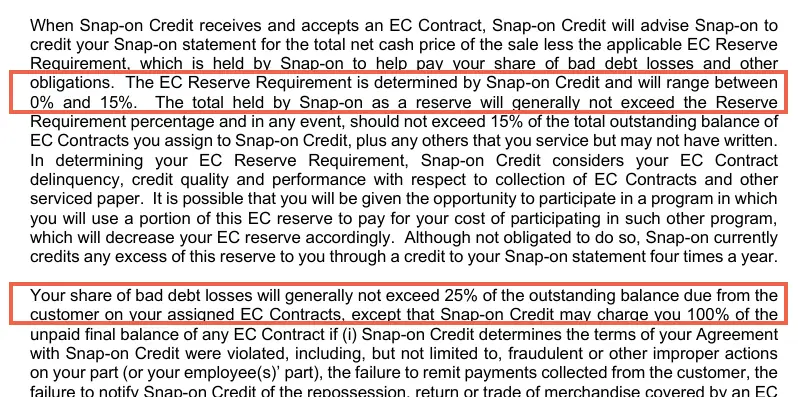
On EC contracts, Snap-on credits any excess reserve to the franchisee’s statement four times a year, and the reserve earns interest at the Fidelity Money Market Fund Retail (FDRXX) rate (Item 6 note 6). You collect EC payments weekly and remit them to Snap-on Credit by direct debit, with no collection fee paid to you, and you repurchase repossessed tools at fair market value (Item 10, Repossessions).
Buying a predecessor’s book
When you take over a List of Calls, the previous franchisee or Snap-on usually offers its RAs at 75% of the balance due. You have 45 days after you start servicing the route to reject accounts in writing; any account not rejected in writing, or any customer you sell to first, counts as purchased (Item 7 note 7). The 25% discount is described as compensation for collecting the accounts and taking on bad-debt risk.
Snap-on Credit’s own numbers show how large this credit machine is. Snap-on Incorporated’s 10-K reports an average yield on finance receivables of 17.6% in 2025, average payment terms of about four years, write-off at 120 days past due absent repossession, and $1,120.9 million of originations in 2025. Those finance receivables are extended-term contracts with franchisees’ customers, and write-offs “are partially offset by recourse from franchisees” (10-K, Note 4).
What do the monthly invoices from Snap-on add up to?
Snap-on does not charge a percentage royalty or an advertising fee. Item 6 lists a $156.00 Monthly License Fee and a $94.00 software development, maintenance and support fee, each of which may rise once a year by the lesser of $50 or 25%. Loan, lease and insurance payments are larger. The 10-K calls these fees “nominal” and reports $21.2 million of franchise fee revenue for 2025.
| Recurring item | Amount | Basis | Source |
|---|---|---|---|
| Monthly License Fee | $156.00 per month | Fixed; annual increase capped at lesser of $50 or 25% | Item 6 note 2 |
| Software Development, Maintenance and Support Fee | $94.00 per month | Fixed; same cap, 30 days’ notice | Item 6 note 3 |
| Startup loan (first option) | $1,702 to $1,923 per month | $134,500 at 8.20% to 10.99% | Item 6 note 4 |
| RA Loan (if used) | $1,093 to $1,221 per month | $85,000 over 9 years 3 months | Item 6 note 5 |
| Van lease plus maintenance | $2,839 to $3,572 plus $325 per month | New van, 72 months | Item 6 note 12 |
| Required insurance (excluding life) | $7,397 to $27,366 per year | Carrier rated “A” or better | Item 6 note 9 |
| Weekly product remittance | 100% of miscellaneous charges less credits, plus any amount needed to be $1.00 under your credit limit | Snap-on can change terms at any time | Item 6 note 1 |
The weekly remittance line matters more than its wording suggests: inventory bought from Snap-on on account is paid down every week from the same cash that funds RA growth. Item 7 note 3 lists dealer discounts from suggested prices of 10% to 43.9%, and discontinued items can be returned for credit only within six weeks of moving to discontinued status.
How many Snap-on routes opened, and how many came back to Snap-on?
Item 20 counts each List of Calls as an outlet. Franchised outlets fell in each of the last three fiscal years, from 3,270 at the start of 2023 to 3,159 on January 3, 2026, while company-owned outlets rose from 139 to 169. In 2025, Table 3 records 195 openings, 227 outlets reacquired by the franchisor, 4 terminations, 1 non-renewal and 0 other cessations.
Reacquisitions by Snap-on (192, 212, 227) exceeded openings (167, 182, 195) in each year from 2023 to 2025. Source: Snap-on FDD issued February 13, 2026, Item 20 Table 3.
| Fiscal year | Franchised start | Opened | Terminated | Non-renewed | Reacquired by Snap-on | Franchised end | Company-owned end |
|---|---|---|---|---|---|---|---|
| 2023 | 3,270 | 167 | 0 | 0 | 192 | 3,238 | 140 |
| 2024 | 3,238 | 182 | 2 | 0 | 212 | 3,201 | 143 |
| 2025 | 3,201 | 195 | 4 | 1 | 227 | 3,159 | 169 |
Source: Snap-on FDD issued February 13, 2026, Item 20 Tables 1 and 3. The rows do not sum exactly: the gap is 7, 5 and 5 outlets for 2023 to 2025, the same as the transfer-related outlets that the Table 3 notes list as signed but not yet operating. End-of-2025 counts exclude 31 signed outlets that were not operating, and include 29 Independent dealer outlets counted as franchised.
Item 20 records most departures as reacquisitions by Snap-on rather than terminations, and Item 7 note 7 explains that Snap-on may buy a departing franchisee’s RAs and offer them to the next franchisee on that List of Calls. That is why buying an existing franchise route is a normal entry here: a Transfer Franchise carries a $16,000 transfer fee and can finance up to $85,000 of RA Acquisition inside a loan of up to $219,500 in the Item 6 illustration. For how these exits compare across sectors, see our Item 20 franchise closure rate study.
The 10-K uses a different count: about 4,700 routes worldwide and about 3,400 in the United States at 2025 year end, down from about 4,775 and 3,425 at fiscal 2020 year end, with company-owned routes at about 5%. The FDD’s 3,328 total U.S. outlets on January 3, 2026 sits close to that 3,400 figure.
Snap-on next to Matco: which printed terms differ?
Matco Tools runs the closest comparable route model, and both FDDs print the same core items. Snap-on’s starting inventory and total investment are higher, its startup loan rates were lower in January 2026, and it charges fixed monthly fees where Matco charges none. The table limits itself to lines both 2026 documents state; the full version is snap-on-vs-matco-fdd-terms.csv.
| Term | Snap-on (FDD Feb 13, 2026) | Matco (FDD Apr 6, 2026, amended Aug 1, 2026) | Items |
|---|---|---|---|
| Initial fee | $8,000 to $16,000 | $10,000 | 5 / 5 |
| Starting inventory at dealer cost | $140,000 to $154,000 | $55,500 to $92,000 | 5 / 7 |
| Total Item 7 | $223,439 to $509,283 | $104,374 to $376,241 | 7 / 7 |
| Fixed ongoing fees | $156 plus $94 per month | No periodic royalty; software maintenance $475 per year | 6 / 6 |
| Startup loan rate | 8.20% to 10.99% (Jan 19, 2026) | 10.75% to 12.75% (Prime plus 4% to 6%) | 10 / 10 |
| Customer list | At least 200 potential Core Customers | Maximum of 325 Potential Customers | 12 / 1 |
| Predecessor accounts | 75% of balance due | Recommended 75% of value | 7 / 5 |
| Assigned customer contracts | EC reserve 0% to 15%; loss share up to 25% | Non-recourse at not less than 85% of net cash price (92% current practice) | 10 / 10 |
| Term and renewal | 10 years; one 5-year renewal | 10 years; 10-year renewal | 17 / 17 |
| Veterans incentive | $25,000 of inventory at dealer cost | $20,000 of hand tools at list | 5 / 5 |
| Signing to opening | 2 to 13 weeks | 20 to 45 days | 11 / 11 |
| Franchised outlets, end of 2025 | 3,159 | 1,741 | 20 / 20 |
Matco figures come from the Matco Tools Corporation FDD on Minnesota CARDS, as recorded in our Matco Tools franchise route and credit breakdown. Item 20 categories differ between the two documents, so compare departures by reading each table rather than by subtracting one column from the other.
Which numbers in circulation do not match the 2026 FDD?
Several pages that rank for this search repeat figures that differ from the February 13, 2026 FDD, mostly through unit mix-ups or older disclosure years. Before relying on any of them, check the line against Item 5, 6 or 7 of the copy Snap-on hands you. The four mismatches below are the ones we found on November 10, 2026.
| Claim found | What the primary source says | Source |
|---|---|---|
| A 2026 deep-dive guide lists the startup loan payment as $1,702 to $3,138 per week | $1,702 to $1,923 per month ($3,138 is the transfer high end), paid weekly | Item 6 |
| The same guide lists van maintenance at $325 per week | $75 per week, $325 per month | Item 10 |
| A franchise directory calls the $156 fee a royalty and lists $20,778 as a net worth requirement | $156 is the flat Monthly License Fee; $20,778 is the low end of Item 7 cash with financing | Items 6, 7 |
| Snap-on’s own comparison page footnotes its data to an FDD effective February 12, 2021 | The current FDD was issued February 13, 2026 | Snap-on Why Own It page |
Which entry path fits your cash and credit position?
The choice turns on three numbers: cash on hand against the $20,778 to $82,943 range, whether you qualify for the $25,000 veterans inventory, and whether you buy an existing book of accounts. Item 10 shuts the second financing option to discount buyers and transfers, so each path below comes with different loan terms, and the timeline shows how the obligations stack up.
| If your situation is | Path the FDD points to | Watch |
|---|---|---|
| Under $25,000 of free cash, good credit | Second financing option: $25,000 bridge at 12.99% over 9 months | $2,919 per month for 9 months before the main loan starts (Item 6) |
| $25,000 or more for a down payment | First option: 8.20% to 10.99%, 90 days without scheduled payments | Interest accrues from day one (Item 10) |
| Honorably discharged veteran, first franchise | $25,000 of inventory at no cost; down payment may be waived | Not combinable with the second financing option (Items 5, 10) |
| Buying a route from an existing franchisee | Transfer Franchise, $16,000 fee, RA Acquisition financed | Verify every account before closing; the 45-day rejection window usually does not apply (Item 7 note 7) |
| Prefer a bank or SBA loan | Outside lender | Lender must subordinate to Snap-on on RAs or at least $45,000 of assets (Item 7 note 11) |
| Want low fixed overhead before any credit sales | Compare with Matco’s no-royalty model | Inventory and Item 7 ranges differ (table above) |
Veterans can compare Snap-on’s inventory grant with other brands in our study of veteran franchise discounts in 2026 FDDs and our guide to franchise opportunities for veterans. Item 12 sets a target of at least 200 potential Core Customers per List of Calls and gives you the list at least 7 calendar days before signing; use that week to drive the stops.
Item 19 of the 2026 FDD is a “Paid Sales” statement for the 2025 reporting period, split into three equal groups of reporting franchises; it reports sales, not profit or owner income. Read it with the cost lines above and our analysis of what Item 19 disclosures contain, and compare other mobile and repair concepts on our automotive franchise opportunities page. The FDD reading guide explains the 14-day waiting period printed on Snap-on’s cover page.
How we compiled this
We read the 622-page marked copy of the Snap-on Tools Company LLC FDD issued February 13, 2026 from Minnesota CARDS (file 2327), decoding each redlined number against the rendered page, plus Snap-on Incorporated’s Form 10-K filings for fiscal 2020 to 2025, four Snap-on franchise web pages and the Matco Tools FDD recorded in our Matco source pack, all accessed in November 2026. We excluded every Item 19 figure, all franchisee names from Item 20 and Appendix A, and all ranking claims. Wisconsin’s franchise search returned HTTP 403, so no Wisconsin copy was used.
Frequently asked questions
How much does a Snap-on franchise cost?
The Snap-on FDD issued February 13, 2026 estimates a total initial investment of $223,439 to $509,283 (Item 7). With Snap-on Credit financing the license fee, the $140,000 to $154,000 inventory and the $3,500 software license, the cash column is $20,778 to $82,943, which includes three months of operating funds and, at the high end, a $25,000 down payment.
How much do Snap-on franchise owners make?
The FDD does not state owner income. Item 19 of the 2026 FDD reports Paid Sales for 2025 in three equal groups of reporting franchises, which are sales figures, not profit. What is left for the owner depends on loan and van payments (Item 6), insurance, fuel, bad debt on Revolving Accounts and dealer discounts of 10% to 43.9% (Item 7 note 3).
Does Snap-on finance the franchise?
Yes. Snap-on Credit LLC lends the license fee, inventory and software license through two options in Item 10. On January 19, 2026 the first option priced at 8.20% to 10.99% with no payments for 90 days; the second used a $25,000 bridge loan at 12.99%. Loans are secured by all business assets and personally guaranteed by the owners.
Do Snap-on franchisees own their trucks?
Most lease them. Franchise Finance borrowers must lease a Program Van from Snap-on Credit, priced new at $173,000 to $198,000, for $2,839 to $3,572 per month plus $325 maintenance (Item 10). At the end of a new-van lease the franchisee may buy it for 10% of the original cost. Owners not using Snap-on financing may buy or lease an approved van elsewhere.
Is there a Snap-on franchise near me?
Snap-on assigns a List of Calls rather than a map territory, aiming for at least 200 potential Core Customers per route (Item 12). Availability depends on which routes are open or being re-offered; Item 20 shows 227 outlets reacquired by Snap-on in 2025. The franchise team’s 7-step process starts with an online request and a ride-along with a current franchisee.
What happens to customer accounts when you take over a Snap-on route?
The previous franchisee, or Snap-on if it bought them, usually offers the Revolving Accounts at 75% of the balance due. You must reject unwanted accounts in writing within 45 days of starting the route, or they count as purchased (Item 7 note 7). Extended Credit accounts on the route are assigned to you to service and collect.
Is a Snap-on dealer a franchise or an independent distributor?
Both have existed. Item 1 says Snap-on sellers became independent distributors around 1945 and the program became a franchise in 1990. The 2026 FDD still counts 29 Independent outlets alongside franchised ones in Item 20. New buyers sign the Snap-on Tools Franchise Agreement, a 10-year license with one 5-year renewal (Item 17).
Sources
- Snap-on Tools Company LLC, Franchise Disclosure Document issued February 13, 2026 (marked copy), Minnesota CARDS file 2327, document 35384-202602-03, Items 1, 5 to 7, 10 to 12, 17, 19, 20 and Appendix A, accessed November 10, 2026.
- Snap-on Incorporated, Form 10-K for fiscal 2025, SEC EDGAR, accessed November 10, 2026; route counts also from the fiscal 2020 to 2024 10-K filings in the same EDGAR archive.
- Snap-on, Franchise Investment Information, accessed November 10, 2026.
- Snap-on, 7 Steps to Own It (PDF), accessed November 10, 2026.
- Snap-on, Why Own It, accessed November 10, 2026.
- Matco Tools Corporation, Franchise Disclosure Document issued April 6, 2026, as amended August 1, 2026, Minnesota CARDS, accessed November 3, 2026.
- 16 CFR 436.5, FTC Franchise Rule disclosure items (Legal Information Institute copy), accessed November 10, 2026.