A Steak n Shake franchise comes in two forms: a $10,000 franchise partner contract to run an existing company restaurant, or a traditional franchise with a $25,000 fee and a $155,970 to $2,340,385 build (2023 FDD, Item 7).
The partner pays far less at the door and gives up more afterwards: Steak n Shake keeps up to 15% of sales and 50% of profits from each partner restaurant, according to the Biglari Holdings Form 10-K for 2025, filed March 2, 2026.
Key takeaways
- Franchise partners pay a $10,000 initial fee to operate one existing company-owned restaurant; Steak n Shake assesses up to 15% of sales plus 50% of profits, and partners rent the building and equipment (Biglari Holdings 10-K, fiscal 2025).
- The traditional franchise fee is $25,000, cut 20% for eligible military and $20,000 for each extra unit under an Area Development Agreement (Steak n Shake FDD issued March 28, 2024, Item 5).
- Item 7 ranges run from $155,970 to $344,790 for a classic-to-quick-service conversion up to $1,344,419 to $2,340,385 for a freestanding quick-service restaurant, land excluded (Item 7).
- Traditional franchisees pay 5% of Gross Receipts in royalty and license fees plus a 1% Digital and Production Fund Fee, both weekly (Item 6).
- On June 30, 2026 the chain counted 183 partner units, 90 traditional franchise units and 126 company-operated units, against 175, 154 and 177 at the end of 2022 (Form 10-Q for Q2 2026).
Which two Steak n Shake franchise deals are on offer in 2026?
Steak n Shake Enterprises, Inc. sells a franchise partner contract on existing company-owned restaurants and a traditional franchise for new or converted sites. Its 2023 Franchise Disclosure Document, issued March 28, 2024, covers the traditional deal and says the partner deal runs under a separate Franchise Partner Disclosure Document. Both use the same menu, Manual and trademarks.
The franchisor is an Indiana company formed on December 9, 2005, owned through Steak n Shake Inc. by Biglari Holdings Inc., which trades on the New York Stock Exchange as BH.A and BH (Item 1). The trademarks belong to another affiliate, Steak n Shake, LLC, so a traditional franchisee signs a separate License Agreement, and 1 point of the 5% royalty goes to that affiliate (Item 6, footnote 1).
| Figure | Value | Source |
|---|---|---|
| Partner initial fee | $10,000 | 10-K 2025, Item 1; FDD Item 1 |
| What Steak n Shake keeps from a partner unit | Up to 15% of sales plus 50% of profits | 10-K 2025, Item 1 and Note 1 |
| Traditional franchise fee | $25,000; $20,000 for additional units under an ADA | FDD Item 5 |
| Traditional initial investment | $155,970 to $2,340,385 by format | FDD Item 7 |
| Royalty plus fund fee | 5% plus 1% of Gross Receipts, weekly | FDD Item 6 |
| Franchise term | 10 years, with 2 options of 5 years each | FDD Item 17(a) |
| Units on June 30, 2026 | 126 company, 183 partner, 90 traditional | 10-Q, Q2 2026 |
| Item 19 | FY23 net sales for 66 traditional and 162 partner restaurants, plus a modified net profit view of partner units | FDD Item 19 (figures not repeated here) |
What does the $10,000 franchise partner fee buy, and what does it not?
The $10,000 buys the right to run one existing company-owned restaurant as its franchisee, not the building or the equipment. The Biglari Holdings 10-K for 2025 says partners rent both from Steak n Shake and are single-unit owner-operators. The brand’s partner page adds 6 months of on-the-job training, no other business ventures and no absentee ownership, and it waives the fee for qualified U.S. veterans who show a DD-214.
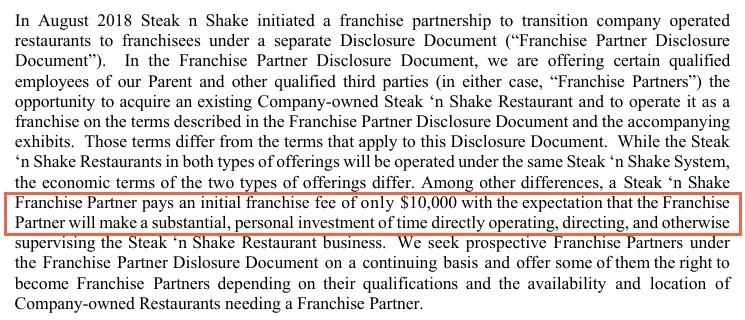
The FDD names the program in Item 1: it started in August 2018 to move company restaurants to franchisees, and Steak n Shake offers partner slots “depending on their qualifications and the availability and location of Company-owned Restaurants needing a Franchise Partner.” You apply for a restaurant the company already runs; you do not pick a site and build.
| Term | What the document says | Source |
|---|---|---|
| Fee | “an upfront investment totaling ten thousand dollars” | 10-K 2025, Item 1 |
| Restaurant | An existing Company-owned restaurant operated as a franchise | FDD Item 1 |
| Building and equipment | “Franchise partners rent buildings and equipment from Steak n Shake” | 10-K 2025, Item 7 |
| Number of units | “Franchise partners are single-unit owner-operators” | 10-K 2025, Item 1 |
| Other businesses | “free of any other active business ventures”; full-time, hands-on | Franchise partner page |
| Training | “6 months on-the-job training” before taking over | Franchise partner page |
| Veterans | Partnership fee waived; DD-214 required | Franchise partner page |
| Back office | “Administrative services (payroll, accounting, etc.)” | Franchise partner page |
| States on the application | Florida, Georgia, Illinois, Indiana, Iowa, Michigan, Missouri, Ohio, Kentucky, South Carolina | Partner application form |
What the fee does not buy is a business you can easily sell. Item 20, Table 2(a) reports 0 transfers of partner restaurants to new owners in FY21, FY22 and FY23, while traditional franchisees recorded 3, 1 and 2 transfers in Table 2(b). That count does not show a sale is barred; the transfer clause sits in the partner agreement, which is not on file in Minnesota.
How does Steak n Shake get paid by a franchise partner restaurant?
Steak n Shake takes a fee of up to 15% of sales plus 50% of profits from each partner restaurant, and the partner also rents the building and equipment, per the Biglari Holdings 10-K for 2025. The filing says this leaves the company “fully affected by the operating results of the business, unlike in a traditional franchising arrangement, where the franchisor obtains a royalty fee based on sales only.”
The 10-K describes three charges that a partner restaurant carries toward Steak n Shake:
- A sales fee of “up to 15%”, which is a ceiling, not a fixed rate (10-K, Note 1).
- Rent on the building and equipment, which the 10-K books inside franchise partner fees (Item 7).
- A 50% share of profits, which the 10-K says produces most of the restaurant segment’s revenue (Note 1).
Neither the 10-K nor the 2023 FDD defines “profits” for this split or lists which costs come off before it. Before signing, ask for three items in writing: the profit definition in the partner agreement, the monthly rent schedule, and the exact sales fee for your restaurant, given the 10-K’s “up to 15%” wording.
Item 19 of the 2023 FDD includes a “modified” Net Profit disclosure built from 162 partner restaurants that had operated at least 24 months; read it in the FDD itself, since this site does not reprint earnings data. Our review of what Item 19 sections report and leave out explains how to read one. Sales-based royalties are the norm at other listed franchisors, as our study of how franchisors make money across 26 public 10-Ks shows.
What must a traditional franchisee fund before opening day?
A traditional franchisee funds the whole build. Item 7 of the 2023 FDD puts the initial investment at $1,344,419 to $2,340,385 for a freestanding quick-service restaurant and $155,970 to $344,790 for converting a closed company “Classic” restaurant, with land or rent excluded from every column. The $25,000 franchise fee is due at signing, and the conversion column shows $0.
| Format (Item 1 size) | Item 7 low | Item 7 high | Notes | Source |
|---|---|---|---|---|
| Freestanding quick-service (about one acre of land) | $1,344,419 | $2,340,385 | Site work $355,902 to $574,036; building $572,151 to $922,824 | FDD Item 7, notes 5, 21 |
| In-line quick-service | $454,000 | $1,371,000 | Building or leasehold $80,000 to $727,000 | FDD Item 7, note 8 |
| Roadside (638 SF to 970 SF) | $705,000 | $1,199,497 | Site of 13,000 to 26,000 square feet | FDD Items 1, 7 |
| Non-traditional (400 SF to 2,400 SF) | $316,000 | $715,000 | Airports, universities, arenas | FDD Items 1, 7 |
| Classic-to-quick-service conversion | $155,970 | $344,790 | Franchise fee $0; rent may be paid to Steak n Shake | FDD Item 7, notes 5, 23 |
Item 7 ranges run from $155,970 (conversion, low) to $2,340,385 (freestanding, high), land excluded; the partner route totals $10,000. Sources: 2023 FDD Item 7; Biglari Holdings 10-K for 2025.
Three lines drive the freestanding total: site improvements, building, and furniture, fixtures, equipment and signage at $305,365 to $492,525. Item 5 prices the required computer systems at $79,623 for quick-service and $44,424 for roadside. Steak n Shake offers no financing, directly or indirectly (Item 7, notes 1 and 19), and Item 11 puts signing-to-opening at 4 to 8 months, with opening required within 12 months.
The brand’s freestanding page asks for liquid capital greater than $400,000 and a net worth greater than $1 million excluding a primary residence. Its in-line page asks for $100,000 minimum liquidity and $500,000 minimum net worth.
What do the FDD’s fee rules come to in dollars?
Every figure below uses only rates and amounts printed in Items 5, 6 and 7, so the arithmetic is the FDD’s own. The Area Development Agreement rows reproduce the FDD’s low and high examples: 2 restaurants with no Territory Fee, and 10 restaurants with a $20,000 Territory Fee per location, each with a $15,000 Per Unit Deposit.
| Calculation | Inputs | Result | Source |
|---|---|---|---|
| Military discount on the first fee | $25,000 x (100% minus 20%) | $20,000 | Item 5 |
| Refund if no site is agreed in 135 days | 75% of $25,000 back; 25% kept | $18,750 back, $6,250 kept | Item 5 |
| Renewal fee | 50% of $25,000 | $12,500 | Item 6 |
| Two opening-date extensions | 2 x $5,000 | $10,000 | Items 5, 7 |
| ADA, 2 restaurants | $25,000 + $15,000 | $40,000 | Item 7, ADA table, note 4 |
| ADA, 10 restaurants | $25,000 + (9 x $15,000) + (10 x $20,000) | $360,000 | Item 7, ADA table, note 4 |
Military buyers can compare this 20% cut with the partner fee waiver and with the offers in our index of veteran franchise discounts across 259 FDDs. Multi-unit buyers can set the ADA deposits against the development agreement terms other franchisors require.
Which weekly and annual charges follow a traditional opening?
After opening, a traditional franchisee pays 5% of Gross Receipts as the Royalty and System Fee and License Fee plus 1% to the Digital and Production Fund, both every Friday by electronic transfer (Item 6). Software and surveillance maintenance adds $6,000 to $7,000 a year. Steak n Shake reserves the right to charge 10% instead of 5% in markets where it runs its own restaurants.
| Fee | Amount | When | Source |
|---|---|---|---|
| Royalty and System Fee and License Fee | 5% of Gross Receipts (4% franchisor, 1% licensor) | Weekly, Friday | Item 6, note 1 |
| Digital and Production Fund Fee | 1% of Gross Receipts | Weekly, Friday | Item 6 |
| Hardware, software and surveillance | $6,000 to $7,000 a year | Monthly or quarterly | Item 6 |
| Transfer fee | $5,000 per restaurant | At approval | Item 6 |
| Additional manager training | $2,000 per manager beyond owners and 3 managers | 30 days after billing | Item 6 |
| Operating assistance | $4,000 a month plus payroll and travel | 30 days after billing | Item 6 |
| Default fee | $100 per week per violation | On demand | Item 6 |
| Late reporting fee | $50 per day | After written request | Item 6 |
| Local marketing accounting | 15% of the invoice | 30 days after billing | Item 6 |
Two contract points deserve a direct question. Item 17(a) lists a 10-year term with 2 five-year options “at no additional charge,” while Item 6 and Item 17(c) list a renewal fee of 50% of the Initial Franchise Fee; ask which governs your agreement. Item 12 grants no exclusive territory, only a possible Protected Area, typically a two-mile radius in suburban or exurban areas, and Item 1 says the Manual sets minimum and maximum menu pricing.
To compare the 6% combined rate with other systems, use our royalty and fee analysis of 259 disclosure documents, which breaks rates out by sector.
Partner contract versus full franchise: what each side gives up
The partner gives up ownership and half the profit in exchange for a $10,000 entry; the traditional franchisee puts up $155,970 to $2,340,385 of capital in exchange for owning the assets and paying a fixed 6% of gross receipts. The diagram and table set each term against the document that states it, so you can see which risk sits with whom.
| Term | Franchise partner | Traditional franchisee | Source |
|---|---|---|---|
| Upfront fee | $10,000; waived for qualified U.S. veterans | $25,000; 20% off for eligible military | 10-K; partner page; Item 5 |
| Initial investment | “totaling ten thousand dollars” | $155,970 to $2,340,385, land excluded | 10-K; Item 7 |
| Building and equipment | Rented from Steak n Shake | Bought or leased by the franchisee | 10-K; Item 7 |
| Ongoing payments | Up to 15% of sales plus 50% of profits, plus rent | 5% plus 1% of Gross Receipts, plus Item 6 fees | 10-K; Item 6 |
| Who bears a bad month | Shared: the franchisor’s take falls with profit | Franchisee: the 6% is due on sales either way | 10-K, Note 1; Item 6 |
| Units | One restaurant | One, or many under an ADA | 10-K; Item 5 |
| Owner time | Full-time, hands-on; no absentee ownership | May appoint a full-time General Manager | Partner page; Item 15 |
| Training | 6 months on the job | Owner program of 5 days plus 1 day in Indianapolis; managers trained | Partner page; Item 15 |
| Transfers to new owners, FY21 to FY23 | 0, 0, 0 | 3, 1, 2 | Item 20, Tables 2(a), 2(b) |
| Disclosure document | Separate Franchise Partner FDD | 2023 FDD, issued March 28, 2024 | FDD Item 1 |
The partner gets a trading restaurant, payroll and accounting support and no construction risk, which is why the entry price can sit at $10,000. The traditional owner carries the build, the lease and the debt, but owns the assets, can grow through an ADA, and under Item 15 can run the unit through a General Manager who lives near the restaurant. Our Item 15 index of semi-absentee franchises compares what 259 FDDs allow on owner time.
Where are the units going: partner, traditional or company-run?
Partner units have stayed between 173 and 183 since the end of 2022, while traditional franchise units fell from 154 to 90 by June 30, 2026, according to the Biglari Holdings 10-K for 2025 and the 10-Q for the second quarter of 2026. Company-run units fell from 177 to 126 over the same span, partly because the company moved restaurants to partners: 7 in 2025 and 4 in the first half of 2026.
| Date | Company-operated | Franchise partner | Traditional franchise | Source |
|---|---|---|---|---|
| Dec 31, 2022 | 177 | 175 | 154 | 10-K 2025, Item 7 |
| Dec 31, 2023 | 148 | 181 | 128 | 10-K 2025, Item 7 |
| Dec 31, 2024 | 146 | 173 | 107 | 10-K 2025, Item 7 |
| Dec 31, 2025 | 131 | 179 | 94 | 10-K 2025, Items 1, 2, 7 |
| Jun 30, 2026 | 126 | 183 | 90 | 10-Q Q2 2026, Item 2 |
Traditional franchise units fell from 154 to 90 between December 31, 2022 and June 30, 2026 while partner units held between 173 and 183. Sources: Biglari Holdings 10-K for 2025 and 10-Q for Q2 2026.
The 10-K counts include restaurants abroad: at December 31, 2025 the traditional column held 12 units in France, and company-run units included 3 in France, 1 in Monaco and 1 in Spain (10-K, Item 2). That is part of why the FDD’s U.S. figure of 111 traditional outlets at December 27, 2023 sits below the 10-K’s 128 at December 31, 2023.
What does Item 20 show for traditional outlets from FY21 to FY23?
Item 20 of the 2023 FDD shows traditional franchised outlets falling from 159 to 111 over FY21 to FY23, with 13 openings against 60 outlets that ceased operations for other reasons. Over the same 3 years, partner outlets rose from 86 to 181, mostly through 129 outlets the table lists as “sold to Franchisee”. Table 5(a) projects 17 more partner outlets in the next fiscal year.
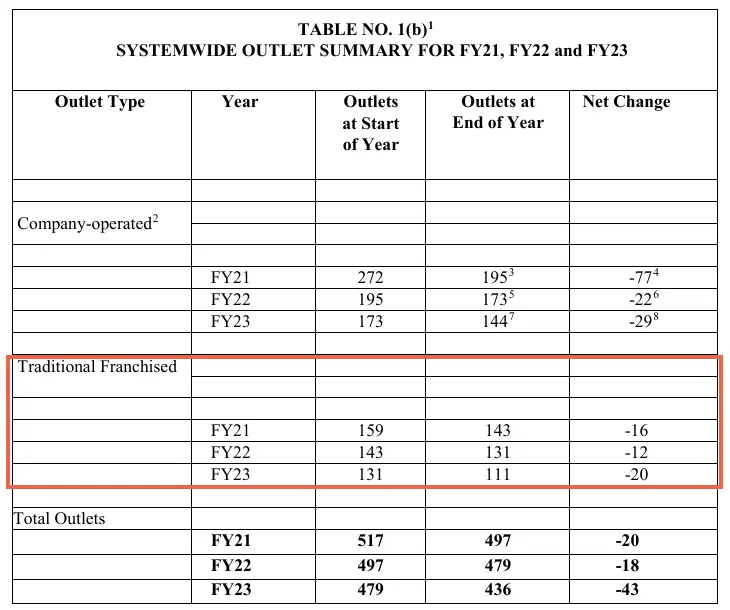
| Fiscal year | Traditional start | Opened | Ceased operations | Reacquired | Traditional end | Partner end | Source |
|---|---|---|---|---|---|---|---|
| FY21 | 159 | 3 | 19 | 0 | 143 | 159 | Item 20, Tables 3(a), 3(b) |
| FY22 | 143 | 10 | 22 | 0 | 131 | 175 | Item 20, Tables 3(a), 3(b) |
| FY23 | 131 | 0 | 19 | 1 | 111 | 181 | Item 20, Tables 3(a), 3(b) |
From FY21 to FY23, 13 traditional outlets opened and 60 ceased operations for other reasons. Source: 2023 Steak n Shake FDD, Item 20, Table 3(b).
Partner restaurants also left the system: Table 3(a) lists 9 terminations and 11 closures in FY22, then 5 and 5 in FY23. To set these exits against other brands, use our Item 20 closure and turnover index. The unit growth review of publicly traded franchisors lists Biglari Holdings with a net change of minus 23 restaurants, or 5.0%, in 2025.
Which document is current, and where do the brand site and the FDD disagree?
The newest Steak n Shake FDD we could open is the 2023 edition, issued March 28, 2024 and received by Minnesota on May 10, 2024; a November 3, 2026 search of Minnesota’s CARDS registry returned no later Steak n Shake filing. The brand’s 2026 website already quotes different in-line figures, so treat every number here as dated and ask for the current FDD and the partner disclosure document.
- 1934: founded in Normal, Illinois (10-K, Item 1).
- 1939: first limited franchises; 1991: general franchise offering (FDD Item 1).
- December 9, 2005: Steak n Shake Enterprises incorporated and takes over franchising (FDD Item 1).
- August 2018: franchise partner program launched under a separate disclosure document (FDD Item 1).
- March 28, 2024: 2023 FDD issued; May 10, 2024: received by Minnesota as CARDS document 31681-202405-06.
- March 2, 2026: Form 10-K for 2025 reports 131 company, 179 partner and 94 traditional units.
- August 7, 2026: Form 10-Q reports 126 company, 183 partner and 90 traditional units at June 30.
- November 3, 2026: Minnesota CARDS search shows no newer Steak n Shake FDD.
| Claim seen in ranking pages | What the primary document says | Source |
|---|---|---|
| A 2023 franchise deep dive and a lender page updated September 2026: 5.5% royalty plus 3% marketing fee | 5% Royalty and System Fee and License Fee plus 1% Digital and Production Fund Fee | FDD Item 6 |
| A lender page title: $1.6M to $4M, citing “the current FDD” without a year | Highest Item 7 total is $2,340,385; the brand home page says “$1.34 to 2.34M” | FDD Item 7; brand home page |
| A listing site: 181 franchise units in total | 181 is the partner count alone; 111 traditional outlets sit on top (FY23 end) | FDD Item 20, Tables 1(a), 1(b) |
| Brand in-line page: $885K to $1.4M estimated total investment | 2023 FDD Item 7 in-line range is $454,000 to $1,371,000, so a newer document likely exists | In-line page; FDD Item 7 |
| Search summaries: partners own or buy a share of the restaurant | Partners rent buildings and equipment from Steak n Shake | 10-K 2025, Item 7 |
| 10-K text: 122 traditional units open on December 31, 2025 | The 10-K unit table shows 94 Steak n Shake traditional units; 94 plus 28 Western Sizzlin franchise units equals 122 | 10-K 2025, Items 2, 7 |
The FDD cover page says you must receive it at least 14 calendar days before signing or paying, and the federal rule behind Items 19 and 20 is 16 CFR 436.5. The brand’s legal page names 14 registration states, including California, Illinois, Indiana, Michigan and Minnesota, where it will not offer a franchise until it has registered. Our guide to reading a Franchise Disclosure Document walks through each item.
Which Steak n Shake route matches your cash, experience and plans?
Start from cash and time. With about $10,000 and the willingness to work one restaurant full time with no other business, only the partner route is open. With $100,000 or more in liquid funds and a $500,000 net worth, the traditional in-line format becomes possible, and the freestanding format asks for more than $400,000 liquid. Each row below names the document behind the threshold.
| If this describes you | Then look at | Why, and the source |
|---|---|---|
| About $10,000 cash, no other business, full-time on site | Franchise partner | $10,000 fee; single-unit owner-operators (10-K; partner page) |
| U.S. veteran with a DD-214 | Partner (fee waived) or traditional ($20,000 first fee) | Partner page; Item 5 military discount of 20% |
| At least $100,000 liquid and $500,000 net worth; small site, no drive-thru | Traditional in-line | In-line page; confirm the current Item 7, which differs from the 2023 range |
| More than $400,000 liquid and more than $1 million net worth | Traditional freestanding with drive-thru | Freestanding page; Item 7 $1,344,419 to $2,340,385 before land |
| Plan to open 2 to 10 restaurants | Traditional with an ADA | ADA fees $40,000 to $360,000 (Item 7, note 4) |
| Want to own the building or sell later | Traditional | Partners rent (10-K); 0 partner transfers FY21 to FY23 (Item 20) |
| Want a manager to run day to day | Traditional with a General Manager | Item 15 allows it; partner page says no absentee ownership |
| Live outside the 10 partner application states | Traditional, or ask about relocation | Application form lists 10 states and asks about relocating |
If the $10,000 route appeals mainly on price, compare it with the formats in our guide to franchises under $100,000, which own their equipment. This page is general information, not legal, financial or investment advice; have a franchise attorney read the partner agreement’s profit definition and the Item 17 renewal clause before you sign either document.
How we compiled this
On November 3, 2026 we read 5 primary sources: the 421-page 2023 Steak n Shake FDD from Minnesota’s CARDS registry, the Biglari Holdings Form 10-K for 2025 and Form 10-Q for June 30, 2026 from SEC EDGAR, 6 pages of steaknshakefranchise.com, and 16 CFR 436.5 from GovInfo, used because eCFR returned a bot check. The Franchise Partner Disclosure Document is not on file in Minnesota, so partner terms come from the 10-K, FDD Item 1 and the brand’s pages. We excluded all Item 19 figures, partner fee revenue totals and franchisee names.
Frequently asked questions
How much is a Steak and Shake franchise?
Two prices apply. A franchise partner pays a $10,000 initial fee to run an existing company restaurant, per the Biglari Holdings 10-K for 2025. A traditional franchisee pays a $25,000 fee and, under Item 7 of the 2023 FDD, invests $155,970 to $2,340,385 depending on format, with land or rent excluded.
What are the Steak n Shake franchise requirements?
For partners, the brand’s page requires the $10,000 fee, 6 months of on-the-job training, no other business ventures and full-time, hands-on work. For traditional units, its pages ask for $100,000 liquidity and $500,000 net worth for in-line sites, and more than $400,000 liquid with over $1 million net worth for freestanding sites.
How much do Steak n Shake franchise owners make?
This site does not publish earnings figures. Item 19 of the 2023 FDD reports fiscal 2023 net sales for 66 traditional and 162 partner restaurants and a modified net profit view of partner units. A partner’s result turns on the up to 15% sales fee, the 50% profit split and rent; a traditional owner’s turns on the 6% Item 6 fees and Item 7 debt.
Is the Steak n Shake franchise partner fee really $10,000?
Yes. FDD Item 1 says a Franchise Partner “pays an initial franchise fee of only $10,000,” and the 10-K for 2025 calls it an upfront investment totaling ten thousand dollars. The brand’s 2026 page waives it for qualified U.S. veterans. The low fee comes with a sales fee of up to 15%, a 50% profit share and rent on the building.
Does Steak n Shake still sell traditional franchises?
Yes. The 2023 FDD offers freestanding, in-line, roadside, non-traditional and conversion formats, and the brand’s 2026 in-line page invites applicants. The base is shrinking: traditional units fell from 154 at the end of 2022 to 90 on June 30, 2026, according to Biglari Holdings’ 10-K and 10-Q filings.
Can a Steak n Shake franchise partner own more than one restaurant?
The 10-K for 2025 describes franchise partners as single-unit owner-operators, and the partner application asks whether you will run a single Steak n Shake as your primary business without owning other businesses. Multi-unit growth runs through the traditional franchise, where an Area Development Agreement covers 2 to 10 restaurants in the FDD’s Item 7 examples.
Sources
- Steak n Shake Franchise Disclosure Document (Steak n Shake by Biglari), issued March 28, 2024, Minnesota document 31681-202405-06. Steak n Shake Enterprises, Inc., via Minnesota Department of Commerce CARDS. Accessed November 3, 2026.
- Minnesota CARDS franchise registration search (Clean FDD, “Steak”). Minnesota Department of Commerce. Accessed November 3, 2026.
- Biglari Holdings Inc. Form 10-K, fiscal year ended December 31, 2025 (filed March 2, 2026). U.S. Securities and Exchange Commission (EDGAR). Accessed November 3, 2026.
- Biglari Holdings Inc. Form 10-Q, quarter ended June 30, 2026 (filed August 7, 2026). U.S. Securities and Exchange Commission (EDGAR). Accessed November 3, 2026.
- Franchise Partners. Steak n Shake Enterprises, Inc.. Accessed November 3, 2026.
- Franchise partner application (Get Started). Steak n Shake Enterprises, Inc.. Accessed November 3, 2026.
- Steak n Shake In-Line Franchise Opportunities. Steak n Shake Enterprises, Inc.. Accessed November 3, 2026.
- Franchise Model (freestanding). Steak n Shake Enterprises, Inc.. Accessed November 3, 2026.
- Steak n Shake franchising home page. Steak n Shake Enterprises, Inc.. Accessed November 3, 2026.
- Legal and Disclaimer. Steak n Shake Enterprises, Inc.. Accessed November 3, 2026.
- 16 CFR 436.5, Disclosure items (2025 edition). U.S. Government Publishing Office (GovInfo). Accessed November 3, 2026.